
AI Agents for Business Automation: Practical Strategies
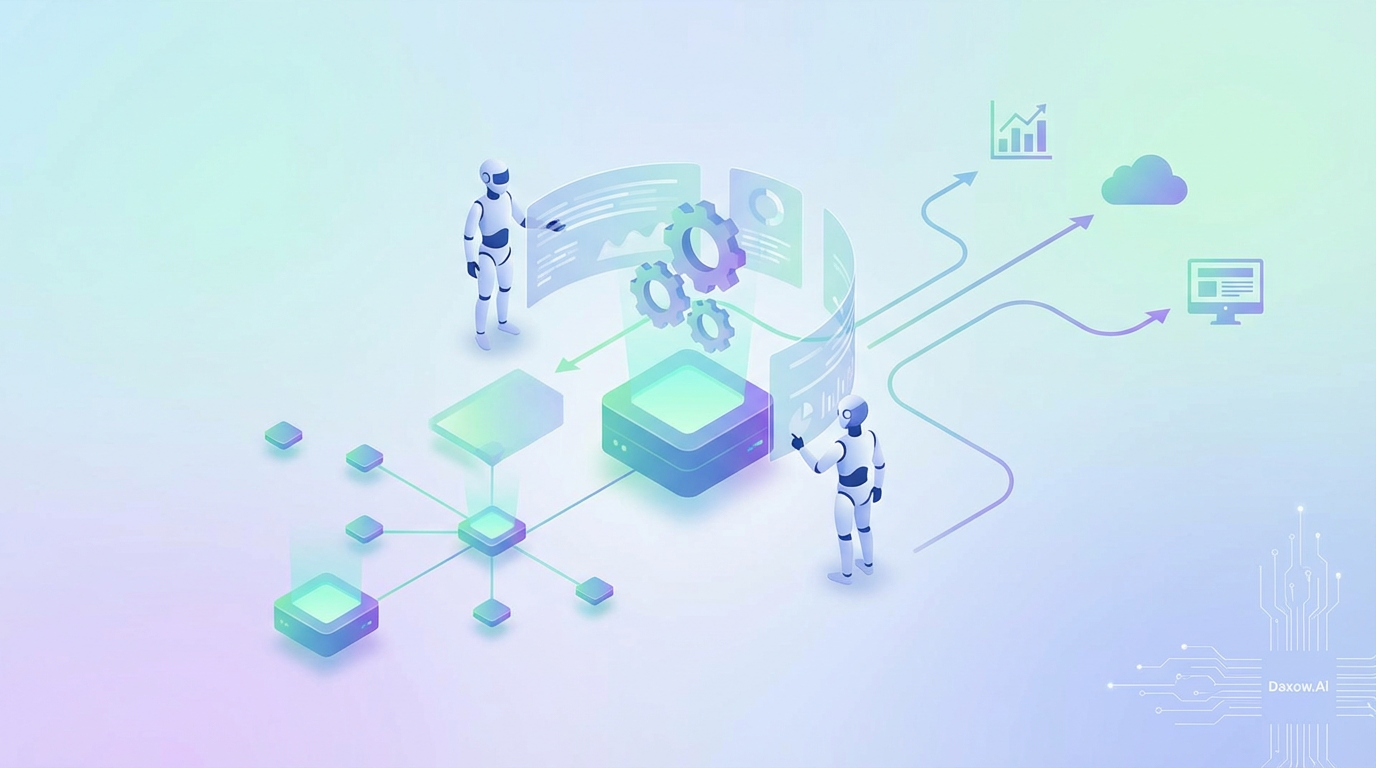
Practical guide to designing, implementing, and scaling AI agents to automate workflows, reduce manual tasks, boost productivity, and improve customer experience.
AI Agents for Business Automation: Practical Strategies to Reduce Manual Tasks, Boost Productivity, and Improve Customer Experience
Estimated reading time: 15 minutes
Key Takeaways
- AI agents combine natural language processing, decision-making, and system integration to automate complex workflows.
- Businesses benefit from reduced manual tasks, increased productivity, improved customer experience, and lower operational costs.
- Key use cases span customer support, sales, finance, HR, healthcare, real estate, and supply chain management.
- Successful AI automation requires process discovery, clear metrics, modular design, robust integration, governance, and continuous improvement.
- Daxow.ai provides tailored AI automation solutions with end-to-end services from process analysis to scaling and governance.
Table of Contents
- AI agents for business automation — What they are and why they matter
- Key use cases — How AI agents and workflow automation deliver value across industries
- Designing AI agents for workflow automation — A practical framework
- Implementation considerations — Technology, people, and process
- Measuring ROI — Metrics that matter
- Risks, challenges, and mitigation strategies
- How Daxow.ai delivers end-to-end AI automation solutions
- Getting started — Practical first steps
- Frequently Asked Questions
AI agents for business automation — What they are and why they matter
AI agents are software systems that perceive their environment, make decisions, and take actions to complete tasks with varying levels of autonomy. In the context of business automation, AI agents go beyond simple automation scripts by combining natural language understanding, decision logic, external system integrations, and process orchestration.
Core capabilities of modern AI agents
- Natural language understanding and generation for human-like interaction.
- Automated data extraction from documents, emails, and forms.
- Decision-making based on business rules, ML models, or knowledge bases.
- Integration with CRMs, ERPs, ticketing systems, and SaaS tools.
- Continuous learning and monitoring to improve performance over time.
Business benefits
- Reduce manual tasks across repetitive processes (data entry, triage, routing).
- Boost productivity by enabling staff to focus on higher-value work.
- Improve customer experience with faster, consistent responses and 24/7 availability.
- Lower operational costs through automation and reduced error rates.
- Scale processes without linear increases in headcount.
Key use cases — How AI agents and workflow automation deliver value across industries
Customer support automation (SaaS, e-commerce, telecom)
- Use case: AI agents handle Tier 1 inquiries across chat and email, perform account lookups, and resolve common issues (password resets, billing status).
- Business outcome: Reduce average handle time, lower support headcount for routine requests, increase CSAT with faster response times.
- Implementation tip: Combine customer support automation with integration to the CRM and ticketing system for context-aware responses.
Sales automation and lead qualification (B2B SaaS, enterprise sales)
- Use case: AI agents qualify inbound leads by analyzing intent and firmographics, schedule discovery calls, and enrich CRM records.
- Business outcome: Higher lead-to-opportunity conversion, shorter sales cycles, improved SDR productivity.
- Implementation tip: Implement scoring thresholds and escalation rules so only high-fit leads are routed to sales.
Finance and accounting automation (finance, healthcare, retail)
- Use case: AI agents extract invoice data, validate against purchase orders, route exceptions, and initiate payments through ERP integration.
- Business outcome: Faster invoice processing, fewer late payments, reduced exceptions and manual reconciliation.
- Implementation tip: Use document automation models combined with business rules to manage tolerance thresholds and approvals.
HR and administrative automation (enterprises, startups)
- Use case: AI agents automate onboarding tasks—document collection, benefits enrollment, access provisioning—and answer policy questions.
- Business outcome: Shorter onboarding timelines, fewer manual mistakes, higher employee satisfaction.
- Implementation tip: Integrate AI agents with HRIS and IAM systems to automate provisioning end-to-end.
Healthcare administrative automation
- Use case: AI agents pre-fill patient intake forms, verify insurance eligibility, and route claims or denials to specialists.
- Business outcome: Reduced administrative burden on clinical staff, faster billing cycles, improved patient experience.
- Implementation tip: Ensure HIPAA-compliant data handling and audit trails for every automated action.
Real estate and property management
- Use case: AI agents screen tenant applications, schedule viewings, manage maintenance requests, and communicate with contractors.
- Business outcome: Lower turnaround for tenant requests, improved occupancy rates and maintenance efficiency.
- Implementation tip: Automate decision thresholds for application screening while keeping manual reviews for edge cases.
Supply chain and logistics
- Use case: AI agents monitor shipment notifications, detect delays, trigger alternative routing, and notify customers proactively.
- Business outcome: Lower disruption impact, improved delivery performance, and reduced customer service volume.
- Implementation tip: Combine real-time telemetry integration with rule-based escalation policies.
Designing AI agents for workflow automation — A practical framework
1. Process discovery and prioritization
- Map current workflows end-to-end.
- Identify repetitive, high-volume tasks and manual hand-offs.
- Prioritize processes by ROI, risk, and ease of automation.
- Daxow.ai service: We conduct a comprehensive process analysis to identify automation opportunities and quantify expected gains.
2. Define clear outcomes and metrics
- Define KPIs: time saved, reduction in manual steps, error rate, CSAT, conversion uplift, cost-per-transaction.
- Establish baseline metrics for meaningful comparison.
- Best practice: Start with one or two measurable outcomes to validate impact quickly.
3. Build modular AI agents and workflows
- Design agents as modular components (NLP module, data extraction, business rules, integrations).
- Favor small, incremental deployments (pilot → expand).
- Daxow.ai service: We design custom AI agents that connect to existing systems (CRMs, ERPs, ticketing) and scale modularly.
4. Integration and data connectivity
- Ensure reliable connectors to business systems using APIs, webhooks, or middleware.
- Standardize data schemas and transformation logic.
- Security note: Ensure encrypted data transfer, role-based access, and audit logging.
5. Governance, compliance, and human-in-the-loop
- Define escalation paths for exceptions and edge cases.
- Implement monitoring dashboards and periodic reviews.
- Retain human oversight for high-risk decisions.
- Daxow.ai approach: We implement governance models and monitoring to maintain control and compliance while maximizing automation.
6. Continuous improvement and scaling
- Monitor performance and retrain models where needed.
- Expand automation scope using lessons from pilots.
- Use A/B tests to compare automated vs. manual outcomes.
Implementation considerations — Technology, people, and process
Technology
- Use robust NLP and document intelligence for accuracy.
- Emphasize integration maturity—connectors to Salesforce, HubSpot, SAP, Workday, Zendesk, etc.
- Design fallbacks for outages and degraded performance.
People
- Communicate impact to stakeholders early.
- Retrain staff to higher-value roles (exception handling, supervisory reviews).
- Encourage adoption with clear SLAs and support.
Process
- Standardize inputs to reduce variability.
- Introduce clear exception handling and audit trails.
- Regularly review automated decisions with domain experts.
Measuring ROI — Metrics that matter
Common metrics
- Time saved per transaction (minutes/hour per employee).
- Reduction in manual FTEs or reallocation of effort.
- Decrease in error rates and reworks.
- Improvement in CSAT or NPS.
- Conversion or lead qualification uplift.
- Cost savings per process and payback period.
Example ROI calculation
Scenario: Customer support automation handles 40% of tickets, saving 5 minutes per handled ticket.
- Inputs: 10,000 tickets/month, average agent cost $25/hour.
- Savings: 4,000 tickets × 5 minutes = 20,000 minutes = 333 hours → $8,325/month.
- Subtract automation operating cost to get net benefit and compute payback period.
- Daxow.ai helps build these ROI models during process analysis so leadership can make data-driven decisions.
Risks, challenges, and mitigation strategies
Data quality and model drift
- Risk: Poor input data reduces automation accuracy.
- Mitigation: Invest in data cleansing, implement human-in-the-loop for retraining, and monitor model performance.
Integration complexity
- Risk: Legacy systems with limited APIs can slow adoption.
- Mitigation: Use middleware, RPA for UI automation where APIs are unavailable, and prioritize integrations by business value.
Change management
- Risk: Resistance from staff fearing job loss.
- Mitigation: Communicate role evolution, provide retraining, and highlight productivity gains that enable growth.
Compliance and security
- Risk: Handling sensitive data without controls.
- Mitigation: Enforce encryption, access controls, and compliance checks; maintain auditable logs of automated actions.
How Daxow.ai delivers end-to-end AI automation solutions
What we offer
- Process analysis and discovery to identify the highest-impact automation opportunities.
- Custom AI agents built for your domain: support bots, lead qualification agents, finance automations, HR assistants, and more.
- Workflow automation and orchestration connecting CRMs, ERPs, ticketing systems, and other tools.
- Document automation and data extraction for invoices, contracts, forms, and claims.
- Integrations and system connectivity to ensure data flows end-to-end.
- Monitoring, governance, and continuous improvement to sustain and grow automation benefits.
Typical engagement flow
- Discovery workshop and process mapping.
- Proof of value (pilot) focusing on a critical workflow.
- Production rollout with full integrations and monitoring.
- Ongoing support with performance optimizations and expansions.
Business outcomes we focus on
- Reduce operational costs by automating repetitive tasks.
- Improve productivity by reallocating human effort to strategic work.
- Increase ROI with measurable process improvements and rapid payback.
- Enhance customer experience through consistent, faster service.
Getting started — Practical first steps
- Run a focused process analysis to identify quick wins (3–6 week sprint).
- Select one pilot use case with clear KPIs (e.g., reduce ticket handling time by 30%).
- Build a minimal viable AI agent tied to core systems and validate performance.
- Scale automation incrementally, expanding to adjacent processes once value is proven.
- Maintain governance and continuous improvement to maximize long-term benefits.
AI agents for business automation are a pragmatic route to reducing manual tasks, boosting productivity, and improving customer experience. With the right process discovery, modular design, and reliable integrations, organizations in any industry can achieve measurable ROI and operational resilience.
Book a free consultation with Daxow.ai to request a process analysis for your company. Contact us to build a custom AI system that automates your most critical workflows and delivers measurable business value.
Frequently Asked Questions
What distinguishes AI agents from traditional automation scripts?
AI agents combine natural language processing, decision logic, and system integrations to handle complex, context-aware tasks autonomously, whereas traditional automation scripts typically follow fixed rules and predefined workflows.
How can businesses ensure data security when implementing AI agents?
Employ encrypted data transfer, role-based access controls, compliance audits, and maintain auditable logs of automated actions to safeguard sensitive information.
Can AI agents integrate with existing CRMs and ERPs?
Yes, AI agents are designed to integrate seamlessly with popular CRMs, ERPs, ticketing systems, and other enterprise platforms using APIs, middleware, or webhooks, enabling end-to-end automation.
What industries benefit the most from AI agent automation?
Industries such as SaaS, e-commerce, telecom, finance, healthcare, real estate, supply chain, and human resources have demonstrated significant gains using AI agent automation to streamline workflows and improve customer experience.