
AI Agents for Business Automation: Practical Roadmap
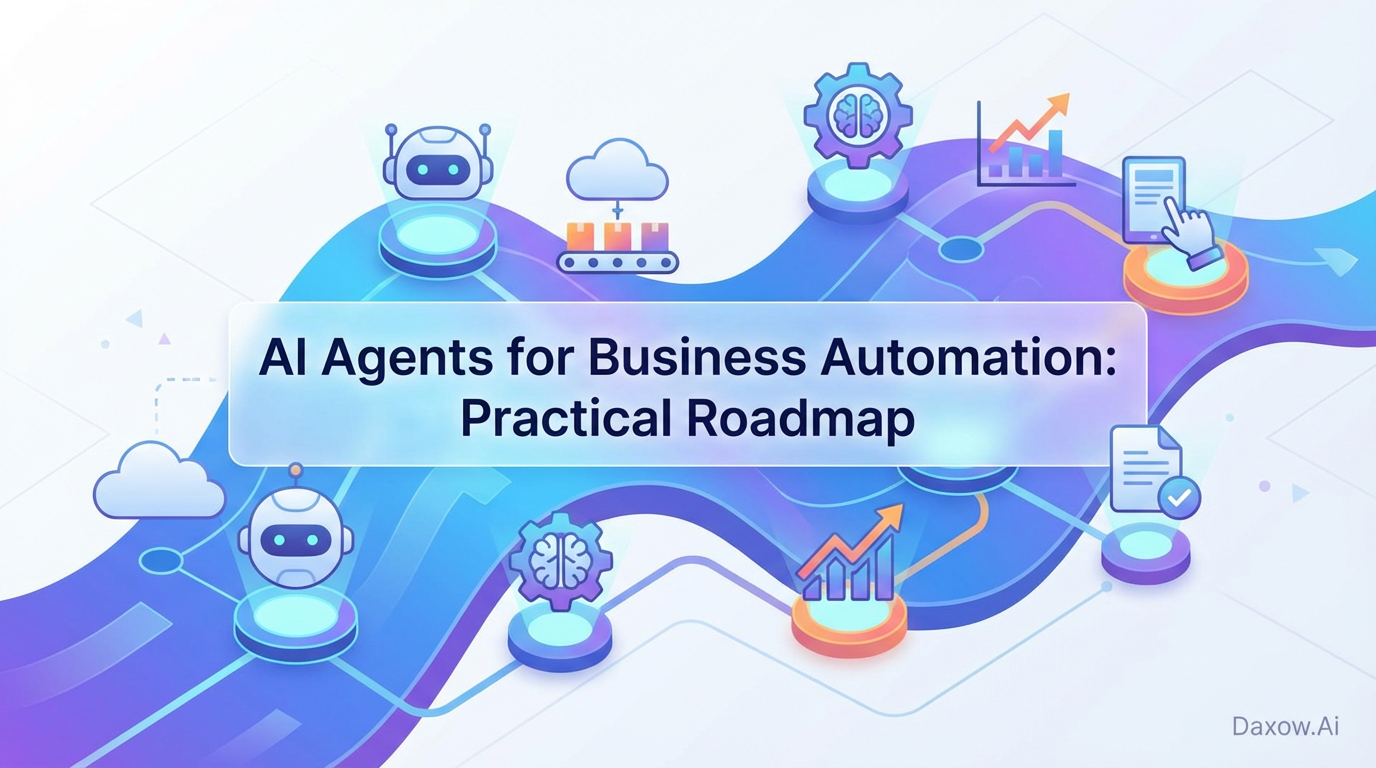
Discover how AI agents automate operations, deliver measurable ROI, and scale safely, with use cases, governance, and Daxow.ai's implementation roadmap.
AI Agents for Business Automation: Transforming Operations in the Agentic Era
Estimated reading time: 15 minutes
Key Takeaways
- AI agents represent a leap from rule-based automation to adaptive, cognitive systems enhancing productivity and decision-making.
- Businesses can reduce manual tasks, improve compliance, and consolidate technology stacks with agentic automation.
- Industry-specific use cases span e-commerce, healthcare, finance, real estate, HR, manufacturing, and supply chain.
- Daxow.ai delivers tailored AI agents designed for end-to-end integration, governance, and measurable ROI.
- A phased roadmap ensures successful AI agent adoption with continuous optimization and robust governance.
Table of Contents
- AI Agents for Business Automation: Transforming Operations in the Agentic Era — what they are and why they matter
- Practical Use Cases — how AI agents deliver measurable business automation across industries
- Implementation roadmap — concrete steps to deploy AI agents and achieve ROI
- Governance and best practices — ensuring safe, scalable automation
- Quantifying ROI — what to expect
- How Daxow.ai converts strategy into operational systems
- Frequently Asked Questions
AI Agents for Business Automation: Transforming Operations in the Agentic Era — what they are and why they matter
AI Agents for Business Automation: Transforming Operations in the Agentic Era is not a theoretical trend — it is a practical shift reshaping how enterprises run operations, serve customers, and scale. These autonomous systems move beyond brittle, rule-based RPA to perceive data, reason across contexts, execute multi-step workflows, and learn over time. For business leaders, that means fewer manual tasks, faster decisions, and measurable productivity gains. At Daxow.ai, we design and deploy custom AI systems that turn these capabilities into operational value — reducing costs, improving customer experience, and freeing teams to focus on strategy.
Capabilities of AI Agents
- Perception: ingesting structured and unstructured data (APIs, documents, email, telemetry).
- Cognitive processing: contextual reasoning and natural language understanding.
- Decision engines: reinforcement and supervised learning to choose optimal actions.
- Action layers: executing tasks via APIs, UI automation, or messaging.
- Continuous learning: improving performance from feedback and outcomes.
Why This Matters to Businesses
- Move from rigid automation to adaptive automation. Unlike traditional RPA, agents handle exceptions, nuance, and evolving rules without constant reprogramming.
- Amplify human skills rather than replace them. Agents remove repetitive work and provide decision support, letting skilled staff focus on high-value tasks.
- Reduce technical debt and consolidate stacks. Agents can orchestrate across CRM, ERP, ticketing, and document systems, decreasing the need for point-to-point tools.
- Improve compliance and oversight. Versioning, audit trails, and human-in-the-loop controls keep governance intact while enabling automation at scale.
How Daxow.ai Applies Agentic Automation
- Discovery and mapping: We analyze current workflows to identify high-impact automation opportunities.
- Custom agent design: We build agents tailored to your data, integrations, and compliance needs.
- End-to-end integration: We connect agents to CRMs, ERPs, support platforms, and custom systems to execute real tasks.
- Operationalization: We deploy monitoring, governance, and continuous improvement loops so agents deliver measurable ROI.
Practical Use Cases — how AI agents deliver measurable business automation across industries
AI agents are industry-agnostic in capability but industry-specific in implementation. Below are practical, actionable use cases with outcomes you can expect.
E-commerce and Retail
- Inventory optimization agent: monitors sales velocity, supplier lead times, and forecast signals to create reorder suggestions and trigger purchase orders.
- Typical impact: 10–30% reduction in stockouts, 10–25% reduction in excess inventory carrying costs.
- Omnichannel fulfillment orchestrator: routes orders to optimal warehouses, schedules carriers, and updates customers with proactive exceptions handling.
- Typical impact: faster delivery pipelines and reduced fulfillment costs.
- Personalized merchandising assistant: generates product recommendations and promotional strategies based on customer behavior and margin targets.
- Typical impact: lift in average order value and conversion rates.
How Daxow helps:
- Integrate with Shopify, Magento, ERP systems and logistics APIs.
- Build agents that reconcile inventory feeds, forecast demand, and execute procurement when thresholds are met.
- Implement dashboards and alerting for human overrides.
Healthcare
- Patient intake and validation agent: extracts information from intake forms and medical records, cross-checks insurance eligibility, and schedules appointments.
- Typical impact: reduction in administrative errors and shorter patient intake times.
- Compliance reporting agent: aggregates clinical documentation, anonymizes data where required, and prepares regulatory reports.
- Typical impact: faster reporting cycles and reduced audit risk.
How Daxow helps:
- Deploy secure document extraction and natural language understanding for medical text.
- Integrate with EHRs and scheduling systems while maintaining data privacy and compliance controls.
Finance and Insurance
- Fraud detection and response agent: monitors transactions in real time, scores anomalies, and triggers containment steps or escalations.
- Typical impact: faster fraud triage and reduced loss exposure.
- Invoice processing and reconciliation agent: extracts invoice data, validates against purchase orders, and posts entries to ERP.
- Typical impact: reduction in processing time and error rates, lower AP costs.
How Daxow helps:
- Connect agents to payment gateways, banking APIs, and accounting systems.
- Implement explainable models and audit logging to satisfy auditors and compliance teams.
Real Estate and Property Management
- Lead qualification agent: ingests inquiries, scores leads by intent and budget, and schedules viewings or hands off to agents.
- Typical impact: faster lead response times and higher conversion rates.
- Contract review and extraction agent: reads leases and contract clauses, flags risks, and extracts key dates and obligations.
- Typical impact: faster closings and reduced legal review effort.
How Daxow helps:
- Build connectors to MLS platforms and CRM systems.
- Train agents on domain-specific language and contract templates.
HR and Talent Management
- Recruitment screener agent: parses resumes and job descriptions, pre-screens candidates, and schedules interviews.
- Typical impact: reduced time-to-hire, lower recruiter workload.
- Employee query support agent: handles benefits, payroll, and policy inquiries via chat with seamless escalation to HR specialists.
- Typical impact: fewer manual inquiries, improved employee experience.
How Daxow helps:
- Integrate with ATS systems, HRIS, and calendar platforms.
- Provide human-in-the-loop for sensitive decisions.
Manufacturing and Supply Chain (Multi-agent systems)
- Quality control agent: monitors sensor data, schedules inspections, and triggers corrective actions.
- Scheduling and capacity agent: balances demand forecasts against production capacity and supplier constraints.
- Typical impact: reduced downtime, improved on-time delivery.
How Daxow helps:
- Design multi-agent architectures where specialized agents coordinate (e.g., quality agent + scheduling agent).
- Implement secure telemetry ingestion and integrations with MES/ERP.
Implementation roadmap — concrete steps to deploy AI agents and achieve ROI
Adopting AI agents requires a phased, governed approach. The following roadmap aligns with industry best practices and Daxow.ai’s delivery model.
1. Discovery: pinpoint opportunities
- Actions: process mapping, complexity and impact scoring, data readiness assessment.
- Deliverable: prioritized backlog of automation opportunities with estimated benefits.
- Daxow role: run workshops, map systems, and define success metrics.
2. Define objectives and pilots
- Actions: select quick wins (high frequency, clear inputs/outputs), establish baseline KPIs.
- Deliverable: pilot scope, acceptance criteria, and test plan.
- Daxow role: prototype agents, define pilot success thresholds, and coordinate stakeholders.
3. Build and integrate
- Actions: implement agents using natural language SOPs, connect APIs to systems like Salesforce, SAP, or custom ERPs, design human handoffs.
- Deliverable: production-ready agents, integration layer, and user interfaces.
- Daxow role: full-stack build, connectors, UI/UX for operator control, and security hardening.
4. Govern and scale
- Actions: set audit trails, permissions, model versioning, monitoring dashboards, and escalation policies.
- Deliverable: governance framework and rollout plan across departments.
- Daxow role: implement monitoring, SSO, role-based access, and governance playbooks.
5. Optimize continuously
- Actions: monitor KPIs (error rates, processing time, resolution time), retrain models, refine SOPs.
- Deliverable: continuous improvement loop with quarterly roadmaps.
- Daxow role: ongoing support, performance tuning, and feature development.
Success metrics to track
- Error reduction percentage.
- Time savings per process (minutes/hours).
- Cost per transaction or ticket.
- Response time improvements for customer interactions.
- Conversion rate lifts (sales/lead qualification).
Governance and best practices — ensuring safe, scalable automation
- Start with cognitive complexity, not low-value rule automation. Target tasks that require context and decision-making.
- Keep humans in the loop for high-risk decisions. Implement clear escalation boundaries.
- Establish auditability and explainability. Maintain versioned SOPs and logs for regulatory compliance.
- Measure outcomes, not just activity. Tie agent performance to business KPIs and incentives.
- Adopt phased rollouts. Pilot, measure, then scale to avoid disruption and ensure adoption.
Quantifying ROI — what to expect
AI agents deliver measurable returns:
- Productivity gains: industry evidence shows up to 40% improvement in worker productivity for tasks augmented by agents.
- Cost reductions: automation reduces labor-intensive processing and error-related costs; enterprises capture savings from consolidated tools and faster cycles.
- Contact-center savings: analyst forecasts place agent-led savings in the tens of billions across service industries.
- Revenue uplift: personalization, faster lead responses, and reduced friction improve conversion rates and customer lifetime value.
Real example metrics to model in pilots:
- Reduce invoice processing time from 48 hours to under 4 hours.
- Cut first response time in customer support from 6 hours to under 30 minutes.
- Decrease time-to-hire by 30% in high-volume recruitment.
How Daxow.ai converts strategy into operational systems
At Daxow.ai, we combine domain expertise, engineering, and product thinking to move you from idea to ROI quickly.
Our offerings
- Custom AI agents: Built to execute business tasks end-to-end — from data ingestion to action execution.
- Workflow automation: Orchestrate multi-step processes with visibility and controls.
- Chatbots and customer support automation: Intelligent conversational agents with handoff and escalation.
- Lead qualification and sales automation: Automated scoring, nurturing, and routing to sales teams.
- Data extraction and document automation: OCR, entity extraction, and reconciliation for invoices, contracts, and medical records.
- Systems integration: Connectors to CRMs, ERPs, ticketing systems, and proprietary tools.
Why organizations choose Daxow
- End-to-end delivery: We handle discovery, build, integration, governance, and continuous improvement.
- Tailored solutions: No one-size-fits-all templates — agents are trained on your data and configured to your processes.
- Operational focus: We prioritize measurable outcomes and clear KPIs.
- Security and compliance: Data governance, role-based access, and audit trails to meet enterprise standards.
- Scalable architecture: Modular agents and orchestrators that grow across teams and departments.
Typical engagement flow with Daxow.ai
- Kickoff and process mapping.
- Pilot delivery with measurable KPIs.
- Production integration and user training.
- Monitoring, governance rollout, and scaling plan.
- Ongoing optimization and feature expansion.
Conclusion and next steps
AI Agents for Business Automation: Transforming Operations in the Agentic Era is a pragmatic path to reduce manual tasks, boost productivity, and improve customer and employee experiences. Organizations that adopt agentic automation thoughtfully — focusing on high-impact processes, governance, and integration — realize measurable ROI and lasting competitive advantage.
Bold action now will create durable operational improvements:
- Reduce manual tasks and error rates.
- Accelerate decision cycles.
- Consolidate toolchains and lower operational costs.
- Free teams to focus on strategy and customer outcomes.
Ready to transform processes with AI agents? Book a free consultation with Daxow.ai, request a process analysis for your company, or contact us to build a custom AI system that automates real work and delivers measurable ROI.
Frequently Asked Questions
What distinguishes AI agents from traditional RPA?
AI agents extend beyond rule-based automation by employing perception, context-aware reasoning, learning, and multi-step decision-making. They adapt dynamically to exceptions without requiring constant reprogramming.
How does Daxow.ai ensure compliance and governance in AI automation?
We implement audit trails, version control, human-in-the-loop decision checkpoints, and role-based access controls to maintain regulatory compliance and scalable governance.
Can AI agents integrate with existing enterprise systems?
Yes. Daxow.ai builds custom connectors and integration layers that connect AI agents to CRMs, ERPs, ticketing systems, payment gateways, and other proprietary platforms.
What industries benefit most from AI agent automation?
AI agents deliver value across diverse sectors including e-commerce, healthcare, finance, real estate, HR, manufacturing, and supply chain management — each implemented with domain-specific expertise.