
AI Agents: Transforming Business Operations with Autonomous Automation
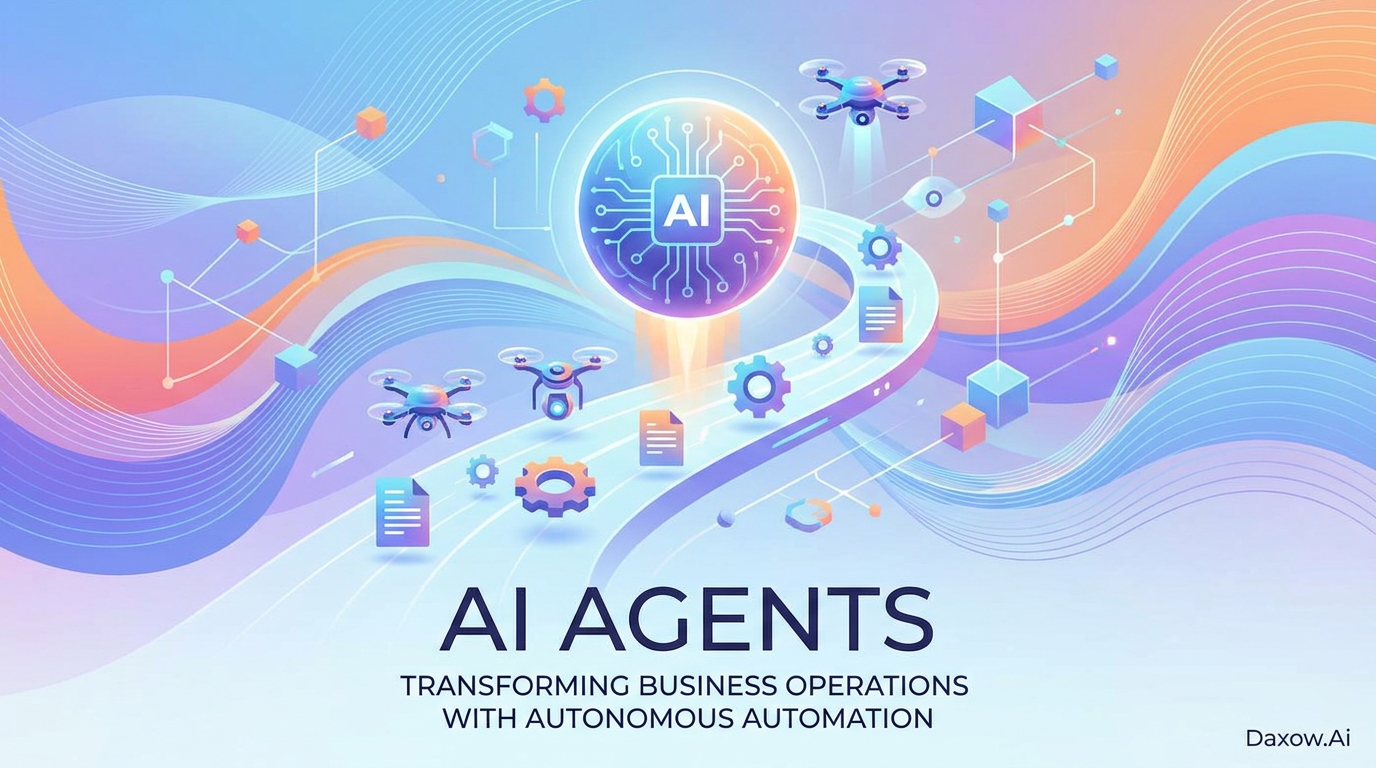
How AI agents reduce costs, boost productivity, and scale operations. Use cases, ROI, and a practical roadmap for enterprise adoption with Daxow.ai.
AI Agents: Transforming Business Operations with Autonomous Automation
Estimated reading time: 15 minutes
Key Takeaways
- AI agents enable autonomous, end-to-end task execution with minimal human intervention, boosting productivity and cutting costs.
- Significant business outcomes include up to 70% cost reduction, 300% first-year ROI, and 24/7 scalable operations without extra headcount.
- Agentic automation advances traditional rule-based systems by reasoning across multiple data sources and systems in real time.
- Industry use cases span e-commerce, healthcare, finance, real estate, HR, customer support, and sales & marketing.
- Daxow.ai offers a full-service approach to designing, building, and scaling custom AI agent workflows tailored to enterprise needs.
- Successful implementation requires staged adoption: identifying cases, assessing readiness, piloting, iterating, and scaling securely.
- Tracking core KPIs and managing risk through governance and human-in-the-loop oversight ensures sustainable automation value.
Table of Contents
- AI Agents: Transforming Business Operations with Autonomous Automation — Why it Matters
- How AI Automation and AI Agents Deliver Business Value
- Practical Use Cases and Industry Examples
- Implementation Roadmap — From Pilot to Enterprise-Scale Workflow Automation
- Measuring ROI and Managing Risk
- Realizing Sustainable Value — Organizational and Operational Considerations
- Getting Started with Daxow.ai: Building Custom AI Systems That Execute Real Tasks
- Frequently Asked Questions
AI Agents: Transforming Business Operations with Autonomous Automation — Why it Matters
AI agents move organizations from reactive, rule-based automation to proactive, agentic workflows that reason across systems and data sources. Key business outcomes include:
- Significant cost reduction: Automation can lower per-task costs by up to 70%.
- Rapid ROI: Organizations report average first-year ROI near 300% and payback in 3–6 months for prioritized pilots.
- Increased productivity: Many teams see productivity gains of 25–47%; 39% of firms report productivity doubling after agent deployments.
- 24/7 scale without headcount growth: Agents operate continuously, handling peak volumes without proportional staffing increases.
These gains occur because agents handle unstructured data, policy interpretation, and cross-system handoffs where traditional automation struggles. They combine large language models, document AI, knowledge bases, and enterprise APIs to reason, act, and escalate with rich context. Additionally, agents reduce error rates (often 60–85% lower in targeted tasks) and shorten decision cycles (e.g., 60% faster time-to-decision in complex configurator workflows).
How AI Automation and AI Agents Deliver Business Value
AI automation is not a single technology — it’s a systems approach. Here’s how agentic automation creates measurable value:
From Rules to Reasoning
- Traditional automation follows predefined rules. AI agents adapt, consult knowledge, and make decisions when inputs are ambiguous.
- Agents can auto-initiate processes (refunds, claims routing), validate using enterprise policies, and escalate with context when necessary.
Grounded Execution and Safe Autonomy
- Agents operate against authenticated data and auditable logs to ensure safe actions.
- Human-in-the-loop patterns handle exceptions while routine work is fully automated.
Integrations and Orchestration
- Agents orchestrate actions across CRMs, ERPs, support platforms, and internal databases.
- This eliminates manual handoffs, synchronizes data, and surfaces real-time insights to decision-makers.
Measurable KPIs
Focus on these outcome metrics:
- Automation rate (target >40%)
- Time-to-resolution and time-to-decision
- Error reduction and compliance metrics
- Cost per transaction and overall ROI
- Customer satisfaction and net retention impact
Practical Use Cases and Industry Examples
E-commerce — Intelligent Product Configurator
Use case: Agents ask targeted questions, query product data, calculate costs, and generate quotes and proposals.
Business impact: 50% improvement in decision precision and 60% reduction in time-to-decision for complex orders.
Daxow.ai approach: Integrate product catalogs, pricing engines, and CRM. Build a conversational agent using LLMs and Document AI to generate quotes and push orders to fulfillment systems.
Healthcare — Patient Triage and Outreach Automation
Use case: Virtual agents triage symptoms, route appointments, and manage follow-ups.
Business impact: High-volume interactions (hundreds of thousands per year) reduce clinical load and improve patient routing.
Daxow.ai approach: Connect EMR data safely, implement compliant triage logic, and implement escalation to clinicians with full interaction history.
Finance & Insurance — Claims Processing and Compliance
Use case: Agents extract data from claims documents, validate policy coverage, and recommend payouts.
Business impact: Faster payouts, fewer manual reviews, and better compliance tracking.
Daxow.ai approach: Combine document extraction, policy engines, and case orchestration. Integrate with core systems to auto-complete approvals and audits.
Real Estate — Lead Enrichment and Deal Forecasting
Use case: Agents enrich leads with market data, match prospects to inventory, and forecast deal likelihood.
Business impact: Clearer pipeline visibility and improved win rates with 25–47% productivity lifts for sales teams.
Daxow.ai approach: Sync MLS/market feeds with CRM, automate lead scoring, and push prioritized prospects to sales reps for human follow-up when required.
HR — Recruitment, Onboarding, and Internal Support
Use case: Agents screen candidates, answer FAQs, and automate onboarding workflows across languages.
Business impact: Scale HR interactions with multilingual support and faster candidate throughput.
Daxow.ai approach: Link HRIS, ATS, and knowledge bases. Automate routine queries (time-off, benefits) and orchestrate onboarding tasks.
Customer Support Automation
Use case: Agents resolve common queries, update CRM records, and create tickets with context.
Business impact: 40% fewer tickets, 120 seconds saved per contact, and improved CSAT scores.
Daxow.ai approach: Build conversational support agents, integrate them with ticketing and CRM, and establish escalation rules for complex cases.
Sales & Marketing — Lead Qualification and Content Orchestration
Use case: Agents qualify leads, enrich profiles, and generate personalized outreach content.
Business impact: Faster lead qualification, higher conversion rates, and significantly lower manual effort in campaign execution.
Daxow.ai approach: Automate lead qualification workflows, integrate with marketing automation tools, and provide content assistants for faster campaign creation.
Implementation Roadmap — From Pilot to Enterprise-Scale Workflow Automation
1. Identify High-Impact Use Cases
- Target repetitive, data-rich processes with measurable costs (claims, support tickets, lead qualification).
- Validate data availability and integration points.
- Deliverable: prioritized use-case list with estimated ROI.
2. Readiness Assessment
- Audit systems, data quality, access, and security.
- Define success metrics and compliance constraints.
- Deliverable: technical and governance readiness report.
3. Pilot Build and Deploy
- Implement 1–3 pilots focusing on quick wins.
- Use modular agent frameworks and LLMs for conversational and decision tasks.
- Deliverable: deployed pilot, monitoring dashboards, and initial KPI report.
4. Test, Measure, and Iterate
- Track automation rate, error reduction, time saved, and customer satisfaction.
- Use A/B testing and gradual rollouts with human oversight for edge cases.
- Deliverable: validated playbook for expansion.
5. Scale Securely
- Harden governance, auditing, and access controls.
- Integrate with enterprise CRMs/ERPs for full lifecycle automation.
- Deliverable: enterprise rollout plan, integrations, and training materials.
Daxow.ai services across the roadmap:
- Process analysis and use-case discovery.
- Custom AI agent development (conversation, orchestration, document automation).
- System integrations (CRMs, ERPs, ticketing systems).
- Monitoring, governance, and ongoing optimization.
- Training and change management for stakeholder adoption.
Measuring ROI and Managing Risk
Core KPIs to Track
- Automation rate and percentage of tasks fully handled by agents.
- Time-to-resolution and time-to-decision improvements.
- Error rate reduction and compliance adherence.
- Cost per transaction and net cost savings.
- Customer satisfaction lift and impact on revenue (e.g., $2M uplift examples).
Typical Gains to Expect
- Productivity: 25–47% increase; some firms report doubled productivity.
- Financial: ~300% ROI within the first year and 3–6 month payback windows.
- Operational: 40–80% of targeted workflows automated.
- Customer: +25% satisfaction, 24/7 availability.
Risk Management and Governance
- Start with measurable pilots and human oversight in early stages.
- Implement data governance, secure APIs, and access controls.
- Maintain auditable logs and review agent decisions for compliance-sensitive tasks.
- Build escalation patterns so agents defer complex or high-risk actions to humans.
Realizing Sustainable Value — Organizational and Operational Considerations
- Cross-functional sponsorship: Involve IT, operations, legal, and business owners from day one.
- Change management: Reskill teams to focus on strategic tasks and oversight.
- Continuous improvement: Agents learn from feedback; treat deployments as iterative programs, not one-off projects.
- Data strategy: High-quality, accessible data is the fuel for reliable agents.
Getting Started with Daxow.ai: Building Custom AI Systems That Execute Real Tasks
Daxow.ai helps businesses move from discovery to enterprise-scale automation with a full-service approach:
- Discovery and Process Analysis: We map workflows, quantify savings opportunities, and prioritize pilots.
- Custom AI Agent Design: We build agents that combine LLMs, Document AI, and rule engines to reason and act.
- End-to-End Workflow Automation: We implement orchestration that spans CRM, ERP, ticketing, and back-office systems.
- Integrations and Data Connectivity: We connect data sources securely and create auditable logs for governance.
- Monitoring, Optimization, and Support: We measure KPIs, iterate on performance, and scale successful agents.
Why partner with Daxow.ai
- Practical, ROI-first approach: Focused pilots, measurable metrics, and rapid payback.
- Industry breadth: Experience across healthcare, finance, e-commerce, real estate, and HR.
- Full-stack delivery: From data extraction to agent orchestration and long-term support.
- Security and governance: Enterprise-grade controls built into every deployment.
Learn more about our services and solutions to start transforming your business operations today.
Frequently Asked Questions
What are AI agents and how do they differ from traditional automation?
AI agents are autonomous software systems that perceive environments, reason across data and systems, and execute complete tasks with minimal human input, unlike traditional automation which follows static rules without adaptive reasoning.
How quickly can organizations expect to see ROI from deploying AI agents?
Organizations typically report an average first-year ROI near 300% and payback within 3 to 6 months for prioritized pilot projects.
What industries benefit most from AI agent automation?
AI agent automation benefits diverse industries including e-commerce, healthcare, finance, insurance, real estate, HR, customer support, and sales & marketing.
How does Daxow.ai ensure security and compliance in AI agent deployments?
Daxow.ai integrates enterprise-grade governance, secure data access, auditable logs, and human-in-the-loop oversight patterns to maintain security and compliance across all deployments.
What support does Daxow.ai provide after deployment?
Daxow.ai offers ongoing monitoring, performance optimization, governance support, and change management training to ensure sustained value from AI agent implementations.