
AI Agents for Business: Unlock Autonomous Automation & ROI
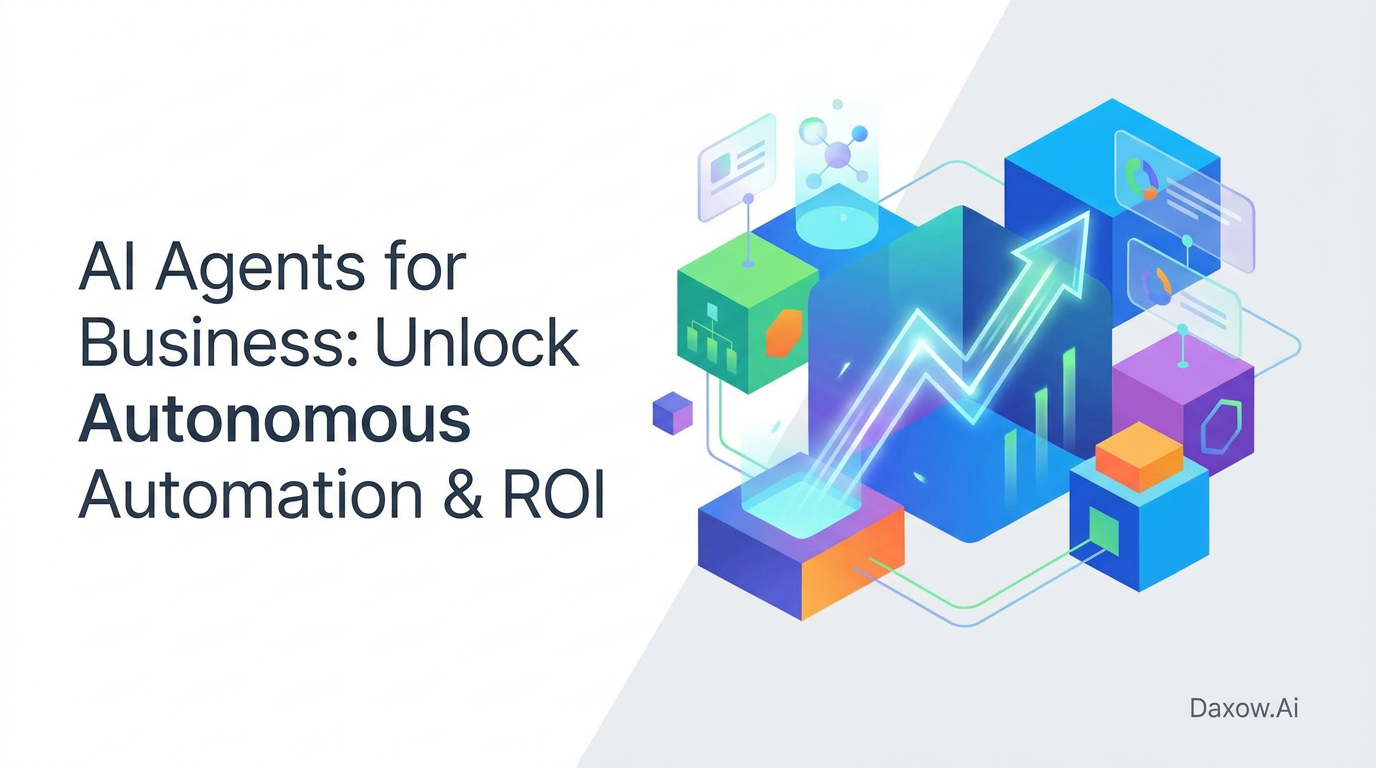
AI agents enable autonomous automation across industries with use cases, implementation steps, and measurable ROI from Daxow.ai.
AI Agents for Business: Unlocking Autonomous Automation for Competitive Advantage
Estimated reading time: 15 minutes
Key Takeaways
- AI agents enable autonomous, goal-oriented automation that improves productivity and reduces costs dramatically.
- They integrate multiple data sources and systems, providing dynamic workflows beyond static automation.
- Strategic implementation of AI agents allows businesses to scale operations without proportional headcount growth.
- Industry-specific use cases show significant impact across e-commerce, healthcare, finance, real estate, HR, and support.
- Daxow.ai offers end-to-end AI agent design and integration services ensuring secure, compliant, and measurable results.
Table of Contents
- What are AI Agents for Business: Unlocking Autonomous Automation for Competitive Advantage
- Strategic Implications for Business Leaders
- Practical Use Cases and Industry Examples
- How AI Agents and Workflow Automation Work Together
- Implementation Steps and Best Practices
- How Daxow.ai Helps: From Audit to Production
- Measuring ROI and Business Value
- Getting Started: Pragmatic Next Steps
- Conclusion and Call to Action
- Frequently Asked Questions
What are AI Agents for Business: Unlocking Autonomous Automation for Competitive Advantage
AI agents are autonomous systems powered by large language models and connected tools that observe environments, reason about goals, plan multi-step workflows, and execute actions across enterprise systems. Unlike reactive chatbots, agents are goal-oriented: they ingest emails, CRM records, tickets, and documents; evaluate next steps; and act through APIs—sending emails, updating databases, booking meetings, or escalating issues—while learning from outcomes.
Key characteristics:
- Perception: ingesting structured and unstructured data across systems.
- Planning: decomposing goals into executable steps.
- Tools & Integrations: calling APIs, sending messages, querying databases.
- Memory & Feedback: maintaining context and improving through continuous feedback.
Why this matters: AI agents convert static automation into dynamic, exception-aware workflows that handle real-world complexity. The result is significant productivity improvements and cost reductions—businesses report 45–70% productivity gains, up to 63% faster decision-making, and meaningful reductions in operational overhead.
Strategic Implications for Business Leaders
AI agents unlock strategic advantages beyond simple task automation. They enable companies to scale knowledge work, enforce business rules consistently, and surface organizational knowledge through semantic search—all while aligning to compliance and governance requirements.
Business outcomes:
- Scale without hiring: Agents replicate knowledge worker patterns, enabling capacity increases without proportional headcount growth.
- Faster, better decisions: Agents synthesize cross-system data for quicker and more accurate outcomes.
- Operational resilience: Agents handle exceptions and adjust plans in real time.
- Continuous improvement: Feedback loops and memory enable improving accuracy and efficiency over time.
For decision-makers, the strategic value is clear: reallocate human talent to high-value work, reduce error-prone manual tasks, and improve customer experience across touchpoints.
Practical Use Cases and Industry Examples
E-commerce
Use cases:
- Demand forecasting and inventory optimization.
- Personalized campaign orchestration and real-time ad adjustments.
- Automated returns handling and customer communications.
Example: An AI agent ingests sales data, web behavior, and inventory levels, then adjusts reorder thresholds and triggers targeted email campaigns during stock surges. The agent also reassigns ad spend across channels to maximize ROI, reducing stockouts and wasted ad spend.
Healthcare
Use cases:
- Patient triage and onboarding automation.
- Compliance monitoring and proactive risk mitigation.
- Automated incident response and record reconciliation.
Example: An AI agent monitors incoming patient messages, schedules appointments, verifies eligibility, and flags compliance risks for clinician review. It enforces HIPAA-aware guardrails and reduces manual intake time while improving patient satisfaction.
Finance and Accounting
Use cases:
- Invoice processing and accounts payable automation.
- Fraud detection and anomaly investigation.
- Financial forecasting and scenario planning.
Example: An agent extracts invoice data, validates against purchase orders, and either approves payments or routes exceptions for human review. This reduces manual invoice queues and frees finance staff for analysis and strategic planning.
Real Estate and Property Management
Use cases:
- Market data synthesis for valuations and briefings.
- Route optimization for property viewings and field operations.
- Lease compliance and document automation.
Example: Agents aggregate market listings, neighborhood indicators, and CRM data to prepare property briefs and suggest viewing schedules, automatically notifying prospects and adjusting routes to minimize travel time.
Human Resources
Use cases:
- New hire onboarding: document collection, tool provisioning, and policy Q&A.
- Benefits enrollment automation.
- Ticket routing and escalation management.
Example: An onboarding agent ensures new hires complete required forms, provisions accounts, and answers policy questions via a conversational interface—reducing IT and HR workload and accelerating time-to-productivity.
Sales and Customer Support
Use cases:
- Account briefing generation from emails, call transcripts, and CRM history.
- Lead qualification and prioritization.
- Autonomous ticket resolution and escalation.
Example: Sales agents auto-generate account summaries and next-step recommendations before meetings. Support agents autonomously resolve common tickets, escalate complex issues, and provide agents with context-rich handoffs.
How AI Agents and Workflow Automation Work Together
AI agents are most effective when embedded within full workflow automation architectures. Combining agents with traditional workflow automation (APIs, scheduled jobs, RPA where needed) provides the right balance of autonomy and control.
Typical architecture elements:
- Integration layer: connectors to CRMs, ticketing systems, email, storage, and telephony.
- Agent engine: LLM-based reasoning, planning, and tool orchestration.
- Knowledge layer: semantic search and organizational memory for context and compliance.
- Monitoring & analytics: success metrics, logs, and feedback loops.
- Governance: data privacy, access controls, and audit trails.
Daxow.ai builds end-to-end systems that combine these elements. We integrate into existing tool stacks to avoid disruptive rip-and-replace projects and enforce enterprise-grade security and compliance.
Implementation Steps and Best Practices
1. Audit and ideation
- Conduct workshops to map current workflows and identify repetitive, high-volume tasks.
- Prioritize based on ROI, integration complexity, and user impact.
- Define KPIs: resolution time, cost per ticket, time-to-hire, conversion rate uplift.
2. Proof of Concept (PoC)
- Build a focused PoC for a single high-impact process (e.g., support auto-resolution or HR onboarding).
- Deliver a functional agent within 30–60 days to validate assumptions.
- Measure functional correctness and business metrics early.
3. Integration and governance
- Connect agents to CRMs, Slack, Zendesk, ERP systems, and document stores via secure APIs.
- Define guardrails: data access policies, role-based permissions, and compliance workflows.
- Ensure GDPR, SOC 2, and industry-specific compliance for sensitive data.
4. Testing and training
- Create diverse datasets and scenario-based tests, including edge cases.
- Run user acceptance tests and small pilot programs.
- Implement continuous learning from production interactions.
5. Scale and monitor
- Deploy with analytics and dashboards for success rates and exceptions.
- Iterate using feedback loops; expand agents to adjacent processes.
- Embed human-in-the-loop controls for high-risk decisions.
Best practice summary:
- Start small to prove value.
- Design universal interfaces to connect across tools.
- Prioritize proactive autonomy while maintaining strict guardrails.
- Measure outcomes and iterate quickly.
How Daxow.ai Helps: From Audit to Production
Daxow.ai specializes in designing custom AI automation systems that integrate AI agents with workflow automation and enterprise tools. Our approach is tailored for business outcomes.
What we deliver:
- Discovery workshops to map workflows and quantify opportunities.
- Rapid PoCs that demonstrate measurable ROI.
- Secure integrations with CRMs, support platforms, ERPs, and third-party tools.
- Custom agent design: perception modules, planning strategies, and memory semantics.
- Governance frameworks: data protection, auditability, and compliance.
- Training and handover: documentation, dashboards, and continuous improvement plans.
Why choose Daxow.ai:
- End-to-end delivery: from ideation to production and scaling.
- Industry experience: practical implementations across e-commerce, healthcare, finance, real estate, HR, and support.
- Business-first focus: we measure and optimize for KPIs that matter to decision-makers.
Learn more about our tailored services on the Daxow.ai Services page.
Measuring ROI and Business Value
AI agents produce measurable results quickly when implemented using the best practices above.
Typical ROI indicators:
- Productivity gains: 45–70% improvement in workflow throughput.
- Faster decisions: decision cycles can accelerate by up to 63%.
- Operational cost reductions: teams eliminate routine queues; small firms can remove entire manual queues, larger enterprises see tens of percent reductions in headcount-intensive tasks.
- Error reduction and compliance: consistent rule enforcement reduces costly mistakes.
Example ROI scenario:
A mid-size contact center automates tier-1 ticket resolution and achieves a 40% performance boost. With reduced call handling time and fewer escalations, labor costs shrink while customer satisfaction improves—yielding a payback period of months, not years.
Getting Started: Pragmatic Next Steps
If you are evaluating AI automation, start with targeted experiments that prove business value quickly.
Recommended first steps:
- Run a process audit to identify high-volume, high-friction tasks.
- Select one priority use case for a 30–60 day PoC.
- Define success metrics (cost per ticket, average handle time, time-to-hire, revenue lift).
- Prepare integration points and security requirements.
How Daxow.ai engages:
- We begin with a no-cost discovery workshop to map processes and quantify potential impact.
- We deliver scoped PoCs that demonstrate real metrics.
- We provide managed deployment, monitoring, and scaling services to embed AI agents into your operations.
Visit our contact page to schedule your initial workshop or PoC discussion.
Conclusion and Call to Action
AI Agents for Business: Unlocking Autonomous Automation for Competitive Advantage is not a theoretical future—it's a practical way to reduce manual tasks, boost productivity, and transform customer and employee experiences today. By combining AI agents with workflow automation, organizations unlock scalable, compliant, and continuously improving systems that deliver measurable ROI.
To explore how AI agents and automation can work in your organization, contact Daxow.ai. Book a free consultation or request a process analysis to identify the highest-impact automation opportunities for your business. Let us design and build a custom AI system that reduces manual tasks, improves productivity, and delivers measurable business value.
Frequently Asked Questions
What distinguishes AI agents from traditional automation tools?
AI agents are autonomous and goal-oriented; they dynamically plan and execute multi-step workflows using real-time data and continuous learning. Traditional automation is typically static, rule-based, and reactive.
How quickly can businesses expect ROI from AI agents?
With a focused PoC and best practices, businesses often see measurable ROI within months, including productivity gains and cost reductions.
Are AI agents compliant with data privacy regulations?
Yes, Daxow.ai integrates compliance and governance frameworks such as GDPR and SOC 2 into every implementation to ensure data privacy and security.
Which industries benefit most from AI agents?
AI agents provide value across multiple sectors, including e-commerce, healthcare, finance, real estate, human resources, and customer support.