
AI Agents & Automation: Transform Your Business
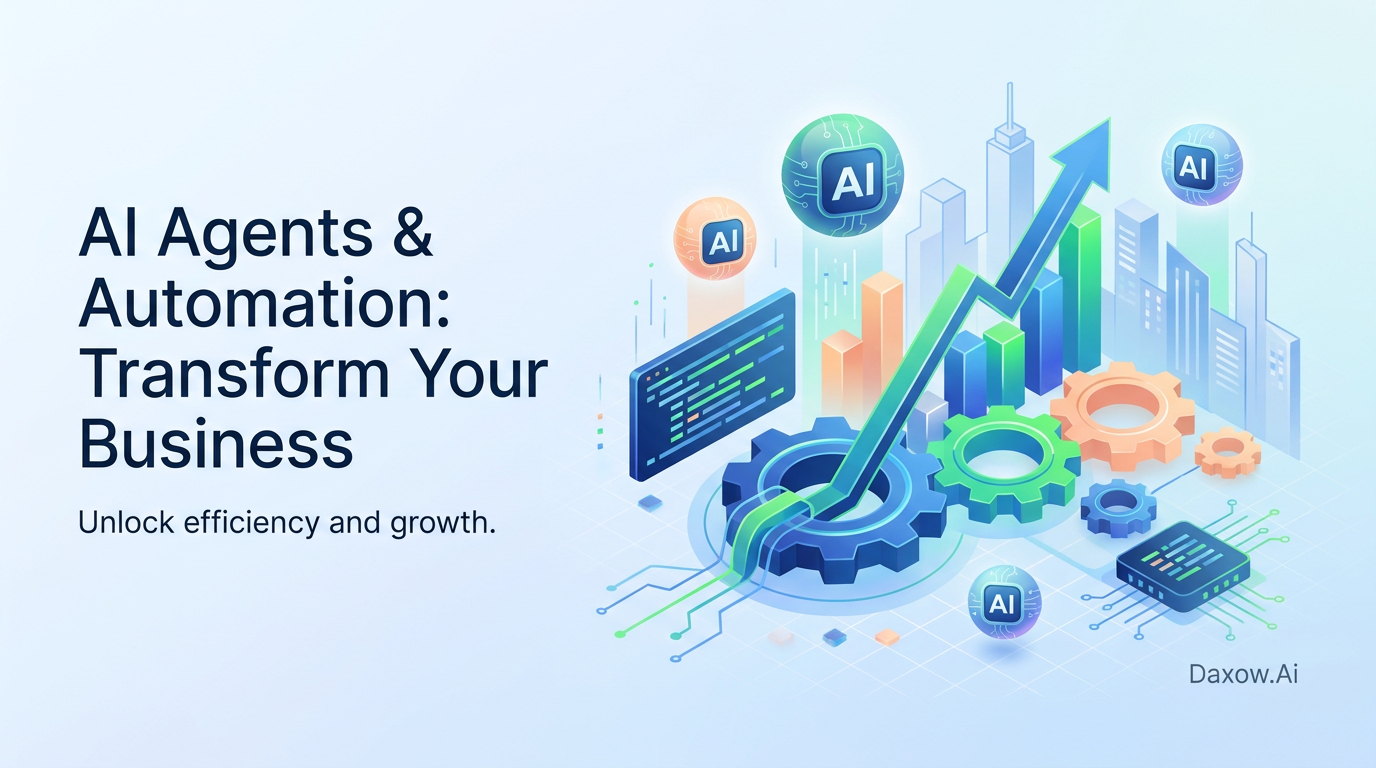
AI agents and automation transforming operations—industry use cases, implementation roadmap, and how Daxow.ai delivers measurable ROI.
AI Agents and Automation for Business Transformation
Estimated reading time: 15 minutes
Key Takeaways
- AI agents represent a shift from rule-based automation to goal-oriented systems with cross-system orchestration and adaptive decision-making.
- Practical use cases span industries like e-commerce, healthcare, finance, real estate, and HR, delivering measurable business impact.
- Successful AI automation relies on core capabilities such as end-to-end workflow ownership, unstructured data reasoning, system integrations, and continuous monitoring.
- Implementation requires a disciplined roadmap from identifying workflows to piloting and iterating with governance and security in place.
- Measuring ROI includes financial levers, modeling approaches, and recognizing strategic value beyond direct cost savings.
- Daxow.ai provides end-to-end AI automation solutions including discovery, custom agent design, integrations, governance, and change enablement.
Table of Contents
- AI Agents and Automation for Business Transformation — What it Means
- Practical Use Cases and Industry Examples
- Core Capabilities That Deliver Value
- Implementation Roadmap and Best Practices
- Measuring ROI and Business Value
- How Daxow.ai Delivers End-to-End Business Automation
- Putting It Into Practice — A Short Example
- Conclusion and Call to Action
- Frequently Asked Questions
AI Agents and Automation for Business Transformation — What it Means
From scripted macros to intelligent, goal-oriented systems, the evolution of automation is transforming how work gets done. Traditional automation eliminated repetitive clicks. Modern AI agents take responsibility for outcomes: they reason across documents, plan multi-step workflows, and act across systems. The result is higher productivity, faster response times, and a reduced need for manual intervention.
Key distinctions:
- Goal-oriented behavior: Agents understand business objectives (e.g., qualify a lead and schedule a demo) rather than only executing pre-set rules.
- Cross-system orchestration: Agents interact with CRMs, ticketing systems, calendars, databases, and communication channels.
- Adaptive decision-making: Agents handle variations and edge cases using contextual reasoning, not brittle logic.
For decision-makers, this shift changes operating models, cost structures, and talent composition. Well-designed AI automation enables businesses to scale processes with software, improve customer support automation, and redeploy human talent to higher-value tasks.
Practical Use Cases and Industry Examples
E-commerce — From browsing to purchase fulfillment
Use cases:
- AI sales and support copilot: Handles pre-purchase queries, recommends products based on browsing behavior, and resolves simple post-purchase issues directly in the ecommerce backend.
- Abandoned cart recovery agent: Detects abandonment events, analyzes user intent, and triggers personalized, multichannel follow-ups with offers or booking human outreach for high-value carts.
- Product content automation: Generates SEO-optimized descriptions, normalizes supplier feeds, and flags inconsistent data.
Business impact:
- Higher conversion rates, lower average handling time for support, and reduced content production costs.
Integration points:
- Ecommerce platform (product catalog), CRM, email/SMS gateways, analytics.
Healthcare — Safer, faster, patient-centric workflows
Use cases:
- Patient intake and triage agent: Collects symptom data, performs risk triage, and schedules appointments with summary notes for clinicians.
- Care coordination agent: Sends automated follow-ups, medication reminders, and escalates clinical flags to care teams.
- Clinical documentation assistant: Transcribes visits, extracts structured data for EHRs, and automates prior authorization requests.
Business impact:
- Reduced clinician administrative burden, fewer no-shows, improved adherence, and better throughput of clinical capacity.
Integration points:
- EHR systems, appointment schedulers, secure messaging, and telehealth platforms.
Finance — Faster onboarding and more effective compliance
Use cases:
- Onboarding and KYC/AML agent: Automates document collection, OCR and verification, and rules-based anomaly detection.
- Transaction review assistant: Aggregates alerts, summarizes context, and drafts investigation recommendations for analysts.
- Financial operations agent: Automates reconciliations, generates management reports, and answers internal finance queries.
Business impact:
- Faster customer onboarding, lower compliance costs, and more timely financial insights.
Integration points:
- Core banking/ledger systems, document stores, external risk feeds, and BI tools.
Real Estate — Speed and personalization at scale
Use cases:
- Lead qualification and speed-to-lead agent: Instantly qualifies leads from portals, updates CRM, and schedules viewings.
- Property concierge agent: Answers detailed property and neighborhood questions, generates tailored lists, and nurtures prospects.
- Back-office automation: Populates listing data, manages document workflows for offers and leases.
Business impact:
- Improved lead conversion, higher productivity for agents, and a differentiated client experience.
Integration points:
- MLS systems, CRM, calendar tools, document management.
HR and People Operations — Faster hiring and better employee experience
Use cases:
- Recruiting agent: Screens candidates, drafts personalized outreach, and coordinates interviews across calendars.
- Employee helpdesk agent: Answers policy, benefits, and payroll questions; escalates complex cases.
- People analytics agent: Aggregates engagement signals and recommends targeted interventions.
Business impact:
- Shorter time-to-hire, reduced HR ticket volume, and more data-driven people decisions.
Integration points:
- ATS, HRIS, payroll systems, and internal knowledge bases.
Core Capabilities That Deliver Value
Successful deployments rely on a consistent set of agent capabilities. Design for these from day one:
- End-to-end workflow ownership: Agents should be able to own outcomes (e.g., “close the support ticket”) not just tasks.
- Reasoning over unstructured data: Ability to read emails, documents, and transcripts, then extract and act on key facts.
- System integrations and tool use: Native connectors to CRM, ERP, communication channels, and orchestration platforms.
- Continuous monitoring and proactive action: Agents operate on event streams (new lead, failed payment) and act proactively.
- Feedback loops and learning: Mechanisms for human feedback, automated metrics, and iterative improvements.
Each capability must be paired with governance: logging, role-based access, audit trails, and escalation policies.
Implementation Roadmap and Best Practices
Step 1 — Identify high-value workflows
Prioritize processes that are:
- High volume and repetitive.
- Standardized with variations suitable for reasoning agents.
- Measurable and tied to clear KPIs (time, cost, conversion).
Examples to start: lead qualification, support triage, recurring reporting, document processing.
Step 2 — Map the current process in detail
Document inputs, decisions, tools, failure modes, and handoffs. This becomes the blueprint for the agent and determines integration work.
Step 3 — Choose architecture and guardrails
Combine:
- An LLM/AI engine for reasoning.
- An orchestration layer for sequencing and retries.
- Secure connectors for your tech stack.
- A control layer for approvals, logging, and observability.
Design for security, privacy, and compliance with clear data governance.
Step 4 — Pilot with constrained scope
Start small: one workflow, one team. Run in shadow mode where agents propose actions and humans approve. Define success metrics (e.g., 50% reduction in handling time).
Step 5 — Iterate toward partial and full autonomy
Use pilot data to refine prompts, rules, and exception handling. Move from supervised actions to selective autonomy in low-risk cases, then to broader autonomy with monitoring and audits.
Best practices summary
- Redesign processes before automating.
- Keep humans in the loop for high-value decisions.
- Measure outcomes, not activity.
- Create an internal owner for automation governance.
- Design for reusability and scale across departments.
Measuring ROI and Business Value
Direct financial levers
- Labor efficiency: Typical reductions of 30–70% in time spent on targeted tasks.
- Revenue uplift: Faster lead follow-up and personalization increase conversion.
- Cost avoidance: Fewer errors, SLA penalties, and compliance fines.
Modeling approach
- Baseline current cost: time per case × volume × fully-loaded hourly cost.
- Estimate impact: target time reduction and conversion uplift.
- Subtract implementation and ongoing costs.
- Typical payback periods: 3–9 months for well-chosen use cases.
Strategic and intangible value
- Competitive differentiation through speed and personalization.
- Agility: update workflows quickly via prompts and policies.
- Talent leverage: shift staff to higher-value activities.
How Daxow.ai Delivers End-to-End Business Automation
Daxow.ai specializes in turning automation opportunities into production-grade AI systems. Our approach aligns with the capabilities and implementation steps above and focuses on measurable business impact.
What Daxow does:
- Process discovery and prioritization: We identify high-ROI workflows using structured audits and stakeholder interviews.
- Custom AI agent design: We build agents that understand your goals, interact with your systems, and execute tasks reliably.
- Systems integration and orchestration: We connect AI agents to CRM, ERP, ticketing, EHR, calendars, and messaging channels using secure, maintainable connectors.
- Governance and monitoring: We implement logging, approvals, data governance, and observability so you stay in control.
- Change management and enablement: We provide training, playbooks, and support so teams adopt human + agent workflows effectively.
How this translates to outcomes:
- Reduced manual tasks across sales, support, HR, and operations.
- Improved productivity and faster time-to-value for key processes.
- Lower operational costs through automation of routine work.
- Scalable solutions that reuse components across the organization.
Daxow combines technical delivery with operational consulting so you move from isolated experiments to a coherent business automation strategy. Learn more about our services and solutions.
Putting It Into Practice — A Short Example
Scenario: A mid-sized SaaS company wants to improve lead conversion and reduce SDR time spent on low-quality leads.
Pilot plan:
- Discover: Map lead sources, response times, and qualification steps.
- Build: An AI agent that reads lead forms, scores leads based on CRM+behavior, drafts personalized outreach, and schedules calls when qualified.
- Integrate: Connect to CRM, calendar, email, and chat.
- Pilot: Run in shadow mode for two weeks, measure accuracy and time saved.
- Rollout: Allow automatic follow-up for leads above a confidence threshold; route ambiguous leads to SDRs with agent-prepared summaries.
Expected impact:
- Faster response times, 20–40% higher conversion from qualified leads, and a 40–60% reduction in SDR time on low-value leads.
Daxow would execute the discovery, build the agent, integrate systems, run the pilot, and support rollout, delivering measurable ROI in months.
Conclusion and Call to Action
AI Agents and Automation for Business Transformation is a strategic lever that reduces manual tasks, improves productivity, and unlocks new levels of customer service and operational efficiency. Organizations that treat automation as a program and partner with specialists achieve faster, safer, and higher-value outcomes.
If you want to move from idea to production with a partner who handles discovery, custom agent design, integrations, and governance, contact Daxow.ai today. Book a free consultation or request a process analysis for your company and start automating high-impact workflows that boost revenue, reduce costs, and improve customer experience.
Frequently Asked Questions
What are AI agents in business automation?
AI agents are intelligent systems designed to achieve specific business goals by reasoning across data, orchestrating workflows across multiple platforms, and adapting to changing conditions without relying solely on predefined rules.
How do AI agents differ from traditional automation?
Traditional automation typically executes fixed, repetitive tasks, whereas AI agents possess goal-oriented behavior, cross-system integrations, and adaptive decision-making capabilities that allow them to handle complex, variable workflows and drive outcomes.
What industries benefit most from AI agents and automation?
Industries such as e-commerce, healthcare, finance, real estate, and HR have demonstrated high-impact benefits by implementing AI agents to improve efficiency, accuracy, and customer experience.
How does Daxow.ai support AI automation implementation?
Daxow.ai provides end-to-end solutions including process discovery, custom agent design, integrations with existing systems, governance frameworks, and change management support to help companies successfully adopt AI automation at scale.