
AI Agents & Business Automation: Daxow.ai Implementation Roadmap
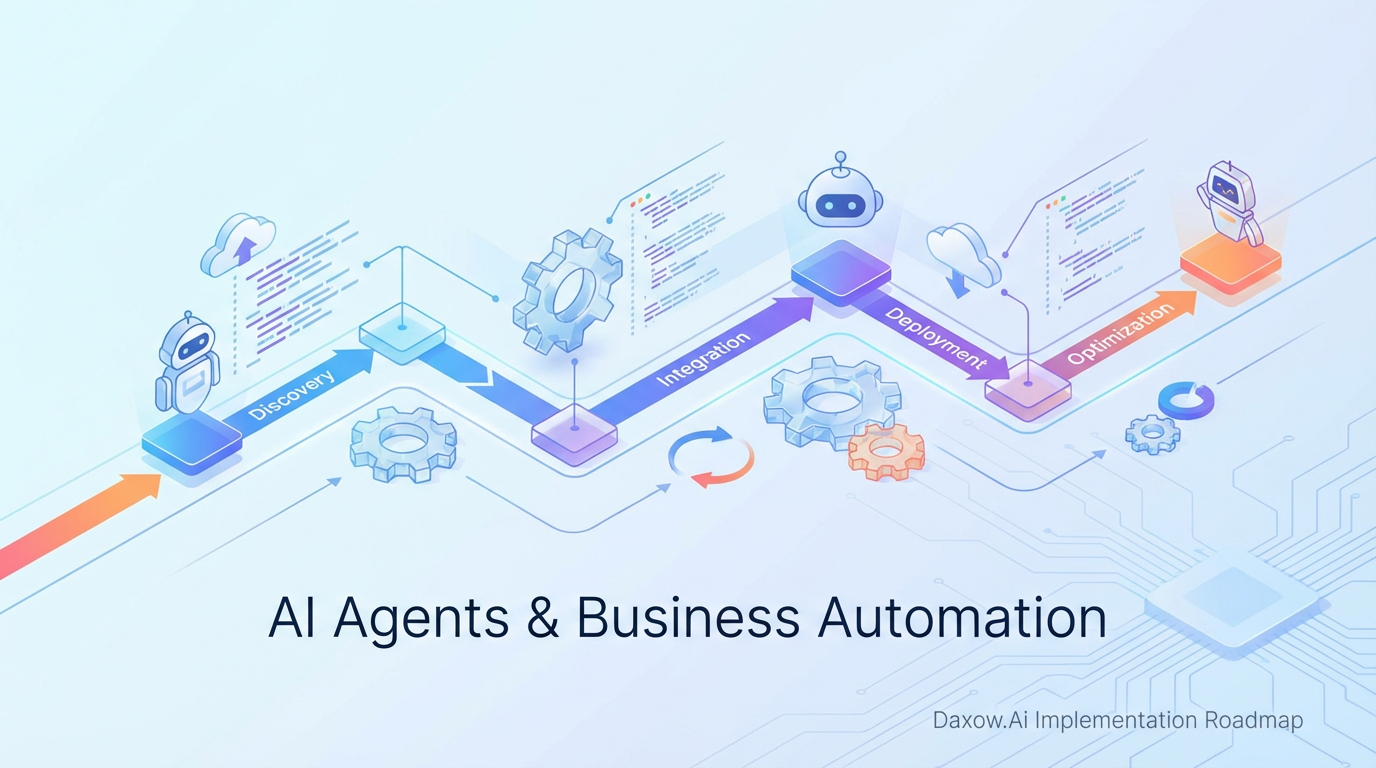
Practical guide on using AI agents and workflow automation to cut manual work, boost ROI, and scale operations — includes industry use cases and Daxow.ai roadmap.
AI Agents and Business Automation: How Intelligent Automation Transforms Modern Organizations
Estimated reading time: 15 minutes
Key Takeaways
- Intelligent automation integrates AI agents, workflow automation, and human-in-the-loop controls to improve business efficiency.
- Industry-specific use cases show measurable improvements in e-commerce, healthcare, finance, real estate, and HR sectors.
- A phased implementation roadmap ensures successful adoption from pilot to enterprise scale.
- Measuring ROI across efficiency, revenue, and compliance validates the business value of AI automation.
- Daxow.ai provides end-to-end AI automation solutions that prioritize security, compliance, and real-world impact.
Table of Contents
- Introduction
- AI Agents and Business Automation
- Practical Use Cases: AI Automation Across Industries
- How AI Agents Operate in Real Systems
- Implementation Roadmap: From Pilot to Enterprise Scale
- Measuring ROI and Business Value
- Integrations, Data, and Governance: The Operational Backbone
- How Daxow.ai Helps — End-to-End AI Automation
- Getting Started: A Recommended First Move
- Conclusion and Next Steps
- Frequently Asked Questions
Introduction
AI Agents and Business Automation: How Intelligent Automation Transforms Modern Organizations is not an abstract trend — it is a practical roadmap for companies that need to reduce manual tasks, boost productivity, and scale with fewer errors. Leaders across industries are deploying AI automation and workflow automation to shorten cycle times, improve customer experiences, and free teams to focus on strategic work. This article explains what intelligent automation looks like in practice, provides industry-specific use cases, offers an implementation roadmap, and shows how Daxow.ai designs and delivers custom AI systems that create measurable business value.
AI Agents and Business Automation: How Intelligent Automation Transforms Modern Organizations
What do we mean by intelligent automation? At its core, intelligent automation combines three capabilities:
- AI agents that understand context, make decisions, and take actions across systems.
- Workflow automation that orchestrates processes end-to-end with minimal human touch.
- Human-in-the-loop controls that maintain quality, compliance, and escalation paths.
The result is a digital workforce that handles repetitive tasks, enforces business rules consistently, and produces audit-ready logs. For decision-makers, that translates into faster operations, lower operational cost, and higher customer satisfaction.
Why this matters now
- Data and integrations are more attainable. Modern APIs and connectors make it possible to link CRM, ERP, ticketing, and legacy systems.
- LLMs and specialized models improved natural language understanding, enabling agents to interact with customers and staff conversationally.
- Business pressure to reduce costs and improve speed has made targeted automation a top priority for leaders.
Below, you’ll find a structured approach to adopting intelligent automation and practical examples that show how to deliver results.
Practical Use Cases: AI Automation Across Industries
E‑commerce (Sales automation and customer support automation)
- AI sales & support agents: 24/7 chat and email agents handle product questions, order status, returns, and size guidance. They escalate complex or high-value interactions to human agents.
- Personalized merchandising: Agents segment customers in real time and trigger targeted offers and dynamic recommendations.
- Lifecycle automation: Automated flows for abandoned carts, replenishment reminders, and VIP upsell sequences.
- Operations automation: Exception handling for address issues and payment failures; automated supplier coordination for restocking.
Business outcomes: higher conversion rates, increased average order value, lower cost per ticket, and improved retention.
Healthcare (Workflow automation and document automation)
- Patient-facing virtual assistants: Symptom triage, appointment scheduling, reminders, and pre-visit intake capture.
- Clinical documentation automation: Drafting clinical notes and discharge summaries for clinician review, reducing documentation time.
- Revenue cycle automation: Claims validation, pre-authorization routing, and automated appeals workflows.
Business outcomes: improved patient throughput, reduced clinician burnout, and more predictable revenue collection.
Finance and Insurance (Risk, compliance, and customer automation)
- Onboarding & KYC automation: Intelligent document extraction and risk scoring with human review for edge cases.
- Fraud detection agents: Continuous transaction monitoring and case creation for suspicious activity.
- Customer self-service agents: Guided loan or claim applications, dispute handling, and policy queries.
Business outcomes: faster onboarding, reduced fraud losses, and lower compliance overhead.
Real Estate (Lead qualification and transaction coordination)
- Instant lead response agents: Capture and qualify leads across portals, website, and social media; route to the right agent.
- Transaction orchestration: Automated document collection, status updates, and reminders across stakeholders.
- Property management automation: Maintenance triage and vendor coordination.
Business outcomes: higher lead conversion, more deals per agent, and reduced transaction friction.
HR & People Operations (Employee productivity and recruiting)
- Recruiting automation: Resume screening, scheduling, and candidate Q&A.
- Employee self-service: HR assistants for PTO, payroll, and policy questions; automated onboarding checklists.
- Engagement automation: Pulse surveys, sentiment analysis, and routed action plans.
Business outcomes: faster hiring cycles, lower HR ticket volume, and better employee experience.
How AI Agents Operate in Real Systems
AI agents act in three roles simultaneously:
- Orchestrators: Move data and tasks across CRM, ERP, helpdesk, and custom apps.
- Analysts: Interpret data, summarize documents, and generate recommendations.
- Operators: Execute actions — creating tickets, updating records, sending communications, and calling partner APIs.
Key capabilities to demand in any automation project:
- Natural language understanding to interact across channels.
- Tool use and integration to execute real tasks via APIs or RPA.
- Context retention for multi-step interactions.
- Policy and governance to enforce approvals and compliance controls.
These capabilities let automation drive end-to-end workflows that are measurable, auditable, and scalable.
Implementation Roadmap: From Pilot to Enterprise Scale
Step 1 — Align automation with business objectives
- Define 2–3 strategic outcomes (e.g., reduce support handling cost by 30%, halve onboarding time, increase conversion by 10%).
- Convert outcomes into KPIs: handle time, time-to-onboard, NPS, resolution rate.
- Daxow.ai role: Facilitate workshops to map objectives to measurable KPIs.
Step 2 — Identify and prioritize use cases
- Map current processes and identify high-volume, error-prone, and high-friction tasks.
- Score opportunities by impact, feasibility, and time-to-value.
- Best practice: Start with high-impact, low-complexity processes.
- Daxow.ai role: Deliver a prioritized backlog with estimated ROI for each use case.
Step 3 — Assess data and systems readiness
- Inventory systems: CRM, ERP, ticketing, HRIS, EMR, billing.
- Evaluate APIs, data quality, and compliance constraints (PII/PHI).
- Daxow.ai role: Build integration blueprints and data-mapping strategies to connect disparate systems.
Step 4 — Design AI agent workflows
- Define scope, boundaries, and escalation rules.
- Map input → decision → action → logging → human review.
- Daxow.ai role: Co-design workflows with stakeholders and build prototypes.
Step 5 — Choose technology and architecture
- Select the right AI models and orchestration layers.
- Choose direct APIs first; use RPA only where necessary.
- Implement security, role-based access, and audit logging.
- Daxow.ai role: Provide modular architecture designs that separate business logic, AI prompts/models, and integrations.
Step 6 — Pilot with human-in-the-loop
- Run pilots in shadow mode: agents draft responses; humans review.
- Measure accuracy, time saved, and failure cases.
- Daxow.ai role: Run pilots, refine models, and train staff on new workflows.
Step 7 — Gradual rollout and change management
- Expand channels and user groups as KPIs stabilize.
- Train teams on collaboration patterns with AI agents.
- Communicate changes to customers and staff.
- Daxow.ai role: Manage rollout, change communications, and internal training.
Step 8 — Continuous monitoring and optimization
- Track volumes handled by agents, satisfaction, error rates, and cost savings.
- Maintain feedback loops and productize automation for ongoing improvements.
- Daxow.ai role: Operate and optimize automation as a managed service, continuing to iterate on performance.
Measuring ROI and Business Value
To make the case for intelligent automation, quantify benefits across three dimensions.
- Efficiency and cost reduction
Measure manual hours replaced and time saved per process.
Target: 20–50% reduction in manual workload for focused processes. - Revenue and growth
Track conversion uplifts, customer retention improvements, and upsell performance.
Even modest percentage gains can compound into substantial revenue. - Risk and compliance
Monitor error rates, audit exceptions, and time to respond to compliance requests.
Automated logs and standardized workflows reduce regulatory exposure.
Illustrative example:
A mid-sized e‑commerce company automates order exception handling and support triage.
Outcome: 40% reduction in support volume, 25% faster order resolution, and a 15% lift in repeat purchases due to faster service.
ROI: Payback in under 6 months from reduced staffing costs and incremental revenue.
Integrations, Data, and Governance: The Operational Backbone
- Integration strategy: Use APIs for direct access, RPA for legacy screens, and message buses for high-scale architectures.
- Data strategy: Identify source-of-truth systems and normalize data for consistent decisioning.
- Governance: Implement role-based access, data masking, audit trails, and human approval gates for sensitive actions.
Daxow.ai builds these foundations so AI agents can execute real tasks reliably and compliantly across complex IT landscapes.
How Daxow.ai Helps — End-to-End AI Automation
- Discovery & process analysis: We map workflows, identify bottlenecks, and prioritize use cases tied to KPIs.
- Custom AI agents: We design agents that understand context, use your systems, and act with guardrails.
- Workflow automation: We implement orchestration layers that execute multi-step processes across tools.
- Customer support automation: We build chatbots and email agents that reduce handle time and improve CSAT.
- Sales automation: We automate lead qualification, follow-ups, and opportunity routing to increase conversion.
- Document automation & data extraction: We extract structured data from invoices, contracts, and forms to feed workflows.
- Integrations and systems connectivity: We stitch together CRM, ERP, ticketing, and legacy systems so automation can act end-to-end.
- Operational support & optimization: We monitor performance, tune models, and iterate on workflows to maximize ROI.
Across each stage, Daxow.ai emphasizes security, compliance, explainability, and human oversight to ensure automation is both effective and trustworthy.
Getting Started: A Recommended First Move
- A one-week process analysis to identify 3 high-impact use cases.
- A 6–8 week pilot to deploy a single AI agent in human-in-the-loop mode.
- Clear KPI targets and a roadmap for scale.
Daxow.ai can run this lifecycle end-to-end: discovery, build, pilot, and rollout — and provide ongoing managed services to keep your automation delivering value.
Conclusion and Next Steps
Intelligent automation—anchored by AI agents and workflow automation—turns manual, fragmented processes into reliable, measurable, and scalable systems. The result is reduced manual tasks, higher productivity, and faster business outcomes across customer support automation, sales automation, and back-office operations.
If you want to see how this applies to your business, take the next step:
- Book a free consultation with Daxow.ai.
- Request a process analysis tailored to your industry and priorities.
- Contact us to build a custom AI system that reduces operational costs and improves ROI.
Start with a short diagnostic and we’ll show the specific pathways to automation for your organization.
Frequently Asked Questions
What is intelligent automation?
Intelligent automation combines AI agents, workflow automation, and human-in-the-loop controls to automate complex business processes with minimal manual effort while ensuring quality and compliance.
How can AI agents improve customer support?
AI agents can handle routine inquiries 24/7, provide personalized assistance, escalate complex issues to humans, and automate follow-up workflows, leading to faster resolutions and improved satisfaction.
What industries benefit most from AI automation?
E-commerce, healthcare, finance, insurance, real estate, and HR are examples of industries where AI automation is delivering significant efficiency, compliance, and revenue benefits.
How does Daxow.ai support automation implementation?
Daxow.ai offers end-to-end services including process discovery, custom AI agent design, workflow automation, integrations, pilot programs, and ongoing operational support to maximize automation impact.