
AI Agents for Business Automation: Rapid ROI & Use Cases
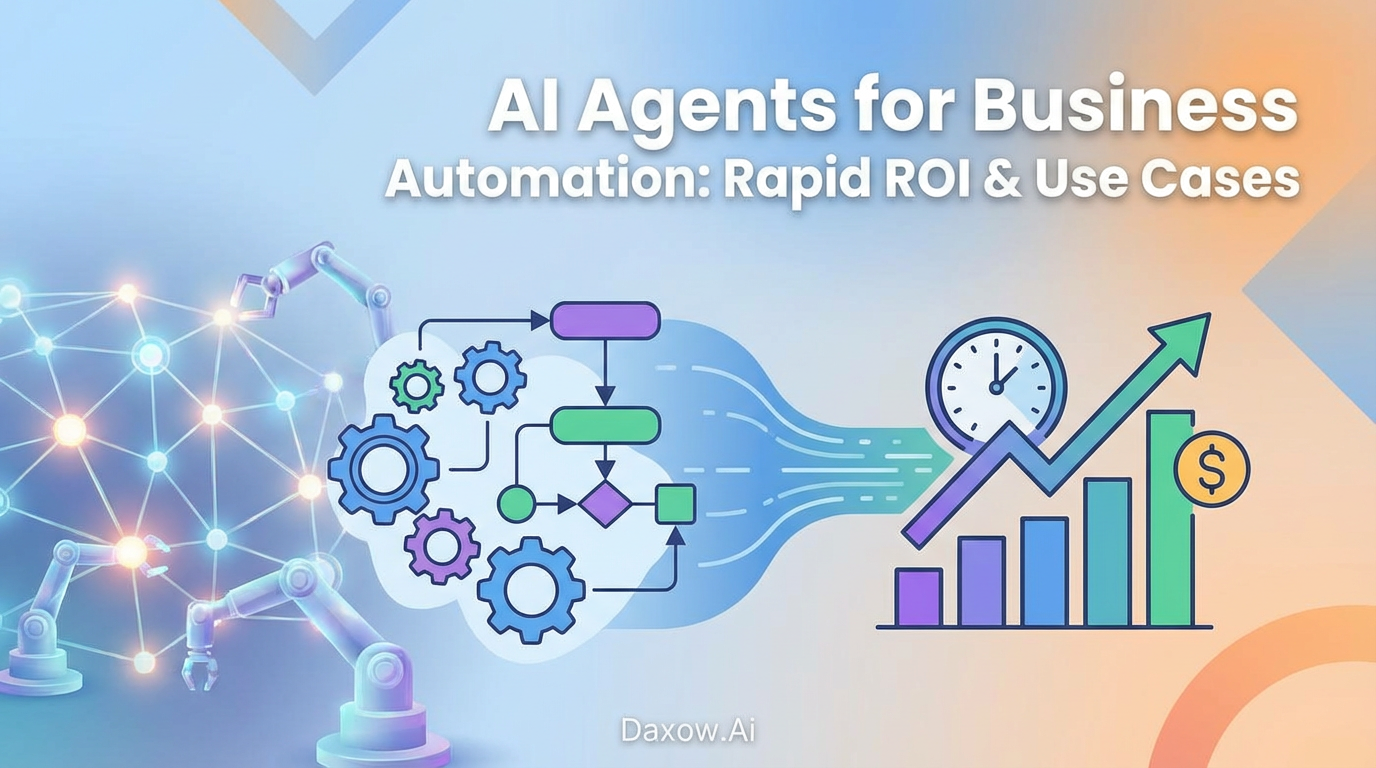
Explore how AI agents deliver 40-400% ROI and 40-65% faster cycle times across support, sales, finance and ops, with practical use cases and deployment steps.
AI Agents for Business Automation: How Autonomous Systems Deliver Rapid ROI
Estimated reading time: 12 minutes
Key Takeaways
- AI agents replace repetitive manual work with intelligent autonomous systems, driving 40–400% ROI and 40–65% faster cycle times.
- Unlike traditional automation, AI agents handle unstructured data, contextual decisions, learning, and multi-step workflows.
- Proven benefits span customer support, sales, finance, HR, real estate, and healthcare with measurable operational improvements.
- Integration with CRMs, ERPs, and business tools through secure connectors and orchestration layers is essential.
- Daxow.ai’s tailored approach includes discovery, prototyping, full implementation, and continuous improvement to scale AI agents successfully.
Table of Contents
- AI Agents for Business Automation — What they are and why they matter
- Proven ROI and Performance: Research Insights
- Practical Use Cases Across Industries
- How AI Agents Integrate with Workflow Automation and Business Systems
- Designing and Deploying AI Agents — Daxow.ai Approach
- Measuring Impact and Scaling Successful Deployments
- Risk Management and Best Practices
- Getting Started with AI Agents for Business Automation
- Frequently Asked Questions
AI Agents for Business Automation — What they are and why they matter
Definition and core capabilities
AI agents are autonomous software entities powered by modern large language models, task orchestration, and business logic. Unlike rule-based automation, AI agents can:
- Interpret unstructured data (emails, invoices, documents).
- Make contextual decisions across multiple systems.
- Learn from feedback and improve over time.
- Execute multi-step workflows end-to-end.
Why they outperform traditional automation
Traditional workflow automation is excellent for predictable, repeatable tasks. AI agents extend that by handling exceptions, understanding nuance, and orchestrating across heterogeneous systems. The result is reduced manual tasks, fewer handoffs, and improvements in accuracy and responsiveness—driving clear business automation value.
Proven ROI and Performance: Research Insights
Measured benefits
Recent industry research and deployments show consistent outcomes:
- ROI range: 40–400% depending on the process and scale.
- Cycle time reductions: 40–65% for multi-step processes with orchestration.
- Improved first-contact resolution in customer support.
- Increased lead-to-opportunity conversion via automated qualification.
These figures demonstrate that AI automation is not theoretical—it's delivering measurable financial and operational returns.
Where the value comes from
- Labor cost reduction by automating repetitive manual tasks.
- Faster throughput and reduced SLAs through workflow automation.
- Higher conversion rates from consistent, timely interactions.
- Better compliance and auditability from standardized AI-driven processes.
Practical Use Cases Across Industries
Customer Support Automation (SaaS, Telecom, E-commerce)
Use case:
- AI agents triage incoming support tickets, extract intent and key metadata, execute diagnostic tasks, and either resolve issues or escalate with a structured summary to a human agent.
Outcomes:
- 50–70% decrease in manual triage time.
- Higher customer satisfaction (NPS) from faster responses.
Daxow.ai role: Build customer support automation agents, integrate with CRMs and helpdesk tools, and implement human-in-loop escalation logic.
Sales Automation and Lead Qualification (B2B, Enterprise)
Use case:
- AI agents ingest leads from web forms, email, and events. They qualify leads based on custom scoring, enrich data via integrations, and route qualified prospects to sales reps with recommended next steps.
Outcomes:
- Higher conversion rates, shorter sales cycles, and more efficient use of sales capacity.
Daxow.ai role: Design lead qualification workflows, integrate with CRMs, and build outbound AI assistants to follow up on low-touch prospects.
Finance and Accounts Payable Automation (Corporate Finance, Healthcare)
Use case:
- AI agents extract invoice data, validate line items against purchase orders, route approvals, and initiate payments.
Outcomes:
- Reduced invoice processing time and exceptions, lower late-payment penalties, and audit-ready trails.
Daxow.ai role: Implement document automation, connector integrations with ERPs, and reconciliation agents to reduce manual accounting work.
HR and Employee Onboarding (Enterprises)
Use case:
- AI agents manage onboarding checklists, verify documents, trigger access provisioning, and answer employee FAQs.
Outcomes:
- Faster onboarding, better compliance, and reduced administrative load on HR teams.
Daxow.ai role: Map HR workflows, build secure integrations, and deliver employee-facing assistants for day-one support.
Real Estate and Property Management
Use case:
- AI agents screen rental applicants by aggregating credit reports, references, and employment data, then recommend approvals based on policy rules.
Outcomes:
- Faster decision-making and fewer manual checks.
Daxow.ai role: Automate data extraction from documents, integrate with property management systems, and enforce risk policies.
Healthcare Patient Triage and Documentation
Use case:
- AI agents pre-screen patient intake forms, summarize symptoms for clinicians, and automate administrative documentation.
Outcomes:
- Reduced clinician administrative time and faster triage for urgent cases.
Daxow.ai role: Ensure PHI-safe integrations, automate documentation flows, and implement compliant escalation paths.
How AI Agents Integrate with Workflow Automation and Business Systems
Architectural principles
- Data connectivity: Secure connectors to CRMs, ERPs, ticketing systems, and document stores.
- Orchestration layer: Central workflow engine to sequence tasks, handle retries, and manage approvals.
- AI/ML layer: LLMs and specialized models for extraction, classification, and decisioning.
- Human-in-loop: Interfaces and guardrails for oversight and exception handling.
- Monitoring and observability: Metrics, logs, and dashboards for performance and compliance.
Typical integration points
- CRMs (lead enrichment, task creation).
- Helpdesk platforms (ticket triage, suggested responses).
- ERPs and accounting systems (invoice posting, reconciliation).
- Document repositories (contract extraction, version control).
Daxow.ai provides the full stack: connectors, orchestration, and secure model hosting—ensuring AI agents execute real tasks across your stack.
Designing and Deploying AI Agents — Daxow.ai Approach
1. Discovery and process mapping
We begin with a focused process analysis to identify high-impact automation candidates. Deliverables:
- Process maps showing manual steps and exceptions.
- Time and cost baseline.
- ROI projections.
2. Prototype and rapid validation
We build a minimal viable AI agent for the highest-value use case to validate performance with real data. This includes:
- Data ingestion pipelines.
- Model selection and fine-tuning.
- Integration with one or two target systems.
Validation metrics include accuracy, time-per-task, and user feedback.
3. Full implementation and integration
- Connect to enterprise systems (CRMs, ERPs).
- Add orchestration for multi-step workflows.
- Implement security, role-based access, and audit trails.
4. Monitoring, continuous improvement, and governance
- SLA monitoring.
- Bias and safety checks.
- Version control and rollback procedures.
5. Scaling across the organization
We prioritize adjacent processes to multiply value, building a roadmap to scale AI agents across departments while maintaining consistency and compliance.
Measuring Impact and Scaling Successful Deployments
Key performance indicators (KPIs)
- Reduction in manual tasks (hours saved per week).
- Cycle time improvements (days to completion).
- Error rate and exception reduction.
- Increase in conversion or resolution rates.
- Cost savings and ROI.
Example metrics from typical deployments
- Support triage: 60% fewer manual triage hours; average response time cut in half.
- AP automation: 70% reduction in manual invoice processing; 30% fewer payment exceptions.
- Sales qualification: 25–40% lift in qualified leads passed to sales.
Risk Management and Best Practices
Operational risks and mitigation
- Implement human-in-loop for high-risk decisions.
- Use strict access controls and data encryption.
- Conduct phased rollouts and regular audits.
Model and data governance
- Log agent decisions and rationales for auditability.
- Maintain datasets for retraining and bias detection.
- Establish escalation paths and SLA-based fallbacks.
Getting Started with AI Agents for Business Automation
Quick checklist to assess readiness
- Do you have repetitive, rule-based or semi-structured processes?
- Are there high-volume touchpoints where response time matters?
- Do you have central systems (CRM, ERP, support desk) to connect?
- Can you provide a small dataset for prototyping?
If you answered yes to two or more, you’re ready to explore AI agents.
How Daxow.ai can help
Daxow.ai offers end-to-end services to design, build, and scale AI automation:
- Process analysis and ROI modelling to prioritize initiatives.
- Custom AI agent development that executes real tasks, not just suggestions.
- Workflow automation and orchestration to manage complex multi-step processes.
- System integrations and data connectivity with enterprise-grade security.
- Ongoing monitoring and continuous improvement to maximize productivity gains.
Frequently Asked Questions
What distinguishes AI agents from traditional automation tools?
AI agents leverage advanced AI models to understand unstructured data, make contextual decisions, learn over time, and manage complex multi-step workflows, whereas traditional automation typically follows fixed rules and handles predictable tasks.
How quickly can businesses expect ROI from AI agent deployments?
Depending on the process and scale, businesses have observed ROI ranging from 40% up to 400%, often within months due to faster cycle times and reduced manual intervention.
Can AI agents integrate with existing business tools?
Yes, AI agents integrate securely with CRMs, ERPs, helpdesk, and document repositories, enabling seamless workflow orchestration across systems.
What industries benefit most from AI agents for automation?
Industries such as SaaS, telecom, e-commerce, corporate finance, healthcare, HR, real estate, and property management see significant impact through tailored AI automation.