
AI Agents for Business Operations: ROI-Driven Automation
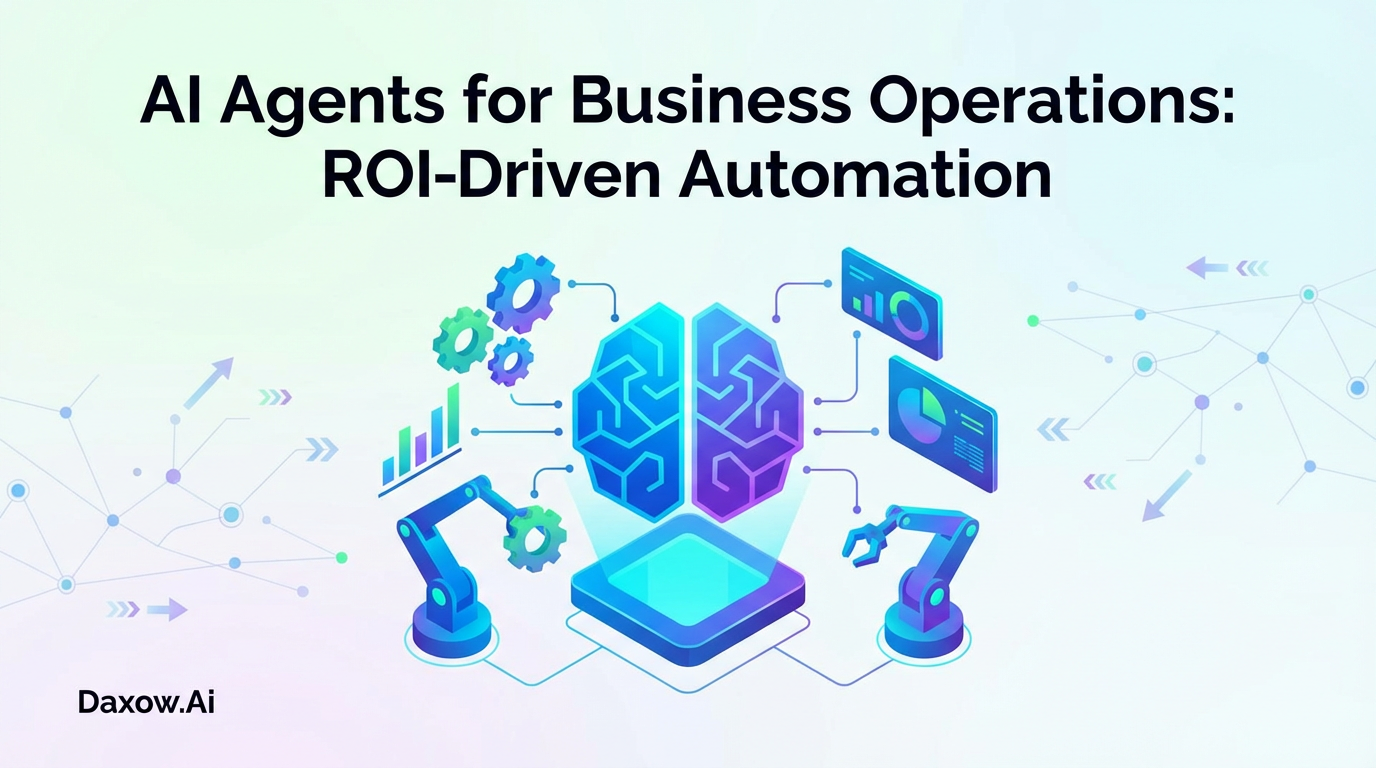
Explore how AI agents and workflow automation streamline operations, reduce manual work, and deliver measurable ROI across sales, support, finance, and HR.
AI Agents for Business Operations: How AI Automation and Workflow Automation Transform Companies
Estimated reading time: 15 minutes
Key Takeaways
- AI agents reduce manual tasks and boost productivity across multiple business functions.
- Combining AI agents with workflow automation enables scalable, end-to-end process improvements.
- Effective integration with CRM, ERP, HRIS, and support systems is vital for delivering real value.
- Measurable ROI is achieved through cost reduction, faster processing, and improved customer and employee satisfaction.
- Responsible deployment requires governance, risk management, and continuous monitoring.
- Daxow.ai partners with organizations to design, build, and operate custom AI systems tailored to business needs.
Table of Contents
- AI agents for business operations — what they are and why they matter
- How AI automation and workflow automation integrate with AI agents
- Practical use cases — AI agents across industries
- Implementation roadmap — from discovery to production
- Measuring ROI — metrics that matter
- Risk management and governance
- How Daxow.ai builds AI agents that execute real tasks
- Organizational readiness and change management
- Next steps — starting your AI agent journey with Daxow.ai
- Frequently Asked Questions
AI agents for business operations — what they are and why they matter
AI agents are software systems that perceive data, make decisions, and execute tasks autonomously or semi-autonomously. When combined with workflow automation, integrations, and data pipelines, AI agents become powerful engines that reduce manual work and streamline end-to-end processes.
Why they matter now
- Scale manual processes: AI agents can handle repetitive tasks at volumes humans cannot sustain, from document extraction to support triage.
- Increase speed and accuracy: Automated decision-making reduces human latency and error for routine operations.
- Free up human capital: Teams focus on strategic, creative, and complex work once repetitive tasks are automated.
- Improve customer experience: Faster response times and consistent answers increase satisfaction and conversion rates.
- Enable continuous improvement: Agents generate operational telemetry that informs process optimization and model retraining.
Key capabilities of AI agents in business automation
- Natural language understanding for customer and employee interactions.
- Document and data extraction for processing invoices, contracts, and claims.
- Process orchestration that triggers actions across CRM, ERP, ticketing, and scheduling systems.
- Decision logic that follows business rules, risk thresholds, and escalation paths.
- Learning and adaptation from feedback loops and monitored outcomes.
How AI automation and workflow automation integrate with AI agents
Deploying AI agents effectively means embedding them into workflows and systems so they can execute real tasks reliably.
Architecture overview
- Data ingestion: Connectors ingest structured and unstructured data from CRMs, email, chat, forms, and documents.
- Processing layer: NLP, computer vision, and extraction models transform raw inputs into structured outputs.
- Orchestration and workflow layer: Automation engines apply business rules and route tasks across systems.
- Execution layer: Agents trigger updates in CRMs, send messages, create tickets, or call APIs.
- Monitoring and feedback: Telemetry, human-in-the-loop interfaces, and retraining pipelines maintain model performance.
Integration and data connectivity
AI agents require robust integrations to deliver value:
- CRM and sales tools: for lead qualification and activity automation.
- Ticketing and support systems: for triage and resolution.
- Document repositories and ERP: for invoices, contracts, and claims processing.
- HRIS and payroll: for onboarding, time-off, and benefits automation.
Daxow.ai builds secure connectors and data mappings that preserve context and maintain data quality. We prioritize clean, governed data and modular integrations to limit disruption to legacy systems.
Practical use cases — AI agents across industries
Customer support automation (SaaS and e-commerce)
Use case: An AI agent triages incoming support tickets, responds to common inquiries, and escalates complex cases to the correct team.
Components:
- NLU for intent classification and entity extraction.
- Knowledge base retrieval and generative response where appropriate.
- Integration with helpdesk and CRM to update ticket status and customer records.
Benefits:
- Reduce average handle time by 30–60%.
- Increase first-contact resolution.
- Lower cost per ticket through automation and deflection.
Sales automation and lead qualification (B2B and startups)
Use case: AI agents qualify inbound leads, enrich profiles, and schedule discovery calls with appropriate reps.
Components:
- Lead scoring model based on behavior and firmographic data.
- Data enrichment connectors (firmographic, intent signals).
- Calendar and CRM integrations to create tasks and book meetings.
Benefits:
- Improve conversion from lead-to-opportunity.
- Reduce SDR workload and cost per qualified lead.
- Shorten sales cycle with faster outreach.
Finance — invoice processing and reconciliation (enterprise)
Use case: Extract line items from invoices, match to purchase orders, and route exceptions for human review.
Components:
- Document OCR and extraction models.
- Rule-based matching and anomaly detection.
- ERP and AP system integrations for posting payments.
Benefits:
- Reduce manual processing time by 70–90%.
- Accelerate days payable processing and capture early-payment discounts.
- Lower error rates in GL entries.
Real estate — tenant onboarding and lease management
Use case: Automate tenant screening, document validation, and lease renewals.
Components:
- Identity and document verification models.
- Contract extraction and clause tracking.
- Automated reminders and payment scheduling integrations.
Benefits:
- Faster move-ins and improved occupancy.
- Reduced administrative overhead for property managers.
- Better compliance through tracked lease terms.
Healthcare — referral coordination and prior authorization
Use case: AI agents extract clinical data, validate insurance coverage, and initiate prior authorization workflows.
Components:
- Clinical NLP and medical code extraction.
- EHR integration and secure messaging.
- Escalation workflows to specialists and payers.
Benefits:
- Reduced time to authorization.
- Lower administrative costs and fewer denials.
- Improved patient experience through faster care coordination.
HR and operations — employee onboarding and admin requests
Use case: Manage onboarding checklists, document collection, and benefits enrollment.
Components:
- Form automation and e-signature integration.
- Task orchestration and HRIS updates.
- Chatbot for employee queries and case creation.
Benefits:
- Faster ramp for new hires.
- Reduced HR manual work and better audit trails.
- Higher employee satisfaction with self-service automation.
Implementation roadmap — from discovery to production
A pragmatic, phased approach reduces risk and ensures measurable ROI.
Phase 1 — Process discovery and prioritization
- Map current workflows and measure manual effort and cycle times.
- Identify high-impact processes with repetitive tasks and structured data.
- Calculate baseline metrics to measure improvement.
Phase 2 — Prototype and pilot
- Build a minimal viable AI agent focused on a narrow scope.
- Deploy in a controlled environment with human-in-the-loop oversight.
- Collect quantitative and qualitative feedback to refine models and rules.
Phase 3 — Scale and integrate
- Harden integrations and security.
- Automate monitoring, alerting, and retraining pipelines.
- Expand to adjacent processes based on pilot outcomes.
Phase 4 — Continuous improvement
- Use telemetry to measure throughput, error rates, and business KPIs.
- Implement A/B testing for decision logic and response content.
- Maintain governance, compliance, and human oversight policies.
Daxow.ai offers an end-to-end delivery model covering discovery, prototyping, integration, and long-term operation. Our teams collaborate with stakeholders to ensure alignment with ROI targets and compliance requirements.
Measuring ROI — metrics that matter
When evaluating AI automation projects, focus on business KPIs that link automation to financial outcomes.
Primary metrics
- Cost reduction: labor hours replaced multiplied by fully loaded labor rate.
- Process speed: reduction in cycle time and time-to-resolution.
- Throughput: increased transactions or tickets handled per period.
- Accuracy and quality: error reduction, compliance improvements, fewer rework instances.
Secondary metrics
- Customer satisfaction (CSAT / NPS improvements).
- Conversion rate increases in sales workflows.
- Employee satisfaction and retention improvements.
- Revenue impact from faster sales cycles or reduced churn.
Example ROI calculation
A support center processes 10,000 tickets/month at $6 average cost/ticket = $60,000/month. AI agent automates 40% of tickets, reducing cost per ticket to $1 for automated cases. Monthly savings = (4,000 * $5) = $20,000 — plus improved CSAT and reduced backlog. With implementation costs amortized over 12–24 months, payback periods are often under 12 months for mid-sized operations.
Risk management and governance
AI agents must be deployed with safeguards to mitigate operational and reputational risks.
Key risk areas
- Data privacy and security when handling PII or PHI.
- Compliance with industry regulations and audit requirements.
- Model drift and performance degradation over time.
- Bias in decision-making or inconsistent customer experiences.
Mitigations
- Implement role-based access, encryption, and secure connectors.
- Maintain transparent audit logs and human-in-the-loop approvals for high-risk decisions.
- Set up automated monitoring and retraining pipelines.
- Use explainable models and bias testing during development.
Daxow.ai builds governance frameworks alongside automation projects. We work with legal, compliance, and security teams to embed policies and ensure traceability of agent actions.
How Daxow.ai builds AI agents that execute real tasks
Discovery and process analysis
- Deep-dive workshops to map workflows and surface automation opportunities.
- Quantitative baselining to prioritize initiatives by ROI and feasibility.
Custom solution design
- Architect modular AI agents with clear interfaces to business systems.
- Combine pre-trained models, bespoke ML components, and rule engines where needed.
Integration and delivery
- Build secure connectors to CRM, ERP, ticketing, and document stores.
- Implement orchestration layers that chain agent actions into end-to-end workflows.
Long-term operations
- Provide monitoring, incident management, and model maintenance.
- Deliver continuous improvement services that expand automation scope based on observed gains.
Practical example: lead qualification automation by Daxow.ai
- Outcome: a B2B client reduced SDR screening time by 60% and increased qualified meetings by 40%.
- How: an AI agent scored leads, enriched profiles, generated personalized outreach drafts, and booked meetings via calendar APIs. Human review was maintained for high-value leads only.
Learn more about our custom AI automation services and how Daxow.ai can tailor solutions to your business needs.
Organizational readiness and change management
Stakeholder engagement
- Include business owners, IT, compliance, and end-users early.
- Use pilot success stories to build internal advocacy.
Skills and training
- Upskill staff to supervise AI agents and manage exceptions.
- Create clear operating procedures for agents and escalation paths.
Cultural adoption
- Position automation as a way to augment roles, not eliminate them.
- Communicate results transparently and quantify benefits to teams.
Next steps — starting your AI agent journey with Daxow.ai
- Request a process analysis to identify the highest-impact automation opportunities.
- Pilot a targeted AI agent for a single, measurable process to validate assumptions.
- Scale iteratively with robust integrations, governance, and performance monitoring.
Daxow.ai helps companies across industries design and deploy AI agents, integrate them with business tools, and operate them for sustained ROI. We offer tailored engagements from discovery workshops to full end-to-end automation programs.
Explore our partnership approach to building AI-driven business automation that delivers measurable results.
Conclusion
AI agents for business operations are no longer theoretical — they are practical tools that eliminate manual tasks, boost productivity, and create better customer and employee experiences. With the right strategy, governance, and integrations, organizations can realize rapid ROI and build scalable automation that drives growth.
Book a free consultation with Daxow.ai to request a process analysis for your company and start building custom AI systems that reduce manual tasks, automate workflows, and improve productivity. Contact us to build an AI agent that executes real business tasks and delivers measurable results.
Frequently Asked Questions
What types of business processes are best suited for AI agents?
Processes with repetitive, rule-based, or data-intensive tasks such as customer support, sales lead qualification, invoice processing, and employee onboarding are ideal candidates for AI agents and workflow automation.
How does Daxow.ai ensure data privacy and security in AI automation?
We implement role-based access control, encryption, secure data connectors, and comply with industry regulations to protect sensitive data, including PII and PHI, throughout the AI agent lifecycle.
Can AI agents integrate with existing enterprise systems?
Yes, Daxow.ai specializes in building modular, secure connectors and data mappings to integrate AI agents seamlessly with CRM, ERP, HRIS, ticketing, and document management systems with minimal disruption.
What is the typical ROI timeframe for deploying AI agents?
Many mid-sized organizations see payback periods under 12 months, driven by substantial labor cost reductions, faster processing times, and improved customer and employee satisfaction.