
AI Agents for Business Process Automation: Practical Roadmap
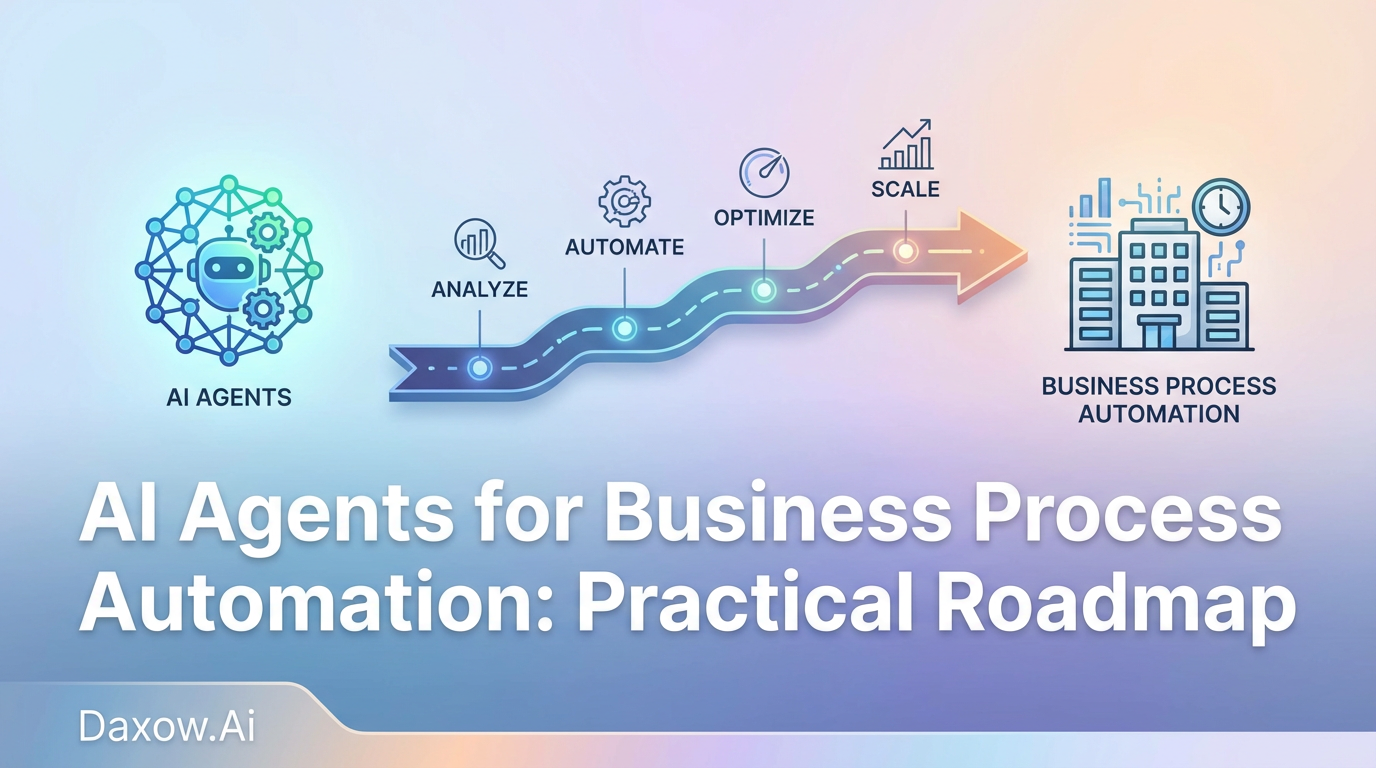
Practical guide to deploying AI agents for business process automation: use cases, implementation roadmap, ROI metrics, and governance with Daxow.ai.
AI agents for business process automation — Practical strategies to reduce manual tasks and boost productivity
Estimated reading time: 12 minutes
Key Takeaways
- AI agents transform business process automation by reducing manual effort and accelerating workflows.
- They combine language understanding, decision automation, and system orchestration beyond traditional RPA capabilities.
- Industry-specific use cases include customer support, sales, finance, HR, healthcare, and real estate.
- Implementing AI agents requires careful process discovery, PoC validation, system integration, and governance.
- Tracking ROI involves measuring time saved, cost reduction, accuracy, customer satisfaction, and compliance.
- Daxow.ai offers tailored AI agent solutions integrating with existing systems for measurable business impact.
Table of Contents
- What are AI agents for business process automation?
- Why adopt AI agents in your AI automation and workflow automation strategy?
- Industry use cases — How AI agents reduce manual tasks and deliver ROI
- How to implement AI agents for business process automation — A clear, actionable roadmap
- Measuring ROI — Metrics that matter
- Technical architecture patterns for AI agents and workflow automation
- Risks, mitigation, and governance
- How Daxow.ai builds AI agents that execute real tasks — Our end-to-end approach
- Practical checklist for decision-makers
- Frequently Asked Questions
What are AI agents for business process automation?
AI agents are software systems that perceive inputs (documents, messages, APIs), reason using models and rules, and take actions—often autonomously—across digital workflows. When applied to business process automation, AI agents can:
- Automate decision points that previously required human review.
- Extract and normalize data from documents and unstructured text.
- Trigger and orchestrate workflows across CRMs, ERPs, ticketing systems, and communication channels.
- Interact with customers and employees through chatbots and virtual assistants.
AI agents differ from traditional RPA by combining language understanding, structured data extraction, and task execution logic—enabling more complex, context-aware automation.
Why adopt AI agents in your AI automation and workflow automation strategy?
Adopting AI agents unlocks measurable business value across dimensions that matter to executives:
- Reduce manual tasks: Automate routine reviews, data entry, and triage to free staff for higher-value work.
- Improve productivity: Shorten cycle times with parallelized, always-on agents that process tasks faster than humans.
- Enhance customer experience: Resolve inquiries faster with intelligent routing and automated responses.
- Lower operational costs: Replace repetitive FTE effort with predictable automation and fewer errors.
- Scale without linear headcount growth: Agents handle increased volume without proportional increases in staffing.
Key capabilities to look for
When planning AI agent deployments, ensure solutions include:
- Natural Language Understanding (NLU) for text and speech.
- Document AI / OCR for structured and unstructured documents.
- Process orchestration to sequence tasks and integrate systems.
- API-first integrations for CRMs, ERPs, ticketing, and databases.
- Auditability and governance for traceability and compliance.
- Human-in-the-loop workflows for exceptions and continuous improvement.
Industry use cases — How AI agents reduce manual tasks and deliver ROI
Customer support automation
Problem: High ticket volumes, slow resolution, inconsistent responses.
AI agent solution:
- Automated ticket triage and categorization.
- Suggested responses and knowledge-base retrieval.
- Automated follow-ups and SLA monitoring.
Business impact:
- 30–60% reduction in average handling time.
- Faster first-response times and higher CSAT.
How Daxow.ai helps: Build custom customer support automation that integrates with your helpdesk, implements escalation rules, and trains agents on company knowledge. See our customer support automation services.
Sales automation and lead qualification
Problem: Sales reps spend too much time qualifying poor-fit leads.
AI agent solution:
- Real-time lead scoring via CRM enrichment and intent analysis.
- Automated outreach sequences and meeting scheduling.
Business impact:
- Higher qualified lead conversion rates and reduced time-to-contact.
- Reps focus on closing rather than qualifying.
How Daxow.ai helps: Implement sales automation that connects to your CRM, marketing platforms, and calendars—automating outreach while providing audit trails. Explore our sales automation expertise.
Finance and accounting — Invoice processing
Problem: Manual invoice data entry, exceptions, and delayed approvals.
AI agent solution:
- Document extraction and data validation.
- Automated coding, matching, and routing for approvals.
- Exception detection and human-in-the-loop resolution.
Business impact:
- 60–80% reduction in invoice processing time
- Fewer payment delays and early-payment discounts captured.
How Daxow.ai helps: Design end-to-end invoice automation with integrations to ERP and banking systems, and implement controls for audit and compliance.
HR and employee onboarding
Problem: Repetitive onboarding steps and inconsistent data capture.
AI agent solution:
- Automated form completion, background checks, account provisioning.
- Chatbot for new-hire FAQs and scheduling.
Business impact:
- Faster ramp-up and improved onboarding experience.
- Reduced HR administrative burden.
How Daxow.ai helps: Automate onboarding workflows with HRIS and identity management integrations to provision accounts and track completion.
Healthcare — Claims and prior authorizations
Problem: Complex documentation and lengthy approval cycles.
AI agent solution:
- Clinical document understanding and rule-based eligibility checks.
- Automated routing to appropriate reviewers and payors.
Business impact:
- Reduced claim adjudication time and fewer denials.
- Better resource allocation to exceptional cases.
How Daxow.ai helps: Build compliant AI agents that handle PHI securely, integrate with EHRs, and include auditable decision logs.
Real estate and property management
Problem: High administrative load processing listings, leases, and tenant inquiries.
AI agent solution:
- Automated listing ingestion and data normalization.
- Rent payment reconciliation and tenant support automation.
Business impact:
- Faster listing turnarounds and lower delinquency rates.
How Daxow.ai helps: Deliver tailored automation that connects MLS systems, payment platforms, and tenant portals.
How to implement AI agents for business process automation — A clear, actionable roadmap
1. Process discovery and opportunity assessment
- Map current workflows and measure time, cost, and error rates.
- Identify high-volume, repetitive tasks and decision points.
- Prioritize automation opportunities by ROI and technical feasibility.
Deliverable: Process catalogue with prioritized automation targets.
2. Proof-of-concept (PoC) and data readiness
- Select a single high-impact workflow for a PoC.
- Assess data quality, labeling needs, and sources.
- Build minimal viable agent to demonstrate value within weeks.
Deliverable: Working PoC with measurable KPIs.
3. Model and agent design
- Define agent responsibilities: perception, reasoning, action.
- Choose model architecture for NLU, extraction, and decision logic.
- Design orchestration and exception-handling policies.
Deliverable: Agent architecture diagram and integration plan.
4. Integration and systems connectivity
- Integrate agents via APIs to CRMs, ERPs, ticketing, and databases.
- Implement secure authentication and data pipelines.
- Ensure real-time or near-real-time processing where required.
Deliverable: Connected automation that works within existing IT landscape.
5. Governance, compliance, and human-in-the-loop
- Implement role-based access, change controls, and audit logs.
- Define SLA thresholds and escalation paths.
- Provide human review interfaces for exceptions and continuous learning.
Deliverable: Governance framework and review dashboards.
6. Rollout, monitoring, and continuous improvement
- Gradually increase automation scope while monitoring KPIs.
- Use feedback to retrain models and refine rules.
- Track performance metrics tied to cost savings and customer metrics.
Deliverable: Production agent with governance and a CI pipeline for updates.
Measuring ROI — Metrics that matter
To justify investment, track a mix of operational and business metrics:
- Time saved (hours/FTE): Measure task completion time reductions.
- Cost reduction: FTE cost savings and lower error-related costs.
- Throughput: Number of cases processed per period.
- Accuracy/Error rate: Data extraction accuracy and exception rate.
- Customer metrics: CSAT, NPS, average response/resolution time.
- Revenue impact: Conversion rate uplift for sales automation or faster billing cycles.
- Compliance metrics: Audit coverage and error-related compliance incidents.
Use baseline measurements during discovery to quantify improvements and create a business case. Typical quick wins show payback periods under 12 months when prioritized correctly.
Technical architecture patterns for AI agents and workflow automation
Event-driven orchestration
- Agents respond to events (new ticket, uploaded invoice).
- Orchestrator coordinates tasks, retries, and human handoffs.
Microservices + API gateway
- Each agent capability (NLU, extraction, routing) is a microservice.
- API gateway enables secure, centralized access.
Hybrid human-AI loop
- Agents handle routine cases.
- Humans receive prioritized exceptions via a review interface.
- Continuous learning pipeline ingests corrections.
Secure data pipelines
- Data ingestion with encryption at rest and in transit.
- Role-based access control and auditable logs.
- Data retention policies for compliance.
Risks, mitigation, and governance
AI agents introduce operational and regulatory risks that must be managed:
- Data privacy and compliance: Implement privacy-by-design and secure integrations.
- Model drift and performance degradation: Monitor, retrain, and maintain validation pipelines.
- Overautomation: Maintain human oversight for ambiguous decisions.
- Change management: Communicate with stakeholders and retrain staff to work with agents.
Daxow.ai incorporates governance controls, monitoring dashboards, and human-in-the-loop design to mitigate these risks.
How Daxow.ai builds AI agents that execute real tasks — Our end-to-end approach
As an AI automation agency founded in Estonia in 2024, Daxow.ai focuses on practical, measurable automation for businesses:
- Process discovery: We map workflows and quantify manual effort to identify highest-value automation opportunities.
- Custom AI design: We design agents tailored to business rules, data sources, and KPIs—combining NLU, document AI, and orchestration.
- Systems integration: We connect agents to CRMs, ERPs, ticketing platforms, and databases for frictionless automation.
- Implementation and governance: We deploy agents with audit trails, role-based controls, and human-in-the-loop workflows.
- Operational support: We monitor performance, retrain models, and continuously improve agents to maximize ROI.
We focus on results: reducing operational costs, increasing productivity, and delivering measurable improvements to customer experience.
Practical checklist for decision-makers
- Do you have mapped processes and baseline metrics?
- Are there high-volume manual tasks consuming FTE time?
- Is the necessary data accessible and of acceptable quality?
- Can you define clear KPIs for automation success?
- Do you have internal stakeholders ready to participate in a PoC?
- Do your systems support API integrations or data exports?
If you answered yes to several items, you are ready to move from assessment to a PoC.
Frequently Asked Questions
What distinguishes AI agents from traditional RPA?
AI agents integrate language understanding, data extraction, and decision-making logic, enabling more context-aware and complex automation beyond rule-based process automation typical of RPA.
How quickly can businesses expect ROI from AI agent implementations?
Typical payback periods are under 12 months when automation opportunities are well-prioritized and implementations follow a focused roadmap including proofs-of-concept and continuous improvement.
Can AI agents integrate with existing enterprise systems?
Yes, AI agents can connect via APIs to CRMs, ERPs, ticketing platforms, databases, and communication channels, ensuring seamless workflow orchestration within your IT landscape.
How does human-in-the-loop improve AI agent deployments?
Human-in-the-loop workflows handle exceptions, ensure quality control, provide feedback for model improvement, and mitigate risks linked to overautomation or ambiguous cases.
Conclusion and call to action
AI agents for business process automation are a strategic lever for reducing manual tasks, improving productivity, and scaling operations without linear headcount growth. With careful process discovery, targeted PoCs, robust integrations, and governance, organizations can realize rapid ROI and transform customer and employee experiences.
To see how AI agents can work in your organization, request a process analysis for your company or book a free consultation with Daxow.ai. Our team will map your workflows, identify high-impact automation opportunities, and design a tailored implementation plan to deploy AI agents that execute real tasks and deliver measurable value. Contact us today to get started.