
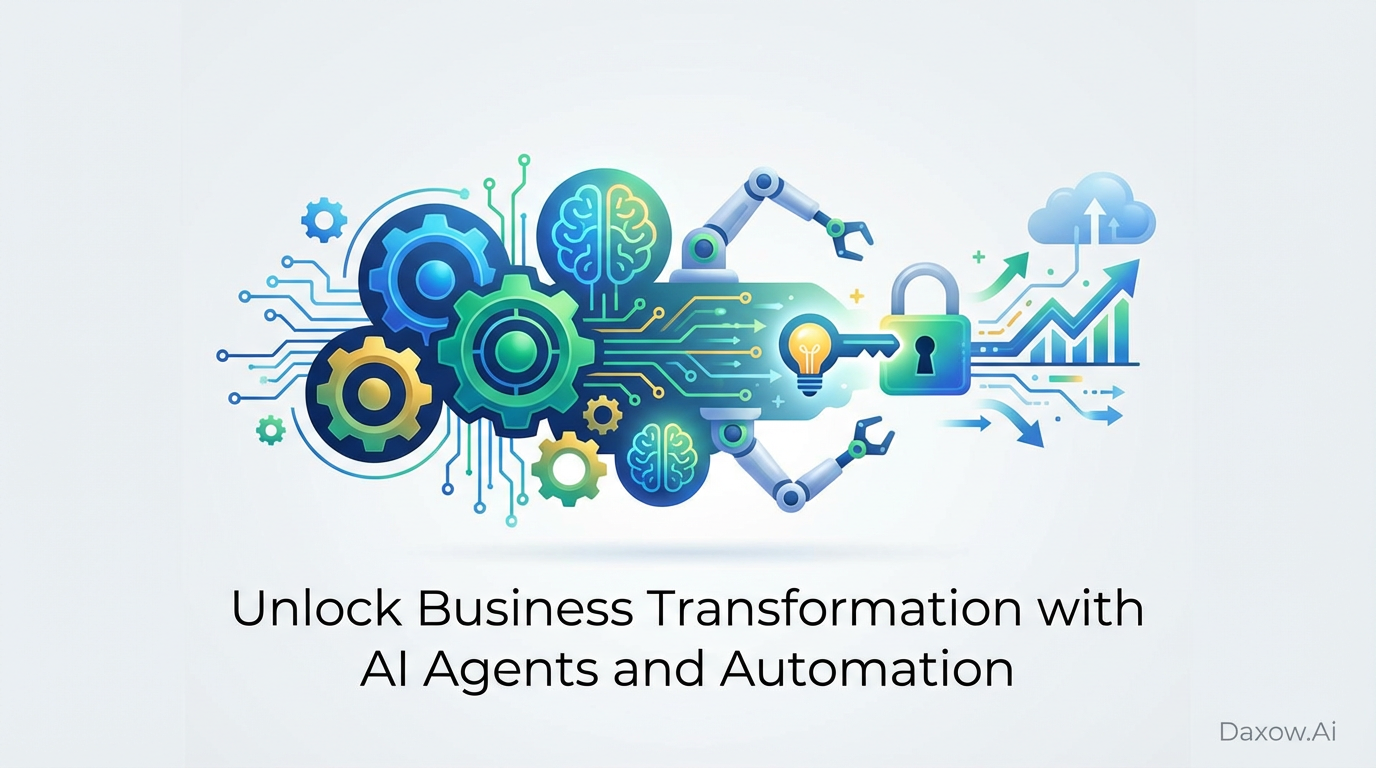
Unlock Business Transformation with AI Agents and Automation
Use AI agents to automate workflows, cut costs, and achieve fast ROI across support, finance, HR and healthcare. Daxow.ai designs and deploys custom solutions.
Unlocking Business Transformation with AI Agents and Automation
Estimated reading time: 15 minutes
Key Takeaways
- AI agents automate entire business processes, enabling faster decision-making and reducing repetitive work.
- Unlike traditional automation, AI agents adapt to ambiguous data and user intent for higher efficacy.
- Industry use cases span e-commerce, healthcare, finance, real estate, HR, and customer support.
- ROI typically occurs within 3–6 months, with up to 300% average annual returns and substantial cost savings.
- Daxow.ai provides end-to-end design, integration, and deployment of custom AI automation solutions.
Table of Contents
- Unlocking Business Transformation with AI Agents and Automation
- What AI Agents Are — and How They Differ from Traditional Automation
- Strategic Implications for Businesses
- Practical Use Cases Across Industries
- Implementation Roadmap — From Assessment to Scale
- Best Practices and Risk Controls
- Measuring ROI and Tangible Business Value
- How Daxow.ai Designs and Delivers Custom AI Automation
- Practical Next Steps for Leaders
- Frequently Asked Questions
Unlocking Business Transformation with AI Agents and Automation
AI agents enable companies to automate entire processes — not just isolated steps — by integrating with CRMs, ERPs, ticketing systems, and knowledge bases to observe context, decide, and act. The result is measurable efficiency: organizations report accelerated decision-making, dramatic reductions in repetitive work, and rapid ROI. Executives in multiple studies see payback in months and productivity doubling for a significant portion of adopters.
What AI Agents Are — and How They Differ from Traditional Automation
Definition and capabilities
- AI agents are autonomous systems that perceive an environment, reason over inputs, and execute multi-step tasks.
- Unlike traditional automation (scripts, RPA) that follow fixed rules, AI agents adapt to incomplete data and ambiguous user intent.
- They can perform actions such as routing tickets, approving invoices, qualifying leads, generating forecasts, and executing transactions.
Core business advantages
- End-to-end automation: Execute full processes from trigger to closure.
- Decision quality: Improve accuracy in forecasting, triage, and fraud detection.
- Continuous learning: Optimize over time as models learn from outcomes.
- System integration: Connect to CRMs, finance tools, and knowledge bases for real-time context.
Strategic Implications for Businesses
Adopting AI agents is a strategic move that shifts resources from repetitive tasks to high-value work. Key implications include:
- Operational efficiency: Automate over 40% of repetitive tasks and reduce time-to-resolution from days to minutes.
- Fast ROI: Many companies report ROI within the first year; typical payback is 3–6 months.
- Cost and error reduction: Expect up to 70% lower cost per task and 60–85% fewer errors in automated processes.
- Scalable productivity: Organizations deploying agents enterprise-wide report doubling of productivity in about 39% of cases.
Practical Use Cases Across Industries
E-commerce — Intelligent configuration, pricing, and lead qualification
- Use case: Dynamic pricing agent that ingests inventory, competitor pricing, and demand signals to adjust prices and push personalized offers.
- Business impact: 25–50% reduction in inventory write-offs, higher conversion through personalized outreach, and automated lead qualification for inbound shoppers.
- How Daxow helps: Build integrations with e-commerce platforms and CRMs, design pricing models, and deploy agents that execute pricing changes and email/SMS outreach.
Healthcare — Symptom triage and claims automation
- Use case: Symptom-checker agent routes patients to appropriate clinicians, books appointments, and pre-fills intake forms.
- Business impact: Handles hundreds of thousands of interactions, reduces clinical admin load by 40–60% in claims processing, and improves response accuracy.
- How Daxow helps: Ensure secure data handling, integrate with EMRs, design triage decision trees, and implement human-in-the-loop escalation for complex cases.
Finance — Automated analyst for fraud detection and forecasting
- Use case: Continuous monitoring agent flags anomalous transactions, creates risk scores, and initiates investigation workflows.
- Business impact: 85% fewer data entry errors, 60% faster decision cycles, and significant reduction in fraud false positives.
- How Daxow helps: Connect to existing finance systems, build explainable models for compliance, and automate case creation and reporting.
Real Estate & Facilities — Predictive maintenance and portfolio optimization
- Use case: Agent simulates supply disruptions, prioritizes maintenance tickets, and re-routes listings based on demand forecasts.
- Business impact: 35–60% faster incident resolution, reduced vacancy and maintenance costs, and better demand matching.
- How Daxow helps: Integrate sensor and facility management data, build forecasting agents, and automate vendor assignment and SLA tracking.
HR — Intelligent recruiting and employee support
- Use case: Recruitment agent screens resumes, schedules interviews, and serves as an onboarding assistant answering common questions.
- Business impact: 30–70% reduction in recruiting overhead and automation of thousands of monthly employee queries without added headcount.
- How Daxow helps: Automate HR workflows, secure PII, integrate with HRIS systems, and deliver conversational agents for employee self-service.
Customer Support & Sales — 24/7 automation that closes tasks
- Use case: Customer support agent resolves Tier-1 tickets, issues refunds, and escalates complex cases to SMEs with context.
- Business impact: Many telecom and enterprise examples show handling up to 80% of queries automatically, increasing customer satisfaction and lowering support costs.
- Sales application: Lead enrichment and qualification agents update pipelines and forecast with higher precision, delivering 25–47% productivity gains for sales teams.
- How Daxow helps: Design orchestration that combines chatbots, CRM updates, and automated workflows, while maintaining human oversight.
Implementation Roadmap — From Assessment to Scale
1. Assess and Prioritize
- Identify high-volume repetitive workflows with measurable KPIs: time saved, error rates, and cost per transaction.
- Prioritize processes offering the most significant time and cost savings (e.g., support tickets, invoice approvals, lead qualification).
- Daxow role: Conduct process audits and baseline measurements to identify automation candidates.
2. Choose Tools and Architecture
- Select frameworks and platforms based on integration needs and scale (agent frameworks, model orchestration, secure connectors).
- Evaluate vendor and custom options for reliability and governance.
- Daxow role: Recommend architectures, select proven platforms, and map integrations to existing tech stacks.
3. Data Preparation and Governance
- Clean and unify multi-source data (CRM, finance, product, logs).
- Apply compliance controls and role-based access to sensitive information.
- Daxow role: Execute ETL pipelines, secure data flows, and implement metadata and monitoring for continuous data quality.
4. Pilot with Clear Success Metrics
- Start small (Tier-1 support, a single sales region, or one HR process).
- Set adoption and performance targets (e.g., 85% automation rate for Tier-1 tickets).
- Daxow role: Rapid prototyping, A/B testing, and measuring impact against KPIs.
5. Scale and Optimize
- Expand agents across departments after validating benefits.
- Monitor metrics like resolution time, decision precision, customer satisfaction, and cost per task.
- Daxow role: Orchestrate enterprise rollout, refine models, and implement monitoring dashboards for ongoing improvement.
Best Practices and Risk Controls
- Ground agents in verified knowledge bases to reduce hallucinations.
- Human-in-the-loop for ambiguous or high-risk decisions.
- Security and compliance by design, especially in regulated industries.
- Integrated logging and audit trails for traceability.
- Continuous monitoring and retraining to maintain performance.
Daxow ensures these controls are embedded across design, deployment, and operations.
Measuring ROI and Tangible Business Value
AI automation produces measurable financial and operational gains:
- Average ROI: Industry findings report up to 300% average ROI in year one.
- Payback: Many organizations recover costs within 3–6 months.
- Cost and error reductions: Expect 70% lower cost per task and 60–85% reduction in errors in automated processes.
- Productivity gains: Some deployers doubled productivity; finance teams report more accurate decisions and higher compliance.
Example KPIs to track:
- Time-to-resolution (support, maintenance)
- Cost per transaction (invoices, claims)
- Conversion lift (sales automation)
- Employee time reallocated to strategic work
- Customer satisfaction and NPS changes
Daxow helps define KPI frameworks, build dashboards, and demonstrate ROI through pilot-to-scale measurement plans.
How Daxow.ai Designs and Delivers Custom AI Automation
Discovery and Process Mapping
- We map current workflows, measure baseline performance, and prioritize automation opportunities.
- Outputs: prioritized roadmap, estimated ROI, and integration plan.
Custom AI Agent Design
- We design agent behavior, decision logic, and escalation policies tailored to your data, systems, and compliance needs.
- We embed human-in-the-loop checkpoints and guardrails to ensure reliability.
Integration and Data Connectivity
- We integrate with CRMs, ERPs, HRIS, ticketing systems, and custom databases.
- We implement secure data pipelines and real-time connectors for reliable automation.
Build, Test, and Deploy
- Rapid pilots validate hypotheses and deliver measurable benefits.
- We iterate on models and workflows to reach production-grade automation.
Operations, Monitoring, and Continuous Improvement
- We provide monitoring dashboards, retraining schedules, and incident management.
- Our model governance ensures explainability, audit logs, and compliance adherence.
Business Outcomes
- Reduced operational costs, faster cycle times, and improved customer and employee experience.
- Scalable automation that yields long-term competitive advantages, not just short-term hour savings.
Practical Next Steps for Leaders
- Run a 4–6 week process audit to identify three high-impact workflows.
- Sponsor a cross-functional pilot with measurable KPIs and executive oversight.
- Ensure data readiness and compliance support before starting model training.
- Plan for change management: communicate benefits and reskilling plans to teams.
Frequently Asked Questions
What distinguishes AI agents from traditional automation tools?
AI agents are autonomous and adaptive systems that perceive their environment, reason over inputs, and execute complex, multi-step tasks. Traditional automation tools follow fixed rules and scripts, lacking the ability to handle ambiguity or unstructured data.
How quickly can companies expect ROI from AI automation?
Many organizations realize ROI within 3 to 6 months, with industry averages showing up to 300% ROI in the first year, driven by reduced costs, error mitigation, and productivity gains.
Are AI automation solutions secure and compliant?
Yes, security and compliance are integral to AI automation design, especially in regulated industries. Solutions include role-based access, human-in-the-loop oversight, audit logs, and ongoing monitoring to meet industry standards.
How does Daxow.ai support ongoing improvements in AI automation?
Daxow.ai provides monitoring dashboards, retraining workflows, and incident management services ensuring continuous performance optimization and compliance adherence after deployment.