
AI Agents for Business Workflow Automation: Boost Productivity
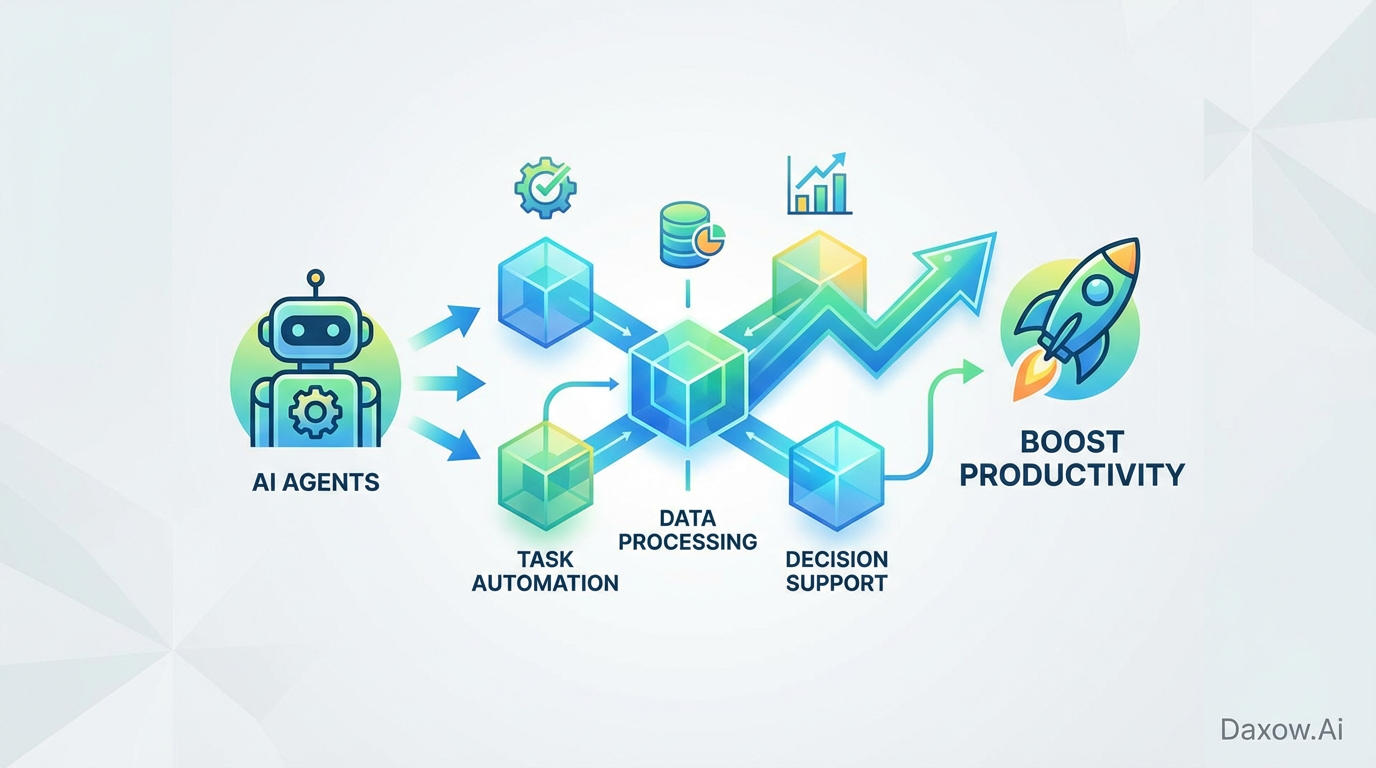
AI agents automate workflows to reduce manual tasks, boost productivity, and cut costs. Includes industry use cases, ROI metrics, and an implementation roadmap.
AI Agents for Business Workflow Automation: How to Reduce Manual Tasks and Boost Productivity
Estimated reading time: 15 minutes
Key Takeaways
- AI agents automate complex business workflows by integrating with systems and using advanced models.
- They reduce manual tasks, increase productivity, and cut operational costs across multiple industries.
- Successful implementation follows a roadmap from discovery and data readiness to governance and scaling.
- Tracking KPIs like automation rate and time saved ensures measurable ROI and continuous improvement.
- Daxow.ai specializes in designing custom AI agents tailored to your business processes and integration needs.
Table of Contents
- Introduction
- What are AI Agents for Business Workflow Automation?
- Why This Matters Now
- Benefits of AI Agents for Workflow Automation
- AI Agents for Business Workflow Automation — Practical Use Cases
- Architecture and Integration Patterns for AI Agents
- How to Implement AI Agents for Business Workflow Automation
- KPIs and Metrics to Evaluate AI Automation Success
- Addressing Challenges in Deploying AI Agents
- Daxow.ai — From Process Analysis to Production AI Agents
- Quick Wins to Test AI Agents
- Conclusion and Next Steps
- Frequently Asked Questions
Introduction
AI agents for business workflow automation are transforming how companies operate by automating routine decisions, routing work, extracting structured data from documents, and executing multi-step processes across systems. For business owners and operations leaders, the core value is simple: reduce manual tasks, improve productivity, and unlock measurable cost savings. This article explains what AI agents for business workflow automation are, shows practical use cases across industries, provides an implementation roadmap, and explains how Daxow.ai designs and delivers custom AI systems that integrate with your tools and drive ROI.
What are AI Agents for Business Workflow Automation?
AI agents are software entities that combine large language models (LLMs), task orchestration, connectors to business systems, and business rules to perform real-world tasks end-to-end. When applied to workflow automation, these agents can:
- Read and interpret unstructured inputs (emails, chat, documents).
- Take context-aware actions (update CRM, create tickets, route approvals).
- Interact with other systems via APIs, RPA, or native integrations.
- Learn from human feedback and improve over time.
The result is business automation that handles complex sequences rather than only single-step automations, enabling faster throughput and fewer human handoffs.
Why This Matters Now
Advances in LLMs, agents frameworks, and integration platforms have made it feasible to deploy reliable, auditable AI systems. Decision-makers face growing pressure to reduce operating costs, accelerate response times, and scale service without linear headcount growth. AI automation and AI agents deliver a competitive advantage by converting manual, repetitive work into measurable productivity gains.
Benefits of AI Agents for Workflow Automation
- Reduce manual tasks: Automate routine triage, data entry, and follow-ups so staff focus on higher-value work.
- Increase productivity: Faster processing times and simultaneous multi-tasking across agents.
- Improve customer experience: Faster response times, 24/7 handling, and consistent answers through customer support automation.
- Cut operational costs: Reallocate FTEs, reduce error rates, and shorten cycle times.
- Integrate systems: Connect CRM, ERP, ticketing, and document stores for seamless end-to-end flows.
- Scale sales and support: Automate lead qualification and sales automation to increase pipeline efficiency.
AI Agents for Business Workflow Automation — Practical Use Cases
E-commerce
- Order exception handling: Agents monitor orders, detect exceptions (stockouts, payment failures), notify customers, and create fulfillment tasks. Result: faster resolution and fewer manual escalations.
- Product content enrichment: Agents extract attributes from supplier documents and update catalog entries automatically, reducing time-to-market for new SKUs.
- Customer support automation: Agents handle common post-purchase inquiries, escalate complex cases to human agents with curated context, and update CRM history.
Finance and Accounting
- Invoice processing and AP automation: Agents extract invoice data, validate against purchase orders, route for approvals, and post to accounting systems. This reduces manual data entry and lowers DSO.
- KYC and onboarding: For financial services, agents consolidate customer documents, extract identity information, and flag inconsistencies for compliance review.
Healthcare
- Referral and prior authorization workflows: Agents collect required documents, validate completeness, and submit authorization requests to payers, reducing administrative burden on clinical staff.
- Patient intake automation: Agents pre-fill intake forms, schedule appointments, and triage inquiries, improving patient throughput and satisfaction.
Real Estate and Property Management
- Tenant onboarding and lease abstraction: Agents extract lease clauses, populate property management systems, and schedule necessary inspections or renewals.
- Maintenance request triage: Agents categorize requests, assess urgency, and dispatch vendors based on contract rules.
HR and Administrative Operations
- Candidate screening and scheduling: Agents pre-screen resumes, score candidates against job criteria, and coordinate interviews with hiring managers.
- Policy exception workflows: Agents handle routine HR requests (leave approvals, expense validation) with audit trails and escalations.
Sales and Marketing
- Lead qualification and routing: Agents enrich inbound leads with firmographic data, qualify according to scoring rules, and create tasks in CRM for account executives.
- Campaign automation: Agents personalize outreach, track responses, and trigger follow-ups based on buyer behavior.
Architecture and Integration Patterns for AI Agents
A robust AI agent solution typically includes the following components:
- Input layer: Email, chat, forms, scanned documents, webhooks.
- Understanding layer: LLMs, OCR, NER, and retrieval-augmented generation (RAG) to extract and verify information.
- Orchestration engine: Rules engine and workflow automation that sequences tasks, handles retries, and manages approvals.
- Action layer: Connectors and APIs to CRM, ERP, ticketing systems, payment gateways, and RPA for legacy systems.
- Monitoring and observability: Logging, traceability, and dashboards for performance and compliance.
- Human-in-the-loop interfaces: Review queues and override controls to manage edge cases and provide training signals.
Key Integration Considerations
- Use secure API connectors and scoped service accounts for system access.
- Adopt a RAG approach for knowledge-based tasks to minimize hallucinations.
- Implement audit trails for compliance and to measure decision accuracy.
- Design for idempotency and transaction safety when agents modify source systems.
How to Implement AI Agents for Business Workflow Automation
1. Discovery and Process Mapping
- Map current workflows, identify manual handoffs, and quantify volume and cycle times.
- Prioritize processes using impact vs. complexity: start with high-volume, rule-heavy tasks.
- Daxow.ai performs a process analysis to surface automation candidates and expected ROI.
2. Data Readiness and Connectivity
- Assess data quality and access: document repositories, CRM fields, ticket histories.
- Build integrations with standard connectors and secure API access.
- When needed, implement extraction tools (OCR/IDP) for document-heavy processes.
3. Design and Prototype (Pilot)
- Define agent responsibilities and success criteria (KPIs).
- Develop a narrow pilot that automates a slice of the workflow end-to-end.
- Use human-in-the-loop controls to validate agent decisions and collect feedback.
4. Model Tuning and Prompt Engineering
- Fine-tune prompts and models for domain-specific language and compliance.
- Implement retrieval systems with vetted documents and knowledge bases to reduce hallucinations.
5. Integration and Orchestration
- Connect agents to production systems, ensuring transactional safety.
- Implement escalation paths and error handling.
6. Monitoring, Governance, and Scaling
- Track KPIs (see next section), set alerting thresholds, and maintain an audit log.
- Iterate on coverage, expand use cases, and scale agents across departments.
- Daxow.ai offers end-to-end deployment support, including SRE, security reviews, and ongoing optimization.
KPIs and Metrics to Evaluate AI Automation Success
To demonstrate business value, track metrics before and after deployment:
- Time saved per transaction: Reduction in average handling time.
- Automation rate: Percentage of cases fully handled by agents without human intervention.
- Reduction in manual tasks/FTEs: Hours reallocated from repetitive work.
- First response and resolution times: Especially for customer support automation.
- Conversion uplift: For sales automation and lead qualification.
- Error rate and rework: Reduction in data entry errors and exception handling.
- Cost per transaction: Lower operational cost after automation.
- Customer satisfaction (CSAT/NPS): Improvements resulting from faster service.
Example ROI Scenario
A mid-sized support organization handles 100,000 tickets annually. Automating first-level triage and templated responses with AI agents can plausibly increase automation rate to 40–60%, reduce average handling time by 30–50%, and free support staff to manage complex inquiries—resulting in significant cost avoidance and faster SLAs. Daxow.ai quantifies these gains during the discovery phase and models the expected payback period.
Addressing Challenges in Deploying AI Agents
- Data quality and access: Bad inputs lead to poor outcomes. Mitigation: data cleaning, validation rules, and human review loops.
- Model hallucinations and safety: Mitigation: RAG, constrained action sets, deterministic business rules, and approval gates.
- Security and compliance: Mitigation: encryption, least-privilege access, and audit trails.
- Change management: Staff may resist automation. Mitigation: communicate ROI, retrain staff, and involve users early.
- Integration complexity: Legacy systems can be brittle. Mitigation: phased integrations, RPA where APIs lack coverage, and thorough testing.
Daxow.ai — From Process Analysis to Production AI Agents
Daxow.ai combines domain expertise, engineering, and systems integration to build custom AI agents that execute real tasks and deliver measurable outcomes.
What We Do:
- Process discovery and ROI modeling: We map your workflows and identify high-impact automation opportunities.
- Custom AI agent development: We design agents that use LLMs, RAG, and rule-based logic to handle decision-making and actions.
- End-to-end integration: We connect agents to CRMs, ERPs, ticketing systems, and document stores for uninterrupted automation.
- Workflow automation and orchestration: We implement orchestration layers that sequence tasks, manage exceptions, and maintain audit trails.
- Compliance and security: We ensure solutions meet regulatory and internal governance requirements.
- Ongoing optimization and support: Continuous monitoring, retraining, and performance tuning to maximize ROI.
Operational Examples of Daxow.ai Engagements
- A fintech firm automated its KYC triage and document validation pipeline, reducing manual review time and accelerating customer onboarding.
- An e-commerce operator implemented agents to handle returns and refunds end-to-end, improving refund turnaround and reducing disputes.
- A property management company automated lease abstraction and maintenance triage, reducing administrative backlog and improving tenant satisfaction.
Quick Wins to Test AI Agents
- Automate inbound lead enrichment and routing for sales.
- Build a support triage agent that suggests responses and auto-tags tickets.
- Create an invoice ingestion pilot that extracts line items and routes for approval.
Start small, measure outcomes, and scale what works. Daxow.ai helps define pilots with clear KPIs and rapid timelines to demonstrate value quickly.
Conclusion and Next Steps
AI agents for business workflow automation are no longer a theoretical advantage — they are practical, deliverable, and essential for companies that want to scale without proportionate headcount increases. By focusing on high-volume, rules-based processes and combining LLMs with robust integrations and governance, organizations can significantly reduce manual tasks, improve productivity, and increase customer satisfaction.
Book a free consultation with Daxow.ai to request a process analysis for your company and explore a custom AI system that automates the workflows most critical to your business. Contact us to build AI agents that execute real tasks, integrate with your systems, and deliver measurable ROI.
Frequently Asked Questions
What types of workflows are best suited for AI agents?
Workflows that are high-volume, rule-based, and involve multi-system interactions are ideal candidates for AI agents. Processes with manual handoffs and structured decisions benefit most.
How do AI agents handle errors or exceptions?
AI agents are designed with escalation paths and human-in-the-loop controls to manage exceptions. They log errors and can route cases requiring manual intervention while learning from feedback to improve.
Are AI agents secure and compliant with regulations?
Yes, they leverage encryption, least-privilege access, audit trails, and governance frameworks to maintain security and compliance with industry standards and regulations.
How does Daxow.ai support ongoing optimization of AI agents?
Daxow.ai provides continuous monitoring, retraining, performance tuning, and security reviews to ensure AI agents adapt to changing business needs and maintain high ROI.