
AI Agents for Business Workflows: How Automation Transforms Operations
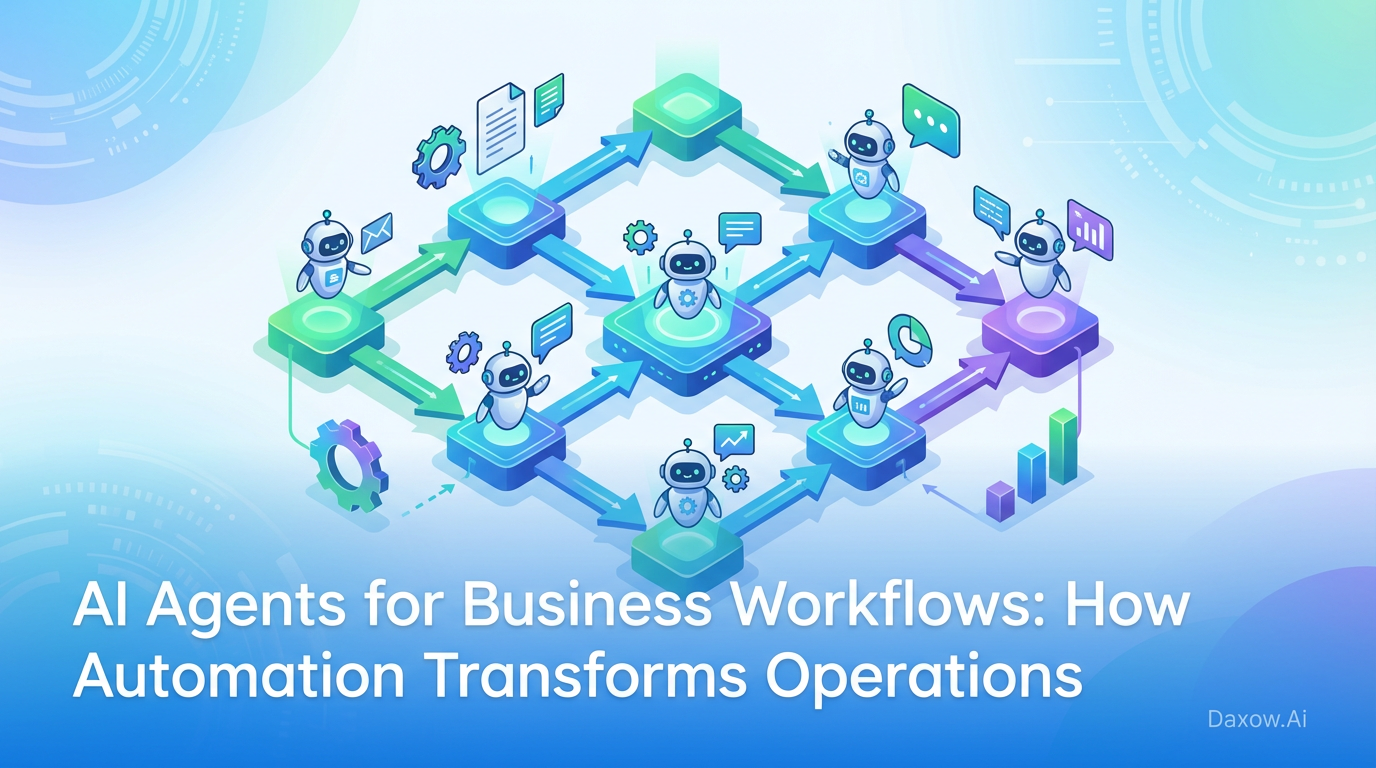
Learn how AI agents and workflow automation cut manual work, integrate systems, and boost productivity. Use cases, playbook, KPIs and a practical 90-day plan.
AI Agents for Business Workflows: How AI Automation Transforms Operations
Estimated reading time: 15 minutes
Key Takeaways
- AI agents enable businesses to automate routine and complex workflows, improving productivity and customer experience.
- Integration and governance are essential for sustained AI automation success.
- Real-world use cases span customer support, sales, document processing, HR, e-commerce, insurance, and real estate.
- Daxow.ai offers end-to-end AI agent design, integration, deployment, and monitoring services.
- A phased, collaborative approach maximizes ROI and minimizes risks in AI workflow automation projects.
Table of Contents
- AI Agents for Business Workflows — Why Now?
- Research Insights — What Leaders Are Learning About AI Automation
- How AI Agents and Workflow Automation Create Business Value
- Practical Use Cases and Industry Examples
- Designing AI Agents for Workflow Automation — A Practical Playbook
- Technical Considerations and Common Integrations
- Measuring Success — KPIs and ROI
- Risks, Challenges, and Mitigations
- How Daxow.ai Builds and Operationalizes AI Agents
- Getting Started — A Practical First 90 Days
- Frequently Asked Questions
AI Agents for Business Workflows — Why Now?
Adoption of AI automation and AI agents has accelerated because businesses need to do more with fewer resources, deliver faster customer responses, and extract value from growing volumes of data. AI agents are software entities that sense information, decide, and act autonomously or semi-autonomously: they can route leads, extract data from documents, triage support tickets, schedule follow-ups, and trigger multi-system workflows without human intervention.
Key drivers today:
- Increasing expectation for instant, personalized customer experiences.
- Pressure to reduce operational costs and cut manual, repetitive work.
- Availability of robust APIs, cloud compute, and pre-trained models that make integrations feasible.
- Demand for scalable automation that integrates with CRMs, ERPs, and collaboration tools.
Research Insights — What Leaders Are Learning About AI Automation
Automation delivers highest ROI on repetitive, rule-based tasks
Organizations report the fastest return on investment when automations target high-volume, repetitive tasks that require deterministic rules plus some natural language understanding — examples include invoice processing, lead qualification, and first-line support.
AI agents extend automation beyond scripts
Unlike traditional RPA, AI agents combine rules, ML models, LLM reasoning, and connectors to take multi-step actions across systems. This enables end-to-end process automation rather than narrow UI-level scripting.
Integration and data connectivity are the bottlenecks
Most projects succeed when teams prioritize integrations to CRMs, databases, and document repositories. Data accessibility, quality, and schema stability strongly influence project timelines.
Governance and monitoring determine long-term value
Automation without continuous monitoring leads to drift, errors, and user mistrust. Successful programs implement model governance, performance monitoring, and feedback loops.
Cross-functional collaboration accelerates adoption
Programs with close partnerships between operations, IT, and business units outperform siloed efforts. Change management and clear KPI alignment are critical.
How AI Agents and Workflow Automation Create Business Value
AI agents deliver tangible value across four main dimensions:
- Reduce manual tasks: Automate repetitive operations such as data entry, document triage, and routine communications.
- Improve productivity: Allow knowledge workers to focus on value-added tasks like strategy and complex problem solving.
- Enhance customer experience: Provide rapid, consistent responses and personalized journeys at scale.
- Lower operational cost and increase throughput: Process more volume with fewer errors and lower marginal cost per transaction.
Practical Use Cases and Industry Examples
Customer Support Automation (All industries)
- Challenge: High ticket volumes, long response times, repetitive queries.
- Solution: AI agent that classifies tickets, provides instant answers via chatbot, escalates complex issues, and updates CRM records.
- Benefits: Faster SLA compliance, reduced human workload, improved CSAT.
- Integrations: Support platforms, CRMs, knowledge bases, email systems.
Sales Automation and Lead Qualification (Technology, B2B SaaS)
- Challenge: Overwhelmed sales teams and slow lead follow-up.
- Solution: AI agent that scores leads from web forms and events, enriches contact records, assigns reps, and schedules follow-ups.
- Benefits: Higher conversion rates, faster response times, efficient quota attainment.
- Integrations: Marketing automation, CRM, calendar, enrichment services.
Intelligent Document Processing (Finance, Healthcare, Real Estate)
- Challenge: Manual extraction of data from invoices, contracts, and medical records.
- Solution: AI agents that perform OCR, extract structured fields, validate against rules, and push to accounting/EMR systems.
- Benefits: Faster processing, fewer errors, lower processing cost.
- Integrations: Document repositories, accounting systems, clinical systems.
HR Onboarding Automation (Enterprises)
- Challenge: Time-consuming onboarding with many manual steps and approvals.
- Solution: AI agent orchestrates offer acceptance, background checks, provisioning of systems, and orientation scheduling.
- Benefits: Reduced time-to-productivity, consistent compliance, improved new-hire experience.
- Integrations: HRIS, identity management, payroll, calendar.
E-commerce Order Management (Retail)
- Challenge: Order exceptions, fraud checks, return processing.
- Solution: AI agent flags risky orders, automates returns approvals, and communicates status to customers.
- Benefits: Lower fraud losses, reduced manual review, improved CX.
- Integrations: E-commerce platform, payment gateway, fulfillment systems.
Claims Triage and Processing (Insurance)
- Challenge: High-volume claims with variable documentation and response time pressure.
- Solution: AI agent extracts claim details, estimates preliminary liability, assigns adjusters, and triggers payments.
- Benefits: Faster settlements, fraud detection, staff efficiency.
- Integrations: Claims systems, payment processors, third-party data sources.
Real Estate Lead Nurturing (Real Estate)
- Challenge: Many inbound inquiries with low manual follow-up rates.
- Solution: AI agent qualifies prospects, schedules viewings, and sends tailored property lists.
- Benefits: Improved lead-to-appointment ratios, higher agent productivity.
- Integrations: CRM, property listings database, calendar.
Designing AI Agents for Workflow Automation — A Practical Playbook
1. Process Discovery and Value Mapping
Start by mapping current workflows and identifying high-frequency, high-effort tasks. Quantify volume, time per task, error rates, and cost to find high-ROI candidates.
- Deliverables: Process maps, KPI baselines, prioritized automation backlog.
2. Data and Systems Assessment
Audit data sources, APIs, and document formats. Evaluate data quality, access controls, and integration complexity.
- Deliverables: Integration plan, data transformation specifications.
3. Prototype and Proof of Value
Build a minimal viable AI agent for a single use case (e.g., lead triage). Validate accuracy, cycle times, and business impact with real users.
- Deliverables: Prototype agent, acceptance criteria, measured outcomes.
4. Scale and Orchestrate Workflows
Design orchestration layers to sequence tasks, handle exceptions, and log actions. Implement connectors to CRMs, ERPs, and messaging platforms.
- Deliverables: Orchestration logic, connector library, error-handling policies.
5. Governance, Monitoring, and Continuous Improvement
Set up monitoring dashboards for agent performance, error rates, and business KPIs. Create feedback loops to retrain models and adjust rules.
- Deliverables: Monitoring dashboards, retraining schedule, governance policies.
Technical Considerations and Common Integrations
- APIs and connectors: Reliable integrations to core systems (CRMs, ERPs, ticketing) are essential.
- Data pipelines: Clean, timely data feeds improve agents’ accuracy and reliability.
- Security and compliance: Encryption, access controls, and audit trails must align with regulatory requirements (e.g., GDPR, HIPAA).
- Scalability: Design for peak load and latency SLAs.
- Fallback and escalation: Define when the agent escalates to a human and how context is passed.
Measuring Success — KPIs and ROI
Define KPIs before launching to prove value and iterate quickly. Typical metrics include:
- Time saved per task or process.
- Reduction in manual touches or headcount equivalent.
- Response time improvement and SLA compliance.
- Conversion rate lift (for sales or marketing automations).
- Error rate reduction and compliance improvements.
- Net cost savings and payback period.
Case example: A mid-sized B2B company automated lead qualification and saw a 40% reduction in response time, a 25% increase in qualified demos, and payback within six months. Results vary by use case, but measurable pilots help refine expectations.
Risks, Challenges, and Mitigations
Data quality and silos
- Mitigation: Prioritize data integration, cleansing, and normalization early.
Model drift and accuracy degradation
- Mitigation: Implement continuous monitoring, active learning, and a retraining cadence.
Employee resistance and change management
- Mitigation: Involve stakeholders early, show pilot wins, and define new roles for human oversight.
Security and compliance gaps
- Mitigation: Apply role-based access, encryption, and regular audits; document data flows for compliance teams.
Over-automation and loss of nuance
- Mitigation: Use hybrid designs where agents handle routine decisions and humans handle exceptions.
How Daxow.ai Builds and Operationalizes AI Agents
Discovery and Process Analysis
We start with operational workshops to map workflows, capture KPIs, and rank automation opportunities. Our analysis includes time-and-motion estimates and ROI modeling.
Custom Solution Design
We design AI agents tailored to your processes, combining:
- AI agents and LLM-based reasoning for contextual decisions.
- Workflow automation to orchestrate steps across systems.
- Chatbots & support automation for customer and employee interactions.
- Document automation for data extraction from invoices, contracts, claims, and medical records.
Integration and Engineering
We build robust connectors to CRMs, ERPs, support platforms, and data lakes. Daxow implements secure API integrations and robust error-handling to ensure reliability at scale.
Deployment, Monitoring, and Optimization
Post-deployment, Daxow sets up monitoring dashboards, retraining processes, and governance. We partner with your teams for change management and to embed automation into daily operations.
Outcome Focused Approach
Our focus is measurable business outcomes: reduced manual tasks, improved productivity, lower operational costs, and faster customer response times. We align solution metrics with stakeholder KPIs and deliver incremental value fast.
Learn more about how we implement these services on our services page.
Getting Started — A Practical First 90 Days
A pragmatic first-90-days roadmap accelerates impact:
- Weeks 1–2: Stakeholder interviews, process mapping, and data inventory.
- Weeks 3–4: Prioritize use cases and build a prototype scope.
- Weeks 5–8: Develop and deploy a pilot AI agent with key integrations.
- Weeks 9–12: Measure results, refine, and prepare a scale plan.
This phased approach minimizes risk and delivers early wins to build momentum. Visit our about page to understand our engagement model.
Frequently Asked Questions
What makes AI agents different from traditional automation?
AI agents combine machine learning models, reasoning, and multiple system connectors to perform complex tasks autonomously versus traditional script-based or rule-based automation limited to fixed workflows.
How do you ensure AI agents remain effective over time?
Continuous governance, monitoring, and feedback loops are essential. We implement dashboards, retraining schedules, and error handling to adapt agents to changing data and business needs.
What types of business processes benefit most from AI agents?
High-volume, repetitive, and data-intensive workflows with clear rules and some natural language elements are ideal. Examples include lead routing, customer support triage, document processing, and claim evaluations.
How does Daxow.ai handle data security and compliance?
We use encryption, strict access controls, audit trails, and compliance documentation aligned with regulations like GDPR and HIPAA to protect sensitive data throughout AI agent workflows.