
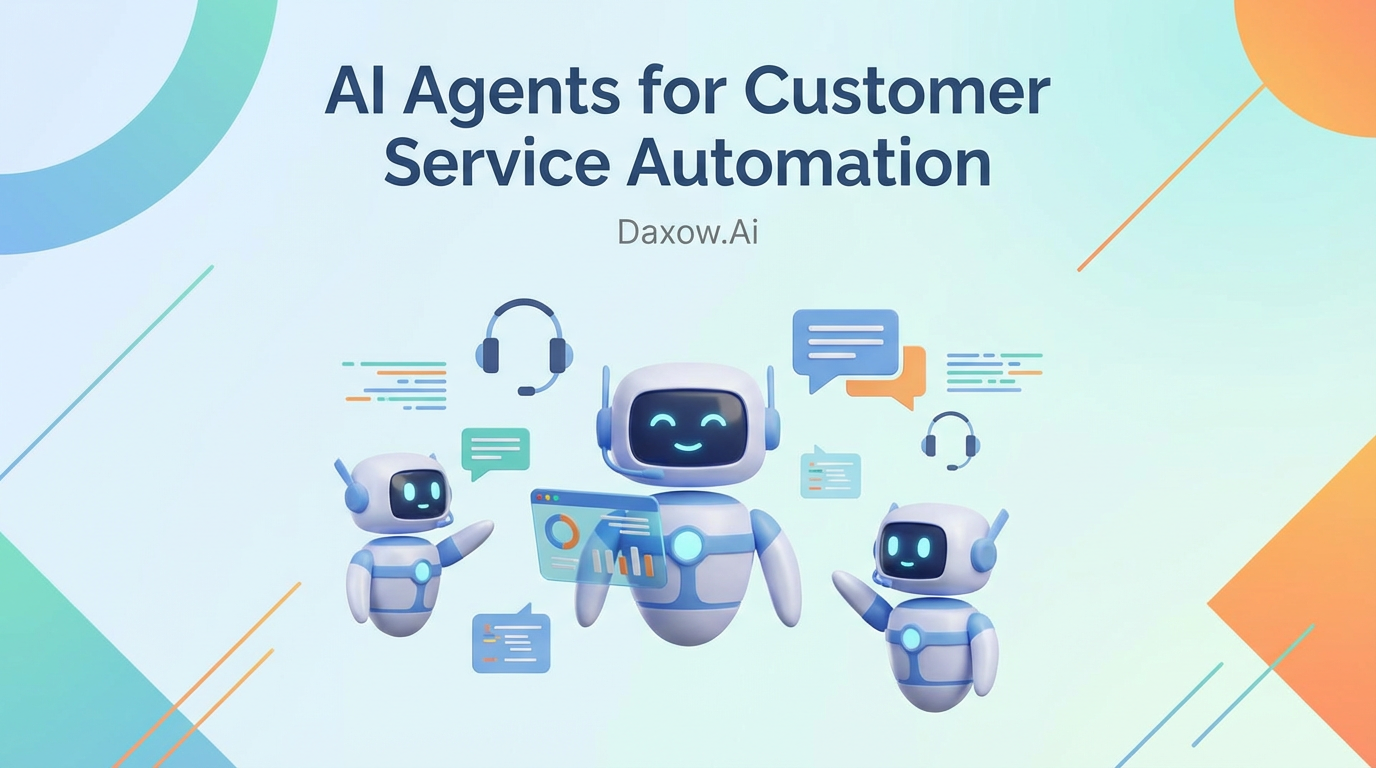
AI Agents for Customer Service Automation
How AI agents use conversational AI, RAG, and workflow automation to scale support, cut costs, and improve CSAT—strategy, metrics, and implementation.
AI Agents for Customer Service Automation: Transforming Support with Scalable, Intelligent Workflows
Estimated reading time: 15 minutes
Key Takeaways
- AI agents automate routine customer service tasks to reduce costs and improve satisfaction.
- Hybrid AI architectures combine conversational AI, RAG, and workflow automation for effective support.
- Phased implementation minimizes risk and accelerates value capture.
- Industry-specific use cases demonstrate strong ROI and customer experience improvements.
- Daxow.ai offers tailored solutions integrating AI agents seamlessly into existing systems.
Table of Contents
- AI Agents for Customer Service Automation — Why it Matters
- How AI Agents Work in Customer Support
- Research-backed Impact and Metrics
- Designing an AI Agents for Customer Service Automation Strategy
- Practical Use Cases Across Industries
- Technical Patterns and Governance
- Measuring ROI and Business Value
- How Daxow.ai Delivers AI Agents for Customer Service Automation
- Best Practices for Successful Deployment
- Frequently Asked Questions
AI Agents for Customer Service Automation — Why it Matters
Customer expectations have shifted toward instant, accurate support across channels. Traditional support teams struggle with high ticket volumes, repetitive inquiries, and fragmented systems. AI agents for customer service automation address these challenges by automating routine tasks, enabling scalable self-service, and providing contextual assistance to human agents.
Key business benefits:
- Reduce manual tasks like ticket triage, status updates, and information lookup.
- Increase productivity by enabling faster resolution and higher handle capacity.
- Improve customer satisfaction with 24/7 availability and consistent answers.
- Lower operational costs through automation and optimized workforce allocation.
- Enable data-driven improvements by capturing structured interaction data.
How AI Agents Work in Customer Support
AI agents combine multiple technologies to deliver end-to-end automation. Understanding this stack helps you design pragmatic solutions.
Core components
- Conversational AI: Natural language understanding (NLU) and generation (NLG) power chatbots and voice agents.
- Retrieval-Augmented Generation (RAG): Provides accurate, up-to-date answers by combining knowledge bases, documents, and CRM data with generative models.
- Workflow Automation: Orchestrates multi-step processes (e.g., refund approvals) across systems.
- Integrations: Connectors to CRMs, ticketing, billing, and telephony systems.
- Supervision & Handoff: Rules and escalation paths for routing to human agents when needed.
Common agent types
- Virtual Assistants: Frontline chat or voice bots handling FAQs, booking, order status.
- Triage Agents: Classify and prioritize incoming requests, attach metadata, and assign to teams.
- Autonomous Action Agents: Execute tasks (create refunds, update profiles) via API integrations under policy controls.
- Agent Assistants: Real-time prompts and summaries to help human agents resolve tickets faster.
Research-backed Impact and Metrics
Recent industry trends show automation delivers measurable results when applied strategically. While organizations vary, typical outcomes observed across deployments include:
- First response time reduction of 50–90% for automated channels.
- Automation rates between 30–70% of inbound volume for mature setups.
- Cost-per-ticket reductions of 20–60% through blended channels.
- CSAT improvements of 5–20 points by eliminating wait times and inconsistency.
Focus on these KPIs when planning:
- Automation rate (percentage of requests fully resolved by agents)
- Average handle time (AHT) for automated vs. human-handled tickets
- Escalation rate (percentage routed to human agents)
- Resolution time and first contact resolution (FCR)
- Customer satisfaction (CSAT/NPS)
- Cost per interaction and total cost of ownership (TCO)
Designing an AI Agents for Customer Service Automation Strategy
A practical, phased approach reduces risk and accelerates value. Daxow.ai follows an end-to-end process to ensure alignment with business goals.
Phase 1 — Discovery and Prioritization
- Map current workflows and identify high-volume, high-effort tasks that are repeatable.
- Analyze ticket types, peak hours, channel distribution, and existing response SLAs.
- Prioritize use cases by impact and feasibility: start with simple FAQ automation, then expand to triage and autonomous actions.
Phase 2 — Design and Data Preparation
- Define conversation flows, escalation rules, business policies, and compliance needs.
- Catalog data sources (knowledge bases, CRM, order systems) and evaluate data quality.
- Prepare labeled examples for NLU training and templates for RAG retrieval.
Phase 3 — Build and Integrate
- Develop AI agents using hybrid patterns: retrieval for factual answers, NLU for intent detection, and rule-based orchestrations for business logic.
- Build connectors to CRMs, ticketing systems, billing platforms, and telephony.
- Implement secure API-based action capabilities for agents to execute tasks under governance.
Phase 4 — Pilot and Iterate
- Launch a controlled pilot on a single channel or customer segment.
- Monitor KPIs closely. Adjust intents, knowledge retrieval, and handoff thresholds.
- Collect user feedback and agent logs for continuous improvement.
Phase 5 — Scale and Optimize
- Expand to additional channels and languages.
- Introduce advanced features: proactive outreach, personalized routing, and predictive escalation.
- Optimize workforce planning using automation-driven load forecasts.
Practical Use Cases Across Industries
E-commerce — Order, Returns, and Recommendations
Use case:
- AI agents handle order tracking, return authorizations, and refund processing.
- Integrations with inventory, shipping, and payment systems enable agents to execute refunds autonomously or create return labels.
Business outcomes:
- Reduce manual tasks in returns handling by up to 70%.
- Faster refunds increase customer trust and repeat purchases.
Finance and Banking — Account Support and Transaction Inquiries
Use case:
- Agents answer balance inquiries, dispute transactions, and initiate routine transfers after identity verification.
- RAG pulls from policy documents to ensure regulatory-compliant responses.
Business outcomes:
- Improve productivity by automating 40–60% of standard inquiries.
- Reduce fraud risk with integrated verification steps.
Healthcare — Appointment Scheduling and Patient Triage
Use case:
- AI agents schedule appointments, check insurance eligibility, and triage symptom-based inquiries with escalation to clinicians when required.
- Integrations with EHRs and calendar systems ensure accurate booking.
Business outcomes:
- Reduce administrative load on staff and improve patient access.
- Shorter scheduling cycles and fewer no-shows via reminders.
Real Estate — Lead Qualification and Property Inquiries
Use case:
- Agents engage website visitors, qualify leads via scripted questions, and book viewings automatically with agents’ calendars.
- CRM integrations push qualified leads to sales teams with enriched profiles.
Business outcomes:
- Increase conversion rates by capturing leads outside office hours.
- Sales teams focus only on high-intent prospects.
SaaS & Enterprise Support — Ticket Triage and Knowledge Access
Use case:
- Triage agents classify bugs vs. feature requests, attach logs, and prioritize critical incidents.
- Agent Assistants provide recommended responses and relevant KB articles to human agents.
Business outcomes:
- Decrease resolution times and improve developer handoff efficiency.
- Better SLA compliance and reduced escalations.
Technical Patterns and Governance
Hybrid architecture recommendations
- Combine RAG with retrieval indexes and vector stores for document-heavy domains.
- Use rules and deterministic flows for high-risk operations (billing, cancellations).
- Implement a short feedback loop for retraining models with resolved ticket data.
Security, compliance, and privacy
- Apply role-based access and least privilege for agent actions.
- Log all automated actions and maintain audit trails for compliance.
- Ensure sensitive data redaction and data residency controls meet industry regulations.
Monitoring and quality control
- Track drift in intent recognition and answer accuracy.
- Use human-in-the-loop reviews for edge cases and monthly audits for policy adherence.
- Establish SLA-based alerting for agent performance drops.
Measuring ROI and Business Value
ROI hinges on thoughtful scope and realistic KPIs. Use a baseline, run controlled pilots, and measure cost and experience improvements.
Example ROI framework
- Baseline metrics: current ticket volume, average handle time (AHT), number of agents, salary costs, CSAT.
- Pilot gains: expected automation rate, reduction in AHT, and change in escalations.
- Financial calculation:
- Annual savings = (Automated tickets × average handle time saved × average labor cost per hour) + (Decrease in overtime/contractor spend) + (reduction in error-related costs).
- Include non-financial benefits: faster time-to-resolution, improved retention, and sales uplift from better CX.
Typical timelines and TCO considerations
- Pilot: 6–12 weeks for initial value proof.
- Production rollout: 3–9 months for multi-channel scaling.
- Ongoing spend: model maintenance, retraining, and cloud inference costs—often smaller than incremental headcount.
How Daxow.ai Delivers AI Agents for Customer Service Automation
Daxow.ai builds tailored solutions that integrate AI agents into your existing operations. Our approach focuses on measurable business outcomes and reliable integration.
End-to-end process
- Discovery: We map workflows and identify the highest-impact automation opportunities.
- Custom design: We design conversational flows, data schemas, and orchestration logic aligned with your SLAs and policies.
- Build & integration: Our engineers implement connectors to CRMs, ticketing systems, telephony, and databases—ensuring secure APIs and audit logging.
- Deployment & monitoring: We deploy pilot agents, instrument KPIs, and set up continuous improvement cycles.
- Training & change management: We work with your teams to update playbooks, train staff, and transition to new operating models.
Typical solutions we build
- AI agents that autonomously process refunds, returns, and subscription changes.
- Triage agents that reduce human workload and improve SLA adherence.
- Sales automation bots that qualify leads and schedule demos.
- Knowledge-first RAG agents that provide accurate, up-to-date answers across channels.
Best Practices for Successful Deployment
- Start small and focus on high-volume, low-risk tasks.
- Ensure end-to-end ownership for integrations and business logic.
- Maintain transparency: log automated actions and provide clear customer-facing disclosures when automation is used.
- Invest in a continuous training loop using real ticket data and customer feedback.
- Involve legal, security, and compliance early for regulated industries.
Avoid common pitfalls
- Don’t over-automate complex cases before your models and data are mature.
- Avoid silos—integrate AI agents into existing workflows, not separate channels.
- Don’t treat automation as a one-time project—plan for ongoing optimization.
Conclusion and Next Steps
AI agents for customer service automation deliver tangible business value: reduced manual tasks, increased productivity, lower costs, and better customer experiences. With a pragmatic, data-driven approach and robust integrations, organizations can transition from reactive support to proactive, scalable service.
Book a free consultation with Daxow.ai to assess where AI agents and workflow automation will have the highest impact in your organization. Request a process analysis for your company or contact us to build a custom AI system that integrates with your tools and delivers measurable ROI.
Frequently Asked Questions
What are AI agents in customer service automation?
AI agents are software bots powered by conversational AI, retrieval-augmented generation, and workflow automation to handle routine customer service tasks, improve response times, and assist human agents.
How do AI agents improve customer satisfaction?
By providing 24/7 instant responses, consistent and accurate answers, and freeing human agents for complex issues, AI agents reduce wait times and improve the overall customer experience.
What industries benefit most from customer service AI agents?
E-commerce, finance, healthcare, real estate, SaaS, and enterprise support are key sectors that see significant productivity gains and improved customer interactions through AI agents.
How does Daxow.ai integrate AI agents into existing systems?
Daxow.ai utilizes secure connectors and APIs to integrate AI agents with CRMs, ticketing, telephony, billing, and other platforms, ensuring seamless workflow automation with audit and security controls.