
AI Agents for Customer Support: Reduce Tasks & Boost CSAT
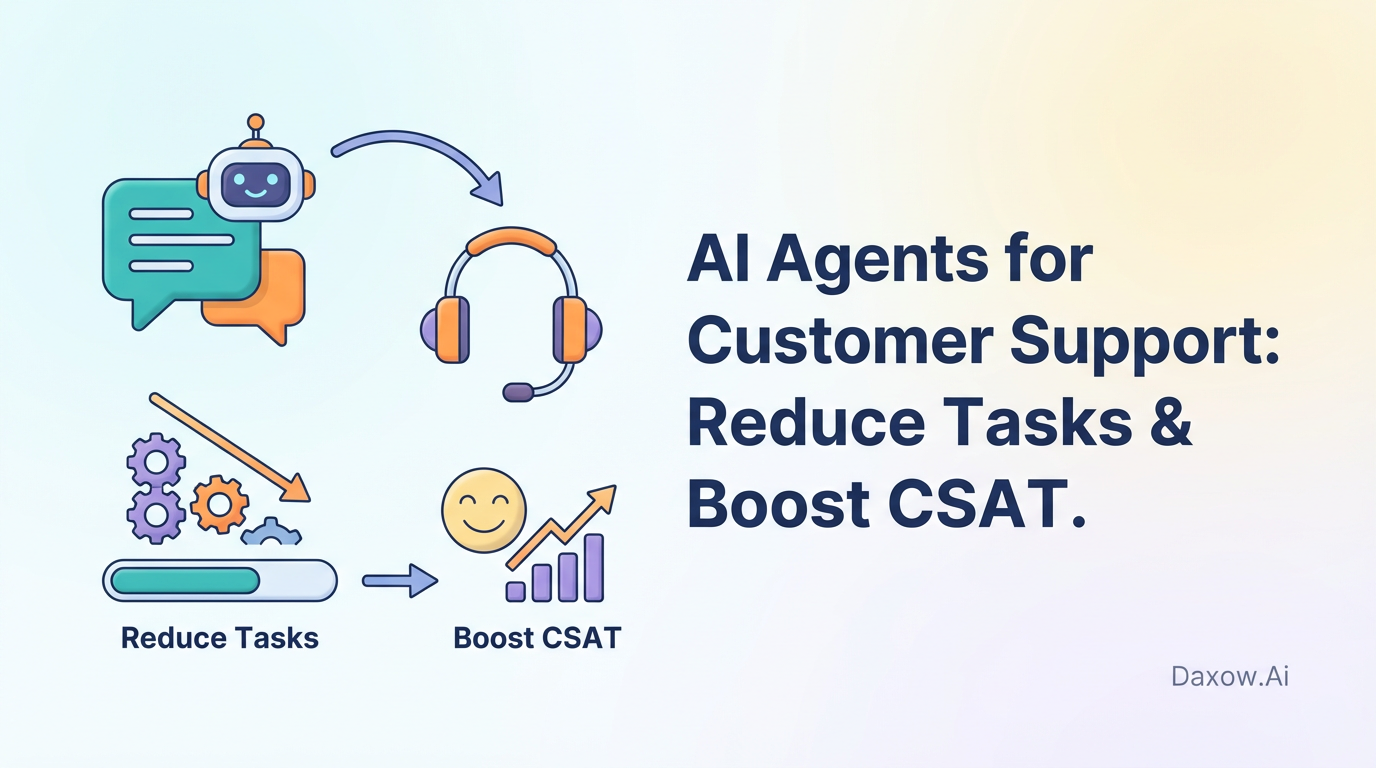
Automate customer support with AI agents to reduce manual tasks, boost productivity, and improve CSAT. Practical implementation steps, use cases, and ROI.
AI Agents for Customer Support Automation: How to Reduce Manual Tasks, Boost Productivity, and Improve Customer Experience
Estimated reading time: 15 minutes
Key Takeaways
- AI agents automate routine customer support tasks, reducing manual effort and operational costs.
- Integration with CRMs, ticketing, billing, and communication channels enables seamless workflows.
- Industry-specific use cases demonstrate how AI agents improve customer satisfaction and business outcomes.
- A practical framework helps scale AI agents from discovery to full deployment and continuous improvement.
- Daxow.ai delivers tailored AI agent implementations that drive measurable productivity and ROI.
Table of Contents
- Introduction
- Why AI Agents for Customer Support Automation Matter
- How AI Agents Work in Customer Support (Technical Overview)
- Business Value and Measurable Outcomes
- Practical Use Cases — Across Industries
- A Practical Framework to Deploy AI Agents for Customer Support Automation
- Measuring ROI and Choosing KPIs
- Best Practices and Common Pitfalls
- Security, Privacy, and Compliance Considerations
- A Sample Project Timeline and Cost Drivers
- Realistic Performance Expectations
- Why Choose Daxow.ai
- Next Steps and Action Plan
- Conclusion and Call to Action
- Frequently Asked Questions
Introduction
AI Agents for Customer Support Automation are transforming how organizations handle inquiries, resolve issues, and qualify leads. By combining AI automation, workflow automation, and smart integrations, businesses can reduce manual tasks, improve productivity, and deliver faster, more consistent customer experiences. This article explains how AI agents work in customer support, presents actionable implementation guidance, and offers industry-specific use cases so leaders can assess business value and next steps.
Why AI Agents for Customer Support Automation Matter
- Customer expectations now demand fast, accurate responses across channels.
- Operational costs for support are a significant ongoing expense; automating routine work reduces overhead.
- Scalability is critical for peak periods, product launches, and growth without linear headcount increases.
- Data-driven improvements enable continuous enhancement of support quality and sales outcomes.
AI agents are not just chatbots; they are task-oriented systems that understand intent, take autonomous actions (including calling APIs, updating CRM records, and routing complex cases), and learn from interactions. When implemented as part of an enterprise workflow automation strategy, AI agents drive measurable gains in efficiency, customer satisfaction, and revenue capture.
How AI Agents Work in Customer Support (Technical Overview)
Core components
- Natural Language Understanding (NLU): Converts customer text or voice into structured intent and entities.
- Dialogue Management: Determines next-best-action using rules, context, and models.
- Action Orchestration: Executes tasks (create ticket, pull account data, schedule callback, trigger refund) via integrations.
- Knowledge Retrieval: Searches FAQs, product docs, and internal KBs to supply accurate answers.
- Analytics & Monitoring: Tracks KPIs, flags drift, and provides feedback loops for retraining.
Integrations and data flow
AI agents must connect to:
- CRMs (for customer context and updates)
- Ticketing systems (for case management)
- Billing and order systems (for refunds/returns)
- Knowledge bases and document stores (for precise answers)
- Communication channels (webchat, email, SMS, voice)
Daxow builds connectors and middleware to ensure secure, reliable data flow and to preserve audit trails and compliance.
Business Value and Measurable Outcomes
- Reduce manual tasks: Automate repetitive work (greeting, triage, status checks, password resets), freeing agents for complex issues.
- Boost productivity: Shorten average handling time and increase cases resolved per agent.
- Improve CSAT and NPS: Faster and more accurate responses raise satisfaction.
- Lower costs: Reduce full-time equivalent (FTE) requirements for first-line support and lower cost-per-ticket.
- Increase revenue: Automate lead qualification and upsell prompts to convert more opportunities.
Practical Use Cases — Across Industries
E-commerce
- Order status, returns, and refunds automation
- AI agent authenticates customers, retrieves order details, processes return labels, and issues refunds via payment gateway integrations.
- Business impact: Faster refunds, fewer escalations, and reduced support volume during peak seasons.
- Post-purchase engagement and cross-sell
- AI agents identify customers with high purchase intent and trigger personalized offers or routing to sales.
- Business impact: Improved conversion and lifetime value through automated sales automation.
Healthcare (non-clinical support)
- Appointment scheduling and pre-visit instructions
- Securely access scheduling systems, send reminders, and pre-visit forms. Escalate clinical questions to nurses.
- Business impact: Reduced no-shows, administrative burden, and improved patient experience.
- Insurance and billing inquiries
- Extract insurance data from documents, check coverage status, and automate common billing clarifications.
- Business impact: Reduced billing disputes and faster collections.
Finance and Banking
- Account verification and fraud triage
- AI agents authenticate, check recent activity patterns, and trigger fraud workflows or human review.
- Business impact: Faster fraud response, reduced false positives, and higher trust.
- Loan application triage
- Automate initial eligibility checks, document collection, and routing to loan officers.
- Business impact: Shorter application cycles, fewer manual checks, and increased throughput.
Real Estate and Property Management
- Tenant support and maintenance requests
- AI agents intake maintenance tickets, classify urgency, schedule contractors, and provide status updates.
- Business impact: Faster resolutions, improved tenant satisfaction, and lower admin costs.
- Lead qualification for showings
- Route high-quality leads to agents while nurturing others automatically.
- Business impact: Higher conversion and more efficient agent time use.
HR and Internal Services
- Employee onboarding and policy queries
- Automate document collection, benefits enrollment guidance, and IT provisioning tasks.
- Business impact: Faster onboarding, fewer HR inquiries, and enhanced compliance.
A Practical Framework to Deploy AI Agents for Customer Support Automation
1. Discovery and process mapping
- Document current workflows and touchpoints.
- Identify high-volume, high-effort tasks that are good automation candidates.
- Define success metrics (automation rate, time-to-resolution, CSAT).
2. Design and prototyping
- Create conversation flows and error paths.
- Define required integrations and data access.
- Prototype an agent on a limited channel (e.g., webchat) and test core intents.
3. Build and integrate
- Implement NLU models and orchestration logic.
- Secure APIs and data connectors to CRM, ticketing, billing, and knowledge systems.
- Establish escalation rules and human-in-the-loop handoffs.
4. Pilot and measure
- Run a controlled pilot with a segment of traffic.
- Measure KPIs: automation rate, deflection, time-to-resolution, CSAT, and cost per ticket.
- Capture edge cases and failure modes.
5. Scale and optimize
- Expand channels and handle additional intents.
- Introduce continuous learning pipelines and retrain models with real interactions.
- Monitor performance, bias, and compliance.
Learn more about our custom AI agent design services that support every stage of this framework.
Measuring ROI and Choosing KPIs
Core KPIs to track
- Automation rate (% of interactions fully handled by the agent)
- Deflection rate (conversations prevented from reaching human agents)
- Average handling time (AHT) reduction
- Cost per ticket / cost per resolved issue
- Customer satisfaction (CSAT) and Net Promoter Score (NPS)
- Lead conversion uplift for sales automation
Example ROI calculation (illustrative)
If 60% of incoming requests are routine and an AI agent can automate 50% of those, the reduction in human-handled tickets is significant. Savings are realized as reduced overtime, fewer hires, or redeployment of staff to higher-value activities. Daxow helps quantify these benefits for your operations and builds dashboards to monitor realized savings.
Best Practices and Common Pitfalls
Best practices
- Start small and iterate: Pilot on a single channel or use case with high volume.
- Human-in-the-loop: Always provide seamless escalation to humans for complex or sensitive cases.
- Governance and compliance: Ensure data privacy, consent, and industry-specific regulations are enforced.
- Knowledge management: Keep the knowledge base authoritative and up to date; agents rely on it.
- Monitor and retrain: Set up continuous monitoring to detect drift and retrain models regularly.
Pitfalls to avoid
- Over-automation: Automating complex, low-frequency tasks can increase friction.
- Under-integrated systems: Agents that cannot update back-end systems create more manual reconciliation work.
- Ignoring edge cases: Failing to capture fallback flows or error handling undermines trust.
- Poor data hygiene: Bad customer data leads to wrong actions and poor CX.
Security, Privacy, and Compliance Considerations
- Enforce least-privilege access for integrations.
- Encrypt data in transit and at rest.
- Implement audit logs for actions taken by AI agents.
- Ensure consent and transparency in customer interactions.
Daxow incorporates security and compliance into every build, especially for regulated industries like healthcare and finance.
A Sample Project Timeline and Cost Drivers
Typical timeline (for a mid-size deployment)
- Discovery & mapping: 2–4 weeks
- Design & prototype: 3–6 weeks
- Integrations & build: 6–12 weeks (depends on systems)
- Pilot & iteration: 4–8 weeks
- Scale rollout: ongoing
Cost drivers
- Number and complexity of integrations
- Volume and complexity of intents
- Required security and compliance controls
- Custom connectors or legacy system work
Daxow provides modular engagement options—proof of concept, pilot, and full-scale implementation—with transparent pricing based on scope.
Realistic Performance Expectations
- Initial automation rates for common support flows often range from 30–60% depending on the organization and maturity of data and processes.
- Over time, with broader knowledge coverage and continuous learning, automation rates and satisfaction typically improve.
- The goal is not to replace humans but to reallocate skilled agents to higher-value work and improve overall productivity.
Why Choose Daxow.ai
- Founded in Estonia in 2024, Daxow combines European engineering discipline with a focus on practical business outcomes.
- We design and deploy AI agents that do more than converse: they act, transact, and integrate.
- Our end-to-end approach—from process discovery through to monitoring—delivers measurable reductions in manual tasks, lower operational costs, and improved ROI.
- We specialize in integrating business automation with CRMs, ticketing systems, and enterprise tools—ensuring AI agents execute real, auditable work.
Explore our customer support automation solutions to learn more about how we can help your business.
Next Steps and Action Plan
- Conduct a rapid process analysis to identify 2–3 high-impact support workflows.
- Run a focused pilot for a single channel and measure core KPIs.
- Expand automation to adjacent workflows and integrate sales automation where applicable.
Daxow will partner with you to scope a pilot, design the AI agents, integrate systems, and measure the outcomes.
Conclusion and Call to Action
AI Agents for Customer Support Automation are a practical, high-impact way to reduce manual tasks, increase productivity, and create better customer experiences. With a disciplined implementation approach and the right integrations, organizations can realize measurable cost savings and higher customer satisfaction.
Contact Daxow.ai to request a process analysis for your company and start a pilot that delivers real business automation. Book a free consultation to evaluate your support workflows and build custom AI agents that execute real tasks and improve ROI.
Frequently Asked Questions
What distinguishes AI agents from traditional chatbots?
AI agents are task-oriented systems that understand intent, take autonomous actions such as API calls and CRM updates, and learn from interactions, whereas traditional chatbots primarily offer scripted conversations without deep integration or autonomous capabilities.
How do AI agents improve customer satisfaction?
By providing faster, more accurate responses 24/7 across multiple channels and automating routine tasks, AI agents reduce wait times, minimize errors, and enable human agents to focus on complex issues, which increases overall customer satisfaction.
What industries benefit most from AI agents?
Industries such as e-commerce, healthcare (non-clinical), finance, real estate, and internal HR services see significant benefits from AI agents through automation of routine inquiries, scheduling, billing, fraud triage, lead qualification, and onboarding.
How does Daxow.ai ensure compliance and security?
Daxow enforces least-privilege access, encrypts data in transit and at rest, implements audit logging for AI agent actions, and ensures customer consent and transparency, especially for regulated industries such as healthcare and finance.