
AI Agents for Customer Support: Cut Costs & Improve CX
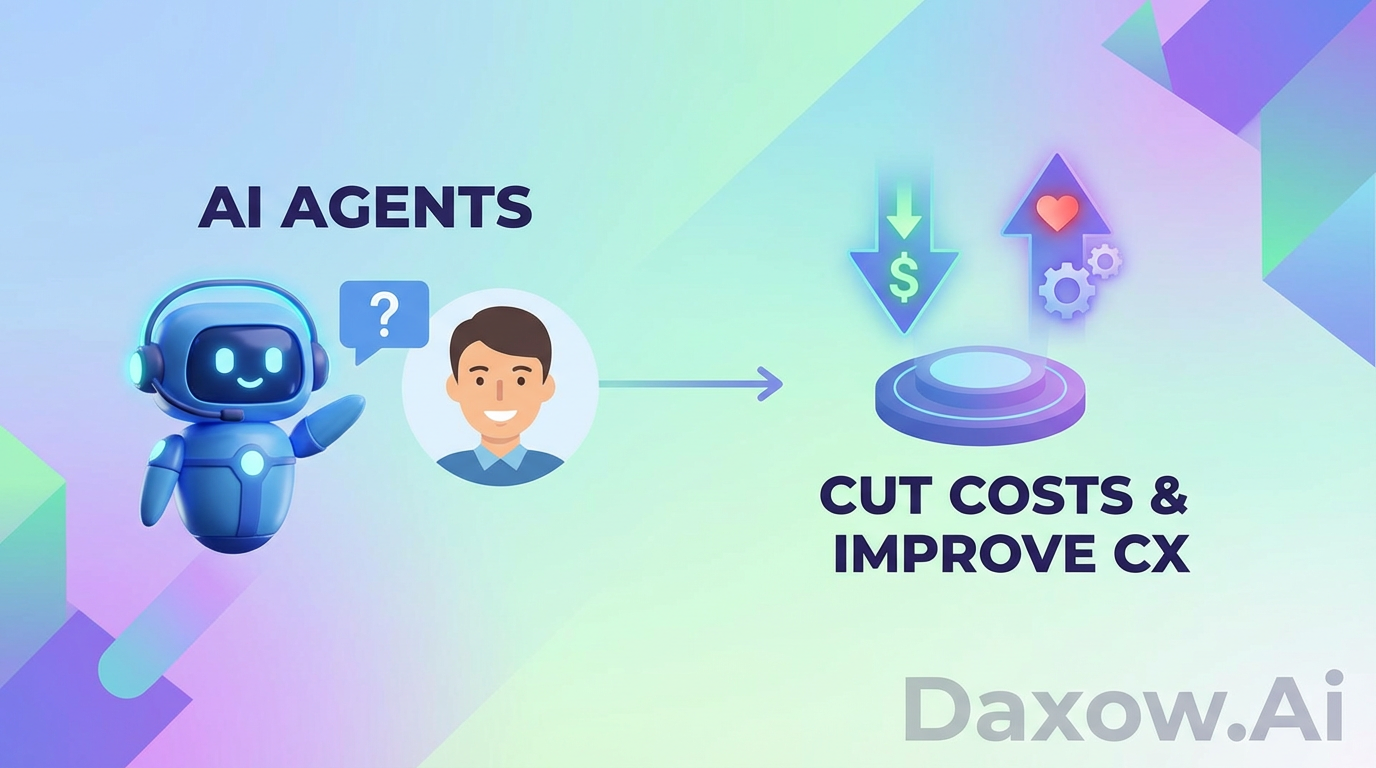
How AI agents automate customer support workflows to cut costs, boost CX, and scale operations. Use cases, ROI examples, and an implementation roadmap.
AI Agents for Customer Support Automation — How to Cut Costs, Improve CX, and Scale with Workflow Automation
Estimated reading time: 15 minutes
Key Takeaways
- AI agents automate repetitive customer support tasks, reducing cost and improving productivity.
- Integration with existing CRM, ticketing, and ERP systems enables seamless workflows and consistent data capture.
- Industry-specific use cases demonstrate scalable improvements in customer satisfaction and operational efficiency.
- A structured implementation roadmap ensures measurable outcomes and continuous improvement.
- Daxow.ai delivers end-to-end AI agent solutions focused on tangible business impact.
Table of Contents
- AI Agents for Customer Support Automation — What Decision-Makers Need to Know
- Business Value: How AI Automation Drives Productivity and Cost Savings
- Practical Use Cases Across Industries
- Implementation Roadmap — From Discovery to Live AI Agents
- Integration and Data Strategy — Making AI Agents Work with Your Systems
- Measuring ROI — How to Quantify Impact
- Risks, Challenges, and Mitigation Strategies
- Why Partner with Daxow.ai for AI Agents and Workflow Automation
- Getting Started — First Steps for Business Leaders
- Case Study Snapshots (Illustrative)
AI Agents for Customer Support Automation — What Decision-Makers Need to Know
AI Agents for Customer Support Automation are rapidly transforming how companies deliver service. For business owners, operations leaders, and technology teams, the question is no longer whether to adopt AI-driven support, but how to integrate AI automation into existing workflows to reduce manual tasks, boost productivity, and deliver measurable ROI. This article explains practical strategies, industry use cases, implementation steps, and how Daxow.ai designs end-to-end business automation and AI agent solutions that execute real tasks and deliver results.
AI agents are autonomous or semi-autonomous systems that interact with customers, internal systems, and staff to complete tasks. When applied to customer support, they combine natural language understanding, workflow automation, integrations with CRMs and ticketing systems, and business rules to handle inquiries, escalate complex issues, and automate follow-ups.
Why this matters now:
- Scale customer service without linear headcount growth.
- Reduce manual tasks such as ticket triage, knowledge retrieval, and status updates.
- Improve response times and first-contact resolution, increasing customer satisfaction.
- Enable consistent data capture for analytics and continuous improvement.
Core capabilities of AI agents in support automation
- Natural language understanding and intent classification.
- Context-aware dialog management and multi-turn conversations.
- Automated ticket creation, categorization, and prioritization.
- Integrations with CRMs, ERPs, order management, and knowledge bases.
- Workflow orchestration to trigger actions (refunds, returns, service scheduling).
- Escalation to humans with context-rich handoff and suggested responses.
- Continuous learning from feedback and supervised fine-tuning.
Business Value: How AI Automation Drives Productivity and Cost Savings
AI agents deliver value across measurable business metrics. Below are key areas where decision-makers see impact.
Reduce manual tasks and operational costs
- Automate repetitive interactions (status checks, password resets, order lookups).
- Reallocate human agents to high-value work (complex escalations, relationship building).
- Typical outcome: 40–70% of routine contacts handled by AI agents, reducing average handling costs.
Improve productivity and customer satisfaction
- Faster response times and 24/7 availability.
- Personalized self-service powered by integrated data.
- Typical outcome: reduced response times, higher first-contact resolution, improved CSAT.
Increase revenue through sales automation and retention
- AI agents can qualify leads, recommend upsells during support interactions, and automate renewal reminders.
- Business benefit: Increased conversion rates and reduced churn.
Practical Use Cases Across Industries
E-commerce — Conversational order management
- Use case: Customers ask about order status, returns, and refunds.
- AI agent actions: Authenticate user, fetch order details from the order management system, process standard returns, generate pre-paid return labels, and update CRM.
- Benefits: Lower contact center volume, faster refunds, improved NPS.
Finance & Banking — Account inquiries and compliance workflows
- Use case: Routine balance inquiries, transaction disputes, and KYC updates.
- AI agent actions: Verify identity, retrieve transactions, open dispute tickets, flag suspicious patterns, trigger compliance workflows.
- Benefits: Faster dispute resolution, reduced compliance overhead, fewer manual audits.
Healthcare — Patient intake and appointment coordination
- Use case: Schedule appointments, collect intake forms, answer billing questions.
- AI agent actions: Pre-fill patient information from prior records, collect consent and insurance data through conversational form filling, integrate with EHR scheduling.
- Benefits: Reduced administrative burden, fewer no-shows, improved patient experience.
Real Estate — Lead qualification and property inquiries
- Use case: Responding to inquiries about listings, booking viewings, and pre-qualifying tenants.
- AI agent actions: Gather contact details, qualification criteria, schedule showings, and update CRM with lead scores.
- Benefits: Faster lead response, higher conversion, better agent utilization.
HR & Admin — Employee onboarding and service desk
- Use case: Streamline onboarding tasks, answer policy questions, and process equipment requests.
- AI agent actions: Orchestrate onboarding workflows (accounts provisioning, training enrollment), automate ticket creation for IT, and provide policy lookups.
- Benefits: Shorter time-to-productivity for new hires, fewer manual follow-ups.
Insurance — Claims triage and documentation
- Use case: Initial claims intake, documentation uploads, and status updates.
- AI agent actions: Guide claimants through structured forms, extract data from uploaded documents using document automation, and create a prepopulated claim in backend systems.
- Benefits: Faster claims processing, lower manual review workload, improved fraud detection downstream.
Implementation Roadmap — From Discovery to Live AI Agents
Adopting AI agents requires a structured approach. Below is Daxow.ai’s proven methodology for reliably delivering business automation.
1. Discovery and process analysis
- Map current workflows and identify high-volume, repetitive tasks.
- Measure baseline metrics: contact volumes, handling times, escalation rates, and error rates.
- Outcome: Prioritized backlog of automation opportunities with expected impact.
2. Design AI-driven workflows
- Define conversational flows, escalation criteria, and success metrics.
- Design integrations with CRMs, ticketing systems, knowledge bases, and payment platforms.
- Build data models and privacy controls to ensure compliance.
3. Build and integrate AI agents
- Implement intent classification and dialog management tuned to your domain.
- Connect to business systems for real-time data retrieval and action execution.
- Develop document automation for extracting structured data from documents.
4. Pilot, measure, and iterate
- Launch a controlled pilot for a segment of traffic.
- Monitor KPIs such as containment rate, CSAT, and cost per contact.
- Iterate on training data and business logic to improve performance.
5. Scale and govern
- Deploy across channels (web chat, SMS, social, voice).
- Implement monitoring, A/B testing, and human-in-the-loop workflows.
- Establish governance for data privacy, model updates, and incident response.
Integration and Data Strategy — Making AI Agents Work with Your Systems
AI agents must be connected to the data that drives decisions. Integration strategy is critical for reliable automation.
Essential integrations
- CRM and ticketing systems for history and updates.
- Order management and inventory systems for commerce actions.
- EHRs or claims systems in healthcare and insurance.
- Identity and authentication services for secure access.
Data requirements and governance
- Ensure access to up-to-date canonical data sources.
- Implement logging for transparency and auditability.
- Apply role-based access and data minimization to protect PII.
- Daxow approach: We design secure connectors and data pipelines that preserve privacy while enabling automation.
Measuring ROI — How to Quantify Impact
Decision-makers need clear metrics. Use this framework to estimate and measure ROI of AI automation.
Key metrics to track
- Contact containment rate (% of inquiries handled without human intervention).
- Average handling time reduction (for remaining human interactions).
- Cost per contact or per ticket.
- CSAT, NPS, and churn impact.
- Sales conversion or upsell lift from automated qualification.
Simple ROI calculation example
- Baseline: 10,000 contacts/month, $6 average handling cost, current cost = $60,000/month.
- After automation: 50% containment by AI, remaining costs = 5,000 * $6 = $30,000/month.
- Operational savings = $30,000/month. Factor in implementation and run costs to calculate payback period.
- Add intangible benefits: faster responses, higher retention, and increased revenue from sales automation.
Risks, Challenges, and Mitigation Strategies
Common challenges
- Poorly scoped processes leading to limited ROI.
- Insufficient integration or data quality issues.
- Overreliance on out-of-the-box models without domain tuning.
- Regulatory and privacy concerns.
Mitigations
- Start with targeted pilots on the highest-impact workflows.
- Invest in integration and data cleanup before full rollout.
- Use human-in-the-loop designs for sensitive or high-stakes interactions.
- Apply continuous monitoring and model retraining.
Why Partner with Daxow.ai for AI Agents and Workflow Automation
Daxow.ai helps businesses from discovery to operations, focusing on measurable business outcomes.
End-to-end expertise
- We analyze workflows to identify automation opportunities and quantify impact.
- We design and build custom AI agents that execute real tasks — not just chat interfaces.
- We deliver integrations with CRMs, ticketing systems, ERPs, and data stores.
Practical benefits we deliver
- Reduced operational costs through automation and reduction of manual tasks.
- Improved productivity by enabling teams to focus on high-value work.
- Seamless system integrations that maintain data integrity and comply with governance.
- Continuous improvement with monitoring, analytics, and retraining.
Typical engagement flow with Daxow.ai
- Discovery and process analysis to build a prioritized automation roadmap.
- Rapid prototyping and pilot deployment for early wins.
- Full-scale implementation, integration, and knowledge transfer.
- Ongoing support, monitoring, and optimization.
Getting Started — First Steps for Business Leaders
Step-by-step starter checklist
- Identify your top 3 high-volume support processes.
- Collect baseline metrics (contacts, times, costs).
- Map the data sources required to automate those tasks.
- Run a short discovery with stakeholders and IT to validate feasibility.
- Pilot with a narrow scope and measure results against KPIs.
Case Study Snapshots (Illustrative)
- Retailer: Automated 60% of order-status and return contacts. Reduced contact center load by 45% and shortened refund cycle by 24 hours.
- Insurance firm: Implemented claims intake agent that prefilled 70% of claims, cutting manual review time by 35%.
- SaaS company: Deployed lead-qualification agent; conversion of qualified leads rose by 18% while support response times halved.
Frequently Asked Questions
What are AI agents in customer support?
AI agents are autonomous or semi-autonomous systems that handle customer inquiries, automate workflows, escalate issues, and integrate with business systems to enhance support operations.
How do AI agents reduce costs?
By automating routine and repetitive tasks such as ticket triage, status updates, and knowledge retrieval, AI agents reduce the workload on human agents and lower average handling costs.
What industries benefit most from AI customer support automation?
Industries including e-commerce, finance, healthcare, real estate, HR, and insurance benefit from AI agents through tailored workflows that improve efficiency and customer experience.
How does Daxow.ai ensure data privacy and compliance?
Daxow.ai designs secure data connectors and pipelines with role-based access controls, data minimization, and audit logging to preserve privacy and comply with relevant regulations.