
End-to-End Workflow Automation with AI Agents
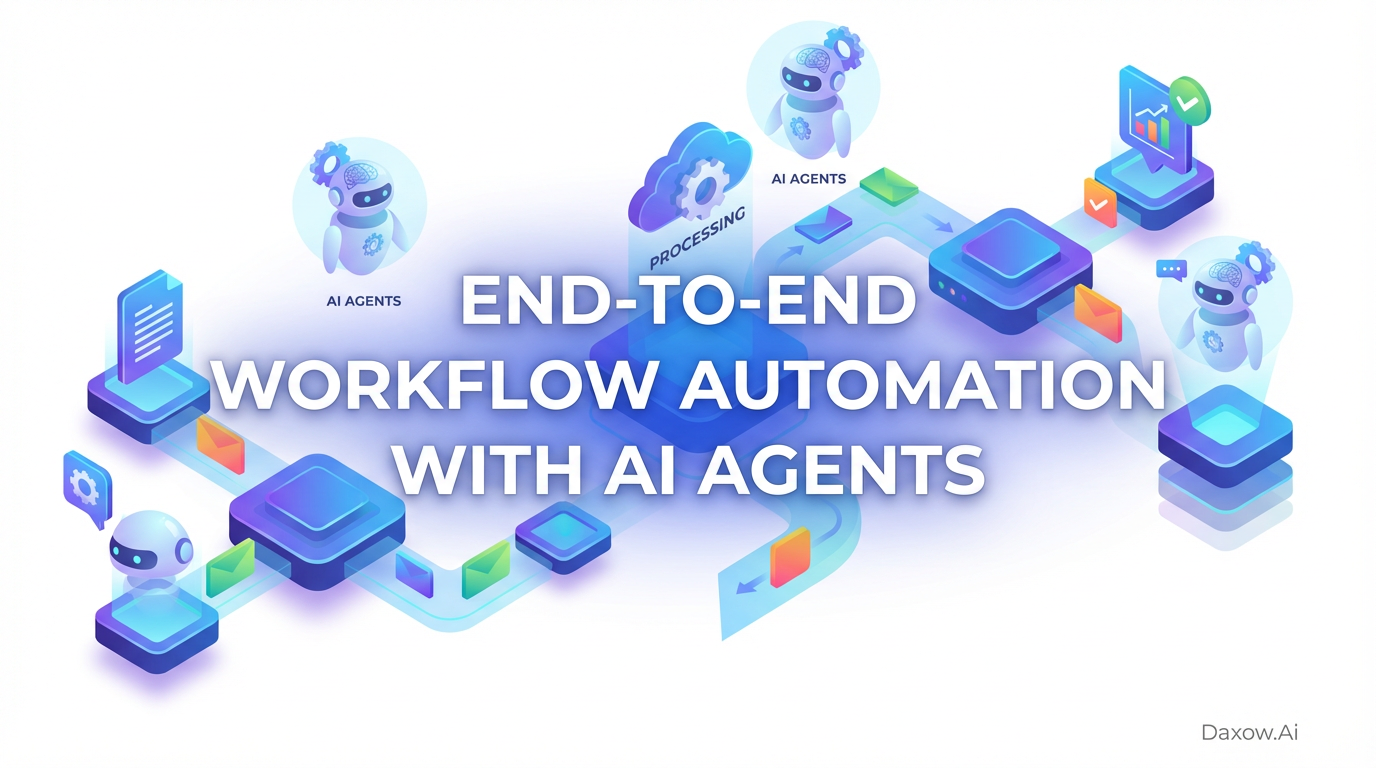
Guide to AI agents for end-to-end workflow automation: business value, architecture, industry use cases, KPIs, and a Daxow.ai implementation roadmap.
AI Agents for End-to-End Workflow Automation: How Businesses Can Reduce Manual Tasks and Boost Productivity
Estimated reading time: 15 minutes
Key Takeaways
- AI agents drastically reduce repetitive manual work, freeing staff for higher-value activities.
- End-to-end workflow automation delivers the biggest operational gains by eliminating handoffs and rework.
- Combining AI with workflow automation and integrations enhances customer experience and accelerates sales cycles.
- Measuring impact using operational, customer, and financial KPIs is essential for continuous improvement.
- Daxow.ai specializes in designing custom AI agents integrated seamlessly into enterprise systems for measurable ROI.
Table of Contents
- AI Agents for End-to-End Workflow Automation — Research Insights
- Why AI Agents and Workflow Automation Deliver Business Value
- How AI Agents Work: Architecture and Components
- Use Cases by Industry (Practical Examples)
- Implementation Roadmap: From Discovery to Production
- Measuring ROI and KPIs for AI Automation
- Common Challenges and How to Mitigate Them
- How Daxow.ai Builds AI Agents for End-to-End Workflow Automation
- Conclusion and Call to Action
- Frequently Asked Questions
AI Agents for End-to-End Workflow Automation — Research Insights
Recent industry reviews and client case studies converge on several consistent findings about AI automation and workflow automation:
- Enterprises adopting AI agents see large reductions in repetitive manual work, freeing staff for higher-value activities.
- Organizations report faster response times and higher first-contact resolution when customer support automation is deployed alongside human agents.
- Sales and lead-qualification automation consistently increases lead-to-opportunity conversion by focusing human sellers on high-value prospects.
- Document and data automation (invoices, contracts, claims) reduces processing time and error rates while improving compliance.
- The biggest operational gains come from end-to-end automation — not point solutions — because orchestration across systems eliminates handoffs and rework.
Key takeaways for decision-makers:
- Focus on processes with high volume, frequent human touchpoints, or high rework costs.
- Combine AI agents with workflow automation and integrations to eliminate manual handoffs.
- Measure impact with operational KPIs (hours saved, cycle time, error rate) and business KPIs (NPS, conversion, cost per ticket).
Why AI Agents and Workflow Automation Deliver Business Value
AI agents — autonomous or semi-autonomous software that can perceive, decide, and act — are powerful when embedded in workflow automation:
- Improve productivity: AI handles repetitive tasks at scale, increasing throughput without linear headcount growth.
- Reduce manual tasks: Routine decisions, data extraction, and standard communications are delegated to AI, cutting back-office workload.
- Enhance customer experience: Faster, consistent, and personalized responses through customer support automation boost satisfaction.
- Lower operational costs: Automation reduces processing time and error remediation, improving margins.
- Accelerate sales cycles: Sales automation and lead qualification prioritize opportunities, reducing time-to-close.
- Standardize compliance: Automated document checks and audit trails reduce regulatory risk.
How AI Agents Work: Architecture and Components
Core capabilities
- Natural language understanding and generation for customer interactions and unstructured data.
- Document and data extraction (OCR + structured parsing) to turn files into actionable data.
- Decision logic and business rules to enforce compliance and route tasks.
- Task orchestration to sequence actions across systems and people.
- Monitoring and analytics for performance and drift detection.
Integrations and data connectivity
- API-first integrations with CRMs, ERPs, ticketing systems, and databases are essential.
- Event-driven architecture (webhooks, message queues) enables real-time automation.
- Secure credentials and role-based access ensure agents act with proper authorization.
Security and governance
- Data privacy, audit logging, and explainability must be embedded.
- Governance processes control model updates and human escalation paths.
- Continuous validation prevents model drift and maintains compliance.
Use Cases by Industry (Practical Examples)
E-commerce
- Returns and refunds automation: AI agent validates return reasons, checks policy compliance, updates inventory, triggers refund, and notifies the customer — reducing processing time from days to minutes.
- Order exception handling: Agents resolve address issues, inventory mismatches, and payment failures by interacting with customers and backend systems automatically.
Business impact: Faster resolution, lower cost per return, improved customer trust.
Healthcare
- Patient intake and triage: AI agents capture medical history, pre-fill EHR forms, triage urgency, and schedule appointments, reducing front-desk workload.
- Claims validation automation: Automated extraction and validation of billing codes reduce denials and speed reimbursements.
Business impact: Better patient throughput, fewer billing errors, and higher staff productivity.
Finance and Accounting
- Invoice processing and AP automation: AI extracts invoice data, matches to purchase orders, routes approvals, and schedules payments.
- KYC and onboarding: AI agents verify documents, cross-check data, and flag anomalies for compliance teams.
Business impact: Shorter payment cycles, fewer exceptions, and stronger compliance.
Real Estate
- Lead qualification and nurturing: AI agents screen inbound leads, verify contact and intent, schedule showings, and update CRM records.
- Property document automation: Contracts and disclosures are parsed, summarized, and routed to stakeholders.
Business impact: Higher agent productivity, faster lead conversion, and reduced legal risk.
HR and Administration
- Candidate screening and scheduling: AI extracts resumes, scores candidates, performs initial screening questions, and coordinates interviews.
- Onboarding workflows: Agents provision accounts, collect documents, and trigger orientation tasks automatically.
Business impact: Reduced time-to-hire, consistent onboarding, and lower administrative burden.
Customer Support and Sales
- Omnichannel conversational agents: AI handles routine queries across chat, email, and voice, escalating complex cases to humans with context.
- Sales playbook automation: Agents prepare proposals, fetch product availability, and create quotes integrated with CRM.
Business impact: Higher first-contact resolution, improved CSAT, better sales productivity.
Implementation Roadmap: From Discovery to Production
-
Discovery and process analysis
- Map current workflows, identify bottlenecks, and prioritize use cases by ROI.
- Validate data sources, volumes, and quality.
- Daxow service: Run a process analysis workshop to quantify potential savings and define target KPIs.
-
Pilot and prototype
- Build a tightly scoped pilot on a high-impact process.
- Use rapid prototyping with real data to validate accuracy and integration points.
- Daxow service: Deliver a working pilot in weeks that integrates with your CRM/ticketing systems.
-
Production build and integration
- Harden the agent: scaling, error handling, security, and audit logging.
- Integrate via APIs, RPA, or middleware to connect end-to-end.
- Daxow service: Implement production-grade integrations and governance controls.
-
Rollout and change management
- Train users, create escalation paths, and monitor adoption.
- Use phased rollout and parallel operation until confidence is achieved.
- Daxow service: Provide training, documentation, and stakeholder alignment.
-
Monitoring, optimization, and maintenance
- Track KPIs, retrain models, and refine business logic.
- Set up alerting for model drift and performance degradation.
- Daxow service: Ongoing support and continuous improvement to maximize ROI.
Measuring ROI and KPIs for AI Automation
Define clear metrics before deployment to prove value:
Operational KPIs
- Hours saved per week/month.
- Cycle time reduction (e.g., time to close a support ticket).
- Error rate reduction and compliance incidents avoided.
Customer and revenue KPIs
- CSAT/NPS improvement.
- Lead-to-opportunity and opportunity-to-close conversion rates.
- Revenue per employee increases from productivity gains.
Financial KPIs
- Cost per transaction or ticket.
- Payback period and internal rate of return on automation projects.
- Total cost of ownership including maintenance and cloud costs.
A disciplined measurement plan ties these KPIs to targeted business outcomes, enabling continuous prioritization of automation efforts.
Common Challenges and How to Mitigate Them
Data quality and availability
Mitigation: Begin with processes that have accessible digital records; invest in data pipelines and validation.
Integration complexity
Mitigation: Use API-driven architectures and middleware; plan for phased integrations.
Change management and adoption
Mitigation: Involve stakeholders early, provide training, and maintain human-in-the-loop controls initially.
Model drift and accuracy
Mitigation: Monitor model performance, maintain feedback loops, and schedule regular retraining.
Governance and compliance
Mitigation: Implement audit trails, role-based policies, and clear escalation rules.
How Daxow.ai Builds AI Agents for End-to-End Workflow Automation
Daxow.ai specializes in turning opportunity maps into production AI systems that execute real tasks. Our approach centers on measurable outcomes and robust engineering:
- Discovery and ROI mapping: We quantify operational and financial impact of automation opportunities, prioritizing workstreams that deliver rapid, meaningful returns.
- Custom AI agents: We design agents combining LLMs, document processing, decision engines, and task orchestration for end-to-end workflow execution.
- Systems integration: We connect agents to CRMs, ERPs, ticketing platforms, and data stores to eliminate manual handoffs.
- Workflow automation: We build resilient orchestration layers that coordinate agents, human approvals, and downstream systems.
- Support automation and sales automation: We deploy conversational AI and lead-qualification agents improving conversion and customer satisfaction.
- Security, governance, and monitoring: We embed audit logs, data protections, and performance monitoring to ensure safe, compliant operation.
- Ongoing optimization: We provide continuous tuning, retraining, and process refinement to sustain and grow value over time.
Why partner with Daxow.ai?
- We combine business process expertise with engineering discipline to deliver solutions that work in production.
- We focus on measurable KPIs, clear ROI, and rapid time to value.
- We provide end-to-end services: discovery, build, integration, rollout, and long-term support.
Learn more about our services on our services page or explore how our AI solutions power business transformation.
Conclusion and Call to Action
AI Agents for End-to-end Workflow Automation are no longer theoretical — they are practical levers for reducing manual tasks, improving productivity, and transforming customer and employee experiences. The highest value comes from agent-driven end-to-end automation, strong integrations, and disciplined measurement.
If you want to evaluate where AI automation can unlock the most value in your organization, take the next step:
Book a free consultation with Daxow.ai to request a process analysis for your company and start building a custom AI system that reduces manual work, boosts productivity, and delivers measurable ROI. Contact us today to transform your workflows with AI agents and enterprise-grade automation.
Frequently Asked Questions
What are AI agents in workflow automation?
AI agents are autonomous or semi-autonomous software systems that perceive, decide, and act to execute tasks within workflows, reducing manual intervention and increasing efficiency.
How does end-to-end automation differ from point solutions?
End-to-end automation orchestrates multiple systems and processes seamlessly, eliminating handoffs and rework, whereas point solutions automate isolated tasks without full workflow integration.
How can businesses measure the success of AI automation?
Success is measured by operational KPIs (e.g., hours saved, error reduction), customer KPIs (e.g., CSAT, conversion rates), and financial KPIs (e.g., cost per transaction, ROI).
What industries benefit most from AI agents and workflow automation?
Industries such as e-commerce, healthcare, finance, real estate, HR, and customer support experience significant benefits through streamlined processes and reduced manual workload.
How does Daxow.ai support businesses implementing AI agents?
Daxow.ai provides end-to-end services including discovery, ROI mapping, custom AI agent design, integration, rollout, training, and ongoing support to ensure successful automation adoption.