
AI Agents for End-to-End Workflow Automation
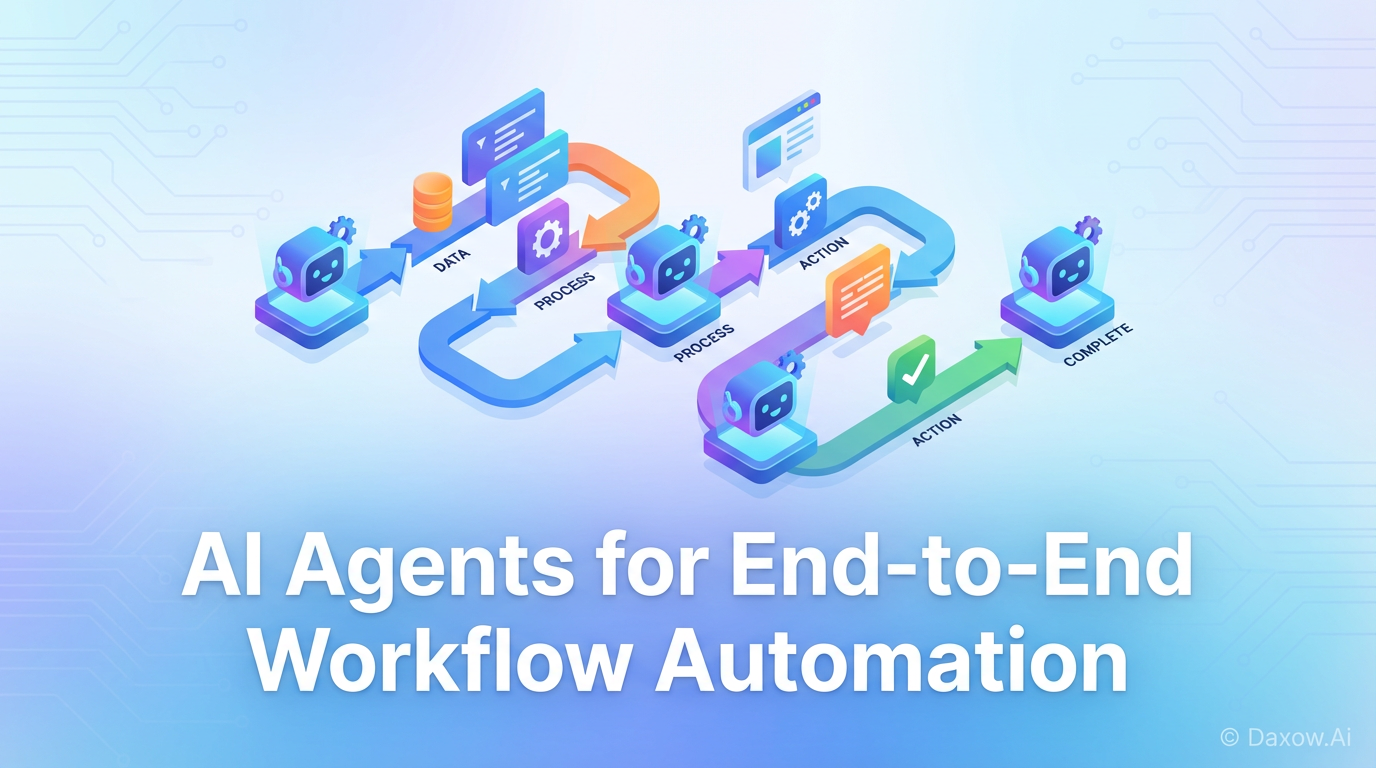
Practical guide to AI agents that automate end-to-end workflows, covering document extraction, orchestration, integrations, ROI, and implementation steps from Daxow.ai.
AI Agents for End-to-End Workflow Automation: Transforming Business Operations with Intelligent Automation
Estimated reading time: 15 minutes
Key Takeaways
- AI agents automate complex workflows by integrating across systems, reducing manual work and improving productivity.
- Core components include data ingestion, decision logic, system integrations, interaction layers, and governance.
- A structured implementation framework prevents risks and maximizes ROI from discovery through continuous optimization.
- Industry use cases span e-commerce, finance, healthcare, real estate, HR, and support to demonstrate scalable business value.
- Measuring ROI requires tracking time savings, cost reductions, SLA adherence, and revenue impact with clear metrics.
- Daxow.ai offers end-to-end AI agent design, integration, and governance to help organizations realize automation benefits.
Table of Contents
- AI Agents for End-to-End Workflow Automation: Why it Matters
- Core Components of AI Agents for End-to-End Workflow Automation
- Practical Implementation Framework: From Discovery to Production
- Use Cases: Industry Examples of AI Agents for End-to-End Workflow Automation
- Measuring ROI: Metrics That Matter
- Best Practices and Common Pitfalls
- How Daxow.ai Helps: From Discovery to Autonomous Agents
- Preparing Your Organization for AI Agents and Automation
- Next Steps: How to Start with AI Agents for End-to-End Workflow Automation
- Frequently Asked Questions
AI Agents for End-to-End Workflow Automation: Why it Matters
AI agents are software entities that can perceive data, reason, and take actions across systems to complete business processes. When deployed as part of workflow automation, they can orchestrate multi-step processes, communicate with CRMs, extract data from documents, qualify leads, escalate tickets, and update records automatically.
Key business outcomes:
- Reduce manual tasks that consume employee time and create bottlenecks.
- Boost productivity by automating routine work and enabling staff to focus on high-value decisions.
- Improve customer experience through faster responses and consistent, 24/7 service.
- Lower operational costs by shortening processing times and reducing error rates.
- Scale operations without linear increases in headcount.
Industry research and market trends indicate that organizations adopting AI automation and workflow automation see significant improvements in processing speed and customer satisfaction. Many enterprises report reduction in handling times by 30–70% and cost savings that justify rapid investment in AI agents.
Core Components of AI Agents for End-to-End Workflow Automation
1. Data Ingestion and Document Automation
AI agents rely on clean, structured data. Document automation and data extraction convert invoices, contracts, forms, and emails into actionable data. Technologies include:
- OCR and intelligent document processing.
- NLP for extracting entities, dates, amounts, and intent.
- Data validation layers to reconcile extracted values with business rules.
2. Decision Logic and Orchestration
Orchestration engines coordinate tasks across systems. Decision logic uses rules and ML models to route cases, approve exceptions, and decide next steps. This layer includes:
- Business rules engine.
- Predictive models for prioritization.
- Workflow engine that sequences tasks and assigns ownership.
3. Integrations and System Connectivity
Seamless integration with CRMs, ERPs, ticketing platforms, and databases is essential. Connectors and APIs enable agents to:
- Read and write records in Salesforce, HubSpot, SAP, and custom systems.
- Trigger downstream processes (billing, shipping, compliance checks).
- Synchronize status updates to stakeholders.
4. Interaction Layer (Chatbots & Support Automation)
AI agents can interact with customers and employees via chatbots, email automation, or voice interfaces. Capabilities include:
- Natural language understanding to interpret queries.
- Automated replies and ticket creation.
- Escalation to human agents with context and suggested actions.
5. Monitoring, Governance, and Security
Operationalizing AI agents requires monitoring performance, auditing decisions, and enforcing compliance. Include:
- Dashboards for throughput, error rates, and SLA compliance.
- Audit logs for decision traceability.
- Role-based access and data encryption.
Practical Implementation Framework: From Discovery to Production
Phase 1 — Process Discovery and Prioritization
- Map current workflows and identify manual tasks and bottlenecks.
- Quantify effort, cost, and impact for each process.
- Prioritize use cases that deliver fast ROI and are amenable to automation.
Phase 2 — Prototype and Proof-of-Value
- Build a narrow-scope prototype that integrates with one or two systems.
- Validate data extraction, decision rules, and basic orchestration.
- Measure time savings, accuracy, and user acceptance.
Phase 3 — Scale and Integrate
- Expand automation to end-to-end flows, incorporate exception handling, and add more integrations.
- Harden security, monitoring, and auditability.
- Implement governance for model updates and change management.
Phase 4 — Continuous Optimization
- Monitor KPIs and retrain models with new data.
- Add automation for adjacent processes (e.g., from invoice automation to payments and reconciliations).
- Embed feedback loops from users to improve agent behavior.
Use Cases: Industry Examples of AI Agents for End-to-End Workflow Automation
E-commerce and Retail
Use case: Order-to-fulfillment automation
- AI agents extract order exceptions from emails and marketplace feeds.
- They validate orders against inventory, route orders to warehouses, and trigger shipment labels.
- Customer support automation gives real-time delivery updates and handles returns.
Business value:
- Faster order processing, reduced shipping errors, and improved customer satisfaction.
- Sales automation through automated upsell suggestions based on order history.
Finance and Accounting
Use case: Invoice processing and AP automation
- Intelligent document processing reads invoices, matches to purchase orders, and posts entries to ERP.
- AI agents flag anomalies, obtain approvals by routing to the right approver, and schedule payments.
Business value:
- Reduced manual tasks in AP, shorter payment cycles, and fewer late fees.
- Clear audit trails for compliance.
Healthcare
Use case: Patient intake and claims processing
- AI agents extract patient details, verify insurance, and pre-fill EHR fields.
- For claims, agents validate coding, check policy coverage, and escalate denied claims with suggested appeals.
Business value:
- Improved administrative productivity, faster patient onboarding, and higher claims recovery rates.
- Better patient experience through proactive communications.
Real Estate and Property Management
Use case: Lease onboarding and maintenance automation
- AI agents extract lease terms, calendar important dates, and schedule move-ins.
- Maintenance requests are triaged by severity, vendor assignments are automated, and tenants get status updates.
Business value:
- Reduced manual coordination, improved tenant satisfaction, and optimized vendor utilization.
HR and Administrative Operations
Use case: Candidate screening and employee onboarding
- AI agents parse resumes, rank candidates, and schedule interviews.
- Onboarding tasks (documents, training enrollments, IT access) are automated end-to-end.
Business value:
- Faster time-to-hire, reduced administrative burden, and consistent onboarding experiences.
Customer Support and Sales
Use case: Lead qualification and support ticket automation
- AI agents qualify leads by parsing inbound messages and enriching records from data sources.
- Support automation resolves common issues via chatbots and routes complex incidents with full context to agents.
Business value:
- Higher conversion rates, reduced SLA breaches, and better agent productivity.
Measuring ROI: Metrics That Matter
To justify investment in AI Agents for End-to-End Workflow Automation you must measure outcomes quantitatively. Key metrics include:
- Time saved per process (hours or percentage reduction).
- Reduction in manual touches or handoffs.
- Cost per transaction before and after automation.
- SLA adherence and first response/resolution times for customer support automation.
- Revenue impact: conversion lift from improved lead qualification and reduced churn.
- Error rates and compliance improvements.
Illustrative ROI calculation:
If automating invoice processing reduces average handling time from 20 minutes to 5 minutes and the team handles 10,000 invoices/year, the annual labor hours saved is substantial. Multiply hours saved by average loaded labor cost to estimate direct savings — then add soft benefits like improved vendor terms and fewer penalties.
Best Practices and Common Pitfalls
Best Practices
- Start small and prove value with a focused proof-of-value.
- Prioritize high-volume, rule-based processes with clear decision points.
- Invest in high-quality data and structured exceptions handling.
- Design for human-in-the-loop where necessary to handle edge cases and maintain trust.
- Govern models and decisions with explainability, audit logs, and version control.
Common Pitfalls
- Trying to automate poorly defined or highly variable processes before stabilization.
- Neglecting integration complexity and underestimating API or data mapping effort.
- Ignoring change management and failing to engage stakeholders early.
- Over-reliance on a single vendor or closed data silos that limit future expansion.
How Daxow.ai Helps: From Discovery to Autonomous Agents
Daxow.ai specializes in designing and implementing AI Agents for End-to-End Workflow Automation tailored to your business.
What Daxow delivers:
- Process discovery and ROI prioritization: We map workflows, quantify impact, and recommend targets for automation.
- Custom AI agents and workflow automation: We build agents that extract data, make contextual decisions, and execute tasks across systems.
- Chatbots & customer support automation: We design bots that resolve issues and escalate with full context when needed.
- Sales automation and lead qualification: We automate lead scoring, enrichment, and routing to increase conversion.
- Data extraction & document automation: We implement intelligent document processing to convert unstructured documents into structured records.
- Integrations and system connectivity: We connect AI agents to CRMs, ERPs, ticketing systems, and databases to ensure seamless end-to-end automation.
- End-to-end implementation and governance: We provide monitoring, security, and continuous optimization to ensure sustained ROI.
Daxow’s approach is hands-on and collaborative:
- We perform a rapid proof-of-value to demonstrate measurable gains.
- We integrate with your stack, protecting data privacy and compliance.
- We transfer knowledge, enabling your team to govern and extend automation over time.
Preparing Your Organization for AI Agents and Automation
Successful adoption is as much organizational as technical.
Checklist for readiness:
- Executive sponsorship and clear KPIs.
- Inventory of systems and data access policies.
- Cross-functional automation team (operations, IT, compliance).
- Training plan for employees to work alongside AI agents.
- Governance framework for risk, security, and continuous improvement.
Next Steps: How to Start with AI Agents for End-to-End Workflow Automation
If you are evaluating AI automation initiatives, take a pragmatic approach:
- Identify a pilot process with measurable volume and clear business rules.
- Request a process analysis to estimate effort, integrations required, and expected savings.
- Run a short proof-of-value to validate outcomes and gain stakeholder buy-in.
- Plan scaling around data governance, security, and maintainability.
Frequently Asked Questions
What are AI agents in workflow automation?
AI agents are software programs that autonomously perform tasks by integrating data ingestion, decision-making, and system interactions to complete complex business workflows without manual intervention.
How do AI agents improve customer experience?
By automating responses, speeding up process times, and providing consistent 24/7 service, AI agents reduce delays and errors, resulting in faster resolutions and enhanced customer satisfaction.
What industries benefit most from AI agents?
Industries such as e-commerce, finance, healthcare, real estate, HR, and customer support have realized significant gains through automation of routine workflows and complex multi-system processes.
How does Daxow.ai support AI automation initiatives?
Daxow.ai offers end-to-end services including process discovery, custom AI agent development, system integration, chatbots, and continuous governance to ensure successful implementation and sustained ROI.