
AI Agents for Enterprise Operations: Automate Workflows & Boost ROI
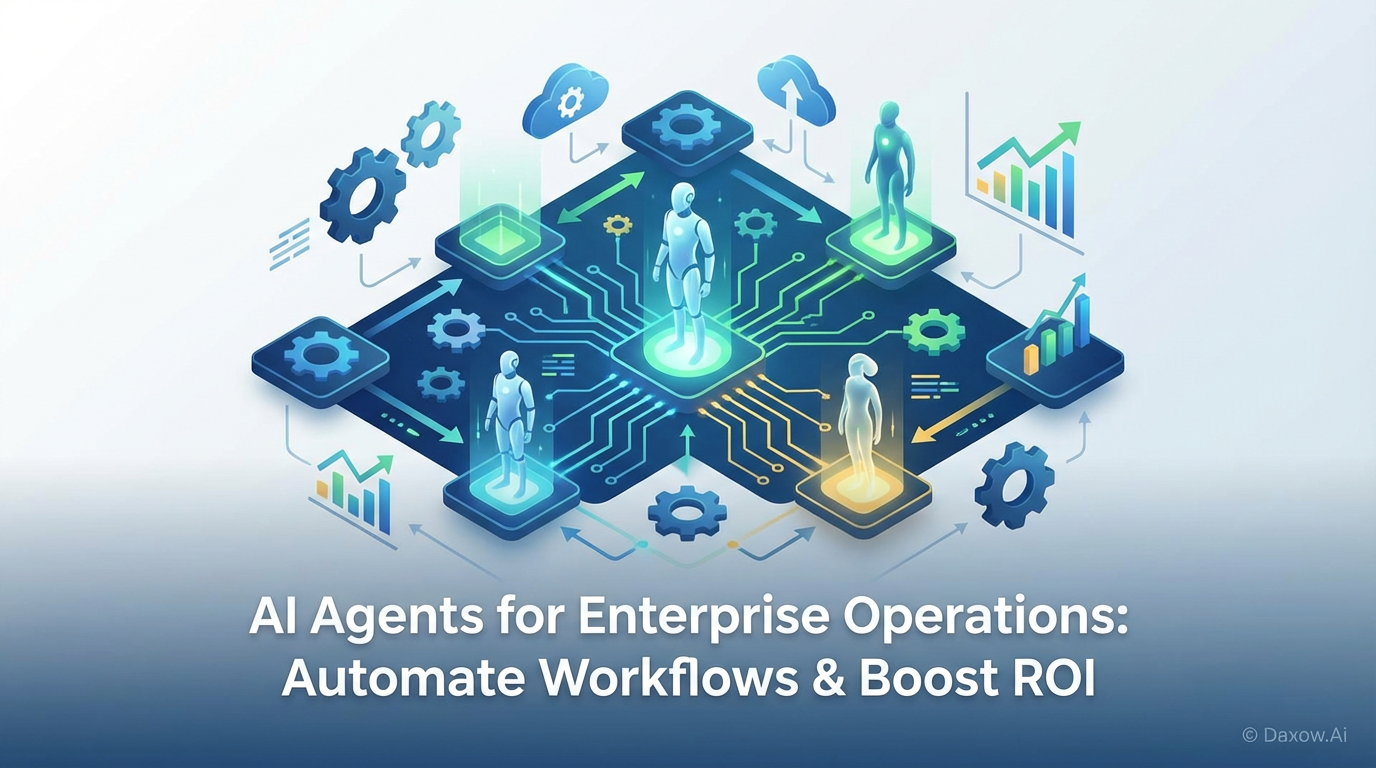
How AI agents automate enterprise operations to streamline workflows, reduce costs, and boost productivity, with practical steps and KPIs. Daxow.ai services.
AI Agents for Enterprise Operations: How AI Automation Transforms Workflows and Boosts Productivity
Estimated reading time: 15 minutes
Key Takeaways
- AI agents automate complex workflows by integrating machine learning, NLP, and business systems for faster and more accurate operations.
- Enterprise leaders benefit from AI through scale, accuracy, reduced cycle times, and freeing teams for strategic work.
- Daxow.ai delivers custom AI automation solutions, from discovery through deployment and continuous improvement.
- Practical applications span customer support, sales, finance, HR, healthcare, and real estate—with measurable ROI.
- Risk management, security, and governance are vital to successful AI agent deployment and scaling.
Table of Contents
- AI agents for enterprise operations
- Quantifying ROI from AI automation
- How to implement AI agents for enterprise operations
- Daxow.ai — end-to-end AI automation and AI agent development
- Practical use cases: AI agents for enterprise operations across industries
- Best practices when deploying AI agents
- Managing risk and compliance with AI agents
- KPIs to monitor post-deployment
- From pilot to enterprise-wide automation
- Daxow.ai’s value proposition
- Ready to automate? A practical first step
- Frequently Asked Questions
AI agents for enterprise operations
AI agents are software systems that perform specific tasks autonomously or semi-autonomously by combining machine learning, natural language processing, workflow logic, and integrations with existing business systems. Unlike point tools or simple robotic process automation (RPA), modern AI agents can understand context, make decisions, and execute multi-step processes across systems — freeing teams from repetitive work and enabling faster, more consistent outcomes.
Why enterprise leaders should prioritize AI automation now
- Scale productivity without linear headcount increases. AI agents automate repetitive decisions and data handling that would otherwise require more staff as volume grows.
- Improve accuracy and consistency. Agents reduce human error in routine tasks like data entry, document classification, and lead qualification.
- Shorten cycle times and SLAs. Automated workflows accelerate processes from onboarding to claims handling.
- Enable higher-value work. By reducing manual tasks, teams can focus on strategy, relationship building, and complex problem solving.
- Integrate across systems. AI agents act as connective tissue between CRMs, ticketing systems, ERPs, and communication platforms.
Functional building blocks
- Data ingestion and extraction (structured and unstructured)
- Natural language understanding and generation
- Decision logic and orchestration engines
- Connectors and APIs for CRM, ERP, email, ticketing, and databases
- Monitoring, observability, and audit logs
- Human-in-the-loop interfaces for escalation and approvals
- Security, access controls, and compliance features
Types of AI agents
- Conversational agents for customer support and internal help desks
- Autonomous data agents for ETL, reconciliation, and reporting
- Task orchestration agents that sequence actions across systems
- Specialist agents for sales qualification, HR onboarding, and claims triage
Quantifying ROI from AI automation
Decision-makers need measurable metrics. Typical KPIs and expected improvements include:
- Reduction in manual tasks: 30–60% fewer manual steps for automated processes.
- Process cycle time: 40–70% faster turnaround on common workflows (e.g., ticket resolution, invoice processing).
- Cost per transaction: Lowered by automating tasks and reducing rework.
- FTE reallocation: Freed capacity that can be redeployed to customer-facing or revenue-generating activities.
- Customer satisfaction: Higher NPS and CSAT scores through faster response and fewer errors.
- Compliance and auditability: Improved traceability and fewer compliance exceptions.
These figures are conservative starting points; actual results vary by process complexity and data maturity. Daxow.ai works with organizations to build realistic business cases and track improvements from pilot through scale.
How to implement AI agents for enterprise operations
1. Discovery and process mapping
- Identify high-volume, repeatable tasks where automation yields clear ROI.
- Map current workflows step-by-step and collect baseline metrics: time per step, error rates, volume, and cost.
- Prioritize opportunities using a value-effort matrix.
2. Design and prototype
- Define agent responsibilities, performance targets, and success metrics.
- Build a minimum viable agent that integrates with one or two systems and handles a subset of cases.
- Establish human-in-the-loop checkpoints for riskier decisions.
3. Integration and security
- Connect the agent to CRMs, ERPs, ticketing systems, and databases using secure APIs and enterprise-grade authentication.
- Implement role-based access control, logging, and data masking for sensitive fields.
4. Pilot and iterate
- Run pilots in controlled environments, monitor performance, and collect qualitative feedback from users.
- Tune models, rules, and orchestration logic based on real interactions.
5. Scale and continuous improvement
- Expand to adjacent processes and systems after meeting success criteria.
- Set up an operations function for ongoing monitoring, retraining models, and updating integrations.
Daxow.ai — end-to-end AI automation and AI agent development
Daxow.ai specializes in delivering practical, business-focused AI automation. Key services include:
- Process discovery and ROI modeling: We identify the highest-impact automation candidates and quantify potential savings.
- Custom AI agent design: We design agents tailored to your workflows, not one-size-fits-all models.
- System integrations and connectors: We integrate AI agents with CRMs, ERPs, help desks, and internal tools to automate real tasks end-to-end.
- Secure deployment and governance: We implement enterprise security, compliance controls, and auditability.
- Operationalization and monitoring: We provide dashboards, alerts, and continuous improvement plans to keep agents performant.
- Change management and training: We help teams adopt new workflows and reallocate capacity to strategic work.
Practical use cases: AI agents for enterprise operations across industries
Customer support automation (SaaS, e-commerce, telecom)
- Scenario: High volume of repetitive support tickets for password resets, billing queries, and order status.
- AI agent capability: Conversational agent triages tickets, provides self-service answers, extracts required data, and updates the ticketing system. Escalates complex cases to humans with context and suggested next steps.
- Business impact: Faster resolution times, reduced ticket backlog, improved CSAT, and lower support costs.
Sales automation and lead qualification (enterprise sales, startups)
- Scenario: Large inflow of inbound leads with varying fit and priority.
- AI agent capability: Automated lead qualification using web data enrichment, scoring models, and email outreach sequences. Updates CRM with disposition and schedules qualified meetings.
- Business impact: Higher conversion rates, reduced SDR load, and more time for high-value selling.
Finance and accounts payable automation (finance departments)
- Scenario: Manual invoice processing, vendor reconciliation, and exception handling.
- AI agent capability: Document extraction with OCR and NLP, validation against purchase orders, auto-posting to ERP, and routing exceptions for approval.
- Business impact: Shorter invoice cycle times, fewer late payments, improved cash flow management, and reduced processing costs.
HR and employee onboarding (HR teams)
- Scenario: New-hire paperwork, equipment provisioning, and training assignments consume HR time.
- AI agent capability: Automates onboarding checklists, triggers equipment requests, populates HRIS, and schedules orientation with calendar integrations.
- Business impact: Faster time-to-productivity for new hires and improved employee experience.
Healthcare patient intake and documentation (health systems)
- Scenario: Administrative burden of intake forms and pre-authorizations.
- AI agent capability: Pre-fill forms from patient records, extract insurance details, and submit authorization requests. Summarize notes for clinician review.
- Business impact: Reduced administrative workload, faster patient throughput, and improved billing accuracy.
Real estate operations (property managers and brokerage firms)
- Scenario: Managing listings, tenant inquiries, and maintenance requests.
- AI agent capability: Aggregate listing data, qualify tenant leads, schedule viewings, and create maintenance tickets with vendor assignment.
- Business impact: Faster turnover, better tenant satisfaction, and more efficient portfolio management.
Best practices when deploying AI agents
- Start with high-impact, low-risk processes. Prioritize workflows that are stable and transactional.
- Keep humans in the loop. Use escalation and approval gates for ambiguous or high-value decisions.
- Design for auditability. Maintain logs and explainability for auditing and regulatory needs.
- Focus on integration. The agent’s value grows with the number of systems it can connect to.
- Measure and iterate. Continuous monitoring and retraining are essential to maintain performance.
- Plan for data quality. Garbage in, garbage out — ensure input data is cleaned and standardized.
- Adopt modular architecture. Build agents as composable services that can be reused across processes.
Managing risk and compliance with AI agents
- Apply least-privilege access and encrypt data in transit and at rest.
- Implement role-based approvals and immutable audit trails.
- Use explainable models or hybrid approaches (rules + ML) for regulated decisions.
- Maintain a governance framework for model updates, performance thresholds, and incident response.
- Ensure data residency and privacy requirements are met for customers in regulated industries.
KPIs to monitor post-deployment
- Percentage reduction in manual steps
- Process cycle time before and after automation
- Cost per transaction
- Number of escalations to humans and their resolution time
- Model precision, recall, and fallback rates
- User satisfaction (CSAT) and business stakeholder feedback
- ROI and payback period
From pilot to enterprise-wide automation
- Build a Center of Excellence (CoE) that standardizes tooling, best practices, and governance.
- Reuse connectors and agent components to accelerate new automations.
- Train business teams to identify automation opportunities and submit candidates to the CoE.
- Maintain a backlog with clear prioritization based on value and feasibility.
- Automate monitoring and deploy self-healing or rollback capabilities for agent updates.
Daxow.ai’s value proposition
- End-to-end delivery: From discovery to production and ongoing optimization.
- Custom solutions: Agents designed specifically to your processes and systems.
- Integration expertise: Connectors for popular CRMs, ERPs, ticketing, and messaging tools.
- Business-first approach: Focus on measurable ROI and operational impact.
- Security and compliance: Enterprise-ready controls and governance baked into every deployment.
- Continuous support: Monitoring, retraining, and improvements as business needs evolve.
Ready to automate? A practical first step
- Conduct a rapid process analysis to identify 3–5 high-impact automation candidates.
- Run a focused pilot for one workflow to prove value and collect performance data.
- Expand to adjacent processes and establish governance for continuous scaling.
Frequently Asked Questions
What distinguishes AI agents from traditional robotic process automation (RPA)?
AI agents combine machine learning, natural language processing, and decision-making capabilities to perform multi-step, context-aware workflows across systems, whereas traditional RPA typically involves rule-based, repetitive task execution without adaptive intelligence.
How does Daxow.ai ensure security and compliance in AI agent deployments?
Daxow.ai integrates enterprise-grade security practices including role-based access control, encryption, audit logs, and compliance frameworks tailored to industry regulations, ensuring reliable governance and data protection.
Can AI agents be customized for specific industry needs?
Yes, Daxow.ai designs custom AI agents aligned with unique business workflows, industry requirements, and integration landscapes to maximize value and operational fit.
What are best practices for scaling AI agents across an enterprise?
Establish a Center of Excellence, reuse components, prioritize automation opportunities collaboratively, and implement continuous monitoring and self-healing mechanisms to effectively scale and maintain AI agents.