
Deploy AI Agents for Enterprise Workflow Automation
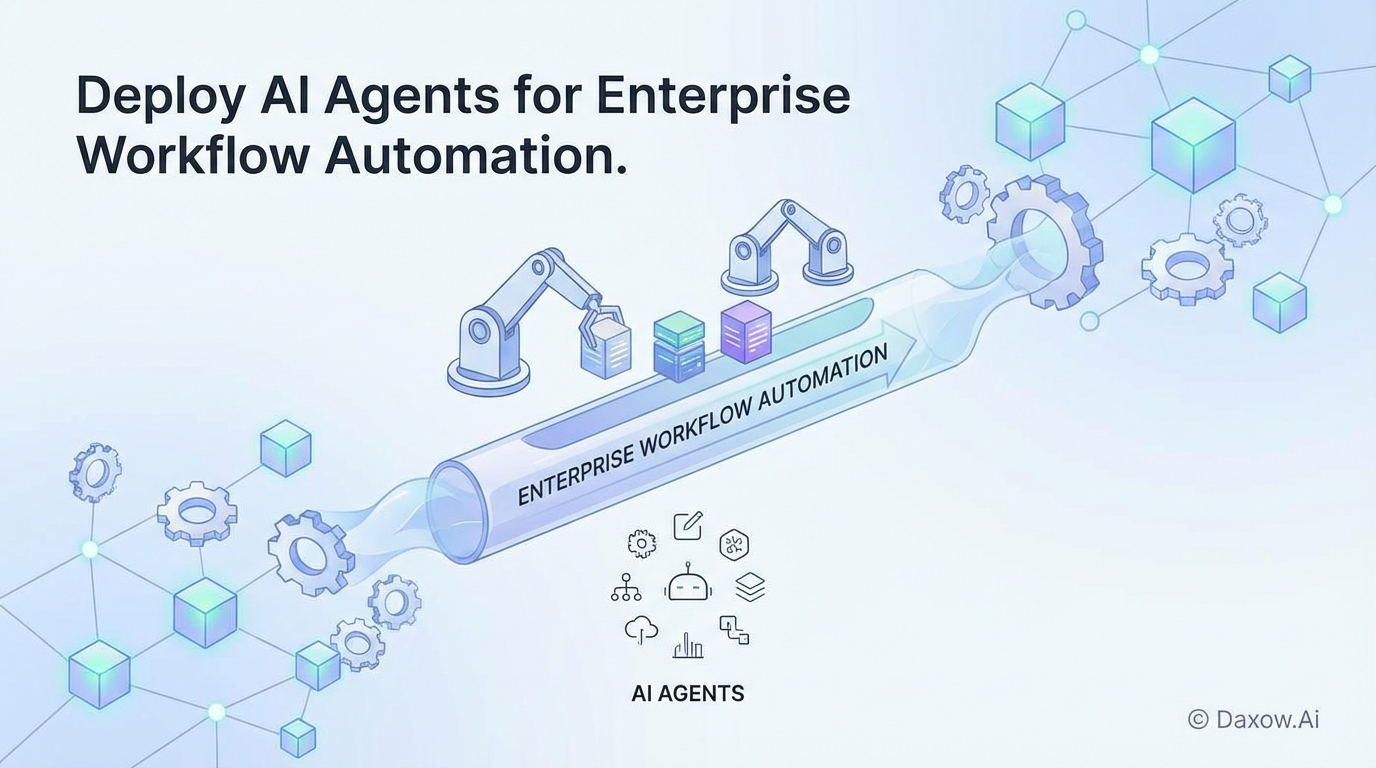
Guide to deploying AI agents to automate enterprise workflows, reduce manual work, and boost productivity with ROI, use cases, and a roadmap.
AI Agents for Enterprise Workflow Automation: How to Deploy AI Automation to Reduce Manual Tasks and Boost Productivity
Estimated reading time: 15 minutes
Key Takeaways
- AI agents enable end-to-end workflow automation beyond traditional rules and RPA.
- Deploying AI agents reduces manual tasks, boosts productivity, and lowers operational costs.
- Integration, human-in-the-loop escalation, and continuous optimization are critical for success.
- Industry use cases demonstrate practical benefits from sales automation to healthcare documentation.
- Daxow.ai offers tailored AI automation services focused on ROI, compliance, and scalability.
Table of Contents
- AI Agents for Enterprise Workflow Automation — Why it matters
- How AI Agents Work in Workflow Automation
- Business Value and ROI of AI Automation
- Industry Use Cases — Practical Examples of AI Agents in Action
- Implementation Roadmap: From Process Discovery to Autonomous Agents
- Risks, Compliance, and Best Practices
- How Daxow.ai Helps You Deploy AI Agents and End-to-End Business Automation
- Measuring Success: KPIs for AI Automation Projects
- Frequently Asked Questions
AI Agents for Enterprise Workflow Automation — Why it matters
Enterprises face growing complexity: distributed teams, high-volume customer interactions, increasing regulatory burdens, and fragmented data across systems. Traditional automation (rules and RPA) delivers value but struggles with unstructured inputs, contextual decision making, and continuous learning. AI agents combine language understanding, task orchestration, and systems integration to automate end-to-end workflows—not just isolated steps.
Key benefits:
- Reduce manual tasks across repetitive processes such as data entry, ticket triage, and contract review.
- Boost productivity by enabling staff to focus on strategic work instead of routine operations.
- Improve customer experience through faster responses and consistent outcomes via customer support automation and sales automation.
- Lower operational costs by replacing manual labor-intensive processes with reliable automated systems.
- Scale knowledge work by encoding domain expertise into agents that operate 24/7.
How AI Agents Work in Workflow Automation
AI agents are software entities that perceive, reason, and act across connected systems to complete defined business tasks. Implementing them requires attention to architecture, integration, and governance.
Core components
- Perception: Natural language understanding (NLU), OCR, and structured data ingestion to interpret emails, documents, and forms.
- Reasoning & Decisions: Knowledge bases, rules, and ML models that determine next steps based on context.
- Action & Orchestration: APIs, RPA connectors, and task runners that execute operations in CRMs, ERPs, ticketing systems, and databases.
- Monitoring & Feedback: Logging, human-in-the-loop checkpoints, and continuous learning pipelines.
Integrations and data connectivity
- Use API-first connectors for CRMs, support systems, and ERP platforms.
- Implement secure data pipelines for document stores and internal knowledge bases.
- Leverage middleware for event-driven orchestration and error handling.
Human-in-the-loop and escalation
Design agents with clear escalation rules. For high-risk or ambiguous situations, agents should escalate to humans with a concise context summary, suggested actions, and source evidence.
Business Value and ROI of AI Automation
Decision-makers evaluate automation projects by expected ROI, risk, and strategic alignment. AI agents produce ROI across time savings, error reduction, and revenue capture.
Quantifying benefits:
- Time savings: Automating email triage, lead qualification, or invoice processing can reduce processing time by 40–80% per transaction.
- Error reduction: Automating data extraction and validation reduces downstream errors and rework, improving accuracy by up to 90% vs manual entry.
- Cost savings: Replace repetitive FTE hours with automation. A single AI agent handling 3,000 monthly transactions can offset development costs within 6–12 months in mid-sized operations.
- Revenue uplift: Sales automation and lead qualification boost conversion rates by ensuring faster, personalized outreach and better lead prioritization.
Key metrics to track:
- Cycle time reduction (end-to-end)
- Volume of tasks automated
- FTE hours reclaimed
- Error/rework rate
- Lead response time and conversion lift
- Customer satisfaction (CSAT/NPS) improvements
Industry Use Cases — Practical Examples of AI Agents in Action
Technology & SaaS — Sales automation and onboarding
Use case: Automatic lead qualification and trial onboarding.
- AI agents parse inbound leads, enrich records via third-party and internal sources, score leads, and trigger tailored onboarding sequences.
- Result: Reduce manual qualification time by 70%, shorten time-to-first-activation, and increase MQL-to-ARR conversion.
E-commerce — Order exceptions and returns
Use case: Intelligent returns processing.
- AI agents extract order details, verify warranty/return eligibility, generate shipping labels, and update inventory and finance systems.
- Result: Lower dispute resolution time by 60%, reduce returns processing costs, and improve customer support automation.
Finance — Invoice processing and compliance
Use case: End-to-end AP automation.
- Agents ingest invoices via OCR, validate line items against POs, route exceptions, and post approved transactions to the ERP.
- Result: Reduce AP cycle time by up to 80%, minimize late-payment fees, and improve audit readiness.
Healthcare — Patient intake and clinical documentation
Use case: Automated intake and prior authorization.
- AI agents pre-fill intake forms, extract clinical information from referrals, and prepare authorization packages for payers.
- Result: Decrease administrative burden on clinical staff, accelerate treatment scheduling, and reduce denials due to incomplete submissions.
Real Estate — Document automation and closings
Use case: Contract review and closing coordination.
- Agents extract clauses, flag deviations from standard terms, assemble closing checklists, and coordinate signatures across parties.
- Result: Reduce closing time and manual coordination, improve contract compliance, and reduce legal review hours.
HR & Administration — Candidate screening and onboarding
Use case: Resume screening and new-hire setup.
- AI agents evaluate resumes against role criteria, schedule interviews, and automate IT and benefits provisioning.
- Result: Accelerate hiring cycles, reduce recruiter time spent on screening, and improve new-hire experience.
Implementation Roadmap: From Process Discovery to Autonomous Agents
1. Process discovery and prioritization
- Map end-to-end workflows.
- Identify high-volume, high-friction tasks where AI adds decision-making value.
- Prioritize use cases by ROI, feasibility, and compliance constraints.
2. Design and proof of value
- Define success metrics and SLAs.
- Build a Minimum Viable Agent for a single high-impact subprocess.
- Validate with real data and stakeholder feedback.
3. Build integrations and data pipelines
- Connect to CRMs, ticketing systems, ERPs, and document repositories.
- Implement secure APIs and data governance.
- Ensure reliable error handling and audit trails.
4. Pilot and human-in-the-loop deployment
- Run pilots with real users and gradually increase autonomy.
- Include escalation paths and supervision dashboards.
- Capture feedback for continuous improvement.
5. Scale and govern
- Standardize agent templates and reusable connectors.
- Monitor performance and drift; retrain models as needed.
- Implement role-based access controls and compliance reporting.
6. Continuous optimization
- Use telemetry to identify bottlenecks.
- Add capabilities (multilingual support, multimodal inputs) incrementally.
- Measure long-term ROI and re-prioritize pipeline.
Risks, Compliance, and Best Practices
Data privacy and security
- Enforce encryption in transit and at rest.
- Minimize data footprints by applying data retention policies.
- Implement strict access controls and audit logs.
Regulatory and compliance considerations
- For regulated industries (finance, healthcare), maintain explainability of decisions, clear audit trails, and human approvals where required.
- Map agent decisions to regulatory obligations.
Bias and quality control
- Regularly audit models for bias and correctness.
- Maintain representative training data and a process for remediation.
Resilience and observability
- Design for graceful failure, retries, and human handoff.
- Implement monitoring dashboards for performance, error rates, and user satisfaction.
How Daxow.ai Helps You Deploy AI Agents and End-to-End Business Automation
Daxow.ai is an AI automation agency founded in Estonia in 2024 that specializes in turning manual operations into scalable, automated systems using AI agents. Our approach is practical, business-focused, and results-driven.
What Daxow.ai does:
- Process discovery and analysis: We map current workflows, quantify manual tasks, and prioritize automation opportunities.
- Custom AI agent design: We build agents tailored to your domain that combine NLU, document understanding, and decision logic.
- Workflow automation and orchestration: We integrate agents into your stack—CRMs, ERPs, support platforms—to automate end-to-end processes.
- Customer support automation & chatbots: We implement intelligent conversational agents that reduce first-response times and increase resolution rates.
- Sales automation & lead qualification: We design qualification agents that route high-value leads and trigger sales workflows.
- Data extraction & document automation: We deliver robust extraction pipelines for invoices, contracts, medical forms, and more.
- System integrations and connectivity: We build secure connectors and middleware for reliable data flow across business tools.
- End-to-end deployment and monitoring: We ensure agents operate reliably with observability, human-in-the-loop workflows, and continuous improvement.
Why partner with Daxow.ai:
- Business-first approach: We prioritize ROI, not novelty. Every project begins with measurable goals.
- Custom solutions: We tailor AI agents to your processes, avoiding one-size-fits-all products.
- Speed and scalability: Rapid pilots prove value, while robust architecture supports enterprise scaling.
- Compliance and security: We implement governance from day one to meet regulatory and internal standards.
Learn more about our services and how we help companies deploy AI automation that truly delivers.
Measuring Success: KPIs for AI Automation Projects
Track these KPIs to evaluate impact:
- Percentage of process automated
- Reduction in average handling time
- Number of FTE hours saved
- Error rate reduction
- Cost per transaction before vs after
- Customer satisfaction and response times
- Conversion rates for sales automation
Frequently Asked Questions
What are AI agents in enterprise workflow automation?
AI agents are software entities that use natural language understanding, machine learning, and system integrations to automate complete business workflows, reducing manual effort and increasing efficiency.
How do AI agents improve productivity?
By automating repetitive, time-consuming tasks such as data entry and ticket triage, AI agents let employees focus on strategic and higher-value work, thereby boosting overall productivity.
Can AI agents handle unstructured data?
Yes, AI agents incorporate natural language understanding and OCR technologies to interpret emails, documents, forms, and other unstructured inputs effectively.
What industries benefit most from AI agent automation?
Technology, e-commerce, finance, healthcare, real estate, and HR are prominent examples. Each benefits from tailored AI agents solving industry-specific workflow challenges.
How does Daxow.ai support AI agent deployment?
Daxow.ai offers end-to-end services from process discovery and custom agent design to integration, pilot deployment, monitoring, and continuous optimization to maximize ROI and compliance.