
AI Agents and Intelligent Automation for Business Transformation
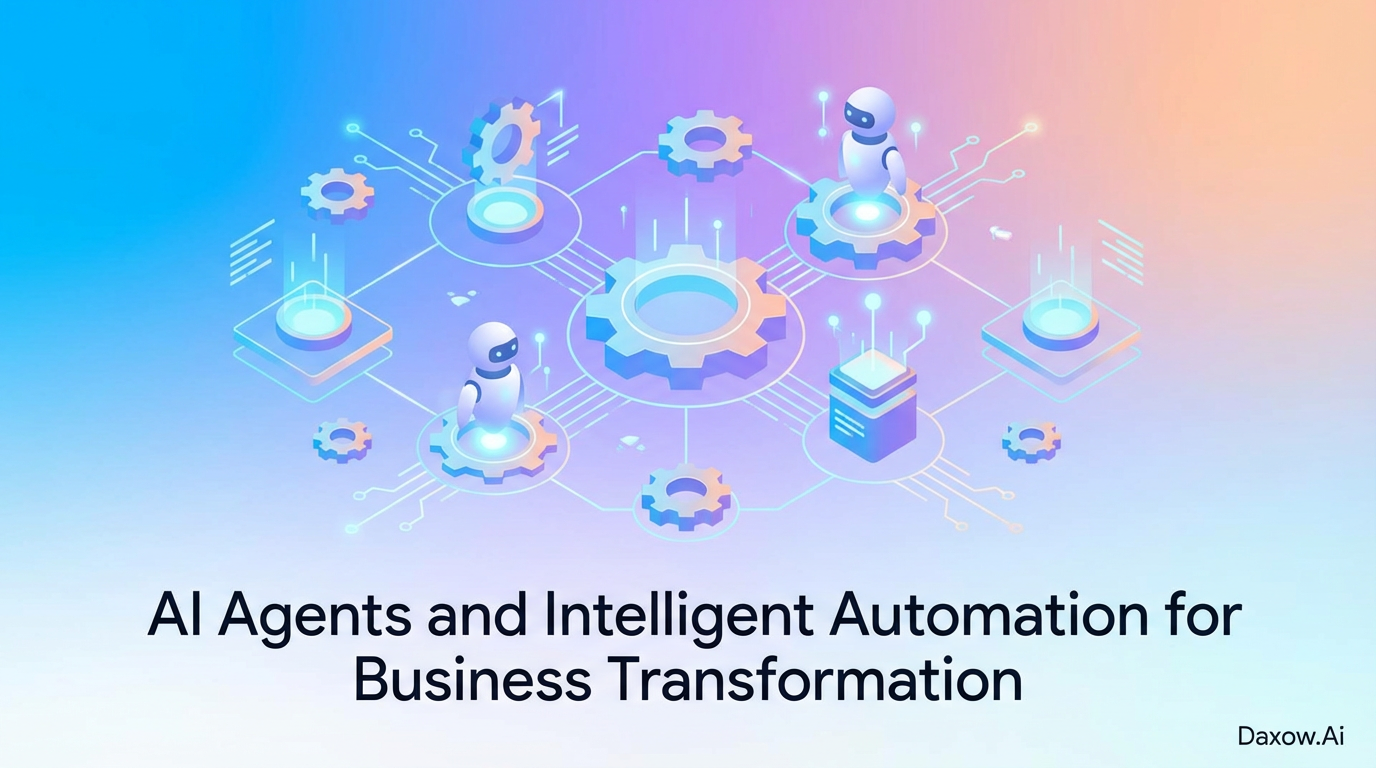
AI agents and intelligent automation that cut manual work, boost productivity, and deliver ROI. Practical roadmap, industry use cases, and Daxow.ai solutions.
Harnessing AI Agents and Intelligent Automation for Business Transformation
Estimated reading time: 15 minutes
Key Takeaways
- AI agents and intelligent automation reduce manual work, accelerate decision-making, and scale operations efficiently.
- Structured implementation can deliver 3–5x faster ROI, with cost savings up to 50% and improved customer experiences.
- Practical use cases span e-commerce, healthcare, finance, real estate, and HR with measurable business impacts.
- A phased roadmap from audit through scale minimizes risks and speeds value realization.
- Daxow.ai provides custom AI agent development and integrates with backend systems for end-to-end automation.
- Governance, risk management, and change management are essential to sustainable AI automation success.
Table of Contents
- Harnessing AI Agents and Intelligent Automation for Business Transformation — Why it matters
- How AI Agents and Workflow Automation Drive Results
- Practical Use Cases Across Industries
- Implementation Roadmap — From Audit to Scale
- Measuring ROI and Business Value
- How Daxow.ai Builds Custom AI Systems and Delivers End-to-End Automation
- Risk Management and Governance
- Quick Checklist for Decision-Makers
- Frequently Asked Questions
Harnessing AI Agents and Intelligent Automation for Business Transformation — Why it matters
AI agents and intelligent automation are autonomous systems that perceive context, make decisions, and execute tasks with minimal human intervention. Unlike traditional RPA, modern AI agents combine machine learning, natural language processing, and workflow orchestration to handle exceptions, adapt to new data, and integrate with backend systems such as CRMs and ERPs.
Key strategic benefits:
- Scale operations without proportional headcount increases.
- Reduce repetitive manual work and human error.
- Accelerate execution and decision-making for faster time-to-market.
- Improve customer satisfaction through faster, accurate responses and 24/7 availability.
- Turn operational data into actionable insights for strategic planning.
Organizations that follow structured implementations realize objectives 3–5x faster, often achieving ROI within 6–12 months. Typical cost savings on automated processes range from 30–50%, with significant uplifts in customer satisfaction and process throughput when deployed correctly.
How AI Agents and Workflow Automation Drive Results
AI agents operate at the intersection of data, process, and action. They extract information from documents, converse with customers, update systems, and trigger downstream workflows — all without manual input.
How these capabilities map to business outcomes:
- Data extraction & document automation eliminate manual data entry and reduce processing times for invoices, claims, and forms.
- Chatbots and customer support automation resolve common inquiries autonomously, improving First Contact Resolution and reducing support costs.
- Lead qualification and sales automation capture, score, and route leads to the right teams, shortening sales cycles and improving conversion rates.
- Integrations with business tools ensure a single source of truth, enabling end-to-end process automation across CRM, ERP, ticketing, and accounting systems.
Practical orchestration example:
An AI agent ingests an email with an attached invoice, extracts fields, validates them against the ERP, submits for approval if values match rules, and escalates exceptions to a human reviewer — reducing manual handling by up to 80% for invoice processing scenarios.
Practical Use Cases Across Industries
E-commerce
Use cases:
- Personalized product recommendations powered by real-time customer behavior signals.
- Inventory forecasting and automated reorder workflows.
- Customer support chatbots that handle up to 80% of routine inquiries autonomously.
Business impact:
- Higher conversion rates and reduced cart abandonment.
- Lower stockouts and carrying costs.
- Faster response times and improved NPS.
Healthcare
Use cases:
- Patient scheduling and triage conversational agents that pre-screen symptoms.
- Automated insurance claim intake and processing with built-in compliance checks (HIPAA-ready design).
- Document digitization for patient records and referrals.
Business impact:
- Administrative burdens reduced by up to 50%.
- Faster patient throughput and fewer scheduling errors.
- Less backlog for billing and claims teams.
Finance
Use cases:
- Real-time fraud detection agents that analyze transaction patterns.
- Automated compliance reporting and KYC document verification.
- Personalized financial advice assistants for customer accounts.
Business impact:
- Lower fraud losses and improved audit trails.
- Faster compliance cycles and reduced manual review workload.
- Better customer retention through timely advisory services.
Real Estate
Use cases:
- Automated lead qualification and follow-up workflows.
- Scheduling virtual or in-person tours and generating property valuations from market data.
- Document automation for leases and closing paperwork.
Business impact:
- Faster lead-to-appointment conversion.
- Reduced manual overhead for agents, enabling higher deal throughput.
- Consistent, traceable documentation across transactions.
HR and Talent Acquisition
Use cases:
- Resume screening and automated candidate shortlisting.
- Onboarding workflows that coordinate IT, payroll, and manager tasks.
- Employee self-service agents for common queries (benefits, leave, policies).
Business impact:
- Time-to-hire reduced by around 40%.
- Better candidate experience and reduced bias through standardized screening.
- Fewer HR tickets and faster new-hire ramp-up.
Implementation Roadmap — From Audit to Scale
A structured, phased approach reduces risk and speeds value realization. Below is a practical implementation roadmap you can adopt.
1. Assess Needs and Define Goals
- Conduct a bottleneck audit to map “as-is” processes and identify high-volume, rule-based tasks.
- Prioritize use cases aligned with strategic objectives (cost reduction, faster turnaround, customer satisfaction).
- Define measurable KPIs up front (e.g., average handling time, error rates, lead conversion uplift).
2. Prepare Data and Systems
- Clean and standardize data sources; build centralized knowledge bases.
- Document workflows and decision rules.
- Ensure integrations with existing CRMs, ERPs, ticketing systems, and compliance frameworks.
3. Select Technology and Team
- Choose scalable platforms that support ML, NLP, and workflow orchestration.
- Assemble a cross-functional team: operations leads, data engineers, subject matter experts, and AI developers.
- Consider no-code/low-code tools for rapid prototyping and faster business validation.
4. Pilot and Test
- Launch a focused pilot in one department or for a single process.
- Monitor performance against KPIs and gather user feedback.
- Iterate quickly: retrain models, refine decision rules, and adjust UX.
5. Rollout and Optimize
- Expand incrementally to additional teams, channels, and geographies.
- Implement continuous improvement: monthly reviews, model retraining, and user training sessions.
- Maintain governance, audit trails, and bias monitoring to ensure compliance and fairness.
Best practices to follow:
- Start with low-complexity, high-volume processes to build momentum.
- Communicate change clearly and provide training to affected teams.
- Monitor for bias and maintain auditability for models and decisions.
- Focus on outcomes over tools — select technology to meet goals, not the other way around.
Measuring ROI and Business Value
Trackable metrics are essential to justify investment and sustain momentum. Focus on operational, financial, and customer metrics.
Operational metrics:
- Reduction in manual handling time or full-time equivalents (FTEs) needed.
- Automated resolution rate for support queries.
- Average processing time for invoices, claims, or applications.
Financial metrics:
- Cost savings as a percentage of process costs (typically 30–50% for automated processes).
- Time-to-value and payback period (common ROI within 6–12 months).
- Revenue uplift tied to improved lead qualification or conversion rates.
Customer metrics:
- Customer satisfaction and Net Promoter Score (NPS) improvements (20–30% uplift in some e-commerce scenarios).
- First Contact Resolution and average response time.
Create a dashboard that maps these KPIs to the pilot use case and then to enterprise-wide adoption. Use A/B testing where applicable to quantify the incremental impact of automation on outcomes.
How Daxow.ai Builds Custom AI Systems and Delivers End-to-End Automation
At Daxow.ai we specialize in designing and deploying AI agents and workflow automation tailored to your business. Our approach focuses on measurable results and seamless integration.
What we do:
- Discovery & Process Analysis: We perform a process audit to identify automation opportunities and define KPIs.
- Custom AI Agent Design: We build agents capable of document understanding, conversational workflows, lead qualification, and decision-making that integrate with your systems.
- Workflow Automation & Integrations: We connect AI agents to CRMs, ERPs, ticketing systems, and databases for true end-to-end automation.
- Data & Compliance: We prepare and secure data pipelines, enforce compliance standards, and establish audit trails.
- Pilot, Iterate, Scale: We run pilots, collect metrics, refine models, and scale across teams while maintaining governance.
Why partner with Daxow.ai:
- End-to-end delivery from strategy to production.
- Industry experience across e-commerce, healthcare, finance, real estate, and HR.
- Focus on ROI — we prioritize automation that produces measurable cost savings and productivity gains.
- Modular integrations that preserve your current investments and extend capabilities without disruption.
- AI agents that execute real tasks — not just proofs of concept.
Example Daxow.ai engagement
- Discovery: 2-week process mapping and KPI setting.
- Pilot: 6–8 week build-run-optimize cycle for one high-impact use case (e.g., automated claims intake).
- Scale: Phased rollout over 3–9 months across departments with governance and model maintenance.
Learn more about our tailored AI systems and services on the Daxow.ai Services and Solutions pages.
Risk Management and Governance
AI projects require disciplined governance to mitigate technical and business risks.
Key controls:
- Data quality and lineage monitoring.
- Model explainability and bias checks.
- Role-based access and audit trails for automated decisions.
- Incident response and manual escalation paths for exceptions.
- Clear SLA definitions for uptime and performance.
Change Management
- Communicate expected benefits and KPIs to stakeholders.
- Train teams on how the new workflows operate and how to work with AI agents.
- Provide mechanisms for feedback and continuous improvement.
Quick Checklist for Decision-Makers
- Do you have high-volume, repetitive tasks with measurable KPIs?
- Are core systems (CRM, ERP, ticketing) centralized and accessible?
- Is data sufficiently clean for pilot use cases or can it be prepared quickly?
- Can you assemble a cross-functional sponsor team for governance?
- Are you prepared to run a time-bound pilot with defined success metrics?
If you answered yes to most items, you’re ready to start.
Conclusion and Call to Action
Harnessing AI Agents and Intelligent Automation for Business Transformation is attainable, measurable, and strategic. The right combination of AI agents, workflow automation, and systems integration turns manual, error-prone processes into resilient, scalable operations — delivering cost savings, faster execution, and superior customer experiences.
Daxow.ai helps businesses design and deploy these solutions end-to-end: from process analysis and custom AI agent development to integrations, compliance, and scaling. If you want to reduce manual tasks, boost productivity, and capture the ROI of intelligent automation, take the next step.
Book a free consultation with Daxow.ai or request a process analysis for your company to identify the highest-impact automation opportunities and build a custom AI system tailored to your goals. Contact us today to begin your automation journey.
Frequently Asked Questions
What is the difference between traditional RPA and AI agents?
Traditional RPA performs rule-based, repetitive tasks without learning capabilities, while AI agents combine machine learning, natural language processing, and contextual decision-making to handle complex workflows and exceptions.
How quickly can businesses expect ROI from AI automation?
Organizations often realize return on investment within 6 to 12 months, especially when following a structured phased implementation roadmap targeting high-impact processes.
Is AI automation suitable for all industries?
AI automation benefits a wide range of industries including e-commerce, healthcare, finance, real estate, and HR, with varied practical use cases that deliver tangible business outcomes.
How does Daxow.ai ensure compliance and governance in AI solutions?
Daxow.ai implements strong governance controls including data quality monitoring, model explainability, audit trails, bias checks, and role-based access to maintain compliance and ethical AI practices.