
AI Agents and Intelligent Automation: Reshaping Business Operations
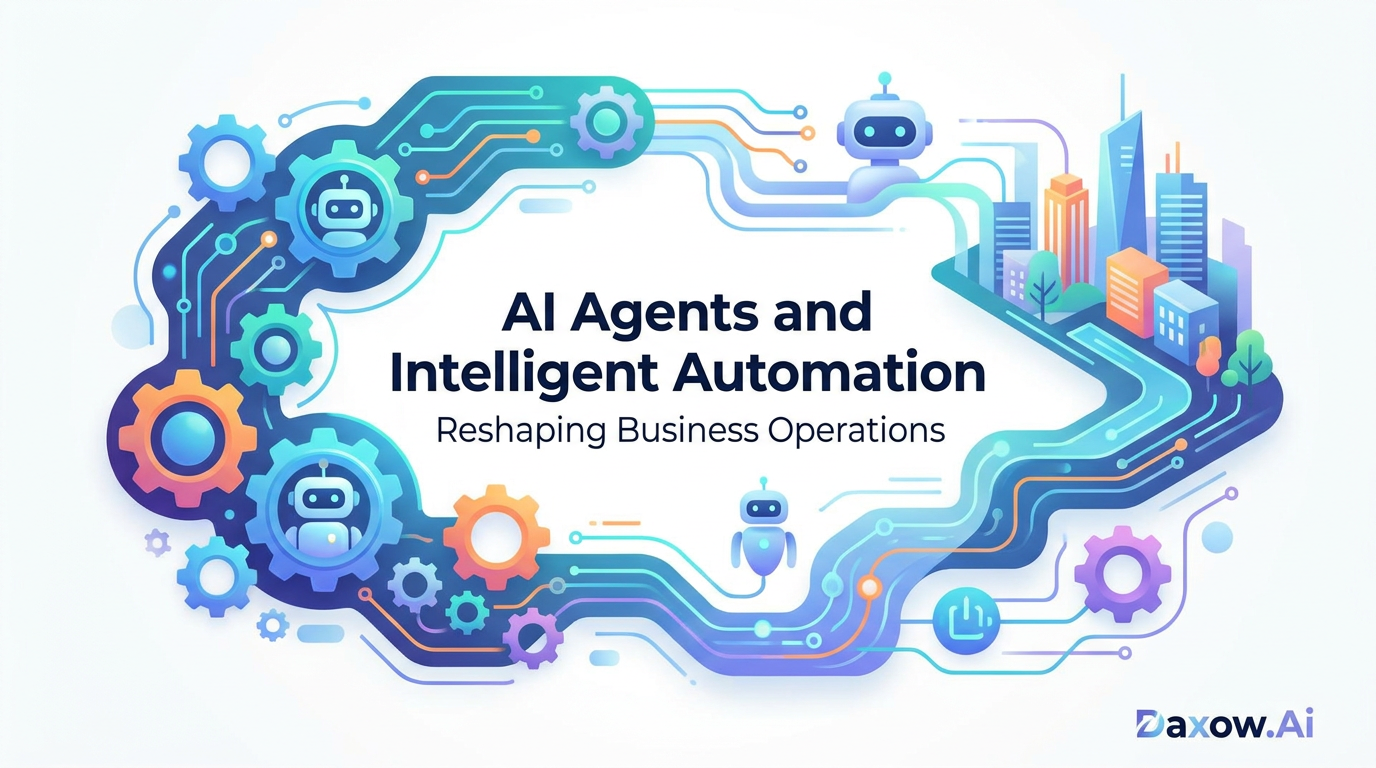
Learn how AI agents and intelligent automation reduce manual work, boost productivity, and scale operations with Daxow.ai's use cases and roadmap.
AI Agents and Intelligent Automation: How They Are Reshaping Modern Business Operations
Estimated reading time: 15 minutes
Key Takeaways
- AI agents enable outcome-based automation beyond scripted tasks by reasoning and orchestrating across systems.
- Intelligent automation offers measurable benefits in cost savings, productivity, revenue, compliance, and customer experience.
- Industry-specific examples show AI agents accelerating workflows in e-commerce, healthcare, finance, real estate, and HR.
- Daxow.ai’s end-to-end approach combines discovery, design, deployment, governance, and continuous improvement.
- Successful AI automation programs require strong KPIs, governance, observability, and responsible automation practices.
Table of Contents
- AI Agents and Intelligent Automation: How They Are Reshaping Modern Business Operations — What It Means
- Key Business Benefits of AI Automation and AI Agents
- Practical Use Cases: How AI Agents Reshape Operations Across Industries
- How Daxow.ai Designs and Delivers AI Agents That Execute Real Tasks
- Implementation Roadmap: From Pilot to Enterprise Scale
- Measuring ROI and Business Impact
- Best Practices and Common Pitfalls
- Compliance, Security, and Responsible Automation
- Frequently Asked Questions
AI Agents and Intelligent Automation: How They Are Reshaping Modern Business Operations — What It Means
AI Agents and Intelligent Automation: How They Are Reshaping Modern Business Operations is not just a headline — it describes a practical shift in how organizations reduce manual tasks, scale operations, and unlock productivity gains. Leaders across industries are moving beyond point solutions to adopt AI automation and workflow automation that combine reasoning, integration, and continuous learning. This article explains what this shift means, gives hands‑on use cases across industries, and lays out an actionable path you can follow — including how Daxow.ai designs and deploys custom AI agents that execute real business tasks end‑to‑end.
AI agents are software systems that perceive inputs (emails, documents, system events), reason about objectives and constraints, and take actions across connected systems to achieve outcomes. Intelligent automation combines AI agents with integrations and orchestration to convert workflows into autonomous processes.
- From tasks to outcomes: Traditional automation performs scripted steps. AI agents achieve outcomes by choosing next actions, handling exceptions, and escalating when needed.
- Cross‑system orchestration: Agents coordinate CRM, ERP, helpdesk, HRIS, and other systems to remove manual “swivel‑chair” work.
- Continuously improving processes: Agents learn from feedback and performance metrics to improve accuracy and efficiency.
For decision‑makers, the implications are clear: faster cycle times, lower operational cost, improved customer experience, and the ability to redeploy human talent to higher‑value work.
Key Business Benefits of AI Automation and AI Agents
Cost and Productivity
- Labor leverage: A single agent can scale to handle the workload of multiple FTEs on repetitive tasks.
- Reduced error and rework: Consistent rule enforcement lowers costly mistakes.
- Faster throughput: Approvals, onboarding, and ticket resolution accelerate, improving capacity without proportional headcount increases.
Revenue and Customer Experience
- Improved conversion: Instant follow‑ups and personalized interactions increase lead conversion.
- Higher retention: Proactive customer support automation reduces churn through faster issue resolution.
- New capabilities: 24/7 digital agents enable premium services without full‑time staffing.
Agility and Compliance
- Faster decisions: Synthesized insights and automated workflows reduce time‑to‑decision.
- Governance built in: Agents enforce compliance policies consistently, with auditable logs.
Practical Use Cases: How AI Agents Reshape Operations Across Industries
E‑Commerce — Customer Support Automation and Order Flow
Use case:
- AI agents classify incoming tickets, draft responses, and execute order changes (refunds, shipping updates).
- Agents validate returns against policy, issue labels, and update inventory.
Outcomes:
- 50–70% reduction in manual handling time for routine tickets.
- Faster refunds and fewer escalations increase CSAT and repeat purchases.
Implementation notes:
- Connect agent to helpdesk, order management, and inventory systems.
- Start with recommendations only, then expand to automatic low‑risk actions.
Healthcare — Intake, Documentation, and Care Coordination
Use case:
- Pre‑visit intake agents capture symptoms and insurance, triage cases, and prepare structured clinician notes from visit transcripts.
- Agents track follow‑ups and alert care teams on missed appointments or abnormal results.
Outcomes:
- Clinicians regain hours per week previously spent on documentation.
- Improved coding accuracy reduces billing errors and denials.
Implementation notes:
- Prioritize privacy and compliance (HIPAA or local equivalents).
- Use human‑in‑the‑loop for clinical judgment until confidence thresholds are validated.
Finance and Fintech — KYC, Fraud, and Finance Ops
Use case:
- KYC agents extract and validate identity documents, cross‑check sanctions lists, and escalate ambiguous cases with risk summaries.
- Invoice processing agents match invoices to POs and route exceptions for approval.
Outcomes:
- Shorter onboarding times, fewer false positives, and lower compliance overhead.
- Reduced AP cycle times and fewer late payments.
Implementation notes:
- Build audit trails and explainability features for regulators and auditors.
- Implement strict role‑based access and data retention policies.
Real Estate — Lead Qualification and Transaction Coordination
Use case:
- Lead qualification agents score incoming leads based on budget, timeline, and preferences.
- Transaction agents track milestones, auto‑generate checklists, and coordinate vendors.
Outcomes:
- Faster response to high‑value leads increases conversion.
- Transaction timelines shorten with fewer missed steps.
Implementation notes:
- Integrate with MLS, CRM, calendar, and document management systems.
- Use agent summaries to prepare agents/brokers for client conversations.
Human Resources — Recruiting, Onboarding, and Employee Support
Use case:
- Resume parsing and ranking agents build shortlists and surface best matches.
- Onboarding concierge agents provision accounts, schedule training, and answer policy questions.
Outcomes:
- Faster time‑to‑hire, lower recruiter workload, and consistent onboarding experiences.
- HR productivity improves while new hire satisfaction increases.
Implementation notes:
- Protect candidate data and align screening criteria with legal and diversity goals.
- Maintain escalation paths for sensitive or subjective decisions.
How Daxow.ai Designs and Delivers AI Agents That Execute Real Tasks
Discovery and Process Analysis
- Process mapping: We document inputs, decision points, exceptions, and systems involved.
- Value prioritization: We identify high‑impact workflows where AI automation will most effectively reduce manual tasks and improve productivity.
Solution Design and Prototyping
- Agent role definition: Single‑purpose vs. multi‑role agents are defined by scope and risk.
- Integration blueprint: APIs, webhooks, and data flows are specified to connect CRMs, ERPs, helpdesks, and other systems.
- Pilot build: Rapid prototype to validate outcomes and KPIs with limited scope.
Deployment, Governance, and Scaling
- Staged rollout: Beta → internal teams → customer cohorts → full production.
- Observability: Logging, monitoring, and dashboards measure time saved, accuracy, and agent confidence.
- Governance: Ownership, approval workflows, data controls, and compliance are embedded from day one.
Continuous Improvement
- Human‑in‑the‑loop feedback: Edge cases are labeled and used to retrain models.
- A/B testing and tuning: Actions are optimized based on KPI outcomes.
- Operationalizing agents as products: Ongoing roadmaps, feature updates, and cost/benefit tracking.
Throughout, Daxow.ai emphasizes integrations and data connectivity to ensure agents can read from and act across your systems — turning automation into a reliable operational capability.
Implementation Roadmap: From Pilot to Enterprise Scale
Step 1 — Identify high‑value workflows
Focus where volume, rules, and measurable outcomes align.
Step 2 — Define business KPIs
Baseline metrics: cost per ticket, time to resolution, error rate, conversion rate, and revenue impact.
Step 3 — Map process and decision logic
Document inputs, systems, decisions, exceptions, and escalation rules.
Step 4 — Design agent architecture and integrations
Choose autonomy level, system connections, and observability needs.
Step 5 — Build a narrow pilot
Use a controlled scope, limited autonomy, and a small user group to validate outcomes.
Step 6 — Establish governance and compliance
Define ownership, approval gates, data policies, and audit trails.
Step 7 — Scale incrementally and iterate
Expand scope, increase agent autonomy where safe, and continuously measure ROI.
Measuring ROI and Business Impact
Quantitative metrics
- Labor savings (FTEs reduced or reallocated).
- Cycle time reductions (average handling time, time to resolution).
- Cost reductions (cost per ticket/order/invoice).
- Revenue impact (conversion lift, upsell rate).
Qualitative metrics
- Employee satisfaction (time freed for higher‑value work).
- Customer satisfaction (CSAT, NPS).
- Compliance improvements (reduced violations and audit findings).
Typical outcomes for well‑chosen workflows range from 30–70% reduction in manual effort, faster processing times (hours to minutes), and measurable improvements in customer and employee satisfaction.
Best Practices and Common Pitfalls
- Start where data and rules are strong. Choose processes with clear inputs and outcomes.
- Automate the path of least regret first. Low‑risk, reversible processes accelerate adoption.
- Keep humans in the loop where judgment and empathy matter. Use agents to prepare and execute, not to replace human relationships.
- Invest in observability. Instrumentation drives continuous improvement and accountability.
- Communicate the value internally. Position agents as productivity multipliers to avoid resistance.
Compliance, Security, and Responsible Automation
- Data protection: PII handling, encryption, retention policies.
- Access control: Role‑based permissions and least privilege.
- Auditability: Action logs and explainability for decisions.
- Ethical guardrails: Bias mitigation, fairness checks, and human oversight for high‑risk decisions.
Daxow.ai embeds these considerations into every project to ensure safe and compliant automation.
Frequently Asked Questions
What distinguishes AI agents from traditional automation tools?
AI agents differ by using reasoning to choose next actions dynamically, handling exceptions autonomously, and continuously learning to improve performance, unlike traditional automation which follows fixed scripts.
How does intelligent automation improve customer experience?
By automating timely, personalized responses and reducing manual errors, intelligent automation accelerates workflows and increases customer satisfaction and retention.
What industries benefit most from AI agents?
AI agents are impacting e-commerce, healthcare, finance, real estate, and human resources by automating routine tasks, improving accuracy, and enhancing coordination.
How does Daxow.ai ensure governance and compliance?
Daxow.ai incorporates audit trails, role-based access controls, compliance policies, and responsible AI guidelines embedded throughout design, deployment, and operation phases.