
AI Agents for Intelligent Process Automation and Business ROI
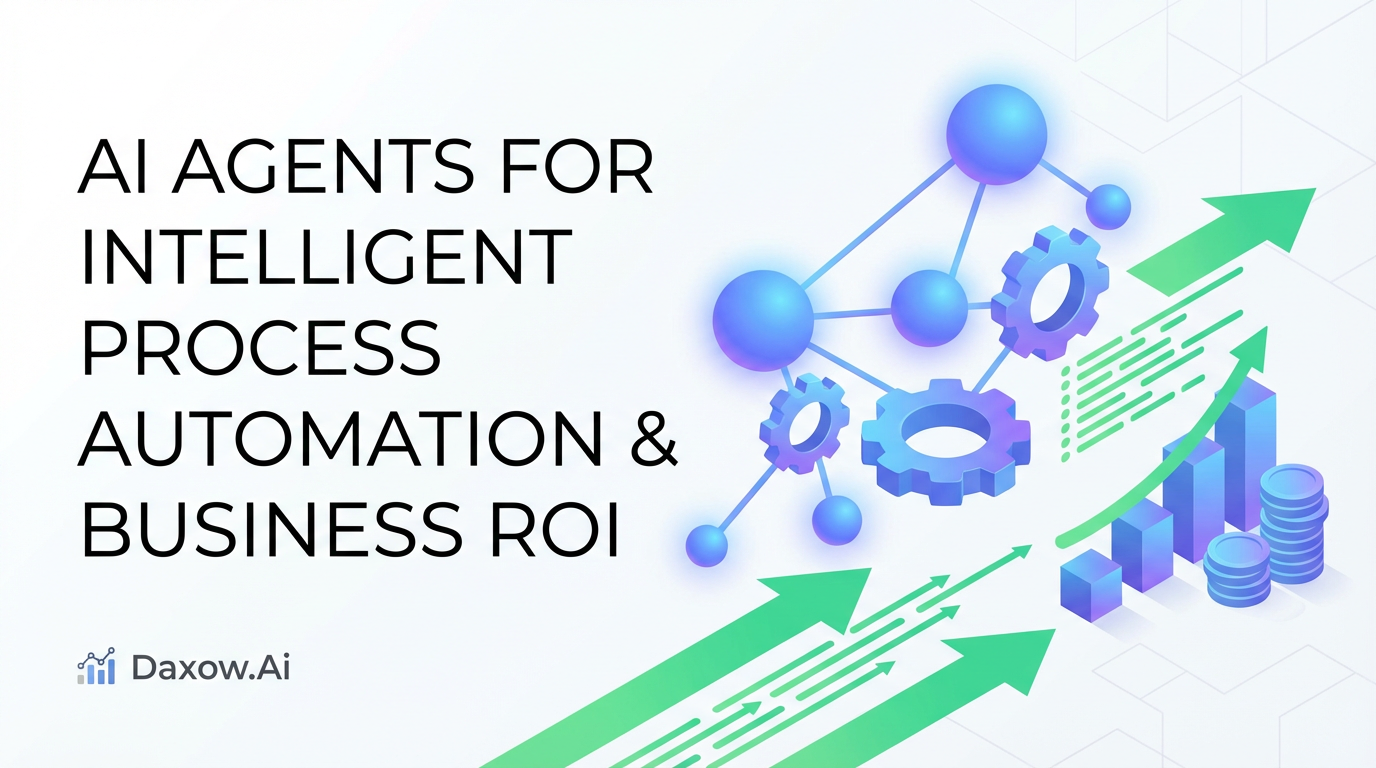
Learn how AI agents and intelligent process automation (IPA) cut costs, boost productivity, and deliver fast ROI with practical steps, use cases, and Daxow.ai solutions.
Unlocking Business Transformation: AI Agents and Automation in Intelligent Process Automation
Estimated reading time: 18 minutes
Key Takeaways
- Intelligent Process Automation (IPA) combines AI, machine learning, and RPA to automate workflows for significant operational benefits.
- Daxow.ai builds custom AI agents and automated workflows integrated with core business systems to drive measurable ROI.
- Industries like e-commerce, healthcare, finance, real estate, and HR benefit significantly from AI-driven automation use cases.
- Successful AI automation requires clear goals, data readiness, cross-functional teams, and iterative deployment.
- Common challenges such as data silos and skill gaps can be mitigated with strategic planning and stakeholder engagement.
- Measurable outcomes include 3-5x ROI, 40-60% efficiency gains, and long-term margin improvements through continuous improvement.
Table of Contents
- Unlocking Business Transformation: AI Agents and Automation in Intelligent Process Automation
- What Intelligent Process Automation Means for Your Business
- How AI Agents and Automation Drive Results
- Practical Use Cases Across Industries
- Implementation Steps and Best Practices
- Common Challenges and Mitigations
- Measuring ROI and Long-term Business Value
- How Daxow.ai Designs and Delivers Custom AI Systems
- Practical Example — End-to-End Automation for Finance
- Final Considerations and Next Steps
- Frequently Asked Questions
Unlocking Business Transformation: AI Agents and Automation in Intelligent Process Automation
Unlocking Business Transformation: AI Agents and Automation in Intelligent Process Automation is not just a headline — it is a strategic imperative for organizations aiming to scale operations, reduce costs, and improve customer outcomes. For decision-makers across sectors, intelligent process automation (IPA) powered by AI agents turns repetitive, manual work into reliable, auditable, and continuously improving workflows. This article explains what IPA means in practice, presents proven implementation steps and best practices, and offers industry-specific use cases that demonstrate real ROI. Throughout, we show how Daxow.ai helps design and deploy custom AI automation solutions that integrate with existing systems and deliver measurable business value.
What does this phrase represent for business leaders? At its core, it describes the convergence of AI automation, machine learning, and workflow automation to create autonomous systems that handle everything from data extraction to complex decision-making. Organizations adopting IPA can expect significant reductions in manual tasks, faster response times, and improved compliance — all while freeing human teams to focus on strategy and customer experience.
Why now?
- Scalability without headcount growth: IPA enables throughput increases without proportional staffing increases.
- Reduced errors and compliance risk: Automation minimizes human error in high-volume tasks like invoice processing and claims handling.
- Faster time to value: Typical pilots deliver results within 6–12 months, with clear metrics for adoption and scaling.
Daxow.ai applies this approach to build AI agents and automated workflows that execute real tasks — from customer support automation to end-to-end sales automation — and connect these capabilities to CRMs, ERPs, and other core systems.
What Intelligent Process Automation Means for Your Business
Intelligent process automation combines robotic process automation (RPA) with AI capabilities like natural language processing (NLP), computer vision, and predictive analytics. The result is workflows that can interpret unstructured inputs (emails, documents, images), make decisions, and learn over time.
Key benefits
- Operational efficiency: Expect workflow automation to reduce processing times and cut operational costs by 20–50% in targeted areas.
- Productivity gains: AI agents reduce time spent on repetitive tasks, boosting employee productivity and morale.
- Customer experience: Automated, consistent responses and faster resolution times increase customer satisfaction and Net Promoter Scores (NPS).
- Risk mitigation: Standardized processes support auditability and regulatory compliance.
Practical impact
- Businesses replace manual data entry and rule-based tasks with systems that maintain logs, versioning, and monitoring dashboards.
- Predictive capabilities allow organizations to forecast demand, flag anomalies, and proactively resolve bottlenecks.
How AI Agents and Automation Drive Results
AI agents are autonomous software entities that do more than follow fixed scripts. They use generative AI, NLP, and decision engines to orchestrate multistep processes and adapt to variations in inputs.
Capabilities of modern AI agents
- NLP for customer-facing interactions: Understands intent in emails and chats to triage tickets, qualify leads, and respond to routine queries.
- Document automation and data extraction: Converts invoices, contracts, and forms into structured data for downstream systems.
- Decisioning and orchestration: Applies business rules and ML models to route tasks, approve exceptions, and trigger integrations.
- Self-optimization: Learns from outcomes to improve accuracy and reduce exception rates over time.
Complementing RPA with AI
RPA handles well-defined, repetitive actions. When paired with AI, those bots can handle unstructured data, make decisions, and escalate intelligently. This combination unlocks higher levels of automation — often referred to as hyperautomation.
Measurable outcomes
- Reduce manual intervention: Daxow.ai implementations commonly achieve 70% reduction in manual touchpoints for target workflows.
- Faster processing: Order-to-cash and claims cycles shorten by 30% or more.
- Predictive risk reduction: Early detection of fraud or compliance issues reduces downstream costs and liabilities.
Practical Use Cases Across Industries
E-commerce — Order-to-cash and fraud detection
Use case
- Automate order validation, inventory checks, shipping label generation, and exception routing.
- Personalize customer communications and recommend related products using NLP and recommendation models.
Business value
- 30% reduction in fulfillment times and improved customer satisfaction.
- Reduced chargebacks through real-time fraud scoring.
Daxow.ai role
- Build AI agents that connect storefronts, warehouses, and payment processors.
- Implement sales automation and customer support automation to manage returns and post-sale inquiries.
Healthcare — Scheduling, claims, and readmission prediction
Use case
- Automate patient scheduling, pre-authorization, and claims submission.
- Use predictive models to flag readmission risk and prioritize follow-ups.
Business value
- Up to 40% reduction in administrative burden, better compliance with privacy regulations, and faster claims processing.
Daxow.ai role
- Ensure HIPAA-aligned data handling, integrate with EHRs, and deploy document automation for clinical forms.
Finance — Invoice matching and compliance
Use case
- Automate invoice capture, PO matching, approvals, and anomaly detection.
- Use ML models to detect suspicious transactions and expedite audits.
Business value
- Faster month-end closes and reduced errors, delivering measurable cost savings often exceeding six figures annually.
Daxow.ai role
- Integrate AI agents with ERP systems and finance workflows to provide transparent dashboards and audit trails.
Real Estate — Lead qualification and contract review
Use case
- Use chat agents to pre-qualify leads, schedule viewings, and parse contracts for key clauses.
- Automate listing updates across platforms and surface price insights.
Business value
- Agents spend time on negotiations and closings rather than administrative follow-up.
Daxow.ai role
- Build CRM integrations and document automation that accelerate conversion and reduce time-to-rent/sale.
HR — Recruitment and employee support
Use case
- Screen resumes, schedule interviews, and automate onboarding checklists.
- Use virtual assistants to answer policy questions and track employee sentiment.
Business value
- Up to 50% reduction in time-to-hire, improved candidate experience, and proactive retention measures.
Daxow.ai role
- Implement workflow automation for the full employee lifecycle and connect HR systems to analytics dashboards.
Implementation Steps and Best Practices
Adopting AI automation successfully requires a disciplined, iterative approach. Daxow.ai follows a proven framework based on industry best practices and real-world outcomes.
Step 1: Define clear goals and audit processes
- Align projects with strategic KPIs (cost reduction, speed, NPS).
- Run process audits to identify high-volume, repeatable tasks that deliver fast ROI.
- Use an AI-first scorecard to assess readiness.
Step 2: Assess and prepare data
- Evaluate data quality, completeness, and access.
- Standardize formats and build secure pipelines.
- Ensure compliance controls are embedded from the start.
Step 3: Select tools and build the right team
- Choose platforms with strong integration capabilities and enterprise security.
- Assemble cross-functional teams: domain experts, ML engineers, RPA developers, and project managers.
- Invest in training and change management to ensure adoption.
Step 4: Prototype, validate, and measure
- Start with a focused pilot on a non-critical but high-impact workflow.
- Use validation datasets and track metrics such as accuracy, exception rate, and processing time.
- Build dashboards for real-time monitoring.
Step 5: Deploy, monitor, and iterate
- Roll out in phases, retrain models with fresh data, and incorporate user feedback.
- Implement governance to avoid shadow AI and scope creep.
- Measure performance against baselines and scale successes.
Best practices checklist
- Start small with high-impact pilots.
- Prioritize ethical AI: bias detection and privacy.
- Enforce integration planning early to break down data silos.
- Define measurable KPIs from day one.
- Use quick wins to secure stakeholder buy-in.
Common Challenges and Mitigations
Challenge: Data silos
Mitigation: Early IT involvement and integration planning to create reliable data pipelines.
Challenge: Skill gaps
Mitigation: Targeted training, hybrid teams, and vendor partnerships to accelerate capability building.
Challenge: Scope creep
Mitigation: Define clear KPIs and pilot boundaries; scale only after measurable success.
Challenge: Resistance to change
Mitigation: Communicate benefits, demonstrate early wins, and include end-users in design and testing.
Measuring ROI and Long-term Business Value
IPA is measurable and often delivers ROI within 6–12 months. Typical outcomes observed in industry research and Daxow.ai projects include:
- 3–5x return on investment within the first year for many automations.
- 40–60% efficiency gains in targeted processes.
- Ongoing margin improvements of 15–25% through continuous learning and retraining of AI agents.
- Specific savings examples: multi-million dollar reductions in operational spend for finance teams and doubled lead conversion rates for sales automation projects.
Daxow.ai has a consistent track record of delivering 200–400% ROI by focusing on high-leverage workflows, tightly integrating automation with business systems, and providing governance and measurement frameworks that ensure sustained gains.
How Daxow.ai Designs and Delivers Custom AI Systems
Daxow.ai provides end-to-end services tailored to your organization’s needs:
- Process discovery and audits that identify the highest ROI automation opportunities.
- Custom AI agents designed to execute real tasks — from customer support automation to sales automation and lead qualification.
- Workflow automation engineering that integrates with CRMs, ERPs, and third-party tools.
- Data engineering and secure pipelines to ensure models have clean, compliant inputs.
- Monitoring, retraining, and governance to keep systems accurate and aligned with changing business conditions.
Our approach is pragmatic:
- We prioritize high-impact pilots.
- We deliver measurable dashboards for business users.
- We embed change management to ensure adoption and long-term value.
Typical delivery roadmap
- Week 1–4: Process discovery, KPI definition, and data assessment.
- Month 2–3: Prototype development and initial integration.
- Month 4–6: Pilot deployment, monitoring, and optimization.
- Month 7+: Scale and expand to adjacent workflows.
Practical Example — End-to-End Automation for Finance
Scenario
- A mid-sized enterprise struggles with manual invoice processing, late payments, and slow month-end closes.
Daxow.ai solution
- Deploy document automation to extract invoice data.
- Build an AI agent to match invoices to purchase orders and flag exceptions.
- Integrate with the ERP and send approval tasks to managers via workflow automation.
- Monitor exceptions and retrain models to reduce false positives.
Business outcome
- Reduction in manual touchpoints by 70%, faster month-end close, and substantial year-over-year cost savings.
Final Considerations and Next Steps
Intelligent process automation powered by AI agents transforms operations from reactive to proactive. Success requires careful planning, high-quality data, and governance. The payoff is significant: operational resilience, improved productivity, reduced manual tasks, and measurable ROI.
If your organization is evaluating AI automation, focus on:
- Identifying high-impact pilots that align with business strategy.
- Ensuring integration readiness to prevent data silos.
- Measuring outcomes and building a roadmap for scaling.
Book a free consultation with Daxow.ai to request a process analysis for your company and start building a custom AI system that reduces operational costs, boosts productivity, and delivers measurable business automation benefits. Contact us to build a custom AI system and turn manual workflows into automated, high-performing processes.
Frequently Asked Questions
What is Intelligent Process Automation (IPA)?
IPA combines robotic process automation with AI technologies such as natural language processing and machine learning to automate and optimize complex business workflows.
How do AI agents differ from traditional automation bots?
AI agents use AI models to interpret unstructured data, make decisions, and adapt over time, whereas traditional bots typically follow static, rule-based scripts.
What industries benefit most from AI-driven IPA?
E-commerce, healthcare, finance, real estate, and HR are among the key industries where AI-driven IPA delivers significant improvements in efficiency and customer satisfaction.
How long does it take to see ROI from IPA implementations?
Many IPA pilots deliver measurable ROI within 6 to 12 months, with some projects achieving 3-5x return on investment in the first year.