
AI Agents and Intelligent Process Automation for Business
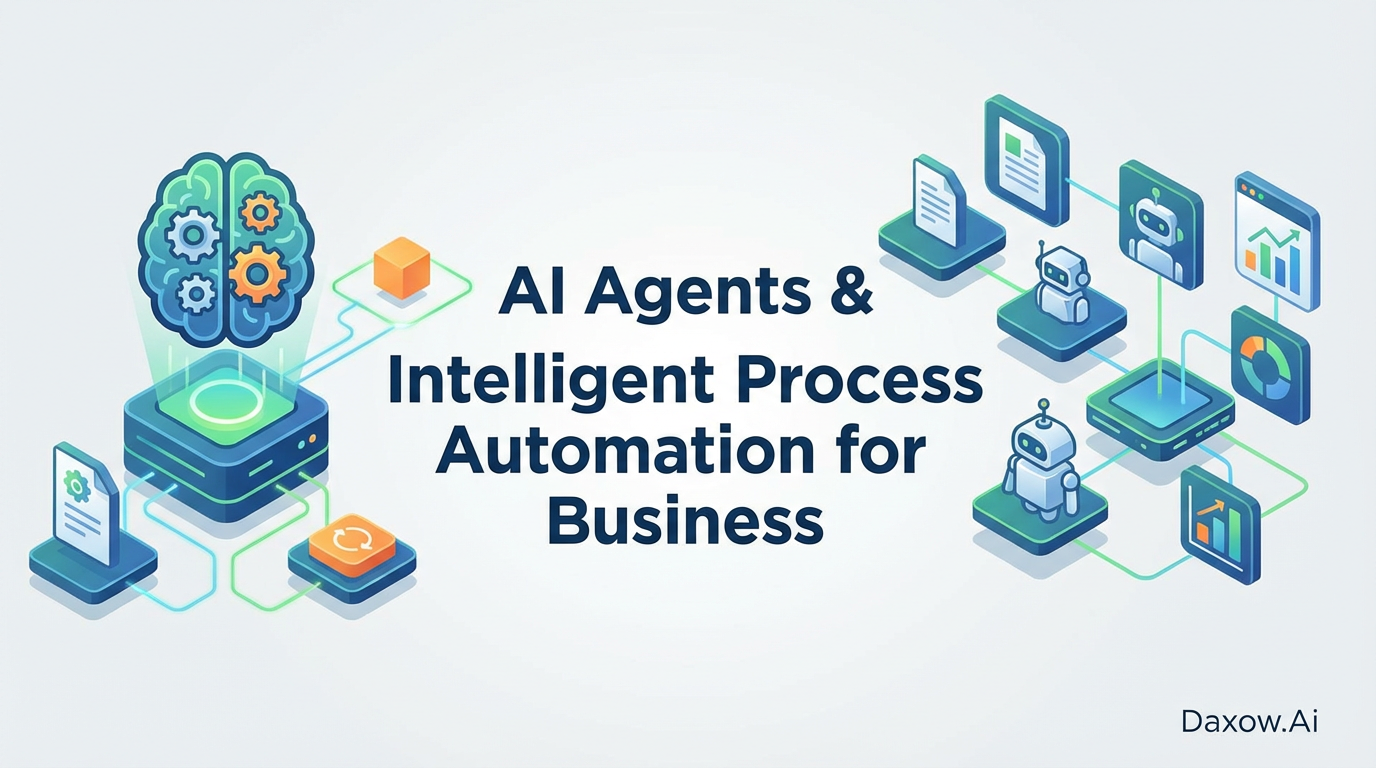
AI agents and intelligent process automation to cut costs, boost productivity, and scale operations. Roadmap, use cases, and Daxow.ai services.
AI Agents and Automation: Unlocking Intelligent Process Automation for Business Transformation
Estimated reading time: 12 minutes
Key Takeaways
- AI agents combine machine learning, NLP, and automation to reduce manual tasks and improve productivity.
- Intelligent Process Automation (IPA) drives operational resilience, customer satisfaction, and competitive advantage.
- Practical AI automation use cases span e-commerce, healthcare, finance, real estate, HR, and customer support.
- Successful implementation requires clear goals, data audits, the right tools, and continuous iteration.
- Measuring ROI and scaling automation ensure sustainable business transformation and cost savings.
- Daxow.ai delivers tailored AI automation solutions from discovery to enterprise-wide scaling.
Table of Contents
- AI Agents and Automation: Why It Matters
- How AI Agents and Automation Drive Business Results
- Practical Use Cases Across Industries
- Implementing AI Agents and Automation: A Practical Roadmap
- Common Challenges and Best Practices
- Measuring ROI and Scaling Automation
- How Daxow.ai Helps: From Assessment to Autonomous AI Agents
- Frequently Asked Questions
AI Agents and Automation: Why It Matters
AI agents and automation combine machine learning, natural language processing, and workflow automation to move beyond rule-based RPA toward systems that can learn, reason, and act. The strategic benefits are clear:
- Reduce manual tasks that consume time and introduce human error.
- Boost productivity by enabling employees to focus on high-value work.
- Improve customer support automation to deliver faster, personalized responses.
- Accelerate sales automation by qualifying leads and automating follow-ups.
- Lower operational costs—targeted processes can see 30–50% cost reductions.
- Drive better decisions with predictive analytics and real-time insights.
For decision-makers, AI automation should be treated as a strategic investment. Organizations that adopt IPA typically see 2–3x higher productivity gains and can scale processes without proportional headcount increases.
What are AI Agents and Intelligent Process Automation (IPA)?
- AI agents are autonomous systems that can perform tasks, interact with systems, and make decisions based on data. They leverage ML models, NLP, and sometimes generative AI to handle complex workflows.
- Intelligent Process Automation (IPA) blends RPA’s task execution strengths with AI’s cognitive capabilities. IPA handles both structured, repetitive tasks and unstructured, data-rich activities such as document understanding and conversational interactions.
- Together, they enable continuous automation, where agents learn from outcomes and improve over time.
Strategic Importance for Businesses
- Operational resilience: IPA builds redundancy for routine processes and reduces dependency on manual labor during disruptions.
- Customer experience: Faster response times, better personalization, and fewer errors increase satisfaction and retention.
- Talent leverage: Automation eliminates repetitive tasks, letting employees focus on strategy, creativity, and customer relationships.
- Competitive advantage: Early adopters can optimize pricing, inventory, and lead conversion faster than competitors.
How AI Agents and Automation Drive Business Results
AI agents and workflow automation orchestrate end-to-end processes, ensuring seamless handoffs between humans and machines. The result is measurable operational performance improvement.
Key capabilities:
- Autonomous task execution: Agents populate systems, update records, and trigger downstream workflows.
- Natural language handling: NLP enables agents to triage inquiries, summarize documents, and draft communications.
- Predictive insights: Forecasting models anticipate demand, risks, and customer churn.
- Integrations: Agents connect CRMs, ERPs, ticketing systems, and databases for unified workflows.
Business outcomes:
- Time savings: 30–70% reduction in process time for automated tasks.
- Error reduction: Up to 90% fewer manual errors in document processing and data entry.
- Faster cycle times: Invoice and order processing times shrink, improving cash flow.
- Cost savings: Targeted automation can reduce process costs by 30–50%, with mid-sized firms capturing $1–5M annually from invoice automation alone.
How to apply these capabilities:
- Map high-volume, repeatable processes.
- Replace manual handoffs with automated rules and agent triggers.
- Use AI agents for triage and escalation where human judgment is required.
- Monitor performance and iteratively improve models.
Practical Use Cases Across Industries
AI agents and automation are versatile—here are practical examples showing how workflows transform across sectors.
E-commerce
- Use case: Order-to-cash automation with inventory forecasting.
- What it does: Agents validate orders, update inventory, trigger fulfillment, notify logistics, and reconcile payments.
- Business impact: Reduced cart abandonment (20–30%) through personalized recommendations; fewer stockouts and faster delivery cycles.
Healthcare
- Use case: Patient triage and record summarization by AI agents.
- What it does: Triage incoming inquiries, summarize EMR notes, flag anomalies in diagnostic data.
- Business impact: Faster response times, improved clinician productivity, and better compliance with privacy workflows.
Finance
- Use case: Invoice processing and fraud surveillance.
- What it does: Extracts invoice data, reconciles with POs, routes exceptions, and runs anomaly detection on transactions.
- Business impact: Audit times reduced by 40%, fewer false positives in fraud detection, and faster vendor payments.
Real Estate
- Use case: Lead qualification and market analysis automation.
- What it does: AI agents qualify inbound leads, schedule virtual tours, and analyze market trends to price listings.
- Business impact: Shorter lead-to-close cycles and higher conversion rates.
HR and Talent
- Use case: Resume screening and predictive attrition.
- What it does: Screens applicants, conducts initial interviews via chat agents, and flags employees at risk of churn.
- Business impact: Onboarding time reduced by 50%, improved hiring quality and retention.
Customer Support and Sales Automation
- Use case: Conversational agents for support and lead nurturing.
- What it does: Handles tier-1 support, routes complex issues to specialists, and automates follow-ups for sales-qualified leads.
- Business impact: Faster resolution, improved NPS, higher conversion from automated lead follow-up.
Each of these examples demonstrates the combination of workflow automation and intelligent agents to both reduce manual tasks and unlock new capabilities like 24/7 support and predictive decision-making.
Implementing AI Agents and Automation: A Practical Roadmap
1. Define Clear Objectives
- Set measurable goals: cost reduction targets, NPS improvement, reduced processing times.
- Use an AI-first scorecard to prioritize processes with high volume and low complexity for early wins.
2. Identify Processes and Audit Data
- Perform process discovery workshops and value-stream mapping.
- Audit data quality, accessibility, and compliance requirements.
- Focus first on processes with structured inputs (invoices, orders) and high repeatability.
3. Select Tools and Build the Right Team
- Choose platforms that support integration with existing CRMs, ERPs, and ticketing systems.
- Assemble cross-functional teams: business SMEs, data scientists, engineers, and IT/security.
- Plan training and change management for affected teams.
4. Prototype and Integrate
- Start with a minimum viable automation for non-critical processes.
- Phase integration with legacy systems; implement robust error handling and human-in-the-loop checkpoints.
- Establish governance to prevent shadow AI deployments.
5. Monitor, Measure, and Iterate
- Track KPIs: cycle time, accuracy, cost per transaction, NPS, and agent utilization.
- Retrain models using real-world feedback and expand automation scope based on ROI.
- Maintain ethical AI practices: fairness, explainability, and privacy safeguards.
Common Challenges and Best Practices
- Data Quality Issues
- Mitigation: Standardize formats, run pre-processing, and implement data pipelines for consistent inputs.
- Integration Hurdles
- Mitigation: Use phased rollouts, API-first designs, and involve IT from the start to manage legacy systems.
- Team Resistance
- Mitigation: Offer training, communicate clear benefits, and demonstrate early wins to build buy-in.
- Scalability Limits
- Mitigation: Select platforms with elastic scaling and design modular automations that can be replicated across functions.
- Governance and Compliance
- Mitigation: Implement model versioning, audit trails, and privacy controls; align with legal and compliance teams.
Best practices: start small, deliver quick, measurable wins, and embed continuous improvement into the automation lifecycle.
Measuring ROI and Scaling Automation
To demonstrate impact and secure further investment, measure outcomes clearly.
Key metrics to track:
- Process cycle time reduction.
- Percentage of manual tasks eliminated.
- Accuracy and error rates before and after automation.
- Cost savings by process and overall.
- Customer satisfaction scores (NPS, CSAT).
- Time to resolution in support cases.
- Revenue impact from improved lead qualification and faster time-to-close.
Expected outcomes (based on industry findings):
- 30–50% cost reduction in targeted processes.
- 30–70% time savings on automated tasks.
- Up to 90% reduction in manual errors for document processing.
- Many organizations recoup investments within 6–12 months.
Scaling considerations:
- Build reusable automation components and connectors.
- Standardize data schemas to accelerate new use cases.
- Create an operations center for monitoring bots and agents.
- Invest in talent and training to maintain and extend automation capabilities.
How Daxow.ai Helps: From Assessment to Autonomous AI Agents
Daxow.ai partners with organizations to design and deliver custom AI automation solutions that generate measurable business value.
Our approach:
- Discovery & Process Analysis: We map workflows, quantify manual tasks, and prioritize automation using an ROI framework.
- Custom AI Agents: We design agents that perform real tasks—triaging support tickets, qualifying leads, extracting data from documents, and updating CRMs automatically.
- Workflow Automation & Integrations: We build end-to-end automations that connect your tools—ERP, CRM, support platforms—so data flows seamlessly and processes execute without friction.
- Pilot & Scale: We prototype quickly with controlled pilots, measure impact, and scale the solutions enterprise-wide.
- Governance & Security: We implement controls for data privacy, auditability, and model governance to ensure compliance and trust.
- Change Management & Training: We deliver training and adoption programs to reduce resistance and embed automation in daily operations.
Example Daxow.ai engagements:
- E-commerce retailer: Implemented order-to-cash automation and personalized recommendation agents, reducing fulfillment time and increasing conversion by double digits.
- Financial services firm: Automated invoice processing and fraud monitoring, cutting audit time and improving cash flow management.
- Healthcare provider: Deployed triage agents and NLP-based record summarization, accelerating patient throughput and supporting clinicians.
Why work with Daxow.ai
- End-to-end delivery from strategy and prototyping to integration and scaling.
- Tailored solutions that match your systems and business goals.
- ROI-focused planning to ensure automation investments pay back quickly.
- Transparent governance and ethical AI practices to protect data and maintain trust.
Frequently Asked Questions
What are AI agents in automation?
AI agents are autonomous systems that perform tasks, interact with software, and make decisions using machine learning, natural language processing, and sometimes generative AI technologies.
How does Intelligent Process Automation differ from traditional RPA?
While traditional RPA focuses on rule-based repetitive tasks, IPA combines RPA with AI cognitive capabilities to handle unstructured data, complex decision-making, and continuous learning.
What industries benefit most from AI automation?
Industries such as e-commerce, healthcare, finance, real estate, HR, and customer support have demonstrated significant improvements by implementing AI agents and automation.
How can my organization start implementing AI automation?
Begin by defining clear objectives, auditing processes and data, selecting appropriate tools, building teams, prototyping solutions, and continuously monitoring and improving results.