
Unlock Business Transformation with AI Agents and Intelligent Automation
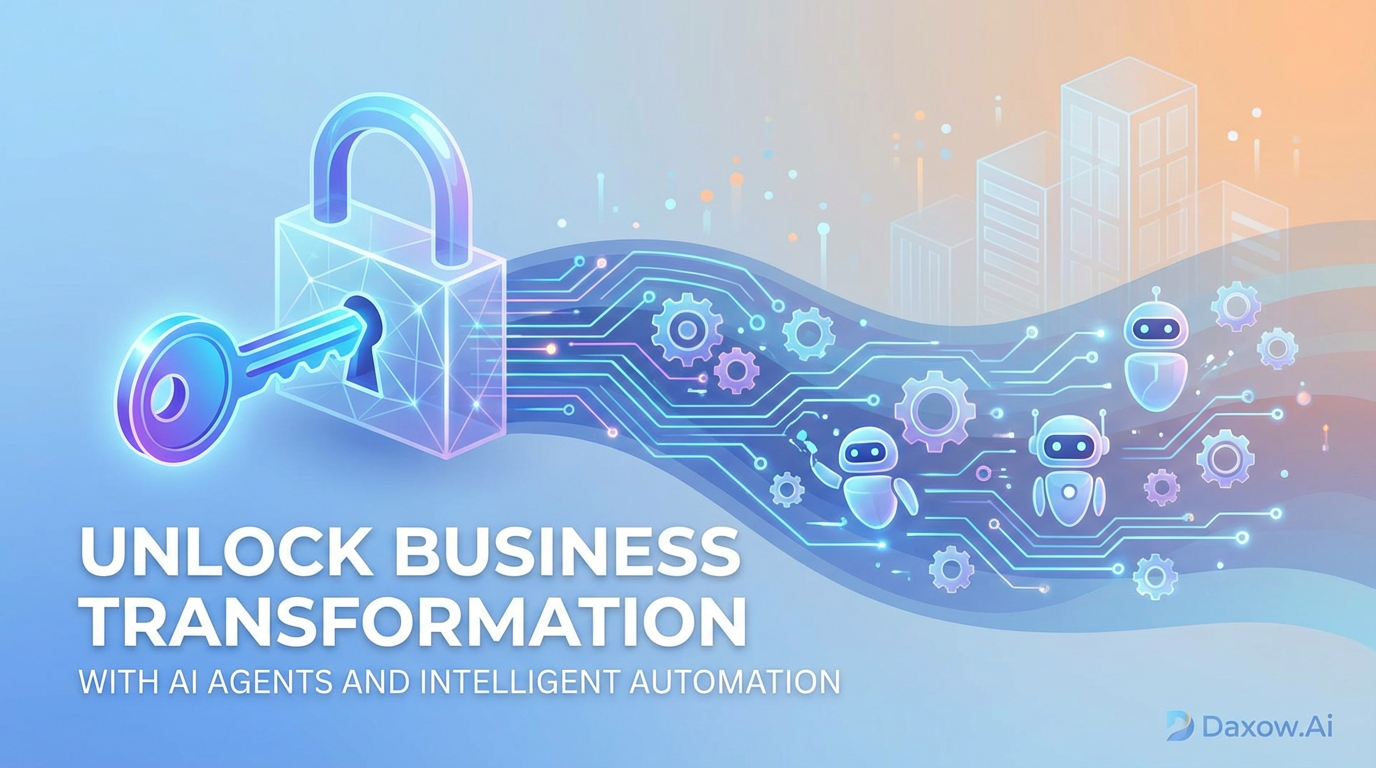
Explore how AI agents and intelligent process automation reduce costs, boost productivity, and scale operations — plus Daxow.ai's implementation blueprint and ROI benchmarks.
Unlocking Business Transformation: AI Agents and Automation in Intelligent Process Automation
Estimated reading time: 15 minutes
Key Takeaways
- Intelligent Process Automation (IPA) integrates AI agents with workflow automation to replace manual tasks and enhance productivity.
- AI agents enable cost savings, scalability, improved customer experiences, and risk reduction across industries.
- Practical use cases span e-commerce, healthcare, finance, real estate, and HR with measurable business impacts.
- Successful IPA implementations rely on modular architecture, integrations, observability, and continuous improvement.
- Daxow.ai delivers tailored AI automation solutions with proven ROI, supporting end-to-end deployment and scaling.
Table of Contents
- Unlocking Business Transformation: AI Agents and Automation in Intelligent Process Automation
- Practical Use Cases: AI Agents and Automation Across Industries
- How AI Agents and Automation Drive Results
- Implementation Steps and Best Practices
- Measuring ROI and Business Value
- How Daxow.ai Designs and Delivers Custom AI Automation
- Roadmap: From Pilot to Enterprise Automation
- Frequently Asked Questions
Unlocking Business Transformation: AI Agents and Automation in Intelligent Process Automation
Unlocking Business Transformation: AI Agents and Automation in Intelligent Process Automation is no longer a theoretical discussion — it is an operational imperative for companies that want to reduce costs, increase agility, and improve customer experiences. For business owners, operations leaders, and technology executives, intelligent process automation (IPA) combines AI agents with workflow automation to replace manual, error-prone steps with systems that perceive, reason, and act. This article explains what IPA delivers, shows concrete use cases across industries, provides an implementation blueprint, and outlines how Daxow.ai designs and deploys custom solutions that drive measurable productivity gains and cost reduction.
What IPA means in practice
- Intelligent process automation (IPA) merges AI-driven decision-making with robotic process automation (RPA) and integrations to automate end-to-end workflows.
- AI agents are autonomous software entities that ingest data, perform analysis, make decisions, and execute actions via APIs, UI automation, or integrations with business tools and CRMs.
- The result is significant productivity improvements, rapid scalability, reduced manual tasks, and better customer outcomes.
Key business outcomes supported by IPA
- Cost savings: Automating repetitive tasks like invoice processing reduces labor costs by up to 40%.
- Productivity: Targeted processes can see 30–50% productivity increases and time savings of 40–60% in document-heavy tasks.
- Scalability: AI agents process spikes in volume without proportional headcount increases.
- Customer impact: Faster, personalized responses through customer support automation improve NPS and retention.
- Risk reduction: Real-time monitoring for fraud and compliance reduces operational risk and potential losses.
Practical Use Cases: AI Agents and Automation Across Industries
E-commerce — smarter operations and better customer journeys
- AI agents analyze reviews, summarize customer sentiment, and draft micro-copy for product pages and social posts.
- Workflow automation predicts inventory shortages and triggers reorder workflows across suppliers.
- Chatbots handle tier-one support, routing complex issues to human agents.
Business impact: Reduced stockouts by up to 25%, improved conversion through tailored product descriptions, and lower support costs with 24/7 automation.
Healthcare — streamlined administration and improved care delivery
- Automated patient onboarding: document extraction, insurance verification, and appointment scheduling.
- Analytics agents detect patterns in diagnostic data and flag anomalies for clinician review.
Business impact: Faster triage, fewer administrative errors, and better patient satisfaction from timely, automated communications.
Finance — secure, compliant, and efficient operations
- Transaction surveillance agents for real-time fraud detection.
- Automated invoice processing, reconciliation, and data extraction from financial documents.
Business impact: Processing time reductions up to 70%, faster audits, and improved compliance through automated trails and anomaly detection.
Real Estate — accelerate transactions and boost conversions
- Lead qualification agents score inbound inquiries, enrich profiles using public data, and route hot leads to sales teams.
- Document automation extracts lease terms, populates contracts, and tracks signatures.
Business impact: Faster deal cycles, personalized listings, and higher conversion rates from focused sales automation.
HR — hire faster and manage talent proactively
- Onboarding workflows that collect documents, set up accounts, and trigger orientation tasks.
- Talent analytics agents surface retention risks and match employees to internal mobility opportunities.
Business impact: Hiring time reductions by up to 50%, reduced manual HR overhead, and improved retention via proactive interventions.
How AI Agents and Automation Drive Results
Architecture patterns that work
- Multi-agent systems: separate responsibilities into ingestion agents (data capture), reasoning agents (analysis and decisioning), and execution agents (task performance). This modular approach supports resilience and easier maintenance.
- Integrations-first design: connect agents to CRMs, ERP, ticketing, and data warehouses to ensure consistent data flow and end-to-end automation.
- Observability and feedback loops: dashboards and KPI monitors enable continuous improvement; agents retrain on new data to maintain accuracy.
Concrete performance improvements
- Agents eliminate manual steps in up to 80% of repetitive processes, freeing staff to focus on strategic work.
- Predictive analytics prevent supply chain disruptions and preserve millions in value by avoiding stockouts or production pauses.
- Customer support automation reduces response times and increases first-contact resolution through smarter routing and context-aware replies.
Implementation Steps and Best Practices
1. Define clear goals and select high-impact processes
- Start with processes that are repetitive, high-volume, and rule-based (e.g., invoice processing, lead qualification, support triage).
- Set measurable objectives: cost reduction targets, response time SLAs, and accuracy thresholds.
2. Assess data, systems, and tools
- Audit data quality, accessibility, and governance.
- Choose platforms that support NLP, document extraction, and ML models and provide pre-built connectors to business systems.
- Favor no-code/low-code options for rapid prototypes and custom code for advanced logic.
3. Build the right team and governance
- Form a cross-functional team: business owners, IT, data engineers, ML engineers, and compliance leads.
- Define ownership for models, monitoring, and change control to prevent “shadow AI” and manage risk.
4. Design, test, and deploy iteratively
- Implement a Minimum Viable Automation (MVA) that proves value quickly.
- Use validation datasets, A/B tests, and phased rollouts.
- Monitor model drift, accuracy, and business KPIs; retrain agents as needed.
5. Integrate and scale
- Ensure seamless integration with CRMs, ERPs, and collaboration tools to automate entire workflows.
- Scale successful automations incrementally to additional teams and geographies.
Best practices and pitfalls to avoid
- Best practices:
- Start small with high-impact pilots to build momentum.
- Ensure compatibility with existing systems and prioritize security and compliance.
- Foster collaboration between IT and business users for sustainable adoption.
- Pitfalls:
- Building overly complex solutions on day one.
- Ignoring data quality and operational observability.
- Failing to plan for retraining and maintenance.
Measuring ROI and Business Value
What to measure
- Efficiency KPIs: task completion time, manual touchpoints reduced, throughput per employee.
- Quality KPIs: error rates, model precision and recall, compliance incidents.
- Financial KPIs: labor cost savings, processing cost per transaction, revenue uplift from improved conversions.
- Customer KPIs: response times, NPS, churn rate.
Typical ROI timelines and benchmarks
- Expect 3–5x ROI within 12–18 months when projects are scoped to high-volume processes.
- Early wins: 30–50% productivity improvements on targeted tasks and 30%+ reductions in labor cost for automated workflows.
- Long-term value comes from continuous improvement and expanding automation into predictive and decisioning use cases.
How Daxow.ai Designs and Delivers Custom AI Automation
Our end-to-end approach
- Discovery and process analysis: We map your current workflows, quantify manual tasks, and identify the highest ROI automation opportunities.
- Prototype and pilot: Build rapid prototypes using AI agents and workflow automation to validate assumptions quickly.
- Production build: Deploy production-grade agents integrated with your CRM, ERP, and communication platforms.
- Monitor and optimize: Provide dashboards, model retraining, and ongoing support to ensure sustained performance and evolving business alignment.
Services tailored to business needs
- AI Agents: Design multi-agent systems that automate ingestion, decisioning, and execution for complex workflows.
- Workflow Automation: Create end-to-end automations that connect tools, orchestrate tasks, and eliminate manual handoffs.
- Chatbots & Customer Support Automation: Implement context-aware chatbots that handle common inquiries and escalate appropriately.
- Lead Qualification & Sales Automation: Build agents that score leads, enrich profiles, and drive faster conversion.
- Data Extraction & Document Automation: Extract structured data from heterogeneous documents to feed downstream systems.
- System Integrations: Connect legacy systems and modern SaaS tools to create seamless, data-driven automation.
Why partner with Daxow.ai
- Practical focus: We prioritize measurable outcomes and quick wins to demonstrate ROI.
- Integration expertise: We integrate AI agents with CRMs, ERPs, and enterprise systems to automate entire processes, not just isolated tasks.
- Security and compliance: Built-in governance, audit trails, and privacy-first data handling.
- End-to-end support: From design to continuous operations, we provide the technical and change-management capabilities you need.
Roadmap: From Pilot to Enterprise Automation
Phase 1 — Discovery (Weeks 1–4)
- Process audits, data assessment, and success metrics definition.
- Deliverable: prioritized automation roadmap with ROI estimates.
Phase 2 — Pilot (Weeks 5–12)
- Develop an MVA with one or two agents and integrate with a single system.
- Deliverable: pilot results, impact metrics, and go/no-go decision.
Phase 3 — Scale (Months 3–12)
- Expand across use cases, integrate additional systems, and implement governance.
- Deliverable: enterprise automation platform, dashboards, and operational playbooks.
Phase 4 — Continuous Improvement (Ongoing)
- Monitor performance, retrain models, and introduce predictive capabilities.
- Deliverable: evolving automation that adapts to market changes and business growth.
Frequently Asked Questions
What is Intelligent Process Automation (IPA)?
IPA combines AI-driven decision-making, robotic process automation (RPA), and system integrations to automate complex, end-to-end business workflows, reducing manual effort and improving efficiency.
How do AI agents improve customer experience?
AI agents provide faster, personalized responses through automation of customer support tasks, enabling 24/7 availability, smarter routing, and context-aware interactions which lead to higher satisfaction and retention.
What industries benefit most from AI agents and automation?
Industries like e-commerce, healthcare, finance, real estate, and HR see significant benefits including cost reductions, improved accuracy, accelerated workflows, and enhanced decision-making capabilities.
How does Daxow.ai ensure security and compliance?
Daxow.ai implements built-in governance frameworks, audit trails, privacy-first data handling, and continuous monitoring to meet security and compliance standards throughout the automation lifecycle.