
AI Agents and Automation: Transforming Business Processes
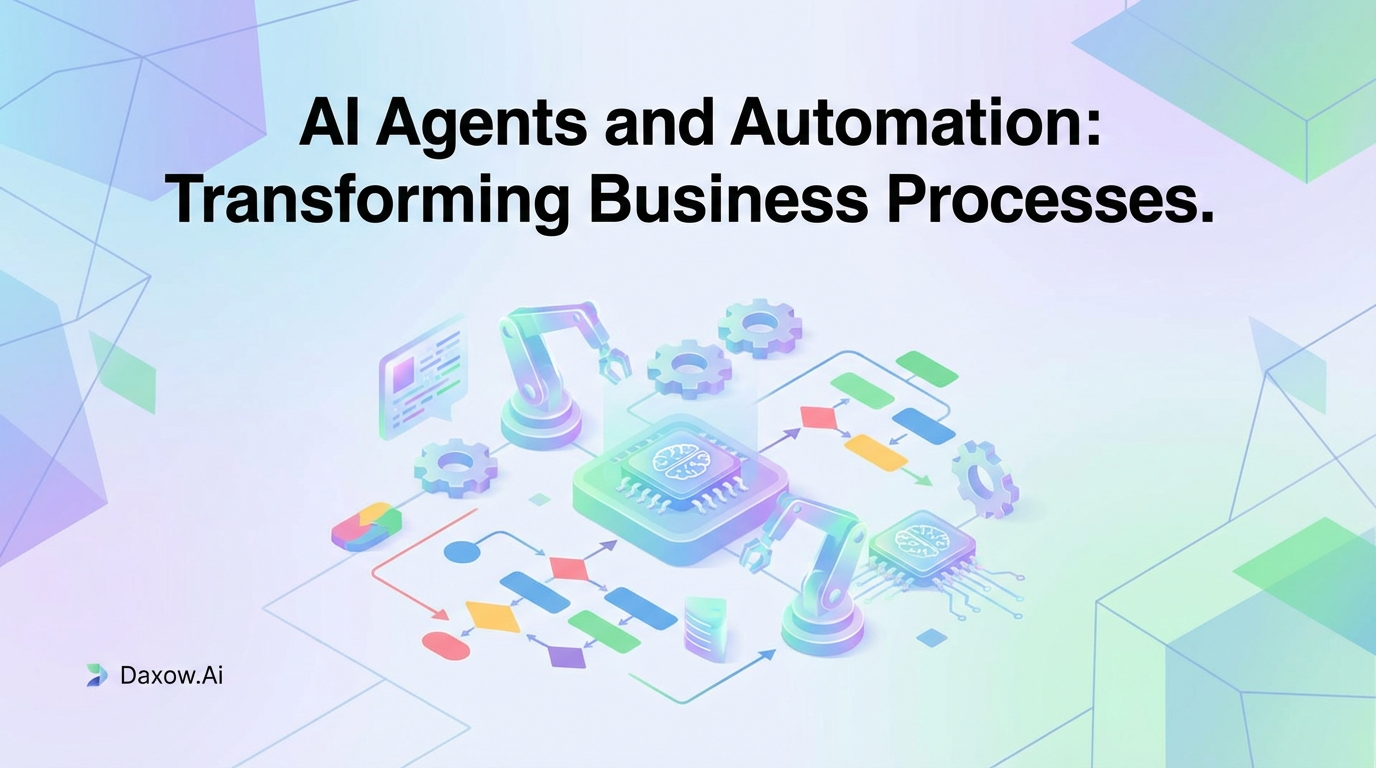
Learn how AI agents and intelligent process automation reduce costs, speed decisions, and scale operations with practical use cases and a clear roadmap.
Unlocking Business Transformation: AI Agents and Automation in Intelligent Process Automation
Estimated reading time: 18 minutes
Key Takeaways
- AI agents combined with intelligent process automation (IPA) reduce manual tasks, boost productivity, and cut operational costs by up to 50%.
- Integration of AI agents enables adaptive decision-making, handling unstructured data and dynamic workflows across industries like e-commerce, healthcare, and finance.
- Strategic governance and continuous model retraining ensure compliant, scalable, and resilient automation deployments.
- Adopting IPA with a clear roadmap, strong data foundations, and cross-functional teams drives faster time-to-value and sustainable ROI.
- Daxow.ai delivers custom AI automation integrating with existing enterprise systems to unlock measurable business outcomes and competitive advantages.
Table of Contents
- Unlocking Business Transformation: AI Agents and Automation in Intelligent Process Automation
- Strategic importance for business leaders
- Practical use cases — industry examples that deliver measurable outcomes
- How AI agents and automation drive results
- Implementation roadmap and best practices
- Estimating ROI and tangible business value
- How Daxow.ai helps you unlock transformation
- Practical checklist to get started this quarter
- Conclusion and next steps
- Frequently Asked Questions
Unlocking Business Transformation: AI Agents and Automation in Intelligent Process Automation
AI agents and automation in Intelligent Process Automation is no longer a theoretical exercise — it is a strategic imperative for companies that want to reduce costs, scale operations, and deliver better customer experiences. Business leaders face mounting pressure from talent shortages, rising operational costs, and customer expectations for instant, accurate service. By combining AI agents with robust workflow automation, organizations can reduce manual tasks, accelerate decision-making, and unlock measurable productivity gains.
This article explains why this trend matters, what successful implementations look like, and how to translate intelligent process automation into sustained business value. It also shows practical use cases across industries and details how Daxow.ai designs and delivers custom AI automation that integrates with existing systems and drives ROI.
Why this matters now
- AI automation and AI agents move organizations from rigid, rule-based workflows to adaptive, decision-making systems that can handle unstructured data, make contextual decisions, and coordinate multi-step processes.
- Repetitive administrative work consumes a large portion of employee time. Studies show this can range from 40–60% of daily activities — an opportunity to dramatically reduce manual tasks and refocus talent on higher-value work.
- Properly implemented, intelligent process automation delivers cost reductions of 30–50%, accuracy improvements exceeding 90%, and productivity increases of 30–50% within the first 12–18 months.
Strategic importance for business leaders
From efficiency to competitive advantage
- Operational resilience: AI agents operate 24/7, reduce human error, and enforce consistent compliance across processes.
- Scalability: Workflow automation enables volume growth without linear increases in headcount.
- Faster decision-making: Agents synthesize data, flag exceptions, and recommend actions in real time, shortening cycle times from days to minutes.
Governance and risk mitigation
- Centralized automation governance reduces the risk of “shadow AI” and fragmented tools.
- Embedding compliance and audit logs in automated workflows ensures traceability for regulators and internal auditors.
Practical use cases — industry examples that deliver measurable outcomes
AI agents and workflow automation are most effective when used to target high-volume, rule-based processes with frequent exceptions. Below are practical use cases across industries, with concrete business outcomes.
E-commerce and retail
- Use case: Order-to-cash automation
- Automate order validation, inventory checks, pricing reconciliation, and refund processing.
- Add AI agents for fraud detection, personalized cross-sell recommendations, and dynamic fulfillment routing.
- Business impact: Conversion and fulfillment speed increase by 20–30%, reduction in manual order exceptions, and lower chargeback rates.
Customer support automation
- Use case: Hybrid AI support system
- Intelligent chatbots handle tier-1 inquiries, AI agents surface case context from CRM and knowledge bases, and human agents focus on escalated tickets.
- Workflow automation routes cases, applies SLAs, and triggers follow-ups.
- Business impact: Reduced response times, increased first-contact resolution, and a significant drop in repetitive ticket volume — freeing agents to handle complex cases.
Healthcare
- Use case: Patient triage and scheduling
- AI agents triage symptoms using NLP, cross-reference patient history, and propose appointment types and urgency.
- Automate claims validation, pre-authorization checks, and appointment reminders.
- Business impact: Administrative burdens reduced by ~40%, faster patient access, and fewer missed appointments.
Finance and accounting
- Use case: Invoice processing and compliance
- Use document automation to extract invoice data, route exceptions to a human reviewer, and auto-post approved invoices.
- AI agents perform anti-fraud checks and compliance screening.
- Business impact: Processing times drop from days to minutes, error rates fall substantially, and audit readiness improves.
Real estate and property management
- Use case: Lead qualification and deal acceleration
- Virtual agents pre-qualify leads, schedule virtual tours, prepare standardized contracts, and track negotiation milestones.
- Business impact: Faster deal cycles, higher lead-to-deal conversion, and stronger client engagement.
HR and talent acquisition
- Use case: Automated recruitment flow
- AI agents screen resumes, conduct initial chat interviews, coordinate assessment scheduling, and onboard new hires with automated document collection.
- Business impact: Time-to-hire reduced by up to 50%, improved candidate experience, and reduced administrative overhead.
How AI agents and automation drive results
Technology components that matter
- Natural language processing (NLP) to interpret unstructured text and customer intent.
- Machine learning models for classification, prediction, and anomaly detection.
- Agentic workflows — autonomous loops of observation, planning, and execution that perform multi-step tasks.
- Integration layers (APIs, connectors) that bridge CRMs, ERPs, ticketing platforms, and document stores.
Key operational benefits
- Reduction of manual tasks: Routine work is automated, freeing staff to focus on strategic initiatives.
- Continuous learning: Models retrain on new data to avoid drift and improve accuracy.
- Improved data quality: Real-time cleansing and validation reduce downstream errors.
- Collaboration: Multi-agent systems coordinate across departments to complete end-to-end processes.
Implementation roadmap and best practices
Adopting intelligent process automation requires a pragmatic, phased approach. The following steps combine strategic alignment with tactical execution.
1. Define clear goals and prioritize processes
- Establish measurable targets (e.g., 25% cost reduction, 30% faster response times).
- Run a process audit to identify high-volume, repetitive tasks and prioritize by ROI, complexity, and compliance risk.
- Use a prioritization matrix to select pilot projects with quick-win potential.
2. Assess data and select the right tools
- Validate data availability, quality, and compliance constraints.
- Standardize formats and create integration points for systems of record.
- Choose platforms that support agentic automation, strong integrations, and enterprise governance.
3. Build a cross-functional implementation team
- Include business owners, IT, data engineers, compliance, and change managers.
- Invest in training and stakeholder communication to maximize adoption.
- Avoid siloed pilots by aligning pilots to enterprise goals.
4. Prototype, pilot, and scale
- Start with a well-defined pilot (e.g., customer support automation).
- Use iterative development: prototype, measure, refine, and expand.
- Apply governance to control sprawl and prevent unmanaged “shadow” automation.
5. Measure performance and iterate
- Track KPIs: accuracy, throughput, cycle time, cost per transaction, and ROI.
- Incorporate user feedback and retrain models regularly.
- Set up ongoing governance for security, compliance, and model lifecycle management.
Common pitfalls to avoid
- Vague objectives and lack of executive sponsorship.
- Ignoring data quality and integration complexity.
- Scaling before stabilizing pilot performance and adoption.
Estimating ROI and tangible business value
- Short-term gains: Automation of transactional work delivers immediate labor savings and speed improvements.
- Mid-term gains (6–18 months): Optimizations and model retraining compound value; businesses often see ROI of 200–400% in this window.
- Long-term strategic value: Reinvested savings fund innovation; automated insights enable new products and customer experiences.
Quantifiable outcomes to track:
- Reduction in manual work hours and headcount reallocation.
- Improvements in speed (order-to-fulfillment, time-to-resolution).
- Accuracy and error reduction metrics.
- Revenue impact from faster cycles and improved customer satisfaction.
How Daxow.ai helps you unlock transformation
Daxow.ai specializes in turning the promise of intelligent process automation into production systems that deliver measurable business outcomes. Our approach is practical, enterprise-grade, and focused on end-to-end value.
Discovery and process analysis
- We map current workflows, quantify manual tasks, and prioritize automation opportunities that maximize ROI.
- Deliverable: A prioritized automation roadmap tied to clear business KPIs.
Custom AI agent design and development
- We design AI agents that perceive, reason, and act — integrating NLP, ML models, and rule-based logic.
- Agents are built to handle exceptions, collaborate across systems, and escalate to humans when needed.
End-to-end workflow automation and integrations
- Daxow.ai connects AI agents to your CRM, ERP, ticketing systems, document stores, and other business tools.
- We implement secure, auditable integrations to ensure compliance and data integrity.
Pilot-to-scale deployment and governance
- We run pilots to prove value quickly, then help you scale while maintaining governance.
- Ongoing monitoring, model retraining, and process optimization are included to sustain performance and ROI.
Measurable outcomes and cost reduction
- Our solutions focus on reducing operational costs, boosting productivity, and improving customer experience.
- We align automation initiatives to P&L impact and provide transparent tracking of benefits.
Practical checklist to get started this quarter
- Identify 3–5 repetitive processes consuming the most manual effort.
- Define clear KPIs and expected outcomes for each process.
- Establish an integration inventory (systems and data sources).
- Select a pilot process with clear user stakeholders.
- Assign a cross-functional team and nombr a project sponsor.
- Engage a partner with experience designing AI agents and connecting enterprise systems.
Conclusion and next steps
Unlocking Business Transformation: AI Agents and Automation in Intelligent Process Automation is not a future project — it is an operational transformation you can start now. Well-designed AI agents and workflow automation reduce manual tasks, improve productivity, and create measurable ROI while enabling your teams to focus on higher-value priorities.
Daxow.ai helps businesses design, build, and scale custom AI automation that integrates with existing systems, reduces operational costs, and delivers measurable outcomes. Whether you want to automate customer support, streamline finance operations, accelerate sales cycles, or modernize HR processes, we provide the expertise, governance, and engineering needed to succeed.
Book a free consultation with Daxow.ai today or request a process analysis for your company to discover where AI automation and AI agents will deliver the fastest, most reliable value. Contact us to build a custom AI system and start transforming your operations.
Frequently Asked Questions
What differentiates AI agents from traditional automation?
AI agents enhance traditional automation by enabling adaptive decision-making, handling unstructured data, and coordinating complex multi-step workflows beyond rigid, rule-based processes.
How quickly can organizations expect to see ROI from intelligent process automation?
Short-term gains are typically visible within 3-6 months, with full ROI (ranging 200–400%) often realized between 6-18 months after deployment through optimization and scaling.
Is AI automation compliant with industry regulations?
Yes, embedding compliance and audit logs into automated workflows ensures traceability and supports regulatory audits, helping organizations maintain governance and risk management.
How does Daxow.ai support scaling automation initiatives?
Daxow.ai provides pilot-to-scale deployment services with governance frameworks, ongoing monitoring, retraining of AI models, and enterprise-grade integrations to ensure sustainable performance and ROI.