
AI Agents and Intelligent Process Automation for Business Growth
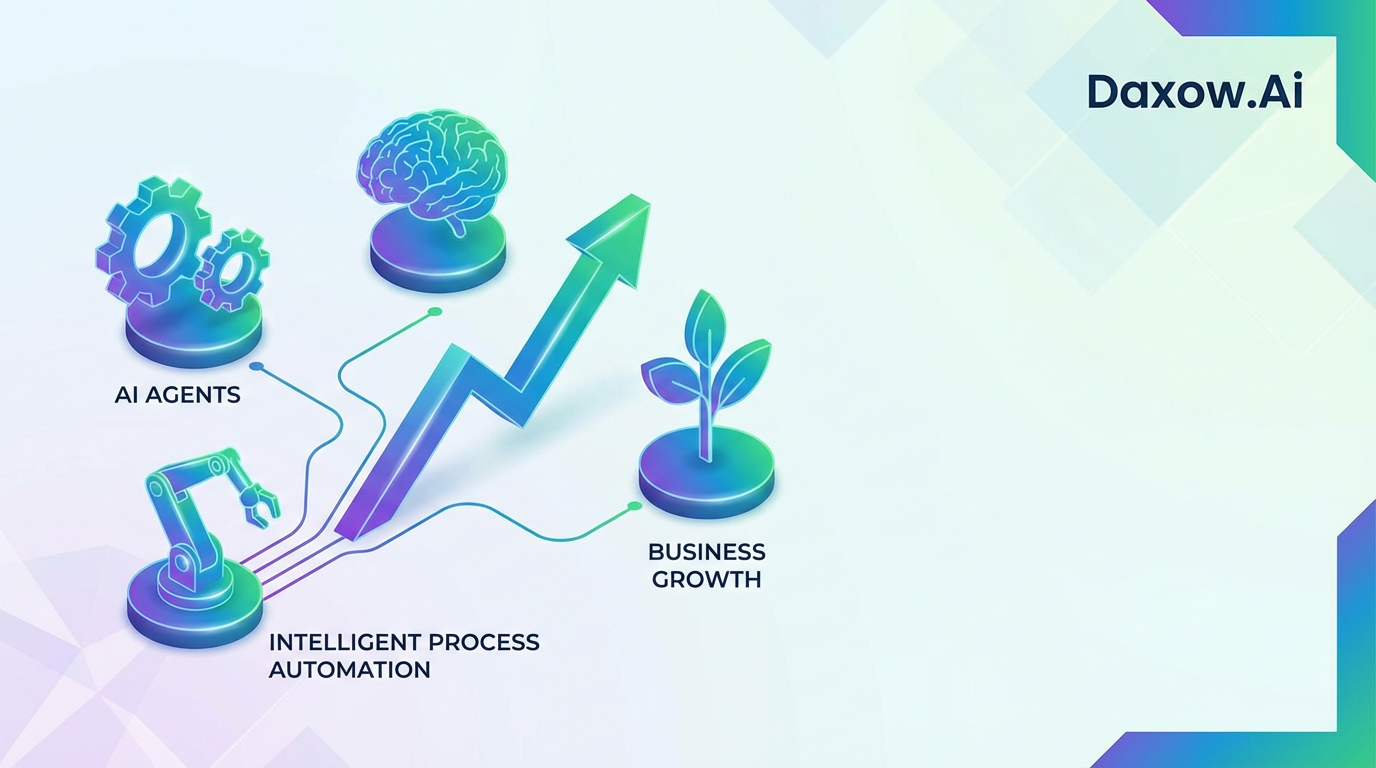
Discover how AI agents plus workflow automation (IPA) cut manual work, boost productivity, and deliver rapid ROI — with industry use cases and a Daxow.ai implementation roadmap.
Unlocking Business Growth: AI Agents and Automation in Intelligent Process Automation
Estimated reading time: 12 minutes
Key Takeaways
- Intelligent Process Automation combines AI agents, workflow automation, and RPA to transform manual tasks into autonomous processes.
- AI agents enable cognitive automation by handling unstructured data, predictive decision-making, and seamless integrations.
- IPA drives substantial business outcomes including cost reduction, productivity increase, and enhanced customer experience.
- Successful IPA deployment hinges on clear goals, data readiness, cross-functional teams, phased rollout, and continuous monitoring.
- Daxow.ai specializes in custom IPA solutions delivering measurable ROI and scalable automation tailored to your business.
Table of Contents
- Unlocking Business Growth: AI Agents and Automation in Intelligent Process Automation
- How AI Agents and Automation Deliver Business Value
- Practical Use Cases: Industry Examples and ROI
- Implementation Steps and Best Practices
- Practical Roadmap and Quick Wins
- Measuring ROI and Business Impact
- Risks and Mitigation
- How Daxow.ai Helps: From Process Analysis to Live AI Agents
- Realistic Expectations and Long-Term Strategy
- Conclusion and Next Steps
- Frequently Asked Questions
Unlocking Business Growth: AI Agents and Automation in Intelligent Process Automation
Unlocking Business Growth: AI Agents and Automation in Intelligent Process Automation is no longer a theoretical advantage — it is a strategic requirement for organizations that want to scale efficiently, reduce operational friction, and improve customer outcomes. For business owners, operations leaders, and technology decision-makers, Intelligent Process Automation (IPA) combines AI agents with workflow automation and RPA to convert manual, repetitive work into autonomous, measurable processes. This article explains how IPA drives value, provides concrete use cases across industries, outlines an implementation roadmap, and shows how Daxow.ai builds custom AI systems to reduce manual tasks, boost productivity, and deliver rapid ROI.
What does this phrase mean in practice? At its core, Intelligent Process Automation uses AI agents — systems capable of reasoning, learning, and acting — together with workflow automation to handle both structured and unstructured tasks. The result is a resilient automation layer that reduces errors, accelerates processes, and frees teams to focus on strategic work.
Why now?
- Operational complexity is increasing across industries; legacy systems and data silos make manual processes slow and error-prone.
- AI agents enable cognitive automation, handling unstructured documents, natural language interactions, and predictive decision-making.
- Measured gains are substantial: targeted process automation can cut costs by 30–50% and increase productivity in routine tasks by 40–60%.
Below we analyze practical applications, implementation best practices, ROI expectations, and how Daxow.ai partners with organizations to deliver end-to-end business automation.
How AI Agents and Automation Deliver Business Value
The capabilities that matter
- Autonomous execution: AI agents carry out tasks end-to-end — from capturing inputs to updating systems and notifying stakeholders.
- Handling unstructured data: NLP and document understanding transform invoices, contracts, and emails into structured, actionable data.
- Predictive and prescriptive actions: Machine learning models identify anomalies or forecast demand and trigger automated responses.
- Seamless integrations: Workflow automation connects CRMs, ERPs, support platforms, and bespoke systems to eliminate manual handoffs.
Tangible business outcomes
- Reduce manual tasks: Automating data entry, reconciliation, and routing cuts labor-intensive steps by up to 70% in focused workflows.
- Improve productivity: Teams reallocate time from routine work to value-adding activities, increasing throughput 40–60% for automated processes.
- Enhance customer experience: Faster response times and accurate resolutions from customer support automation raise satisfaction and retention.
- Lower operational costs: End-to-end IPA implementations frequently deliver 3–5x returns within 12–24 months for mature deployments.
Practical Use Cases: Industry Examples and ROI
E-commerce
- Use case: Order exception handling and inventory forecasting
- How it works: AI agents monitor incoming orders, identify exceptions (wrong SKUs, payment failures), automatically open remediation workflows, and alert fulfillment teams.
- Outcome: Reduced order resolution times by 50–70%, preventing delayed shipments and reducing churn.
- Value add: Predictive inventory models integrate with procurement to reduce stockouts and lower carrying costs by 15–30%.
Healthcare
- Use case: Patient intake and document automation
- How it works: Automate patient onboarding, extract structured data from intake forms and medical records, and feed analytics pipelines.
- Outcome: Faster registration, fewer billing errors, and earlier detection of anomalies through surveillance AI agents.
- Value add: Staff time savings and improved compliance with reduced manual double-entry.
Finance
- Use case: Fraud detection and credit decisioning
- How it works: AI agents monitor transactions in real-time, score risk, trigger investigation workflows, and recommend credit approvals or rejections.
- Outcome: Fraud detection accuracy improvements of 25–40% and faster credit decisions through automated scoring.
- Value add: Lower fraud losses and faster time-to-decision improve revenue and customer trust.
Real Estate
- Use case: Market analysis and transaction processing
- How it works: Agents aggregate market data, highlight valuation patterns, and automate contract and invoice processing for faster closings.
- Outcome: Quicker time-to-offer, reduced administrative delays, and streamlined client communications.
- Value add: Higher deal throughput and improved agent productivity.
HR and Talent
- Use case: Candidate screening and employee onboarding
- How it works: AI agents parse resumes, score candidates against role criteria, automate interview scheduling, and complete onboarding paperwork.
- Outcome: Faster time-to-hire, consistent candidate evaluation, and a frictionless onboarding experience.
- Value add: Reduced recruiter workload and increased retention through improved onboarding.
Each of these examples emphasizes processes with repetitive elements and high ROI potential: data extraction, decision automation, and customer-facing workflows.
Implementation Steps and Best Practices
1 — Define clear goals and target processes
- Identify bottlenecks with the highest cost or customer impact (e.g., invoice processing, support triage).
- Set measurable objectives (e.g., 20% cost reduction, 30% faster response time).
- Prioritize processes that are repetitive, high-volume, and integrate across systems.
2 — Assess data and select the right tools
- Audit data quality for completeness, accuracy, and regulatory compliance.
- Choose platforms that support NLP, ML model lifecycle, and robust integrations.
- Favor scalable architectures that allow iterative improvements.
3 — Build a cross-functional team
- Include business stakeholders, data engineers, ML specialists, and change managers.
- Provide training to reduce resistance and avoid "shadow AI" solutions that fragment operations.
- Establish governance for data, model performance, and ethical considerations.
4 — Test, deploy, monitor, and iterate
- Use a rigorous validation dataset and define performance SLAs (accuracy, recall, latency).
- Deploy in phases: pilot → extend → scale.
- Implement dashboards and alerting for real-time monitoring and scheduled retraining.
Best practices summary
- Design workflows for human-AI collaboration, not replacement.
- Address infrastructure limitations early and ensure secure, auditable integrations.
- Partner strategically with experienced vendors to accelerate implementation and long-term adaptability.
Practical Roadmap and Quick Wins
A pragmatic rollout maximizes early wins while building toward larger automation outcomes.
- Phase 1 — Assessment (2–4 weeks)
Map processes, quantify manual hours, and identify quick-win automations. - Phase 2 — Pilot (4–8 weeks)
Implement a single use-case (e.g., customer support triage, invoice OCR) and measure KPIs. - Phase 3 — Scale (3–9 months)
Expand to adjacent workflows, integrate more systems, and refine models. - Phase 4 — Continuous improvement (ongoing)
Monitor ROI, retrain models, and identify additional business automation opportunities.
Quick wins often include customer support automation for high-volume inquiries, automated document processing for finance, and lead qualification for sales — these deliver immediate productivity gains and provide data for larger IPA initiatives.
Measuring ROI and Business Impact
To justify investment and measure success, track a combination of operational, financial, and customer metrics:
- Operational metrics: time-to-completion, error rate, manual hours reduced.
- Financial metrics: cost per transaction, savings in headcount-equivalent labor, fraud reduction.
- Customer metrics: response time, resolution rate, Net Promoter Score (NPS).
- Strategic metrics: time-to-market improvements, increased deal throughput, and revenue lift from faster sales cycles.
Expectations: initial pilots can show 20–50% efficiency gains in targeted workflows. Mature IPA programs often deliver 3–5x returns in 12–24 months when governance and continuous improvement are in place.
Risks and Mitigation
Common risks include data quality issues, poor change management, and overambitious scope. Mitigation strategies:
- Start small with high-impact, low-complexity processes.
- Enforce data governance and monitoring from day one.
- Keep humans in the loop for exception handling until models reach acceptable confidence levels.
- Maintain explainability and audit trails for compliance-sensitive domains.
How Daxow.ai Helps: From Process Analysis to Live AI Agents
Daxow.ai specializes in designing and delivering custom AI automation solutions that transform manual processes into autonomous workflows. Our approach combines domain expertise with engineering rigor to ensure measurable outcomes.
What Daxow.ai delivers:
- Process discovery and mapping: We identify automation candidates, quantify ROI, and create a prioritized roadmap.
- Custom AI agents: Design and build agents that read documents, interact with systems, and execute end-to-end tasks.
- Workflow automation and integrations: Connect CRMs, ERPs, support platforms, and third-party APIs to eliminate manual handoffs.
- Customer support automation and sales automation: Implement bots and workflows to qualify leads, route tickets, and automate routine communications.
- Data extraction and document automation: Convert unstructured documents into clean, actionable data for downstream systems.
- End-to-end project delivery: From pilot to scale, including training, monitoring dashboards, and continuous model maintenance.
Why work with Daxow.ai?
- Practical orientation: We prioritize high-impact use cases that reduce manual tasks quickly and sustainably.
- Custom engineering: No one-size-fits-all templates — solutions are tailored to your tech stack and business rules.
- Integration-first: Our engineers ensure automations operate seamlessly within your existing systems, minimizing disruption.
- Focus on ROI: Projects begin with measurable goals and deliver transparent KPIs to ensure business value.
Explore more about our services on the Daxow.ai Services page and learn how tailored AI agents can accelerate your automation journey.
Realistic Expectations and Long-Term Strategy
Automation is a journey, not a one-off project. Early wins build momentum; governance, retraining, and continuous discovery unlock sustained value. For decision-makers:
- Treat IPA as a capability that should be embedded in product and operations roadmaps.
- Invest in cross-functional teams and data infrastructure to scale automation.
- Use pilots to de-risk investments and establish measurable performance baselines.
Conclusion and Next Steps
Intelligent Process Automation — powered by AI agents and workflow automation — is a proven path to reduce manual tasks, increase productivity, and unlock scalable business growth. The most successful implementations combine targeted pilots, strong data practices, and integration-focused engineering to deliver measurable ROI.
Ready to move from strategy to execution? Book a free consultation with Daxow.ai to request a process analysis for your company. Contact us to build a custom AI system that reduces operational costs, improves customer experience, and turns manual workflows into business acceleration.
Frequently Asked Questions
What is Intelligent Process Automation (IPA)?
IPA is the combination of AI agents, workflow automation, and robotic process automation (RPA) to convert manual and repetitive tasks into autonomous, efficient processes.
How do AI agents help automate unstructured data?
AI agents leverage natural language processing (NLP) and document understanding to extract actionable data from unstructured sources like emails, invoices, and contracts.
What industries benefit most from IPA?
Industries such as e-commerce, healthcare, finance, real estate, and human resources see significant gains from IPA through automation of high-volume, repetitive workflows.
How can I start implementing IPA in my organization?
Begin with defining clear goals, assessing data readiness, building a cross-functional team, and piloting a focused use case before scaling gradually with continuous monitoring and improvement.
Why choose Daxow.ai for IPA projects?
Daxow.ai offers tailored AI agent design, seamless system integration, practical ROI-focused solutions, and full project delivery expertise to ensure successful automation outcomes.