
Intelligent Process Automation: AI Agents Driving Business ROI
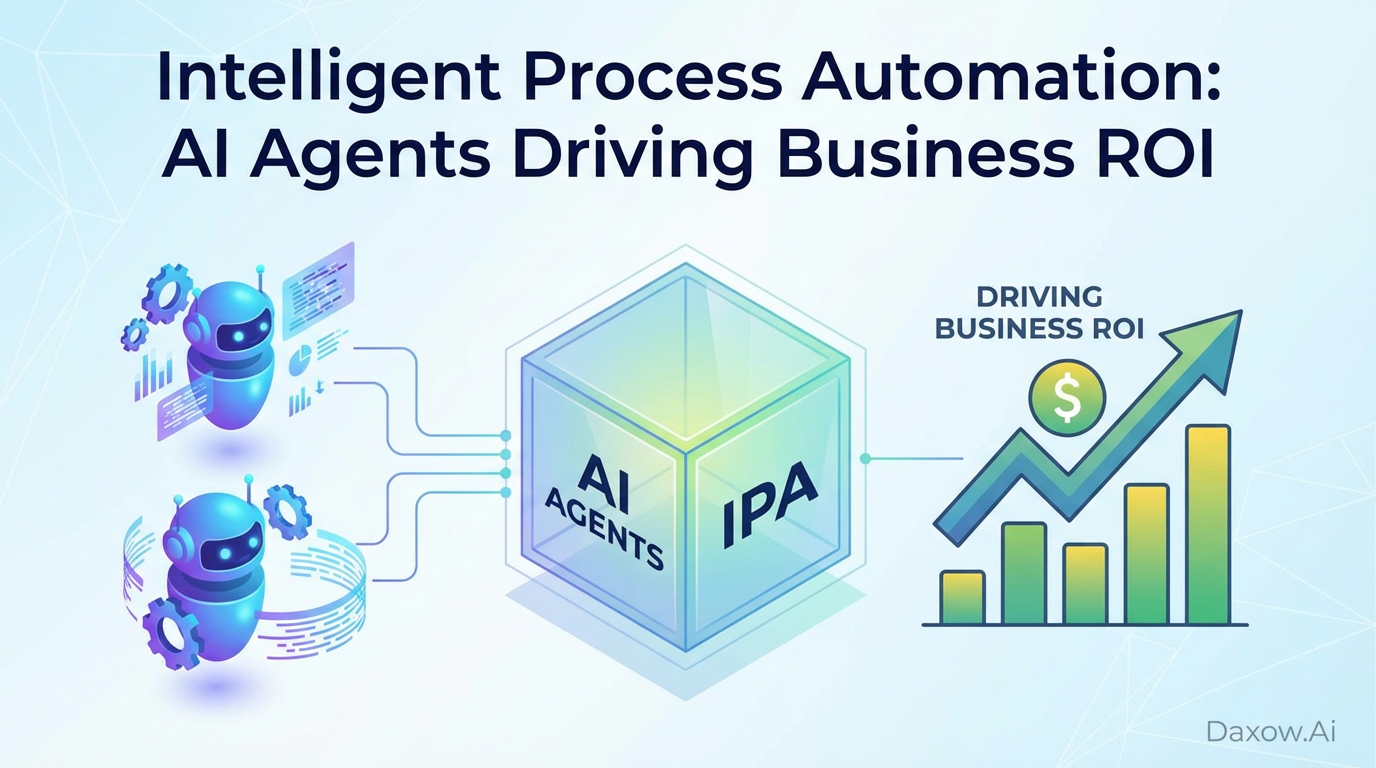
AI agents and intelligent process automation that cut costs, boost productivity, and deliver ROI. Use cases, implementation steps, and Daxow.ai support.
Unlocking Business Transformation: AI Agents and Automation in Intelligent Process Automation
Estimated reading time: 15 minutes
Key Takeaways
- Intelligent Process Automation (IPA) leverages AI agents and workflow automation to transform complex business processes and reduce operational costs.
- IPA delivers measurable benefits such as up to 50% cost reduction, 3-5x productivity gains, faster ROI, improved customer experience, and adaptive operations.
- Pragmatic implementation involves goal definition, data assessment, cross-functional teams, prototyping, and scaling with governance.
- Industries from e-commerce to healthcare, finance, real estate, and HR benefit from AI-powered automation tailored to their requirements.
- Daxow.ai offers end-to-end expertise, practical AI and workflow automation solutions, and a structured pilot approach to drive measurable outcomes.
Table of Contents
- Unlocking Business Transformation: AI Agents and Automation in Intelligent Process Automation
- What Intelligent Process Automation Means for Businesses
- Practical Use Cases Across Industries
- How AI Agents and Automation Drive Results
- Implementation Steps and Best Practices
- Measuring ROI and Building the Business Case
- Why Partner with Daxow.ai
- Getting Started: A Pragmatic First Project
- Frequently Asked Questions
Unlocking Business Transformation: AI Agents and Automation in Intelligent Process Automation
Intelligent process automation combines autonomous AI agents with workflow automation and robotic process automation (RPA) to handle complex, end-to-end business processes. Unlike rule-only automation, AI agents can reason over data, learn from new information, and execute multi-step tasks across systems. This enables organizations to automate not only repetitive work but also decisions that once required human judgment.
Key outcomes of IPA include:
- Significant cost reduction: Targeted areas often see operational cost decreases of 30–50%.
- Rapid productivity gains: Teams can achieve 3–5x improvements in throughput for automated processes.
- Faster payback: Many pilots produce ROI within 6–12 months for high-volume activities.
- Improved customer experience: Reduced response times and consistent, accurate answers across channels.
- Adaptive operations: Systems that retrain and adapt reduce error drift and scale during demand spikes.
What Intelligent Process Automation Means for Businesses
From manual drudgery to intelligent orchestration
IPA transforms manual, data-heavy tasks—like invoice handling, claims triage, lead qualification, and document extraction—into orchestrated processes where AI agents take responsibility for routine decisions and escalate exceptions. This shift frees teams to focus on strategy, relationship-building, and innovation.
Where value typically appears first
- Invoice and payment processing
- Customer support triage and response
- Compliance monitoring and reporting
- Lead intake and qualification
- HR onboarding and documentation
Tangible business metrics to target
- Processing speed (time per transaction)
- Error rates (defect or rework percentage)
- Cost per case or customer interaction
- Customer satisfaction (CSAT / NPS)
- Revenue conversion uplift from faster lead handling
Practical Use Cases Across Industries
E-commerce — customer support automation and supply chain resilience
Problem: High volumes of customer inquiries and returns create long response times and expensive manual processing.
Solution: Deploy AI agents to handle multi-turn customer conversations across chat and email, automate return authorizations, and analyze customer feedback for product improvements. Integrate agents with inventory and logistics systems to predict supply chain disruptions and trigger contingency workflows.
Impact:
- Reduce fulfillment times by up to 40%
- Faster first response and resolution, improving CSAT
Daxow.ai contribution: We build chatbots and integrated workflow automation that connect storefronts, CRMs, and logistics platforms—automating order exceptions and summarizing customer sentiment for merchandising teams.
Healthcare — patient intake, triage, and documentation automation
Problem: Manual patient onboarding, documentation backlog, and billing errors slow care and increase compliance risk.
Solution: Use AI agents to extract data from intake forms and referral documents, triage patient inquiries with clinical rules and NLP, and automate billing reconciliation to detect anomalies.
Impact:
- Faster patient onboarding and reduced administrative backlogs
- Improved billing accuracy and regulatory compliance
Daxow.ai contribution: We design secure, compliant AI systems that extract structured data from unstructured records and integrate with EHRs and billing systems while maintaining auditability.
Finance — fraud detection and document automation
Problem: Vast transaction volumes and regulatory reporting create risk and manual workload.
Solution: Introduce AI agents that continuously monitor transaction patterns, flag anomalies, and assemble compliance reports from multiple data sources. Automate invoice ingestion, validation, and reconciliation.
Impact:
- Reduced fraud losses and faster investigations
- Lower processing costs and improved reporting accuracy
Daxow.ai contribution: We implement predictive agents that combine statistical models and business rules, integrate with core banking and accounting systems, and provide explainable alerts for compliance teams.
Real estate — lead qualification and document processing
Problem: Slow lead response times and manual extraction from property documents delay deals.
Solution: Automate lead scoring using AI agents that merge inquiries, property data, and market trends. Use document automation to extract lease clauses and property details.
Impact:
- Faster deal cycles and higher conversion rates
- Reduced administrative lag between offer and closing
Daxow.ai contribution: We create lead qualification agents that push qualified leads to CRM workflows, and automate document data extraction into pricing and contract workflows.
HR — automated onboarding and workforce analytics
Problem: Lengthy onboarding and manual resume screening slow hiring and increase attrition risk.
Solution: Use AI agents to screen resumes for required skills, automate offer and onboarding workflows, and analyze sentiment from employee surveys to predict turnover.
Impact:
- Reduced time-to-hire and onboarding cost
- Early detection of retention risks, enabling proactive intervention
Daxow.ai contribution: We automate candidate triage and onboarding task orchestration, integrating HRIS systems and providing dashboards for workforce insights.
How AI Agents and Automation Drive Results
Autonomous execution with human-in-the-loop control
AI agents execute multi-step workflows, invoke APIs, read and write to CRMs, and route exceptions to humans when confidence is low. This hybrid approach balances automation scale with governance and oversight.
Learning systems that adapt
Unlike static RPA, AI agents retrain on new data and detect concept drift. Regular retraining pipelines and performance alerts are essential to maintain accuracy in evolving environments.
Example workflow: invoice processing
- Step 1: Document ingestion and OCR (data extraction)
- Step 2: AI agent validates vendor, amounts, and PO matching
- Step 3: Exceptions are routed to AP specialists with suggested resolutions
- Step 4: Payments are scheduled and accounting records updated
Benefits include faster cycle times, fewer payment errors, and measurable cost savings.
Implementation Steps and Best Practices
Adopting IPA successfully requires discipline and cross-functional collaboration. Below is a pragmatic implementation framework Daxow.ai follows with clients.
1. Define goals and identify processes
- Map current workflows and prioritize by volume, cost, and error rate.
- Set measurable objectives (for example: reduce processing time by 40% or cut manual FTE hours by 50%).
Daxow.ai: We conduct discovery workshops and process mapping to identify quick wins and medium-term transformations.
2. Assess data and select tools
- Audit data quality, accessibility, and compliance needs.
- Choose platforms with pre-built connectors and open APIs for legacy systems.
Daxow.ai: We design data pipelines and select the right stack—balancing cloud services, LLMs, and connectors to enterprise systems.
3. Build cross-functional teams
- Include business owners, IT, data engineers, and compliance advisors.
- Train employees to work with AI systems and reduce “shadow AI.”
Daxow.ai: We embed change management and training into every deployment, ensuring teams can operate and improve automations.
4. Prototype, test, and deploy
- Start with a pilot on a well-scoped process using validation datasets and clear KPIs.
- Implement monitoring dashboards and automated retraining triggers.
Daxow.ai: We deliver rapid prototypes, measure impact against KPIs, and iterate before enterprise rollout.
5. Scale and govern
- Establish governance for model updates, explainability, and ethical use.
- Plan for integration across systems and continuous improvement.
Daxow.ai: We provide managed services for monitoring, retraining, and security to ensure automations remain performant and compliant.
Common challenges and mitigations:
- Data quality issues: Standardize formats and implement preprocessing pipelines.
- Legacy system integration: Use middleware and pre-built connectors to reduce integration time.
- Employee resistance: Pair automation with mandatory training and clear role redesign.
- Performance drift: Schedule retraining and implement alerting for degradation.
Measuring ROI and Building the Business Case
Essential KPIs to track
- Throughput and processing time per case
- Error and exception rates
- Cost per transaction or interaction
- Employee hours saved and redeployed
- Customer metrics: CSAT, NPS, conversion rates
Example ROI scenarios
- Finance: Automation of invoice processing reduces FTE hours by 60%, cutting costs and enabling faster payments that preserve supplier discounts.
- Customer support: Automated triage and response increase first-contact resolution, boosting CSAT and reducing escalations.
- Sales: Lead qualification agents prioritize high-intent leads, improving conversion rates and shortening sales cycles.
Building a conservative forecast
- Model direct savings (reduced headcount hours), indirect revenue uplift (faster response = more conversions), and hard benefits (reduced fines, fraud losses).
- Include ongoing costs: hosting, maintenance, and retraining.
Why Partner with Daxow.ai
End-to-end expertise
Daxow.ai combines process analysis, AI engineering, and systems integration to build custom solutions that solve real business problems. We do not deliver generic models; we deliver automation that connects to your tools—CRMs, ERPs, ticketing systems—and executes real tasks.
Practical service offerings
- AI Agents that reason, integrate, and act across systems.
- Workflow Automation to orchestrate end-to-end processes.
- Chatbots & Customer Support Automation for consistent, scalable support.
- Lead Qualification agents that improve sales efficiency.
- Data Extraction & Document Automation for structured data from unstructured sources.
- Integrations with business tools and CRMs to ensure seamless operations.
Measurable outcomes
We focus on measurable outcomes: reducing manual tasks, improving productivity, lowering operational costs, and increasing ROI. Our clients see improved SLA compliance, fewer errors, and faster customer response times.
Security, compliance, and governance
Daxow.ai implements robust security controls, data governance, and explainability features to meet enterprise requirements. We embed monitoring and retraining pipelines to reduce model drift and ensure long-term reliability.
Getting Started: A Pragmatic First Project
Pilot approach
- Select a single high-impact process that is well understood.
- Run a 6–12 week pilot to validate metrics, then scale.
Daxow.ai: We offer a structured pilot program: discovery, rapid prototype, measurable pilot, and scale plan.
What success looks like
- Quantifiable time and cost savings within the pilot window.
- Clear scaling roadmap and integration plan.
- Stakeholder alignment and operational ownership.
Frequently Asked Questions
What is Intelligent Process Automation (IPA)?
IPA combines AI agents, workflow automation, and robotic process automation to automate complex business processes that involve decision-making, learning, and multi-step tasks.
How does Daxow.ai support IPA implementation?
Daxow.ai partners with organizations to map workflows, design custom AI and automation solutions, run pilots, and scale enterprise deployments with governance, security, and training.
Which industries benefit most from AI agents and automation?
Industries including e-commerce, healthcare, finance, real estate, and HR see the highest value by automating high-volume, rules-plus-data tasks.
How quickly can my organization expect ROI from IPA?
Many high-volume use cases achieve ROI within 6 to 12 months, with measurable cost reductions and productivity gains starting during pilot phases.