
AI Agents and Process Automation for Business Transformation
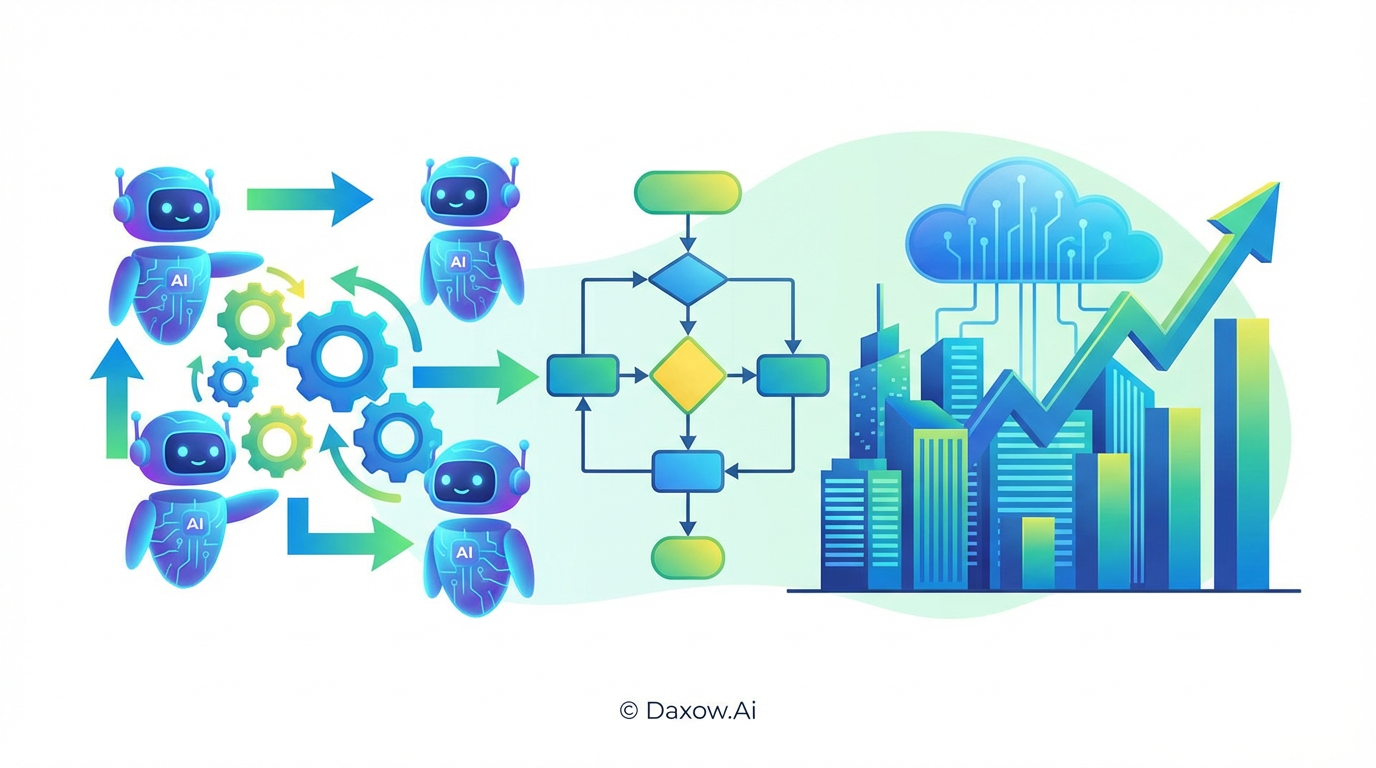
AI agents and process automation to cut costs, boost productivity, and deliver measurable ROI—use cases, implementation roadmap, and Daxow.ai's approach.
Unlocking Business Transformation: The Power of AI Agents and Process Automation
Estimated reading time: 15 minutes
Key Takeaways
- AI agents and process automation significantly reduce costs and improve productivity across industries.
- AI agents differ from traditional automation by learning, adapting, and making contextual decisions in closed-loop workflows.
- Practical use cases span e-commerce, healthcare, finance, real estate, and human resources, delivering measurable KPIs improvements.
- Successful implementation relies on clear goals, data quality, cross-functional teams, iterative testing, monitoring, and governance.
- Partnering with Daxow.ai ensures custom-designed, end-to-end AI agent solutions with measurable ROI and integration into existing systems.
Table of Contents
- Unlocking Business Transformation: The Power of AI Agents and Process Automation
- Practical Use Cases Across Industries
- How AI Agents and Automation Drive Business Outcomes
- Implementation Steps and Best Practices
- Measuring ROI and Setting KPIs
- Example Project: From Discovery to Live Agent
- Security, Compliance, and Ethical Considerations
- Why Partner with Daxow.ai
- Frequently Asked Questions
Unlocking Business Transformation: The Power of AI Agents and Process Automation
Unlocking Business Transformation: The Power of AI Agents and Process Automation is no longer a hypothetical advantage — it is a strategic imperative. Business leaders face pressure to reduce operating costs, improve customer experience, and scale without proportionally increasing headcount. This article explains what AI agents and workflow automation mean for decision-makers, presents structured research-based guidance, and delivers practical use cases across industries. You will also see how Daxow.ai designs and deploys custom AI systems that cut manual work, boost productivity, and produce measurable ROI.
What this concept covers
- AI agents are autonomous software entities that perceive environments, reason over data, make decisions, and execute actions across systems using machine learning, natural language processing, and generative AI.
- Process automation (including intelligent process automation or hyperautomation) automates rule-based and complex tasks—everything from invoice processing and lead qualification to fraud detection and predictive logistics.
Why it matters now
- Cost reductions up to 40% and productivity gains between 20–50% are achievable when automation targets the right processes.
- Employees spend 20–30% of their time on repetitive tasks; automation reallocates that capacity to higher-value work.
- Companies that adopt AI-first workflows respond faster to market changes and deliver superior customer experiences, improving NPS and revenue outcomes.
The business value is clear: scalability, operational resilience, and measurable improvement in KPIs such as processing speed, error rates, customer satisfaction, and sales conversion.
How AI agents differ from traditional automation
- Traditional automation executes predefined rules. AI agents can learn, adapt, and make contextual decisions.
- Agents can orchestrate multi-step workflows: read documents, update records in a CRM, notify teams, and initiate follow-ups without human handoffs.
- This closed-loop capability delivers 24/7 operations and continuous improvement through retraining on fresh data.
Practical Use Cases Across Industries
AI automation and AI agents excel in high-volume, data-rich environments. Below are actionable use cases with expected benefits.
E-commerce
- Customer support automation with conversational AI agents that resolve common issues, escalate complex tickets, and summarize recurring complaints.
- Benefits: Faster resolution times, higher NPS, and reduced support staffing costs.
- Inventory and supply chain predictability—agents analyze demand signals and supplier risk to recommend reorder levels.
- Benefits: Reduced stockouts, lower holding costs, improved fulfillment rates.
- KPI examples: first response time, resolution rate, cart abandonment reduction, inventory turnover.
Healthcare
- Document automation and patient data extraction—agents extract structured data from referrals, lab results, and intake forms.
- Benefits: Faster billing, improved coding accuracy, and reduced administrative load on clinicians.
- Pattern detection for early warnings—agents flag anomalies in patient vitals or lab trends for triage.
- Benefits: Earlier interventions, reduced readmission rates.
- KPI examples: claims processing time, documentation error rate, clinician time saved.
Finance
- Fraud detection and compliance reporting—agents monitor transactions, detect anomalies via unsupervised models, and auto-generate regulatory reports.
- Benefits: Faster fraud response, reduced losses (reported reductions up to 60% in some cases), and lower compliance overhead.
- Loan processing automation—agents extract application data, perform credit checks, and route approvals.
- Benefits: Shorter approval cycles, higher throughput.
- KPI examples: fraud loss ratio, compliance report turnaround, loan processing time.
Real Estate
- Lead qualification and virtual tours—conversational agents pre-qualify leads, schedule viewings, and deliver automated virtual tour summaries.
- Benefits: Higher-quality leads, reduced salesperson time on low-value prospects.
- Market analytics—agents analyze listings and local trends to recommend pricing and marketing actions.
- KPI examples: lead-to-conversion rate, time-on-market reduction, brokerage costs per listing.
Human Resources
- Candidate screening and onboarding—AI agents screen resumes, conduct initial interviews, and populate HRIS records.
- Benefits: Reduced time-to-hire (sometimes by 50%), more consistent candidate evaluation.
- Employee churn prediction—agents analyze engagement signals to identify flight risk and suggest retention actions.
- KPI examples: time-to-hire, retention rate, recruiting cost per hire.
Across industries, the same pattern repeats: automation handles high-volume, repeatable tasks and agents tackle unstructured data and decision points, together delivering faster processes, fewer errors, and scalable operations.
How AI Agents and Automation Drive Business Outcomes
AI agents augment human teams by orchestrating multi-step processes and integrating with existing systems—CRMs, ERPs, ticketing systems, and data warehouses. The result is a closed-loop system that:
- Surveils data: agents monitor events and data streams in real time.
- Detects anomalies: models surface risks or opportunities (fraud, supply delays, churn).
- Acts autonomously: agents execute playbooks—block transactions, reroute orders, or create tickets.
- Learns continuously: outcomes feed back for retraining and improved decision quality.
Concrete operational benefits
- Reduced manual tasks: eliminates repetitive work like data entry, routing, and first-line support.
- Improved accuracy: fewer human errors in billing, compliance, and reporting.
- Faster decision cycles: automated analysis and action compress cycle times from days to minutes.
- Scalable 24/7 operations: agents operate outside business hours, increasing throughput without proportional staffing.
Daxow.ai’s approach
- We design AI agents that perform real tasks within your operational environment.
- Our focus is end-to-end process automation: mapping workflows, integrating data sources, developing agent logic, and deploying monitoring and retraining systems.
- We prioritize business value by targeting high-ROI processes first and scaling to enterprise-wide automation.
Implementation Steps and Best Practices
Successful AI automation follows an iterative, measurable process. Use this roadmap to avoid common pitfalls and accelerate time to value.
1. Define goals and audit your data
- Start with a clear objective: cost reduction target, resolution time improvement, or sales uplift.
- Conduct a data audit for quality, completeness, and compliance (GDPR, HIPAA where applicable).
- Best practice: prioritize high-frequency, high-cost processes for rapid ROI.
2. Select tools and assemble cross-functional teams
- Choose platforms with robust APIs and scalable integration capabilities.
- Build a team with domain experts, ML engineers, software engineers, and a project manager.
- Best practice: include compliance and security leads early.
3. Develop, test, and pilot
- Use labeled datasets for supervised learning where possible; apply unsupervised models for anomaly detection.
- Validate models with accuracy, precision, recall, and business-oriented KPIs.
- Pilot in a single department to limit scope and gather feedback.
4. Deploy, monitor, and retrain
- Implement dashboards and alerts for model drift and operational metrics.
- Schedule automated retraining and human-in-the-loop checkpoints.
- Best practice: create a governance framework to avoid shadow AI and ensure reproducibility.
Common pitfalls and mitigations
- Legacy system integration: mitigate by selecting middleware with strong connectors and conducting API audits.
- Poor data quality: allocate time to data engineering and normalization before modeling.
- Skill gaps: invest in training and hire hybrid roles (ML + devops).
- Ethical risks and bias: embed compliance experts in design and audit models regularly.
Measuring ROI and Setting KPIs
To justify investment, track baseline metrics and post-deployment outcomes. Typical KPIs include:
- Processing time per transaction or ticket.
- Error rate or rework percentage.
- Cost per case or cost per lead.
- Sales conversion rate and average deal size.
- NPS or customer satisfaction scores.
Example ROI calculation (invoice automation)
- Baseline: 1,000 invoices/month, manual cost per invoice $8 → monthly cost $8,000.
- Post automation: 40% cost reduction → new cost $4,800 → monthly savings $3,200.
- Annualized savings: $38,400; payback period depends on implementation cost.
Measure long-term value:
- Track system adoption, model accuracy trends, and business KPIs.
- Reinvest a portion of savings into further automation and retraining to compound benefits.
Example Project: From Discovery to Live Agent
Typical Daxow.ai engagement for mid-size enterprise (8–12 weeks pilot):
- Week 1–2: Discovery & process mapping
- Identify three priority workflows with measurable KPIs.
- Audit data sources and integration points.
- Week 3–4: Prototype & model development
- Build an agent prototype that performs core actions (e.g., invoice extraction + CRM update).
- Validate against holdout dataset.
- Week 5–6: Pilot deployment
- Deploy to a controlled environment, integrate with production systems, and gather user feedback.
- Week 7–8: Scale & automation
- Implement retraining pipelines, dashboards, and user training.
- Hand over operational playbook and support options.
Deliverables
- Production-ready AI agent(s) integrated with existing systems.
- Monitoring dashboards, retraining pipelines, and governance documentation.
- Measured KPI improvements and a roadmap to scale.
Security, Compliance, and Ethical Considerations
Automation must respect privacy and regulatory requirements.
- Data protection: enforce encryption, least-privilege access, and logging.
- Bias mitigation: test models for disparate impact and retrain with representative data.
- Auditability: maintain explainability where required for compliance or customer transparency.
Daxow.ai integrates compliance checks into every engagement and embeds reporting features to satisfy audits and regulatory reviews.
Why Partner with Daxow.ai
- Custom design: We don’t offer one-size-fits-all products. We assess your workflows and tailor AI agents to your specific needs.
- End-to-end automation: From discovery and model development to integrations and monitoring.
- Systems integration: We connect AI agents to CRMs, ERPs, support tools, and data warehouses so your automation works within current operations.
- Execution-focused agents: Our agents are built to take real actions—creating tickets, updating records, blocking transactions, and initiating communications—reducing manual tasks across the enterprise.
- Measured ROI: We help define KPIs, baseline performance, and deliver measurable cost savings and productivity improvements.
Companies that partner with Daxow.ai move faster from idea to value because we combine domain experience, engineering discipline, and a focus on business outcomes.
Frequently Asked Questions
What are AI agents and how do they differ from traditional automation?
AI agents are autonomous software entities that learn, adapt, and make contextual decisions, orchestrating multi-step workflows without human intervention. Unlike traditional automation, which follows predefined rules, AI agents continuously improve through data and retraining.
Which industries benefit the most from AI agents and process automation?
Industries with high-volume, data-rich environments benefit greatly, including e-commerce, healthcare, finance, real estate, and human resources, among others.
How does Daxow.ai ensure compliance and security in AI automation projects?
Daxow.ai enforces data protection standards such as encryption, least-privilege access, and logging, embeds bias mitigation and auditability processes, and integrates compliance checks into every engagement to satisfy regulatory requirements.
What is the typical timeline for implementing an AI agent project with Daxow.ai?
A typical engagement spans 8 to 12 weeks, including discovery, process mapping, prototype development, pilot deployment, and scaling automation with ongoing monitoring and retraining.