
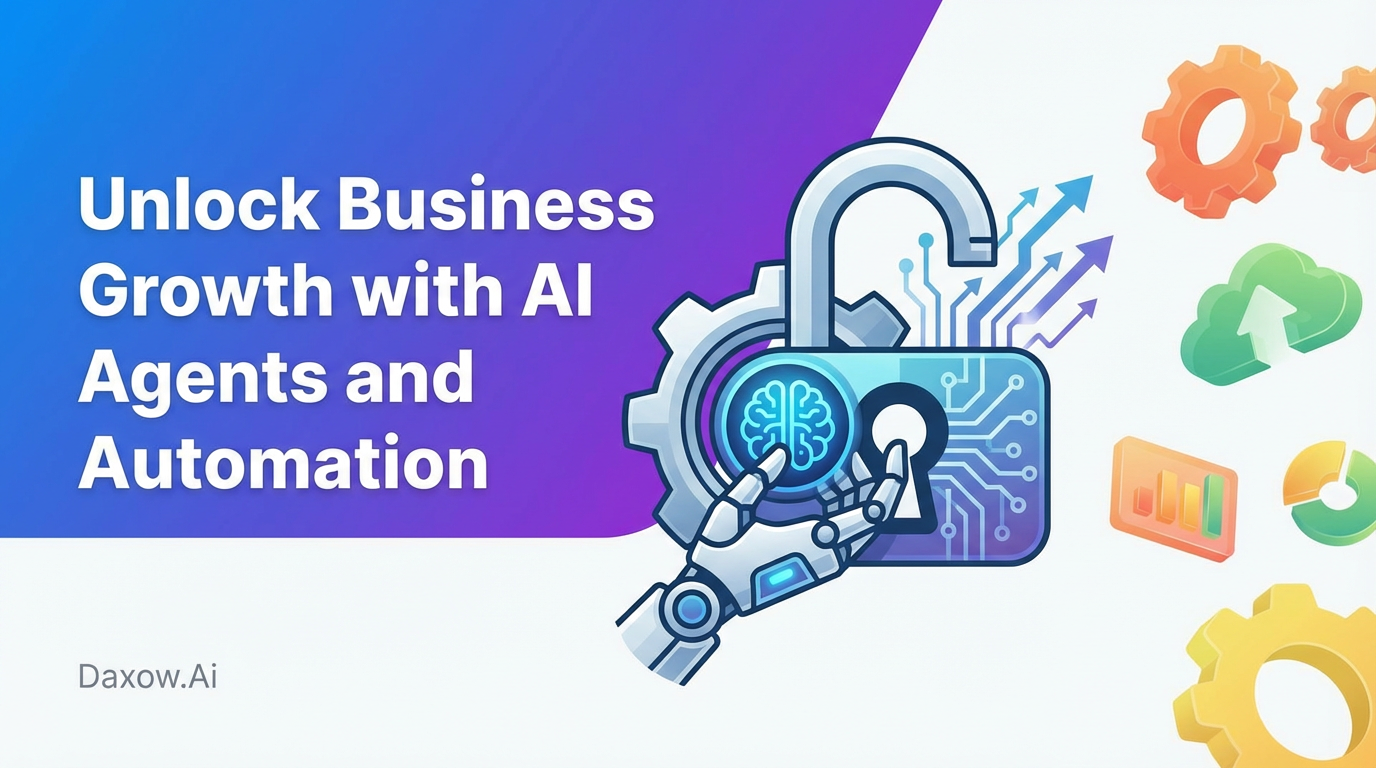
Unlock Business Growth with AI Agents and Automation
AI agents and workflow automation that optimize processes, cut costs, and scale operations. Roadmap, industry use cases, and Daxow.ai implementation guide.
Unlocking Business Growth: AI Agents and Automation in Process Optimization
Estimated reading time: 12 minutes
Key Takeaways
- AI agents combined with workflow automation reduce manual tasks, boost productivity, and enhance customer experience.
- Industry-specific use cases demonstrate measurable ROI and operational improvements.
- A phased implementation roadmap ensures scalable, governed AI deployments.
- Best practices and pitfalls guide successful automation strategies.
- Daxow.ai partners to deliver custom AI automation solutions tailored to enterprise needs.
Table of Contents
- Unlocking Business Growth: AI Agents and Automation in Process Optimization — What it Means for Your Business
- Practical Use Cases and Industry Examples
- How AI Agents and Automation Drive Business Transformation
- Implementation Roadmap — From Pilot to Enterprise-Scale Automation
- Best Practices and Common Pitfalls
- Measuring ROI and Business Value
- How Daxow.ai Delivers End-to-End AI Automation
- Practical Checklist to Start Automating Today
- Conclusion — Move from Opportunity to Outcome
- Frequently Asked Questions
Unlocking Business Growth: AI Agents and Automation in Process Optimization — What it Means for Your Business
AI agents are autonomous software entities that combine machine learning, natural language processing, and business logic to perform multi-step tasks without constant human supervision. When paired with workflow automation, these agents orchestrate data flows, decision points, and system integrations so teams can focus on strategy instead of repetitive work.
Key business impacts:
- Reduce manual tasks across departments by automating rule-based activities like data entry, invoice processing, and lead qualification.
- Increase productivity by enabling teams to focus on higher-value work, while agents execute routine operations.
- Improve customer experience through faster, personalized interactions using customer support automation and AI-driven recommendations.
- Lower operational costs with targeted savings often between 20–50% in automated areas and faster throughput.
- Scale reliably with systems that monitor, learn, and adapt to exceptions, reducing human intervention over time.
Practical Use Cases and Industry Examples
E-commerce and Retail
- Order-to-cash automation: Agents validate orders, reconcile payments, and trigger fulfillment workflows, cutting order processing time by up to 70%.
- Customer support automation: Chatbots and ticket triage agents resolve common inquiries and escalate complex cases to human agents with full context.
- Inventory prediction: AI agents analyze sales trends and supplier data to predict stockouts and suggest replenishment, reducing lost sales.
- Marketing automation: Agents generate personalized product recommendations and dynamic email content to increase conversion rates.
Business value: Faster fulfillment, improved NPS, and reduced cart abandonment.
Healthcare and Life Sciences
- Document automation: AI extracts structured data from referral letters, lab reports, and consent forms to populate EHRs.
- Clinical triage agents: Summarize patient histories and surface anomalies for clinician review, improving triage speed.
- Compliance monitoring: Agents validate documentation and flag potential regulatory gaps for audit readiness.
Business value: Reduced administrative burden for clinicians and improved compliance posture.
Finance and Insurance
- Fraud detection agents: Real-time monitoring of transaction patterns with automated escalation to compliance teams.
- Document processing: High-volume invoice and claims processing with automated reconciliation and exception workflows.
- Risk forecasting: Agents analyze macro and internal data to produce scenario forecasts for treasury and underwriting.
Business value: Lower fraud losses, faster claim resolution, and more accurate risk models.
Real Estate and Property Management
- Lead qualification: AI agents research leads, score prospects, and schedule viewings or follow-ups.
- Market analysis: Agents aggregate listings, sales, and neighborhood metrics to generate investment-ready reports.
- Tenant support automation: Chatbots handle maintenance requests, schedule contractors, and track resolution.
Business value: Shorter sales cycles and improved portfolio performance.
HR and Administration
- Resume screening: Automated parsing and ranking of candidates against role criteria.
- Employee support agents: Answer payroll and benefits queries and route complex requests to HR staff.
- Attrition prediction: Sentiment analysis of surveys and performance data to proactively target retention efforts.
Business value: Faster hiring times and improved employee satisfaction.
How AI Agents and Automation Drive Business Transformation
AI agents extend automation from single-step tasks to dynamic, multi-step processes. They do more than follow rules: they reason, adapt, and integrate data across systems to execute complete workflows.
Core capabilities:
- Autonomous orchestration across CRMs, ERPs, ticketing systems, and custom databases.
- Natural language understanding to interact with customers and employees.
- Continuous learning and retraining to reduce bias and improve accuracy.
- Exception handling that routes ambiguous cases to humans with context and recommendations.
The result is hyperautomation: a coordinated stack of tools where AI handles exceptions intelligently and human teams focus on strategy and exceptions that truly need judgment. Mature deployments report human intervention reductions of up to 80% in targeted workflows and measurable ROI within 12–18 months.
Implementation Roadmap — From Pilot to Enterprise-Scale Automation
Phase 1 — Define Objectives and Prioritize Use Cases
- Define measurable goals (e.g., 30% reduction in invoice processing time, 20% lower support costs).
- Use an AI-first scorecard to evaluate readiness: data quality, process volume, compliance constraints.
- Prioritize quick wins with high volume and low technical risk.
Phase 2 — Process Discovery and Data Audit
- Map current workflows to identify handoffs, bottlenecks, and data sources.
- Conduct a data audit for accuracy, completeness, and accessibility.
- Standardize formats and establish single sources of truth to feed AI models.
Phase 3 — Prototype and Pilot
- Build a minimum viable agent for a single, non-critical workflow.
- Integrate with one or two core systems (CRM, accounting, support platform).
- Measure baseline metrics and iterate rapidly.
Phase 4 — Scale and Integrate
- Expand to adjacent processes and add system integrations.
- Implement governance for model retraining, bias monitoring, and security.
- Automate monitoring and alerts for performance regressions.
Phase 5 — Continuous Improvement and Governance
- Track KPIs: productivity, error rate, cycle time, revenue impact, and customer satisfaction.
- Establish an AI Center of Excellence or cross-functional team to manage lifecycle.
- Enforce policies to mitigate shadow AI and ensure model explainability.
Best Practices and Common Pitfalls
Best practices:
- Start with clean, well-governed data.
- Define measurable outcomes before technical design.
- Form cross-functional teams including IT, security, and business owners.
- Prefer no-code/low-code tools for early pilots, scaling to custom AI agents as needs mature.
- Monitor for bias and retrain models regularly.
- Design for observability: log decisions, inputs, and confidence levels.
Common pitfalls to avoid:
- Rushing into broad automation without a prioritized roadmap.
- Ignoring integration complexity and downstream system impacts.
- Underinvesting in change management and user training.
- Allowing shadow AI tools to proliferate without governance.
Measuring ROI and Business Value
Quantifying impact is essential for sustained investment. Typical outcomes observed across early and mature adopters include:
- 30–70% reductions in process times, depending on process complexity.
- Error rates reduced to under 5% in well-designed document and data pipelines.
- 3–5x return on investment within 12–18 months for high-volume automation initiatives.
- 20%+ profit margin improvements for mature adopters that reengineer end-to-end workflows.
Measure using a combination of financial and operational KPIs:
- Cost per transaction and total cost of ownership.
- Cycle time and throughput.
- Customer satisfaction (NPS, CSAT) and employee productivity metrics.
- Compliance and risk indicators.
How Daxow.ai Delivers End-to-End AI Automation
Daxow.ai is built to help organizations transition from manual operations to fully automated, AI-driven workflows. Our service model is practical, measurable, and designed for enterprise realities.
What we do:
- Discovery and process analysis to identify high-impact automation opportunities.
- Data engineering and integration with CRMs, ERPs, ticketing systems, and proprietary databases.
- Custom AI agent development that executes real tasks: document extraction, lead qualification, customer support automation, and sales automation.
- Deployment and observability: continuous monitoring, retraining, and performance optimization.
- Governance and security: compliance-ready designs, access controls, and explainability.
How Daxow.ai adds business value:
- End-to-end process automation reduces handoffs, removes manual errors, and accelerates throughput.
- Custom AI agents perform multi-step workflows and integrate natively with existing tools.
- Measurable ROI focus: we define success metrics up front and structure pilots to deliver rapid value.
- We reduce time-to-value with low-code prototypes before scaling to robust, production-grade systems.
Typical Engagement Flow with Daxow.ai
- Initial consultation and process mapping.
- Proof of concept for one prioritized process.
- Integration, testing, and secure deployment.
- Scale-up plan and ongoing managed services.
Practical Checklist to Start Automating Today
- Identify 2–3 high-volume, repetitive processes (billing, claims, customer inquiries).
- Run a data audit to confirm access and quality.
- Define 3 measurable KPIs (e.g., reduce cycle time by X%, decrease errors by Y%).
- Choose a pilot that minimizes customer risk but delivers measurable outcomes.
- Engage stakeholders across IT, security, and the business.
- Partner with a specialist to accelerate design and integration.
Conclusion — Move from Opportunity to Outcome
AI agents and workflow automation are the levers that transform operational inefficiency into sustained competitive advantage. Organizations that implement automation with clear objectives, strong data governance, and the right partners realize faster processing, lower costs, and improved customer and employee experiences.
Daxow.ai helps organizations unlock growth by designing custom AI systems that automate end-to-end processes, integrate with existing systems, and deliver measurable ROI. Whether your priority is customer support automation, sales automation, document extraction, or full workflow automation, Daxow.ai combines strategic consulting with hands-on engineering to make automation real.
Frequently Asked Questions
What are AI agents in business automation?
AI agents are autonomous software programs that use machine learning and business logic to perform multi-step tasks and workflows without continual human intervention.
How does workflow automation improve productivity?
By automating repetitive, rule-based tasks, workflow automation allows teams to focus on strategic, higher-value activities, increasing overall productivity and efficiency.
What industries benefit most from AI automation?
Industries like e-commerce, healthcare, finance, real estate, and HR see significant benefits through improved process speed, accuracy, and customer experience.
How does Daxow.ai support AI automation projects?
Daxow.ai offers end-to-end services including process discovery, data engineering, custom AI agent development, deployment, governance, and ongoing optimization tailored to enterprise needs.