
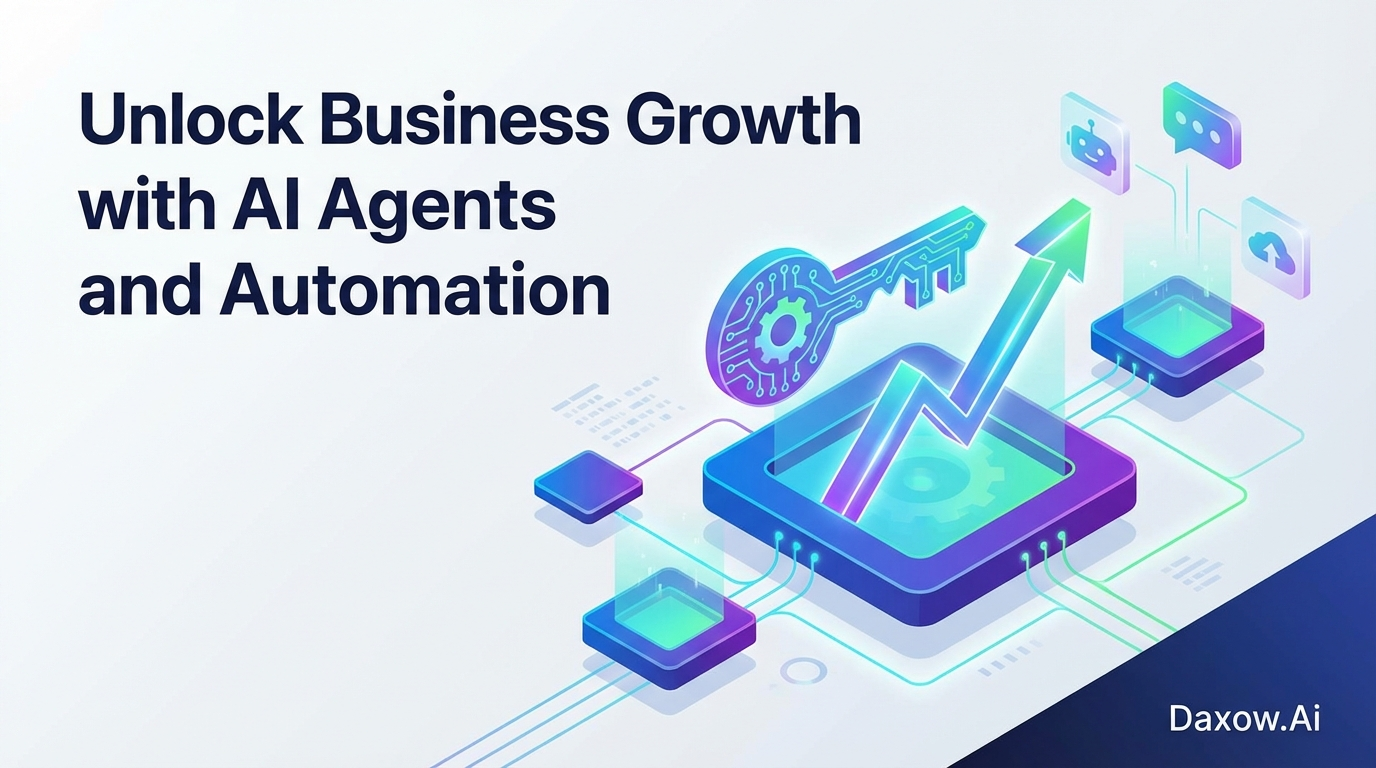
Unlock Business Growth with AI Agents and Automation
How AI agents and workflow automation boost productivity, cut costs, and scale operations — plus Daxow.ai's roadmap to build, deploy, and measure ROI.
Unlocking Business Growth: AI Agents and Automation in Intelligent Process Optimization
Estimated reading time: 15 minutes
Key Takeaways
- AI agents and workflow automation reduce manual tasks and improve operational efficiency across industries.
- Businesses benefit from productivity gains, cost reduction, scalability, and faster time-to-value through AI automation.
- Industry-specific use cases demonstrate actionable ways to implement AI agents and automation.
- Daxow.ai offers a comprehensive, end-to-end approach to custom AI agent design, integration, and scaling.
- A phased implementation roadmap with best practices helps mitigate risks and ensures sustainable adoption.
- Measuring clear KPIs and tracking ROI are critical to justifying AI automation investments.
Table of Contents
- What AI Agents and Automation Mean for Your Organization
- Key Business Impacts
- Practical Use Cases: AI Automation and AI Agents Across Industries
- How Daxow.ai Builds Custom AI Agents and Delivers Workflow Automation
- Implementation Roadmap and Best Practices for AI Automation
- Common Pitfalls and How to Avoid Them
- Measuring ROI and Expected Business Value
- Getting Started with Intelligent Process Optimization
- Frequently Asked Questions
What AI Agents and Automation Mean for Your Organization
AI agents are autonomous software entities that perform multi-step tasks by combining AI reasoning, data extraction, and system integration. They go beyond rule-based RPA to learn from data, adapt to exceptions, and improve over time.
Workflow automation connects those agents to your systems and processes so tasks are completed accurately and at scale, freeing teams from repetitive work.
Business automation with AI offers three immediate benefits: reduced manual tasks, improved productivity, and faster, more consistent customer outcomes.
Key Business Impacts
- Productivity gains: Targeted workflows often see 30–50% efficiency improvements.
- Cost reduction: Automated tasks can reduce operational costs by 40–60% in scope areas.
- Scalability: AI-driven systems handle 5–10x volume increases without proportional headcount growth.
- Faster time-to-value: Well-scoped pilots often pay back within 6–12 months.
Practical Use Cases: AI Automation and AI Agents Across Industries
E-commerce
- Automated order-to-cash and returns handling
AI agents extract order details, reconcile payments, trigger refunds, and update inventory.
Business outcome: Reduce manual order exceptions by up to 80% and improve cash flow visibility. - Personalized recommendations and conversational commerce
Chat agents qualify leads, recommend products based on behavioral data, and escalate high-value prospects to sales.
Business outcome: Increase conversion rates and reduce average handling time in customer support.
Healthcare
- Patient intake, scheduling, and claims processing
AI agents extract information from referrals and insurance documents, triage appointment requests, and autofill forms.
Business outcome: Reduce administrative backlog from days to hours and improve patient satisfaction. - Remote monitoring and anomaly detection
Agents analyze device telemetry and trigger alerts for early intervention.
Business outcome: Improve care outcomes while lowering the cost per patient.
Finance
- Fraud detection and compliance automation
Real-time transaction analysis flags suspicious patterns; an automated case-management agent assembles evidence for investigators.
Business outcome: Prevent losses and reduce investigation time by a large margin. - Regulatory reporting and document extraction
Agents extract structured data from filings and produce audit-ready reports.
Business outcome: Cut reporting labor and improve accuracy for regulatory compliance.
Real Estate
- Lead qualification and lease automation
AI agents match listings with buyer or tenant preferences, schedule viewings, and draft lease summaries.
Business outcome: Increase qualified leads and shorten time-to-rent/sale cycles. - Market insights and pricing predictions
Agents aggregate economic indicators and local listings to suggest optimal pricing.
Business outcome: Improve margin and speed of decisions for brokers and investors.
HR and People Operations
- Resume screening and onboarding automation
Agents summarize candidate fit, schedule interviews, and automate paperwork.
Business outcome: Reduce time-to-hire and ensure consistent candidate experiences. - Employee churn prediction and engagement automation
Agents analyze engagement signals and trigger retention workflows targeted to at-risk employees.
Business outcome: Lower attrition and reduce associated hiring costs.
Customer Support and Sales Automation
- Support chatbots and escalation agents
Chat agents resolve routine queries and escalate complex issues with context-rich handoffs.
Business outcome: Resolve up to 80% of routine requests automatically and free human agents for high-value work. - Lead qualification and CRM enrichment
AI agents enrich leads with intent signals and prioritize follow-up.
Business outcome: Increase sales velocity and improve conversion rates.
How Daxow.ai Builds Custom AI Agents and Delivers Workflow Automation
Daxow.ai specializes in designing bespoke AI systems that integrate with existing business tools and CRMs to automate end-to-end processes. Our approach is practical, measurable, and aligned to business outcomes.
-
Discovery and process mapping
We start with a focused process audit to identify high-impact areas where AI automation can reduce manual tasks and improve customer support automation or sales automation.
Deliverables: Process maps, ROI estimates, prioritized backlog. -
Data audit and objectives
We assess data quality, accessibility, and compliance constraints and define measurable goals (e.g., reduce invoice processing time by 50%).
Deliverables: Data inventory, compliance checklist, success metrics. -
Prototype and proof-of-value
We build a rapid prototype—often using low-code integrations—to validate assumptions with real users and real data.
Deliverables: Working prototype, pilot plan, performance baseline. -
Build and integrate
Our engineers create robust AI agents that connect via APIs to CRMs, ERPs, ticketing systems, and document stores.
We use secure, scalable architectures and implement monitoring and retraining pipelines.
Deliverables: Production-ready agents, integration adapters, monitoring dashboards. -
Training, change management, and governance
We train cross-functional teams, mitigate shadow AI risk, and establish governance for model updates and bias monitoring.
Deliverables: Training sessions, governance playbook, escalation paths. -
Scale and continuous improvement
After pilot success, we scale automation across workflows and provide continuous improvement cycles to retrain models, optimize triggers, and expand integrations.
Deliverables: Scaling roadmap, ROI tracking, ongoing support.
Why Daxow.ai’s approach pays off
- End-to-end delivery: From process design to production deployment, reducing handoffs and minimizing time-to-value.
- Systems integration expertise: Connects legacy systems, modern CRMs, and cloud services so AI agents can act across your stack.
- Custom agents that execute: We build agents that not only analyze but also perform actions—updating records, creating tickets, sending communications—so manual tasks are eliminated.
- Security and compliance by design: We embed data protection and auditability suitable for regulated industries.
Implementation Roadmap and Best Practices for AI Automation
-
Phase 1 — Identify high-impact processes
Use task mining or stakeholder interviews to find repetitive, high-volume tasks.
Prioritize for cost savings, error reduction, or NPS improvements.
Best practice: Start with 1–3 processes to demonstrate value quickly. -
Phase 2 — Data readiness and objective-setting
Audit data sources for quality and machine-readability.
Define KPIs: processing time, error rate, NPS, conversion uplift.
Best practice: Ensure legal and compliance teams review data usage early. -
Phase 3 — Tool selection and prototyping
Choose platforms that support secure integrations and model management.
Build a low-risk pilot to measure real-world impact.
Best practice: Favor modular, API-driven architectures for portability. -
Phase 4 — Cross-functional build and training
Assemble stakeholders: business owners, IT, data scientists, and operators.
Provide user training and identify champions to increase adoption.
Best practice: Maintain clear documentation and runbooks for exceptions. -
Phase 5 — Launch, monitor, and iterate
Deploy with monitoring for accuracy, latency, and business KPIs.
Retrain models frequently and incorporate human feedback.
Best practice: Use A/B testing to validate impact before scaling. -
Phase 6 — Scale and govern
Expand automation to adjacent workflows.
Implement governance policies for lifecycle management and bias detection.
Best practice: Maintain a central automation registry to avoid sprawl.
Common Pitfalls and How to Avoid Them
- Poor data quality: Fix source data and use enrichment before model training.
- Ignoring IT: Involve IT early to ensure security and reliability.
- Over-automation: Preserve human oversight for high-risk decisions.
- No measurement: Define KPIs before launch and track continuously.
Measuring ROI and Expected Business Value
To justify investments, executives need clear KPIs and realistic timelines. Here are metrics and benchmarks to use in your case for automation.
Key metrics to track
- Time saved per process (hours/week)
- Error reduction rate (%)
- Cost per transaction before vs. after automation
- Customer satisfaction (NPS or CSAT) changes
- Lead-to-deal conversion and sales cycle reduction
- Compliance/regulatory reporting accuracy
Benchmarks and expectations
- Cost savings: 40–60% on automated tasks in targeted areas.
- Productivity: 3–5x improvement for teams handling automated workflows.
- Payback period: Often 6–12 months for well-scoped pilots.
- Scalability: Systems can absorb 5–10x volume increases without proportional staffing.
Illustrative ROI example
A mid-sized finance team automates invoice processing:
- Manual: 4 FTEs, 1,600 invoices/month, average 30 minutes per invoice.
- Automated: Reduced FTE effort by 70%, invoices processed in hours, error rate reduced by 85%.
- Outcome: Payback on implementation costs within 9 months and ongoing annual savings of 40–50% in processing costs.
Getting Started with Intelligent Process Optimization
If your business wants to reduce manual tasks, improve productivity, and implement AI automation that integrates with existing CRMs and systems, Daxow.ai can help. Our engagements typically begin with a focused discovery to produce a concrete roadmap and quick wins.
What a Daxow.ai consultation delivers
- Rapid process analysis to identify high-impact automation opportunities.
- Data readiness assessment and measurable objectives.
- Pilot design to validate ROI with minimal disruption.
- Integration plan and security review tailored to your environment.
Frequently Asked Questions
What distinguishes AI agents from traditional RPA?
AI agents combine AI reasoning, data extraction, and system integration with learning capabilities that adapt to exceptions, unlike traditional rule-based RPA which follows fixed instructions.
How soon can I expect ROI from AI automation?
Well-scoped pilots typically pay back within 6 to 12 months, depending on the complexity and scale of automation implemented.
What industries benefit the most from intelligent process optimization?
E-commerce, Healthcare, Finance, Real Estate, HR, and Customer Support are key verticals where AI agents drive measurable results, though most sectors can benefit.
How does Daxow.ai ensure security and compliance?
We design systems with data protection, audit trails, and compliance policies embedded, addressing regulatory requirements especially for sensitive industries.