
AI Agents and Automation for Intelligent Process Optimization
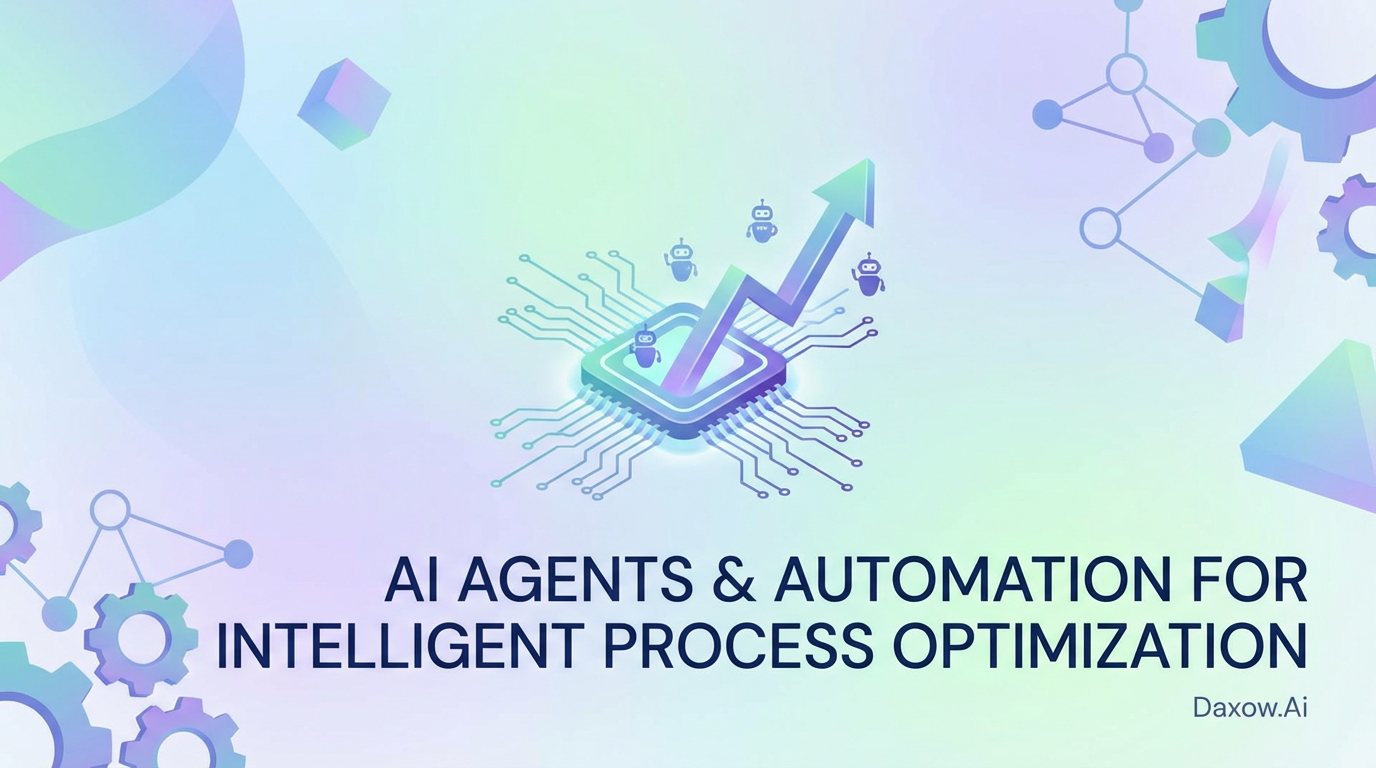
Learn how AI agents and automation optimize processes, boost productivity and ROI across industries with a practical roadmap and Daxow.ai's end-to-end services.
Unlocking Business Growth: AI Agents and Automation in Intelligent Process Optimization
Estimated reading time: 15 minutes
Key Takeaways
- AI agents and automation reduce manual tasks, boosting productivity and resiliency.
- Cross-industry use cases demonstrate measurable improvements in operations and customer experience.
- Successful AI automation requires phased implementation, integration, and continuous monitoring.
- Daxow.ai delivers tailored AI automation solutions with end-to-end design, integration, and governance.
- Measuring ROI with clear KPIs ensures tangible business value and faster payback timelines.
Table of Contents
- Unlocking Business Growth: AI Agents and Automation in Intelligent Process Optimization
- Practical Use Cases: AI Agents and Automation across industries
- How AI Agents and Automation Drive Transformation
- Implementation Roadmap for AI Automation
- Measuring ROI and Business Value
- How Daxow.ai Delivers Custom AI Automation
- Getting started with intelligent process optimization
- Frequently Asked Questions
Unlocking Business Growth: AI Agents and Automation in Intelligent Process Optimization
Strategic value at a glance
- Reduce manual tasks by automating rule-based and cognitive workflows.
- Improve productivity — many organizations report productivity gains of up to 40% and ROI that can reach multiple times the initial investment.
- Increase resiliency through systems that scale on demand and adapt to new data.
- Enhance customer experience with faster response times, personalized interactions, and more consistent service.
AI agents combine machine learning, natural language understanding, and workflow orchestration to act autonomously on behalf of users. Unlike basic macros or RPA alone, modern AI agents handle unstructured data, make contextual decisions, and execute multi-step processes across systems. That convergence of capabilities is what enables intelligent process optimization at scale.
Practical Use Cases: AI Agents and Automation across industries
E-commerce
- Inventory forecasting and dynamic pricing: AI agents analyze sales velocity, seasonality, and supplier lead times to optimize reorder points and pricing rules. This reduces stockouts and overstocks while improving gross margins.
- Customer support automation: Chatbots handle common inquiries, escalate complex issues, and create tickets in CRM systems. Result: reduced first response times and lower support headcount requirements.
- Checkout and fraud monitoring: Automation flags anomalous transactions and triggers verification workflows, reducing chargebacks and false positives.
Healthcare
- Triage and appointment scheduling: Conversational AI agents triage symptoms, prioritize cases, and schedule appropriate appointments, improving access and reducing administrative burdens.
- Clinical documentation and coding: Automated extraction from notes speeds billing and reduces errors while maintaining compliance.
- Supply chain and compliance reporting: Workflow automation ensures supplies are tracked, expirations managed, and regulatory reports generated on schedule.
Finance
- Compliance and transaction monitoring: AI agents continuously analyze transactions for anomalies and generate audit trails for regulators.
- Loan processing and underwriting: Automation extracts applicant data, runs risk models, and composes decision summaries for human review, cutting turnaround times.
- Forecasting and scenario planning: Agents refresh financial models with live data and produce scenario outputs for finance leaders.
Real estate and property management
- Lead qualification and virtual touring: Virtual agents engage prospects, pre-qualify leads, and schedule tours automatically.
- Tenant screening and lease automation: Automated workflows handle background checks, document verification, and contract generation.
- Market analysis and valuation: AI agents aggregate market signals to produce comparative valuations and pricing guidance.
HR and operations
- Resume screening and interview coordination: AI agents shortlist candidates, schedule interviews, and automate offer letters.
- Onboarding workflows: New hires receive automated checklists, training assignments, and compliance forms with progress tracked.
- Attrition prediction and training personalization: Predictive models identify turnover risks and recommend targeted interventions to retain talent.
Each use case demonstrates how AI automation shifts organizations from reactive firefighting to predictable, measurable operations. Daxow.ai builds tailored systems that integrate these capabilities with your CRM, ERP, and internal tools so business value is realized quickly and reliably.
How AI Agents and Automation Drive Transformation
Core capabilities that matter
- Task autonomy: Agents perform complex multi-step tasks — from extracting data in emails to updating records and notifying stakeholders.
- Integration power: Successful automation requires seamless connectivity to CRMs, ERPs, cloud services, and bespoke databases.
- Data-driven decisioning: Machine learning models enable predictions, anomaly detection, and personalized recommendations.
- Scalability and continuous learning: Cloud-native agents scale with demand and improve over time through retraining and feedback loops.
What differentiates modern AI automation
- Handling of unstructured data (email, documents, images) via NLP and computer vision.
- End-to-end orchestration that ties decisioning to action (e.g., approve invoice → update ledger → notify vendor).
- Embedded monitoring and observability to track performance, surface drift, and trigger retraining.
Implementation Roadmap for AI Automation
Phase 1 — Assess readiness
- Inventory processes to identify repetitive, high-volume workflows and data sources.
- Evaluate infrastructure: cloud readiness, data quality, and connectivity.
- Set measurable KPIs: time savings, error reduction, cost per transaction, NPS impact.
Phase 2 — Define scope and pilot
- Start with high-value, low-complexity processes (e.g., rule-based data extraction, simple chatbots).
- Design a pilot with clear success metrics and a rollback plan.
- Produce an MVP AI agent that integrates with one or two core systems.
Phase 3 — Build and integrate
- Data preparation: collect, clean, and annotate training data.
- Model selection and training: choose appropriate models and fine-tune for your domain.
- System integration: connect agents to CRMs, ERPs, email systems, and other business tools.
Phase 4 — Deploy, monitor, and refine
- Deploy incrementally and monitor with dashboards for latency, accuracy, and business KPIs.
- Implement retraining schedules and feedback loops to address model drift.
- Include manual oversight and escalation rules where risk is high.
Phase 5 — Scale and govern
- Expand automation to adjacent processes and cross-functional workflows.
- Enforce data governance, privacy controls, and ethical AI checks.
- Regularly audit models for bias and compliance.
Common pitfalls and how to avoid them
- Underestimating data silos: Map data sources early and plan integration.
- Vague objectives: Use specific KPIs to avoid scope creep.
- Overly complex platforms: Favor modular architectures that can evolve.
- Skipping retraining: Build continuous monitoring to catch drift.
Daxow.ai specializes in each phase of this roadmap. We conduct readiness assessments, deliver pilots, integrate AI agents with business systems, and set up monitoring and governance to ensure sustained ROI.
Measuring ROI and Business Value
What to measure
- Operational metrics: task completion time, throughput, error rates.
- Financial metrics: labor cost savings, error-related cost reduction, incremental revenue from personalization.
- Customer metrics: response times, satisfaction scores, conversion lift.
- Risk and compliance metrics: audit times, regulatory exceptions, accuracy of compliance checks.
Typical outcomes
- Faster processing: Many clients see workflow cycle times cut by 20–50%.
- Lower errors: Automation can reduce manual error rates by up to 90% in structured tasks.
- Productivity uplift: Organizations commonly report 30–40% productivity gains; some achieve 3–5x ROI depending on scale and scope.
- Payback periods: Pilot-to-payback timelines often fall under 12 months when focused on high-volume workflows.
Example ROI calculations (simplified)
- A support team handling 10,000 monthly queries where automation reduces manual interventions by 40% can translate to a 30–40% reduction in support costs.
- An accounts payable process that reduces invoice processing time by 60% and error rates by 80% improves working capital and reduces late fees.
Daxow.ai builds tracking frameworks so KPIs are visible and attributable. We link automation outcomes directly to cost centers and revenue streams to demonstrate real business value.
How Daxow.ai Delivers Custom AI Automation
End-to-end design and delivery
- Discovery and process analysis: We map existing workflows, identify automation targets, and quantify potential savings.
- Custom AI development: We design AI agents tailored to your data, language, and business logic.
- Integration and deployment: We connect agents to CRMs, ERPs, email systems, and third-party APIs to execute workflows end-to-end.
- Monitoring and governance: We implement dashboards, retraining pipelines, and compliance controls to keep systems performant and auditable.
Typical engagements
- Pilot projects to demonstrate initial value and refine models.
- Departmental rollouts for HR, finance, and support to deliver immediate cost reductions.
- Enterprise-wide automation programs for cross-functional orchestration and strategic transformation.
Why partner with Daxow.ai
- Practical focus on business value: We prioritize measurable outcomes over technology for technology’s sake.
- Full-stack capabilities: From data engineering and ML to workflow orchestration and UX, we cover the full delivery stack.
- Flexible integration approach: We integrate with commercial and legacy systems, minimizing disruption while maximizing impact.
- Security and compliance: We build with privacy and governance controls appropriate for your industry.
Getting started with intelligent process optimization
Quick starter checklist
- Identify 3–5 high-volume processes that are prime for automation.
- Define KPIs and baseline current performance.
- Gather representative data for training and integration points.
- Choose a small pilot with clear success criteria and an expected ROI timeline.
Example pilot idea
Automate invoice intake: use document AI to extract fields, validate against purchase orders, route exceptions, and update the ERP. Expected benefits: faster processing, fewer late payments, and reduced AP headcount time spent on reconciliation.
Conclusion
Unlocking Business Growth: AI Agents and Automation in Intelligent Process Optimization is achievable with a pragmatic, measured approach. The potential outcomes — reduced manual tasks, significant productivity gains, lower operational costs, and improved customer experience — are within reach when AI agents are designed to work with your systems and data.
If you want to move from concept to outcomes, Daxow.ai can help. We deliver tailored AI automation: from process analysis and pilot delivery to enterprise-scale integrations and ongoing optimization. Book a free consultation or request a process analysis for your company today to see how a custom AI system can reduce manual work, improve ROI, and transform your operations.
Contact Daxow.ai to build a custom AI system and start your intelligent process optimization journey.
Frequently Asked Questions
What industries benefit most from AI agents and automation?
AI agents and automation benefit a wide range of industries including e-commerce, healthcare, finance, real estate, and HR operations by streamlining repetitive tasks and improving decision-making processes.
How long does it take to see ROI after implementing AI automation?
Typical payback periods fall under 12 months, especially when focusing on high-volume workflows that yield quick efficiency and cost savings.
Can Daxow.ai integrate AI agents with our existing business systems?
Yes, we specialize in seamless integration with CRMs, ERPs, email systems, and more, ensuring minimal disruption and maximum impact.
How do you ensure AI compliance and governance?
We implement data governance, privacy controls, continuous monitoring, and regular audits to ensure ethical AI use and compliance with industry regulations.