
AI Agents and Automation for Intelligent Process Optimization
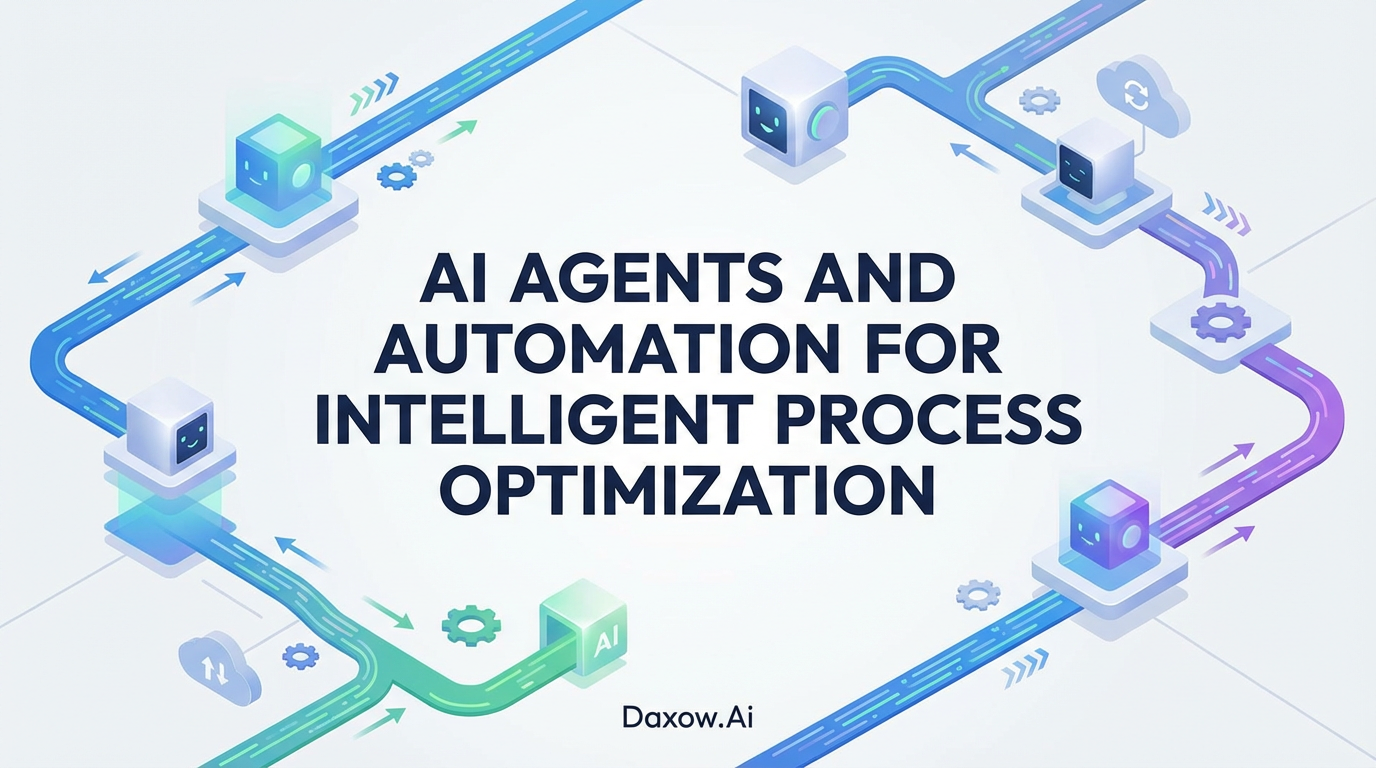
Practical guide on using AI agents and workflow automation to cut costs 30–50%, speed processes, and deliver measurable ROI with a pilot-to-scale roadmap.
Unlocking Business Growth: AI Agents and Automation in Intelligent Process Optimization
Estimated reading time: 15 minutes
Key Takeaways
- AI agents combined with workflow automation enable 3–5x faster implementation success and measurable ROI.
- End-to-end AI systems orchestrate processes rather than isolated tasks, improving throughput, accuracy, and compliance.
- Real-world use cases across e-commerce, healthcare, finance, real estate, and HR demonstrate significant cost and time savings.
- A phased implementation roadmap and best practices minimize risk and ensure scalable adoption.
- Daxow.ai offers custom AI design, integration, and scalable automation solutions to accelerate business outcomes.
Table of Contents
- Unlocking Business Growth: AI Agents and Automation in Intelligent Process Optimization
- Why AI Agents and Automation Matter Now
- Practical Use Cases Across Industries
- Implementation Roadmap and Best Practices
- Measuring ROI and Business Impact
- How Daxow.ai Delivers End-to-End Business Automation
- Next Steps — How to Evaluate and Start Small
- Conclusion and Call to Action
- Frequently Asked Questions
Unlocking Business Growth: AI Agents and Automation in Intelligent Process Optimization
AI agents — autonomous, learning-driven software that execute tasks, make decisions within defined boundaries, and escalate when needed — combined with workflow automation produce a new operating model for organizations. Rather than simply replacing individual tasks, these systems orchestrate end-to-end processes: collecting and validating data, applying business rules or ML models, routing exceptions to people, and continuously improving through feedback loops.
Key strategic implications:
- 24/7 availability to handle high-volume, repetitive work.
- Faster throughput and lower cycle times, enabling quicker customer responses and decision-making.
- Lower error rates and improved compliance through automated validation and audit trails.
- Reallocation of human effort from repetitive tasks to higher-value activities like strategy and customer relationship building.
Evidence from recent industry implementations shows targeted workflows can yield 30–50% cost reductions, process times dropping by similar margins, and error rates falling to single digits. These are realistic, measurable outcomes when workflow automation is paired with robust implementation practices.
Why AI Agents and Automation Matter Now
The difference between basic automation and AI agents
Basic automation executes deterministic workflows — it follows scripts and rules. AI agents add adaptability: they interpret unstructured inputs, apply learned patterns, prioritize tasks, and handle exceptions with contextual judgment. This makes them suitable for more complex, data-rich processes where variability previously required human oversight.
Business drivers for immediate adoption
- Rising operational costs and talent shortages.
- Increased customer expectations for speed and personalization.
- Need for tighter compliance and traceability in regulated sectors.
- Opportunity to quickly capture ROI by targeting high-volume, low-complexity processes.
Measurable outcomes to prioritize
- Productivity improvements: reduce manual tasks and reassign headcount to strategic work.
- Faster time-to-resolution for customer queries and approvals.
- Reduction of manual errors and rework.
- Higher conversion and retention through consistent, timely interactions (sales automation, customer support automation).
Practical Use Cases Across Industries
E-commerce — Inventory, fulfillment, and personalized experience
Use case:
- AI agent monitors inventory levels, analyzes sales velocity, and predicts demand.
- When thresholds are met, agent creates purchase orders, checks supplier lead times, and updates the ERP.
- Customer-facing bots provide status updates and personalized recommendations based on order history and real-time inventory.
Benefits:
- Reduced stockouts and overstocks.
- Faster order processing and fewer fulfillment exceptions.
- Improved conversion through personalized recommendations.
KPIs: Inventory turnover improvement, fulfillment SLA adherence, reduction in backorders, conversion lift.
Example Daxow.ai approach: Integrate with your e-commerce platform, ERP, and supplier portals. Build a demand-prediction model fine-tuned to your catalog. Deploy an AI agent that automates ordering, flags exceptions, and notifies purchasing teams for review.
Healthcare — Scheduling, triage, and documentation
Use case:
- Patient intake forms are processed via document extraction and normalized into EHR fields.
- AI triage agents assess symptom descriptions to prioritize appointments.
- Agents prepare consultation packets and flag incomplete records or missing consents.
Benefits:
- Administrative burden reduced by up to 40%.
- Faster patient throughput and improved compliance.
- Better clinician time utilization and improved patient experience.
KPIs: Reduced patient wait times, lower administrative FTE hours, fewer documentation errors.
Daxow.ai role: Implement secure integrations with EHR systems, configure HIPAA-compliant workflows, and design escalation rules for clinical exceptions.
Finance — Invoice processing, compliance, and fraud detection
Use case:
- Invoice OCR extracts line items; AI agents validate amounts against purchase orders, flag exceptions, and prepare routing for approvals.
- Fraud detection models monitor patterns and escalate suspicious transactions.
Benefits:
- Shorter processing cycles and fewer discrepancies.
- Stronger audit trails and faster month-end close.
KPIs: Processing time reduction, percentage of automated approvals, reduction in duplicate payments.
Daxow.ai approach: Build an end-to-end invoice automation pipeline with OCR, validation models, ERP integration, and automated posting for approved invoices.
Real Estate — Lead qualification, listing management, and contracts
Use case:
- AI agents screen incoming leads, qualify them against property criteria, and schedule viewings.
- Listing agents automatically enrich property descriptions with extracted features and nearby amenity data.
- Contract review agents flag non-standard clauses and summarize key terms for agents.
Benefits:
- Faster lead-to-viewing conversion and shorter sales cycles.
- Reduced manual work in listing management and contract review.
KPIs: Lead qualification rate, time-to-first-contact, contract review turnaround.
Daxow.ai support: Integrate CRM, MLS systems, and contract management tools to automate lead routing and contract triage.
HR — Recruitment, onboarding, and performance management
Use case:
- Resume parsing and candidate matching accelerate screening.
- Scheduling agents coordinate interviews across stakeholders and send automated reminders.
- Onboarding checklists are tracked and escalated for incomplete steps.
Benefits:
- Hiring time reduced by up to 50%.
- Improved candidate experience and lower administrative overhead.
KPIs: Time-to-hire, candidate-dropout rate, onboarding completion rates.
Daxow.ai implementation: Configure ATS integrations, build candidate scoring models tuned to role profiles, and set up automated onboarding workflows.
Implementation Roadmap and Best Practices
A phased approach to minimize risk
Successful programs follow a phased sequence:
- Assess and Prioritize (4–8 weeks): Map workflows, identify high-impact, repetitive processes, and establish clear objectives.
- Plan and Prepare: Clean data, map integrations, define KPIs, and set governance and escalation criteria.
- Select Technology and Pilot: Pilot a single use case on a scalable platform that supports AI models and workflow orchestration.
- Rollout and Optimize: Expand by capability and team; introduce feedback loops.
- Monitor and Scale: Continuous KPI tracking, bias audits, and data governance.
Best practices to ensure success
- Start with high-volume, rule-based tasks to realize early wins.
- Invest in data readiness; poor data is responsible for a majority of AI failures.
- Maintain human oversight where accountability and judgment are required.
- Use short feedback loops to refine models and update workflows.
- Establish governance covering data quality, ethics, and security.
Measuring ROI and Business Impact
What to measure
- Operational: processing time, error rate, FTE hours saved, automated throughput.
- Financial: cost per transaction, savings from reduced rework, incremental revenue from faster lead handling.
- Experience: customer satisfaction, NPS, employee engagement.
Typical ROI timeline and expectations
- Pilot phases commonly deliver measurable savings within months.
- Scale deployments often achieve 3–5x faster realization of objectives versus ad-hoc AI projects.
- Targeted workflow transformations report 30–50% reductions in processing costs and single-digit error rates.
Example KPI dashboard
- Average handle time (AHT) before/after.
- Percentage of fully automated transactions.
- Exception rate and time-to-resolution for escalations.
- Monthly cost savings and cumulative ROI.
How Daxow.ai Delivers End-to-End Business Automation
Daxow.ai was founded in Estonia in 2024 to help organizations move beyond pilots and deploy production-grade AI automation that delivers measurable business value. Our approach is pragmatic and outcome-driven:
- Process discovery and assessment: We map current workflows, quantify automation potential, and prioritize opportunities that will reduce manual work and boost productivity.
- Custom AI system design: We build AI agents tailored to your data, policies, and integration landscape. Models are fine-tuned with your business data for rapid adaptation.
- Workflow automation and orchestration: We design robust workflow automation that combines AI decisions with rule-based logic and escalation paths.
- Integrations and data connectivity: We connect CRMs, ERPs, document stores, and third-party APIs to create end-to-end automation.
- Implementation and change management: We run pilots, implement governance, and provide training to ensure adoption and continuous improvement.
- Monitoring and scaling: Post-deployment, we monitor KPIs, tune models, and scale across departments.
Why partner with Daxow.ai:
- End-to-end delivery from process analysis to full production automation.
- Proven frameworks that prioritize business value and governance.
- Ability to build AI agents that execute real tasks — not just provide insights — reducing operational costs and improving ROI.
Learn more about our solutions and case studies to see how we enable intelligent process optimization across industries.
Next Steps — How to Evaluate and Start Small
Quick starter checklist
- Identify three candidate processes that are repetitive, high-volume, and rule-based.
- Gather data samples and integration points (CRM, ERP, document repositories).
- Define 2–3 KPIs you will measure to evaluate a pilot.
- Assign an executive sponsor and a cross-functional delivery team.
Pilot design tips
- Keep pilots scoped to a single process and customer segment.
- Use measurable success criteria tied to cost, time, or experience improvements.
- Ensure a clear escalation path to human operators for edge cases.
Conclusion and Call to Action
AI agents and workflow automation are proven levers to reduce manual tasks, improve productivity, and drive measurable business automation across industries. By focusing on data readiness, targeted pilots, and strong governance, organizations can unlock rapid ROI and reallocate teams to strategic initiatives.
Ready to transform back-office operations, customer support automation, or sales automation with practical, measurable AI solutions? Book a free consultation with Daxow.ai to request a process analysis for your company and start building a custom AI system that reduces operational costs and improves ROI. Contact us today to begin.
Frequently Asked Questions
What are AI agents and how do they differ from traditional automation?
AI agents are autonomous, learning-driven software that handle complex tasks by interpreting unstructured data, prioritizing actions, and escalating exceptions. Unlike traditional automation that follows fixed rules, AI agents adapt and improve through feedback.
How quickly can organizations expect ROI from AI automation?
Pilot phases typically show measurable savings within months, with scaled deployments delivering 3–5x faster realization of objectives compared to ad-hoc projects. Targeted workflows can reduce processing costs by 30–50%.
What industries benefit most from AI-powered process optimization?
E-commerce, healthcare, finance, real estate, and HR are prominent sectors with proven success, but AI agents can optimize processes across virtually all industries that handle repetitive, data-intensive workflows.
How does Daxow.ai support ongoing governance and model updates?
We provide continuous monitoring of KPIs, bias audits, data quality checks, and short feedback loops to refine models and workflows, ensuring compliance, security, and sustained performance.