
AI Agents Transform Workflow Automation for Business
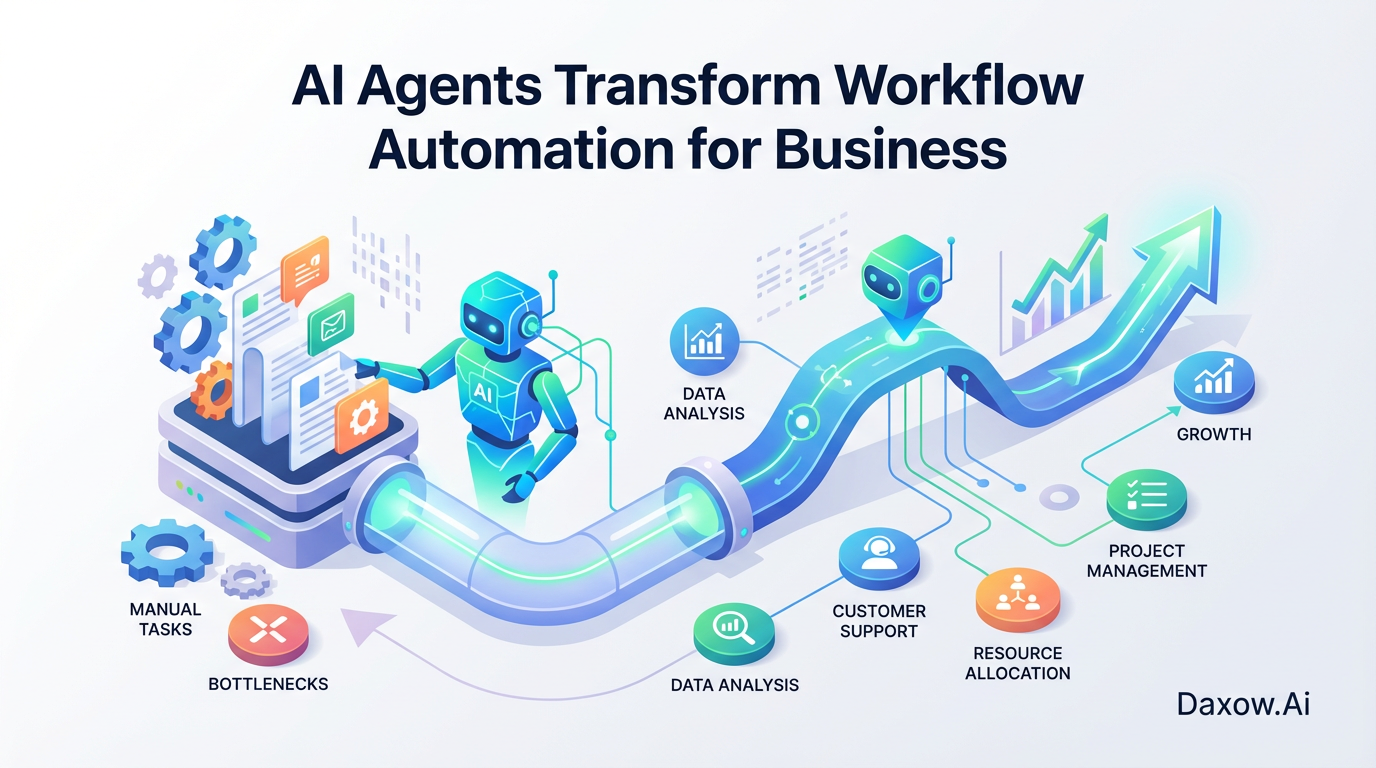
AI agents automate end-to-end workflows to cut costs, reduce errors, and scale operations. Use cases, implementation roadmap, and a 90-day pilot from Daxow.ai
AI Agents in Business: Transforming Workflow Automation for Higher Productivity
Estimated reading time: 15 minutes
Key Takeaways
- AI agents automate and manage end-to-end workflows, transforming manual processes into scalable operations.
- Key benefits include faster decision making, cost savings, improved compliance, and operational scalability.
- Industry-specific AI agent use cases include e-commerce support, healthcare authorization, fintech compliance, real estate lead handling, and HR recruitment.
- A structured implementation roadmap guides organizations from pilot to scale, ensuring measurable ROI.
- Governance, security, and human oversight are critical components of successful AI agent deployment.
Table of Contents
- AI Agents in Business: Transforming Workflow Automation
- Practical Use Cases Across Industries
- Implementation Roadmap: From Pilot to Scale
- Practical Agent Flows: Example Sequences
- Governance, Security, and Human-in-the-Loop
- Measuring ROI and Building the Business Case
- Getting Started: A Simple 90-Day Pilot Plan
- Frequently Asked Questions
AI Agents in Business: Transforming Workflow Automation
What we mean by AI agents and workflow automation
AI agents are software entities that perceive information across channels (email, chat, documents, APIs), reason about context, and act by triggering workflows, updating systems, or interacting with people. When combined with workflow automation, they become end-to-end process owners: not simply executing a task, but managing an entire process from trigger to resolution.
Key capabilities:
- Perception: Extract and normalize data from documents, chat, and systems.
- Reasoning: Apply business rules, risk models, and contextual logic.
- Action: Execute integrations, create records, send communications, and escalate.
- Learning: Improve from feedback and operational data.
These capabilities translate into clear business outcomes: faster cycle times, fewer errors, and scalable operations that do not require linear increases in headcount.
Why this matters now
- Competitive speed: Decisions and actions that used to take hours can be reduced to minutes or seconds.
- Cost efficiency: Automating repetitive work lowers labour cost per transaction and reduces rework.
- Consistency and compliance: Automated processes follow rules reliably and produce audit trails.
- Scalability: Teams scale capacity without proportional hires, enabling expansion into new markets.
Daxow.ai partners with organizations to identify these opportunities, design agent blueprints, and implement secure integrations that connect AI agents to business systems and CRMs.
Practical Use Cases Across Industries
E-commerce: Customer support automation and order orchestration
Use case: AI sales and support agents
- Trigger: Customer message (chat/email/social) about an order.
- Agent actions:
- Authenticate customer and fetch order details from the CRM/ERP.
- Provide instant order tracking, return instructions, or issue a refund draft.
- If issue is complex, create a ticket with context and suggested resolution steps.
- Integrations: E-commerce platform, fulfillment system, payment gateway, ticketing system.
- Measurable targets: 30–70% of support interactions automated; average handle time reduced by 40–60%.
- Business impact: Higher conversion, reduced support costs, improved NPS.
Use case: Order and fulfillment automation
- Agent actions:
- Reconcile orders across marketplaces.
- Create shipment requests and update inventory.
- Auto-handle exceptions (failed payment, address issues) and escalate only when necessary.
- Business impact: Fewer fulfillment errors and faster delivery lead times.
Healthcare: Patient front desk and back-office automation
Use case: Virtual patient assistants and prior authorization agents
- Trigger: Appointment request or insurance verification need.
- Agent actions:
- Schedule appointments, send reminders, and collect pre-visit intake.
- Perform eligibility checks, assemble prior authorization packets, and route to clinical reviewers.
- Draft clinical notes from visit transcripts for clinician review.
- Integrations: Scheduling system, EMR, payer portals, secure document storage.
- Measurable targets: Reduced no-show rates, fewer administrative hours per clinician, faster authorization turnaround.
- Business impact: Lower clinician burnout and faster patient throughput.
Finance & Fintech: KYC, transaction monitoring, and finance operations
Use case: KYC / AML automation agent
- Trigger: New account onboarding or suspicious transaction alert.
- Agent actions:
- Collect and OCR identity documents, extract structured data, and perform automated screening.
- Produce risk scores, attach supporting evidence, and prepare analyst summary.
- Route high-risk cases to compliance team with an audit trail.
- Integrations: KYC providers, CRM, AML engines, case management.
- Measurable targets: Faster onboarding, reduced manual review time, improved fraud detection rates.
- Business impact: Lower compliance costs and faster customer activation.
Use case: Invoice processing and reconciliations
- Agent actions:
- Extract invoice data, match to POs, code GL accounts, and queue exceptions.
- Auto-create drafts for approval and post payments when approved.
- Business impact: Finance teams handle larger volumes with the same headcount and fewer errors.
Real Estate: Lead qualification and transaction orchestration
Use case: Lead capture and qualification agent
- Trigger: Website inquiry or SMS lead.
- Agent actions:
- Immediately respond, gather qualification details, and suggest viewing times.
- Score leads, schedule viewings, and route hot leads to sales agents with context.
- Integrations: CRM, calendaring, SMS/email platforms.
- Measurable targets: Faster lead response times (seconds), conversion uplift, fewer missed leads.
- Business impact: Higher close rates, less admin burden on agents.
Use case: Transaction coordination
- Agent actions:
- Track milestones, send reminders to parties, and surface overdue tasks.
- Auto-generate closing documents from templates and collect signatures.
- Business impact: Fewer delays in closings and reduced transaction leakage.
HR: Recruitment automation and employee self-service
Use case: Recruitment screening and scheduling
- Agent actions:
- Parse CVs, score candidates against role criteria, and present a shortlist.
- Coordinate interview scheduling and send automated communications.
- Integrations: ATS, calendar systems, HRIS.
- Measurable targets: Shorter time-to-hire and reduced recruiter hours per hire.
- Business impact: Improved candidate experience and faster talent acquisition.
Use case: Onboarding assistant
- Agent actions:
- Guide new hires through compliance forms, training modules, and access requests.
- Escalate outstanding tasks to HR with a clear checklist.
- Business impact: Faster ramp-up and fewer missed requirements.
Implementation Roadmap: From Pilot to Scale
Daxow.ai follows a pragmatic, outcome-led approach that ensures measurable value and controlled risk.
Step 1: Define high-impact objectives
- Select 1–3 goals (e.g., reduce support cost by 30%).
- Identify owners and metrics.
- Daxow.ai helps quantify opportunity and build a credible ROI model.
Step 2: Map the process and identify automation candidates
- Document triggers, decision points, systems, volumes, and exception patterns.
- Prioritize processes where data exists and success is easily measurable.
- Daxow.ai facilitates process workshops and documents the current state.
Step 3: Design the agent blueprint
- Define scope, inputs/outputs, integrations, and guardrails.
- Decide autonomy level: suggest-only, co-pilot, or fully autonomous.
- Daxow.ai creates the design, including prompts, decision trees, and escalation rules.
Step 4: Prepare data and knowledge
- Ensure secure access to required systems and quality of data.
- Curate SOPs, templates, and knowledge bases the agent will use.
- Daxow.ai implements secure connectors and data governance.
Step 5: Build and pilot
- Deploy a limited pilot with performance dashboards.
- Validate accuracy, user experience, and edge cases.
- Daxow.ai builds the agent, integrates systems, and runs the pilot with your team.
Step 6: Govern and scale
- Implement audit logs, approval thresholds, and monitoring for bias or drift.
- Iterate with feedback loops and expand to adjacent workflows.
- Daxow.ai supports governance frameworks and ongoing maintenance.
Practical Agent Flows: Example Sequences
Example: Order Exception Agent (E-commerce)
- Trigger: Failed payment notification from payment gateway.
- Agent actions:
- Retrieve order and customer data.
- Attempt automated retry; if retry fails, send personalized email with payment link.
- Update order status and create a support ticket if no response in 48 hours.
- Integrations: Payment gateway, CRM, order management, email service.
- Outcome: Reduced manual follow-up and fewer abandoned carts converted to recovery.
Example: Prior Authorization Agent (Healthcare)
- Trigger: Procedure scheduled requiring prior authorization.
- Agent actions:
- Pull patient demographics and clinical notes.
- Populate payer portal forms, attach supporting documentation, and submit.
- Monitor response and escalate if additional info is required.
- Integrations: EMR, payer portals, document store.
- Outcome: Faster authorizations and fewer denied claims.
Governance, Security, and Human-in-the-Loop
- Auditability: Agents must log decisions, data accessed, and actions taken.
- Access control: Role-based permissions limit what agents can see and do.
- Approval gates: Humans approve high-risk actions (financial commitments, clinical decisions).
- Monitoring: Track error rates, automation coverage, and user feedback.
- Compliance: Data handling and retention must meet regulatory standards.
Daxow.ai embeds governance and security into every project to ensure that automation reduces risk rather than introducing it.
Measuring ROI and Building the Business Case
To secure executive buy-in, present a clear 90-day pilot plan and a 12–24 month ROI model:
- Quantify FTE hours saved and the cost equivalent.
- Model revenue uplift from faster responses or higher conversion.
- Estimate reduction in error-related costs (rework, penalties).
- Include qualitative benefits: improved employee retention and customer satisfaction.
Daxow.ai produces the pilot plan, ROI model, and a roadmap for scaling successful pilots into enterprise-wide automation.
Getting Started: A Simple 90-Day Pilot Plan
- Week 1–2: Discovery and prioritization with stakeholders.
- Week 3–4: Process mapping and data access setup.
- Week 5–8: Build agent prototype and integrations.
- Week 9–12: Pilot, measure, and iterate; produce a go/no-go decision and rollout plan.
Daxow.ai will run this process alongside your teams, deliver a working pilot, and provide clear metrics to demonstrate impact.
Conclusion and Call to Action
AI Agents in Business: Transforming Workflow Automation is the operational lever that turns repetitive work into strategic capacity. Whether your priority is reducing manual tasks in support, automating document workflows in finance, or building lead qualification agents for sales, Daxow.ai delivers custom AI solutions, secure integrations, and governance to ensure measurable value.
Book a free consultation with Daxow.ai to request a process analysis for your company or contact us to build a custom AI system that reduces operational costs, increases productivity, and improves customer experience.
Frequently Asked Questions
What are AI agents and how do they differ from traditional automation?
AI agents are autonomous software that perceive, reason, and act across multiple channels and systems to manage entire workflows end-to-end, unlike traditional automation which typically executes predefined, isolated tasks.
How can AI agents improve productivity in my business?
By automating repetitive tasks, applying contextual reasoning, and continuously learning from data, AI agents reduce cycle times, minimize errors, and enable teams to focus on higher-value activities, resulting in scalable productivity gains.
What industries benefit most from AI workflow automation?
Industries such as e-commerce, healthcare, finance, real estate, and Human Resources have proven use cases where AI agents improve customer support, compliance, transaction processing, lead management and recruitment efficiency.
How does Daxow.ai ensure security and governance in AI agent deployments?
Daxow.ai implements role-based access control, audit logging, approval workflows for critical actions, and continuous monitoring to comply with regulatory standards and minimize operational risk.