
Transform Business with AI Agents and Workflow Automation
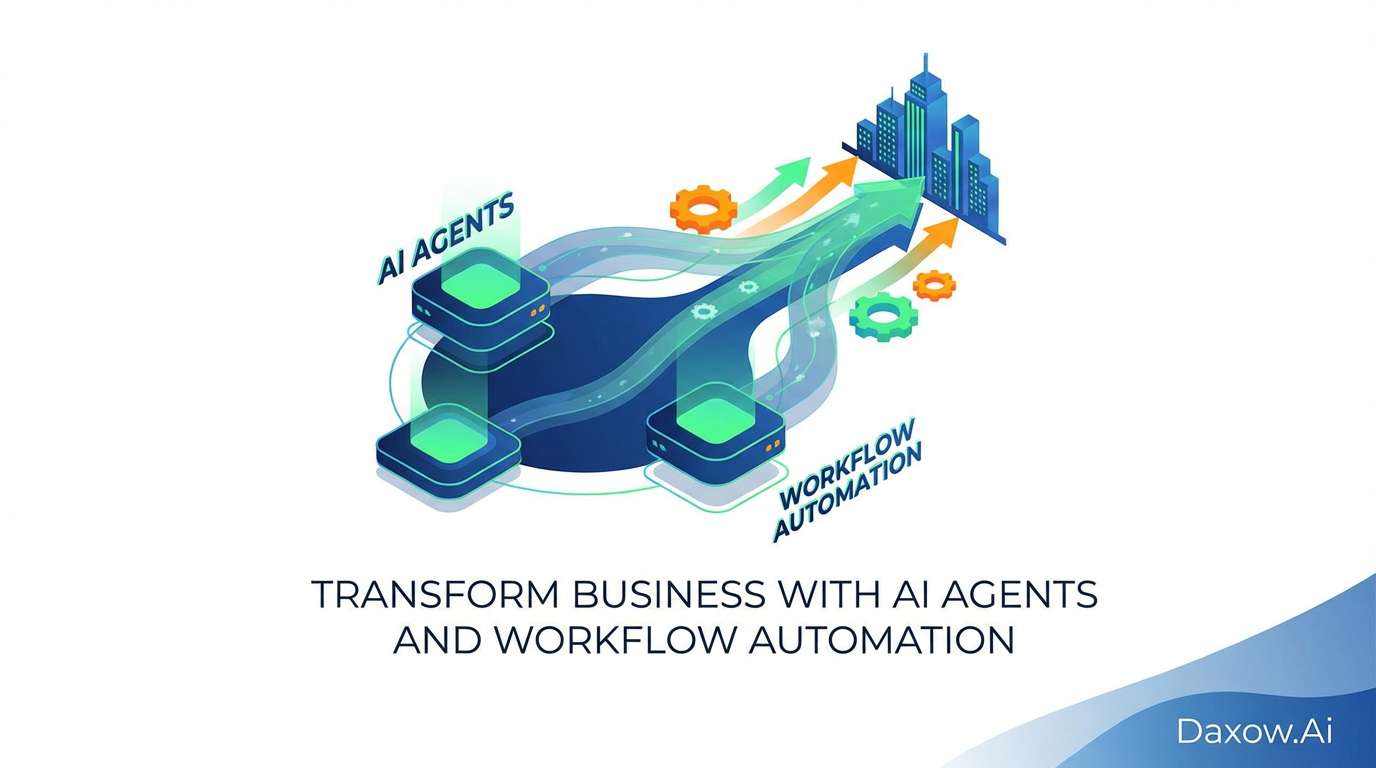
Learn how AI agents and workflow automation cut costs, speed processes, and improve customer experience with use cases, ROI metrics, and a Daxow.ai roadmap.
Unlocking Business Transformation: The Power of AI Agents and Automation
Estimated reading time: 15 minutes
Key Takeaways
- AI agents and workflow automation drastically improve efficiency, reduce costs, and enhance customer experiences.
- Strategic implementation enables faster decision-making, higher productivity, and sustainable ROI.
- Industries like e-commerce, healthcare, finance, real estate, and HR benefit from AI-driven automation workflows.
- Successful deployment requires clear goals, quality data, integration, monitoring, and governance.
- Daxow.ai delivers end-to-end AI agent and automation solutions aligned with business needs and compliance requirements.
Table of Contents
- Unlocking Business Transformation: The Power of AI Agents and Automation
- Why AI Agents and Workflow Automation Matter Now
- Practical Use Cases Across Industries
- How AI Agents and Automation Drive Results
- Implementation Roadmap and Best Practices
- Measuring ROI and Business Value
- How Daxow.ai Helps Companies Unlock Transformation
- Getting Started — Next Steps for Decision-Makers
- Frequently Asked Questions
Unlocking Business Transformation: The Power of AI Agents and Automation
What we mean by AI agents and automation
AI agents are intelligent systems that autonomously execute multi-step tasks by combining machine learning, natural language processing, and rule-based logic. Workflow automation uses deterministic rules and integrations to remove repetitive, manual work. Together, these technologies enable organizations to scale processes without proportional headcount increases, reduce error rates, and free people to focus on strategic work.
Strategic impact for business leaders
- Cost savings: Targeted automation projects commonly reduce process costs by 20–50% and can deliver break-even in 6–12 months.
- Productivity: Automating routine work raises employee productivity and reallocates capacity to higher-value tasks such as product innovation and customer success.
- Customer experience: AI-driven customer support automation shortens response times, raises Net Promoter Scores, and reduces churn.
- Decision quality: AI agents analyze patterns and surface predictive insights — for example, sales forecasts or fraud signals — improving operational decision-making.
Why AI Agents and Workflow Automation Matter Now
From manual bottlenecks to scalable operations
Many organizations still rely on manual data entry, spreadsheet workflows, and fragmented systems. These create slow response times, high error rates, and limited visibility. AI agents plus workflow automation transform these bottlenecks into scalable, auditable processes by connecting systems, validating data, and executing decisions automatically.
When to prioritize automation
Prioritize initiatives that are:
- High-volume and repetitive (e.g., invoice processing, lead qualification).
- Rule-driven or predictable but benefit from occasional human oversight (e.g., claims triage).
- Cross-system and integration-heavy, where manual handoffs create delays.
- Customer-facing with measurable service-level objectives (e.g., support ticket response).
Practical Use Cases Across Industries
E-commerce — Order-to-cash and customer support automation
Use case:
- Automate order validation, inventory reconciliation, and exception routing.
- Deploy AI chatbots for post-purchase inquiries and returns processing.
Business outcome:
Reduce fulfillment errors, lower cart abandonment through faster responses, and shorten order cycle times by 30–50%.
How Daxow helps:
Build AI agents that interface with your e-commerce platform, ERP, and logistics APIs to automate dispatch and refund workflows.
Healthcare — Scheduling, triage, and claims processing
Use case:
- Automated patient scheduling with priority-based rules and no-show prediction.
- AI agents triaging routine inquiries and preparing prefilled forms for clinicians.
Business outcome:
Faster access to care, reduced administrative burden, improved compliance, and enhanced patient satisfaction.
How Daxow helps:
Integrate clinical systems with secure data pipelines, implement privacy controls, and build agents that reduce manual appointment management.
Finance — Invoice processing, fraud detection, and compliance
Use case:
- Extract data from invoices and contracts using document automation; route anomalies to a compliance queue.
- Run anomaly detection models across transactions to detect suspicious patterns.
Business outcome:
Faster audits, lower error rates (often <1% in automated steps), and improved regulatory reporting.
How Daxow helps:
Combine OCR, LLM validation, and rule engines to automate accounts payable and reconcile exceptions with auditors’ logs.
Real estate — Lead qualification and contract automation
Use case:
- AI agents qualify inbound leads via chat and email, schedule viewings, and prepare initial contract drafts.
Business outcome:
Faster deal cycles, higher agent productivity, and improved conversion rates.
How Daxow helps:
Deploy lead qualification agents that score leads, sync with your CRM, and automate document generation and e-signing.
HR — Recruitment and onboarding automation
Use case:
- Screen resumes, schedule interviews, and automate onboarding checklists (policy acknowledgements, equipment provisioning).
Business outcome:
Shorter time-to-hire (up to 40% reduction), better new-hire experience, and lower administrative cost per employee.
How Daxow helps:
Build HR automation that integrates ATS systems, identity providers, and internal HRIS to make onboarding frictionless.
How AI Agents and Automation Drive Results
Beyond rule-based automation — intelligent autonomy
Rule-based automation is reliable for deterministic tasks. AI agents add capacity to understand unstructured inputs, make contextual decisions, and learn over time. Examples:
- Natural language understanding for customer support automation.
- Predictive models that flag at-risk customers for proactive outreach.
- Autonomous multi-step workflows that collect data, apply rules, and escalate exceptions to humans.
Integration and data connectivity
The value of automation depends on connectivity. Key components:
- Robust API integrations into CRMs, ERPs, ticketing systems, and analytics platforms.
- Reliable data pipelines and standardized data models.
- Secure authentication and audit trails.
Daxow’s approach includes building connectors and middleware to ensure end-to-end orchestration and real-time event handling.
Monitoring, governance, and human-in-the-loop
Automation should be observable and governed. Implement:
- KPI dashboards to track cost savings, throughput, error rates, and NPS.
- Drift detection and model retraining schedules.
- Human-in-the-loop patterns for exception handling and continuous improvement.
Implementation Roadmap and Best Practices
A phased, low-risk approach
- Define Clear Goals and Identify Processes
- Focus on measurable objectives (e.g., reduce invoice processing time by 30%).
- Prioritize high-impact workflows with clear baselines.
- Avoid vague targets that cause scope creep.
- Assess Data Quality and Accessibility
- Audit existing data for completeness and cleanliness.
- Standardize formats and create pipelines for reliable AI inputs.
- Ensure compliance with privacy and security requirements.
- Select Tools and Build a Cross-Functional Team
- Choose scalable platforms with strong integration capabilities.
- Assemble data scientists, engineers, domain experts, and PMs.
- Involve IT and security early to avoid integration roadblocks.
- Prototype, Test, and Deploy
- Start with non-critical workflows to validate value.
- Use metrics like accuracy and F1 score for models; measure process KPIs for workflows.
- Deploy with clear rollback and escalation paths.
- Monitor, Measure, and Iterate
- Track KPIs (cost per process, time-to-resolution, NPS).
- Retrain models, collect feedback, and refine rules.
- Establish governance to prevent shadow AI and uncontrolled sprawl.
Common pitfalls and how to avoid them
- Poor data quality: Invest in data hygiene before automation.
- Skill gaps: Train teams and partner with experts for rapid onboarding.
- Ignoring governance: Implement bias checks, privacy safeguards, and audit logs.
- Over-ambitious scope: Deliver incremental value through targeted pilots.
Measuring ROI and Business Value
How to quantify success
- Establish baseline metrics before automation (processing time, error rate, FTE hours).
- Track improvements: many organizations see 20–70% reductions in process time and rapid error reduction.
- Calculate payback period: typical projects recover costs within 6–12 months for high-volume processes.
Long-term value
- Scalable operations with predictable cost models.
- Improved customer satisfaction and retention.
- Enhanced agility to respond to market changes and new opportunities.
- A culture of continuous improvement as agents learn and optimize.
How Daxow.ai Helps Companies Unlock Transformation
End-to-end service model
- Discovery & process mapping: We audit workflows and identify high-impact automation candidates.
- Custom AI design: We architect AI agents tailored to your domain, combining models, rules, and integrations.
- Development & integration: We build connectors to your CRM, ERP, support systems, and third-party APIs.
- Deployment & monitoring: We deploy agents, set up observability, and establish retraining cycles.
- Continuous optimization: We operate feedback loops to refine models and expand automation coverage.
Capabilities aligned to business needs
- AI Agents: Autonomous multi-step workflows that take actions on behalf of users.
- Workflow Automation: Orchestration of tasks across systems with business rules.
- Customer Support Automation: Chatbots and ticket automation that combine NLU with escalation logic.
- Sales Automation: Lead qualification, opportunity tracking, and workflow triggers to accelerate pipeline velocity.
- Data Extraction & Document Automation: OCR and LLM validation for accurate data ingestion.
- Integrations: Connectors to major CRMs, ERPs, messaging platforms, and internal systems.
Security, compliance, and governance
Daxow builds solutions with enterprise-grade security controls, audit trails, and compliance patterns adapted to regulated industries such as healthcare and finance. We implement privacy-by-design and bias mitigation practices to ensure ethical AI deployment.
Example engagement (hypothetical)
- Client: Mid-market e-commerce company
- Problem: High return processing time, fragmented systems, and slow customer responses.
- Approach:
- Discovery: Map order-to-return process and measure baseline (48-hour average handle time).
- Prototype: Build an AI agent to validate return eligibility, create return labels, and update inventory.
- Integrations: Connect to e-commerce platform, warehouse management, and support desk.
- Deployment: Roll out in a single product line, monitor KPIs.
- Outcome:
- Return processing time reduced by 60%, customer response time cut from 24 to 2 hours.
- Payback achieved within 9 months through reduced manual handling and faster reshipments.
Getting Started — Next Steps for Decision-Makers
Practical first moves
- Run a short process audit to identify top 3 automation opportunities.
- Establish baseline KPIs and measurable targets.
- Pilot an AI agent for a contained workflow with clear rollback plans.
- Ensure IT and legal are involved early for integration and compliance clearance.
Why partner with Daxow.ai
- Domain-focused: We translate business objectives into technical designs that deliver measurable outcomes.
- End-to-end delivery: From discovery and integrations to monitoring and continuous improvement.
- Proven ROI mindset: We focus on projects with clear financial and operational impact.
Contact us to transform a high-friction workflow into an automated, measurable advantage. Book a free consultation or request a process analysis for your company and start reducing manual tasks, boosting productivity, and unlocking the business value of AI automation.
Book a free consultation with Daxow.ai or request a tailored process analysis to begin building custom AI agents and workflow automation that drive results.
Frequently Asked Questions
What are AI agents and how do they differ from traditional automation?
AI agents autonomously perform multi-step tasks using machine learning, natural language processing, and rule-based logic, enabling them to handle complex, unstructured inputs and make contextual decisions, unlike traditional deterministic automation that follows fixed rules.
Which industries benefit most from AI-driven automation?
Industries such as e-commerce, healthcare, finance, real estate, and human resources show significant benefits by automating repetitive workflows, improving customer experience, and enhancing compliance using AI agents and workflow automation.
How quickly can businesses expect ROI from AI automation?
Many targeted automation projects achieve break-even within 6 to 12 months, especially in high-volume, repetitive processes where cost savings and productivity gains are significant.
How does Daxow.ai ensure security and compliance?
Daxow.ai designs automation solutions with enterprise-grade security controls, audit trails, privacy-by-design principles, and bias mitigation, aligning with industry regulations in healthcare, finance, and other regulated sectors.