
AI Agents for Workflow Automation — Practical Guide
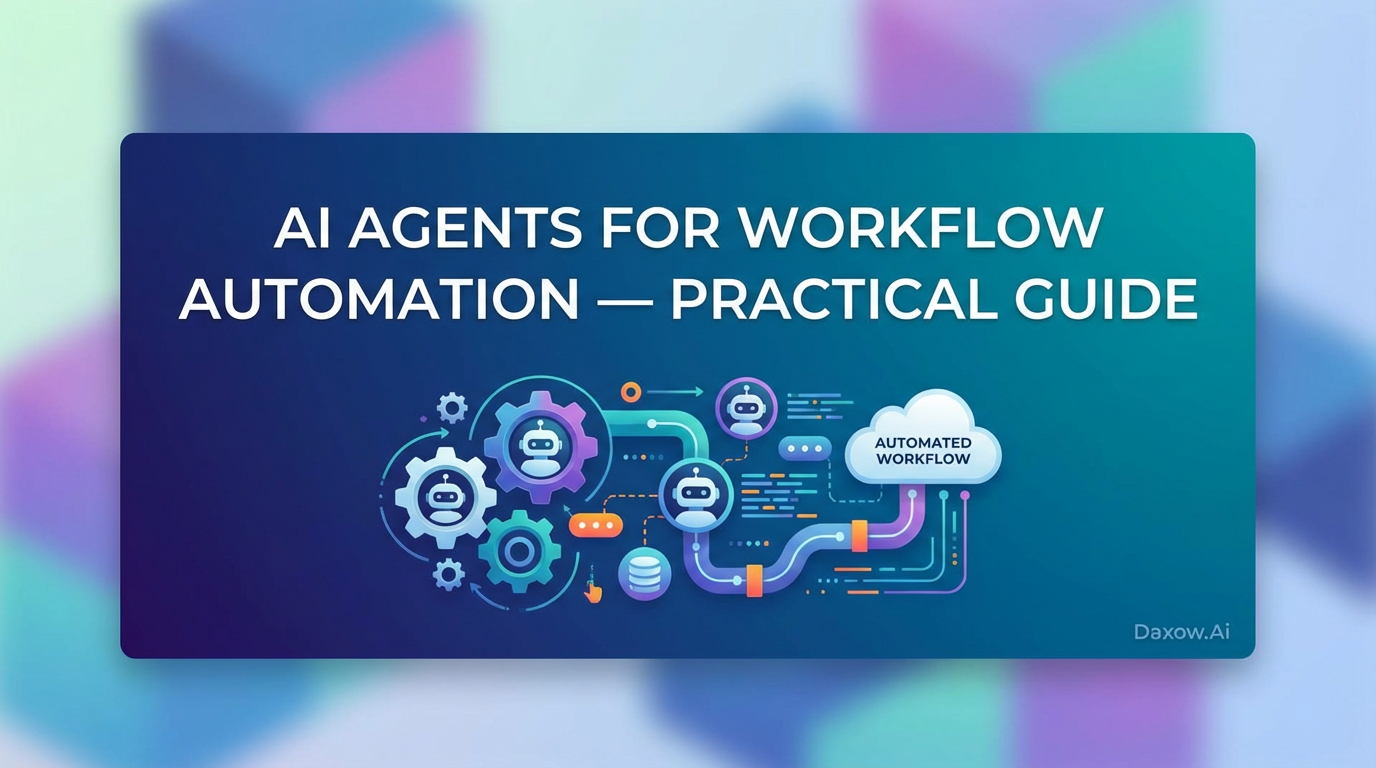
Practical guide to implementing AI agents that cut manual tasks, boost productivity, and deliver ROI. Use cases, KPIs, and an implementation roadmap with Daxow.ai.
AI Agents for Workflow Automation — A Practical Guide to Reducing Manual Tasks and Boosting Productivity
Estimated reading time: 15 minutes
Key Takeaways
- AI agents automate repetitive workflows, reducing manual tasks and errors.
- They boost productivity by reallocating staff to higher-value work.
- Real-world use cases span e-commerce, healthcare, finance, real estate, HR, and customer support.
- A structured implementation roadmap ensures predictable success and measurable ROI.
- Daxow.ai delivers tailored AI automation solutions integrating with your existing systems.
Table of Contents
- AI Agents for Workflow Automation — What They Are and Why They Matter
- How AI Agents for Workflow Automation Drive Business Value
- Use Cases Across Industries
- Designing and Implementing AI Agents for Workflow Automation
- Technical Patterns and Integration Options
- Practical Implementation Example — Sales Automation Flow
- Measuring Success and Scaling Automation
- Why Choose Daxow.ai to Build Your AI Agents for Workflow Automation
- Common Challenges and How to Overcome Them
- Getting Started — A Practical Checklist
- Frequently Asked Questions
AI Agents for Workflow Automation — What They Are and Why They Matter
AI agents are software entities that perform specific tasks autonomously or semi-autonomously by interacting with systems, data, and users. In workflow automation, these agents execute steps traditionally done by humans — from data extraction and routing to decision-making and follow-ups.
Core capabilities of AI agents
- Data ingestion: Automatically extract information from documents, forms, emails, and APIs.
- Orchestration: Coordinate multi-step processes across tools and teams.
- Decisioning: Apply rules and ML models to make or recommend decisions.
- Interaction: Communicate via chatbots, email, or system updates.
- Learning: Improve through feedback loops and supervised retraining.
Business impact
- Reduce manual tasks and human error by automating repeatable workflows.
- Boost productivity by reallocating staff to higher-value work.
- Improve customer experience with faster, consistent responses.
- Lower operational costs through labor reduction and faster cycle times.
- Enable scalability without proportionally increasing headcount.
How AI Agents for Workflow Automation Drive Business Value
Companies measure success through throughput, error rates, cost per transaction, and customer satisfaction. AI agents directly influence these metrics.
Key performance indicators (KPIs) to track
- Time saved per task and per employee.
- Percentage reduction in manual interventions.
- Error rates before and after automation.
- SLA compliance and response times for customer support.
- Conversion rates and lead qualification velocity for sales automation.
- Cost savings and ROI calculation (payback period, NPV).
Example ROI calculation (high-level)
- Baseline: 5 FTEs handling invoice processing, each costing $60k/year.
- Automation reduces manual effort by 70%, equivalent to 3.5 FTE reallocation.
- Realized labor savings: 3.5 x $60k = $210k/year.
- Estimated cost of implementing AI agents (project + license + integration): $120k first year.
- Net first-year benefit: $90k; payback under one year with ongoing benefits in subsequent years.
Use Cases Across Industries
E-commerce — Order processing and returns
- Problem: Manual order reviews, fraud checks, and return validations create delays and errors.
- AI agent solution: Automate order validation, fraud scoring, inventory checks, and automated return approvals. Integrate with CRM, ERP, and payment gateways.
- Benefits: Faster order-to-fulfillment cycles, fewer chargebacks, improved customer satisfaction.
Healthcare — Patient intake and claims processing
- Problem: Time-consuming manual entry from scanned forms, long claims cycles, staffing constraints.
- AI agent solution: Extract structured data from intake forms, validate insurance coverage, route exceptions to staff, and auto-populate EHR fields.
- Benefits: Reduced administrative burden, faster billing cycles, improved data accuracy, and better patient experience.
Finance — Loan origination and compliance
- Problem: Manual underwriting steps, document collection, and regulatory checks cause delays.
- AI agent solution: Automate document ingestion, KYC checks, credit scoring, and compliance flagging. Provide decision-support recommendations for underwriters.
- Benefits: Faster approvals, consistent compliance controls, and reduced processing costs.
Real Estate — Lead qualification and property management
- Problem: High volume of inbound leads with inconsistent follow-ups and slow response times.
- AI agent solution: Qualify leads via chatbots, schedule viewings automatically, sync with CRM, and handle recurring tenant requests (maintenance tickets, payments).
- Benefits: Higher lead-to-client conversion, reduced manual scheduling, and better tenant retention.
HR & Admin — Candidate screening and onboarding
- Problem: High recruiting volume and repetitive onboarding steps slow HR teams.
- AI agent solution: Screen resumes, schedule interviews, validate references, and automate onboarding checklists and document submissions.
- Benefits: Faster hiring cycles and consistent onboarding compliance.
Customer Support Automation — Multi-channel case handling
- Problem: Slow first response times, inconsistent answers, and repetitive inquiries.
- AI agent solution: Deploy support chatbots and email automation that resolve common queries, escalate complex cases, and summarize interactions for agents.
- Benefits: Lower support load, improved CSAT, and higher agent efficiency.
Designing and Implementing AI Agents for Workflow Automation
A structured approach reduces risk and delivers predictable results.
Step 1 — Process discovery and prioritization
- Map current workflows and manually measure time and error rates.
- Identify high-volume, high-variability, or high-cost tasks.
- Prioritize use cases with clear KPIs and fast payback.
Step 2 — Solution design and prototyping
- Define the agent’s scope: inputs, outputs, decision logic, and exception paths.
- Build a prototype that integrates with key systems (CRM, ERP, ticketing).
- Validate with users and iterate quickly.
Step 3 — Integration and data connectivity
- Connect to data sources via secure APIs, RPA connectors, or direct database access.
- Ensure real-time or near-real-time sync where needed.
- Implement centralized logging and observability for monitoring agent actions.
Step 4 — Governance, security, and compliance
- Define access controls and data handling policies.
- Implement audit trails for all automated decisions.
- Ensure compliance with industry regulations and data protection laws.
Step 5 — Deployment, monitoring, and continuous improvement
- Gradually roll out, starting with supervised automation (human-in-the-loop).
- Track KPIs and tune models or rules.
- Set up learning pipelines for retraining ML components based on outcomes.
Technical Patterns and Integration Options
Orchestration platforms and workflow engines
- Use orchestration layers to sequence tasks, handle retries, and manage state.
- Integrate with business process management (BPM) tools for complex workflows.
Hybrid automation: Rules + ML
- Combine deterministic business rules for compliance with ML for classification and prediction.
- Example: Rules validate mandatory fields; ML scores leads for conversion likelihood.
Human-in-the-loop for exception handling
- Route ambiguous cases to human operators with context and suggested actions.
- Capture operator decisions to improve agent models.
APIs and connectors for system integration
- Connect AI agents to CRMs, ERPs, ticketing systems, and document repositories.
- Use standardized connectors or build custom adapters where needed.
Practical Implementation Example — Sales Automation Flow
- Ingest lead data from web form, email, or marketplace.
- Normalize fields, enrich with firmographic data via API.
- Score lead using predictive model (conversion probability).
- If score > threshold, create CRM opportunity and schedule a meeting (calendar integration).
- Send nurturing sequence for medium scores; discard low-quality leads after verification.
- Route exceptions to sales development rep with summarized context and recommended next steps.
Business outcomes
- Faster lead response time, increasing conversion.
- Reduced SDR workload by automating repetitive tasks.
- Better pipeline hygiene and measurable uplift in qualified opportunities.
Measuring Success and Scaling Automation
Launch metrics
- Pilot duration: 4–8 weeks for initial deployment.
- Immediate KPIs: Reduction in manual steps, average handling time, SLA compliance.
Scaling strategy
- After proving value in a pilot, standardize templates and connectors.
- Prioritize adjacent processes that share data or decision logic.
- Establish a center of excellence for automation best practices and governance.
Why Choose Daxow.ai to Build Your AI Agents for Workflow Automation
Daxow.ai specializes in designing and implementing custom AI systems that deliver business outcomes. Here’s how we help:
End-to-end process automation
- We map your current workflows, identify automation candidates, and build complete solutions from data ingestion to orchestration and monitoring.
- We focus on measurable outcomes — reduced manual tasks, increased productivity, and improved customer metrics.
Custom AI agent development
- We design AI agents that execute real tasks: document automation, lead qualification, support triage, scheduling, and decisioning.
- Agents are tailored to your processes and integrated with your tools and data.
System integrations and data connectivity
- We connect AI agents to CRMs, ERPs, ticketing systems, and databases using secure APIs and enterprise-grade connectors.
- We ensure data consistency and build pipelines for ongoing model retraining and improvement.
Reducing operational costs and improving ROI
- Our projects are structured to deliver rapid payback, focusing first on high-impact, low-complexity workflows.
- We provide transparent KPIs and reporting so you can measure cost savings and productivity gains.
Security, compliance, and governance
- We implement audit trails, role-based access controls, and documented data handling policies to meet industry and regulatory requirements.
Common Challenges and How to Overcome Them
Data quality and availability
- Challenge: Missing or inconsistent data reduces automation accuracy.
- Solution: Implement data validation rules, enrichment APIs, and phased automation with human oversight.
Change management
- Challenge: Staff resistance or process inertia.
- Solution: Engage stakeholders early, run pilots with operational teams, and demonstrate time savings and improved outcomes.
Overreliance on a single model
- Challenge: Models degrade over time or under domain shifts.
- Solution: Establish monitoring, drift detection, and scheduled retraining procedures.
Getting Started — A Practical Checklist
- Map and measure current processes to quantify manual tasks.
- Prioritize workflows by volume, cost, and business impact.
- Build a lightweight prototype integrating with one or two core systems.
- Use human-in-the-loop initially to validate and improve performance.
- Measure KPIs and iterate — expand automation once ROI is confirmed.
Conclusion
AI Agents for Workflow Automation are a practical, high-value way to reduce manual tasks, improve productivity, and transform customer and employee experiences. Whether you need to automate support, sales, finance, or HR processes, Daxow.ai delivers tailored, end-to-end solutions that integrate with your systems and deliver measurable ROI.
Book a free consultation with Daxow.ai to request a process analysis for your company and start building a custom AI system that reduces manual work and scales your operations. Contact us to begin your automation journey.
Frequently Asked Questions
What exactly is an AI agent in workflow automation?
An AI agent is a software program designed to perform specific tasks autonomously or with minimal human intervention, often by interacting with other systems, data, and users to streamline workflows and reduce manual effort.
How quickly can companies see ROI from AI agent automation?
Many organizations observe payback within the first year, especially when focusing on high-impact workflows. For example, labor savings combined with process acceleration can lead to an ROI under 12 months.
Can AI agents integrate with existing enterprise systems?
Yes, AI agents are designed to integrate with popular enterprise platforms such as CRMs, ERPs, ticketing systems, and databases via APIs and connectors. This integration is crucial for seamless automation.
What industries benefit most from AI workflow automation?
E-commerce, healthcare, finance, real estate, HR, and customer support are among the leading sectors benefiting from AI agents due to high volumes of repetitive, manual tasks and regulation-heavy processes.