
AI Agents Transforming Workflow Automation: Use Cases & ROI
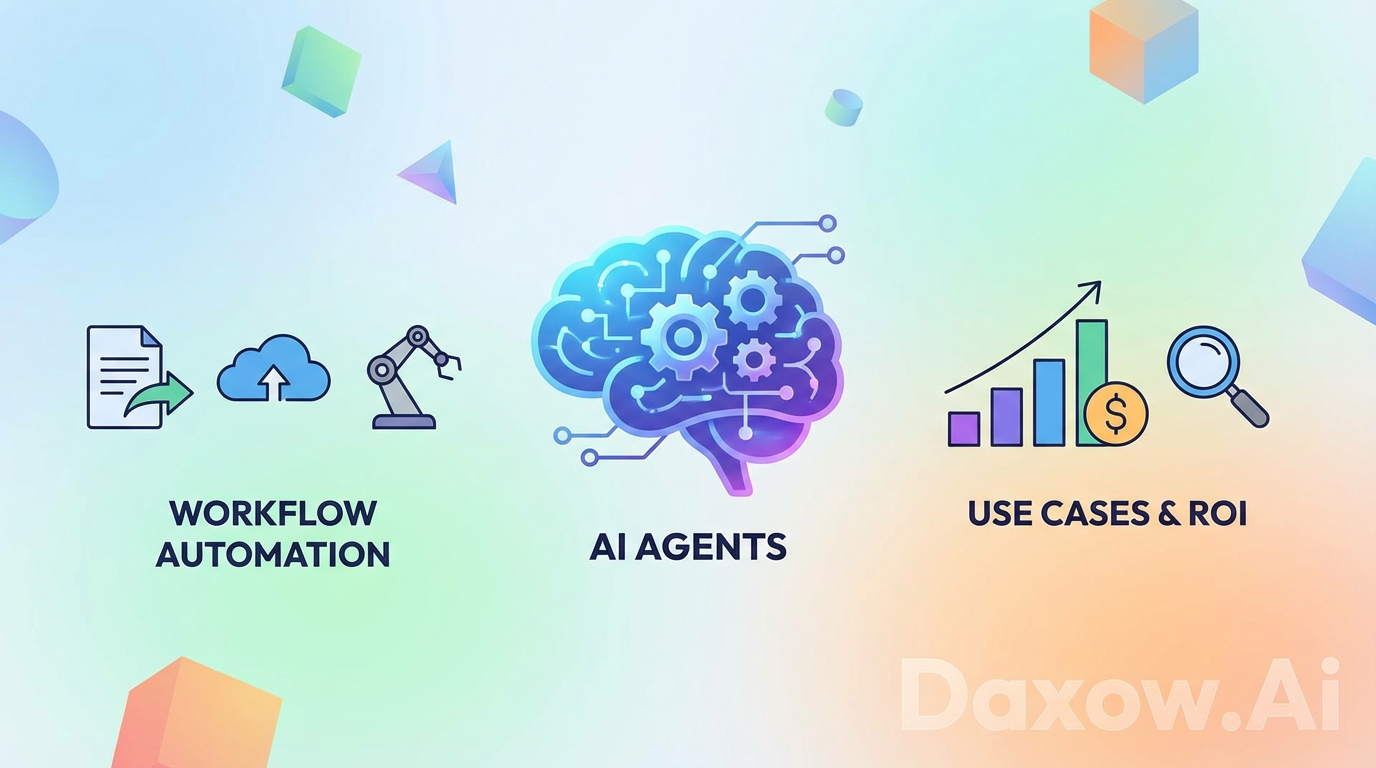
Explore how AI agents automate workflows, reduce manual work, and boost ROI across industries with Daxow.ai's design, integration, and scaling.
How AI Agents are Transforming Workflow Automation
Estimated reading time: 15 minutes
Key Takeaways
- AI agents enable autonomous decision-making and multimodal system orchestration, scaling automation beyond traditional bots.
- Businesses observe up to 70% reduction in manual tasks and faster response times through AI-driven workflows.
- Practical AI applications span industries such as SaaS, e-commerce, finance, healthcare, real estate, and HR.
- Successful implementation requires structured process mapping, pilot testing, seamless integration, monitoring, and governance.
- Daxow.ai specializes in designing, deploying, and scaling custom AI agents to deliver measurable ROI for business automation.
Table of Contents
- What is an AI Agent and Why It Matters for Workflow Automation
- Research-Backed Benefits and Measurable Impact
- Practical Use Cases: How AI Agents are Transforming Workflow Automation Across Industries
- Designing and Implementing AI Agents for Workflow Automation
- Measuring ROI and Business Value
- How Daxow.ai Builds and Scales AI Agents
- Best Practices and Common Pitfalls
- Next Steps: Evaluate Your Workflows for AI Agent Automation
- Frequently Asked Questions
What is an AI Agent and Why It Matters for Workflow Automation
An AI agent is a software entity that can perceive its environment, make decisions, and execute tasks autonomously or semi-autonomously across systems. Unlike rule-based bots or point automations, modern AI agents combine language understanding, process logic, and integrations to complete end-to-end work.
Key distinctions:
- Autonomous decision-making: Agents interpret inputs and choose appropriate actions instead of strictly following scripted flows.
- Multimodal inputs: They can handle text, documents, forms, emails, and API data.
- System orchestration: Agents coordinate work across CRMs, ERPs, ticketing systems, and databases.
- Continuous learning: They improve through supervised feedback and analytics.
These capabilities make AI agents ideal for scaling business automation beyond repetitive tasks into complex workflows that traditionally required human judgment.
Research-Backed Benefits and Measurable Impact
Deployments of AI agents and advanced automation routinely show improvements in operational metrics. While exact outcomes depend on process complexity and implementation quality, across industries organizations commonly observe:
- Significant reduction in manual tasks: Automating routine decisions and data handling often reduces manual work by 40–70% for targeted processes.
- Faster response times: Customer support automation and agent-assisted ticket triage can cut first-response time by 60% or more.
- Higher throughput with the same headcount: Sales and lead qualification automation can increase qualified lead handling by 2–4x.
- Improved accuracy and compliance: AI-driven document extraction and validation reduce data entry errors and maintain audit trails.
- Lower operational costs and improved ROI: Typical projects see payback within 6–12 months when automation is targeted to high-volume processes.
These outcomes are realized when AI automation is applied strategically: focusing on high-frequency workflows, integrating with core systems, and measuring business KPIs rather than only technical metrics.
Practical Use Cases: How AI Agents are Transforming Workflow Automation Across Industries
Technology & SaaS — Faster Customer Onboarding and Support
Problem: New user onboarding and Tier 1 support consume engineering and success team time.
AI agent solution:
- Automated onboarding agent that extracts customer configuration from emails and forms, provisions accounts via API, and populates CRM.
- Support agent triages incoming requests, suggests knowledge-base articles, and creates or escalates tickets when necessary.
Business impact:
- Reduce manual tasks for onboarding teams by 60%.
- Increase productivity of support engineers: handle 2–3x more issues without increasing headcount.
Daxow role: Design onboarding workflows, integrate with SaaS APIs and CRMs, and build monitoring to continuously improve agent decisions.
E-commerce — Order-to-Fulfillment and Customer Support Automation
Problem: Order exceptions, returns, and customer inquiries create high-volume repetitive work.
AI agent solution:
- Order reconciliation agent matches orders to payments and flags discrepancies.
- Returns processing agent validates reasons, initiates RMA, and updates inventory and refunds.
- Customer support automation provides personalized status updates and resolves common queries.
Business impact:
- Faster resolution of returns and disputes.
- Reduced manual reconciliation by 50–70%.
- Higher customer satisfaction with 24/7 automated responses.
Daxow role: Connect agents to e-commerce platforms, payment gateways, and fulfillment providers; implement rules for exception handling and escalation.
Finance — Accounts Payable Automation and Compliance
Problem: Manual invoice processing, vendor verification, and exception handling are slow and error-prone.
AI agent solution:
- Document automation extracts invoice fields, validates them against POs, and posts to accounting systems.
- Approval-routing agent enforces thresholds and audit workflows and flags suspicious entries.
Business impact:
- Reduce manual tasks in AP by up to 80%.
- Improve payment accuracy and supplier relations.
- Shorter close cycles and stronger controls for compliance.
Daxow role: Build secure document pipelines, integrate with ERPs, and implement governance controls for auditability.
Healthcare — Patient Intake and Administrative Workflows
Problem: Administration burden on clinicians and staff due to paperwork and scheduling.
AI agent solution:
- Patient intake agent extracts and verifies patient data from forms, verifies insurance, schedules appointments, and updates EHRs.
- Prior authorization agent assembles required documentation and tracks status.
Business impact:
- Faster patient processing and reduced administrative overhead.
- Better clinician time utilization and fewer scheduling errors.
Daxow role: Ensure HIPAA-compliant designs, integrate with EHR systems, and implement role-based access controls.
Real Estate — Lead Qualification and Transaction Orchestration
Problem: High volume of inbound leads with limited time to qualify and manage transactions across systems.
AI agent solution:
- Lead qualification agent scores and enriches leads, schedules viewings, and updates CRM.
- Transaction agent manages document collection, signature workflows, and compliance checklists.
Business impact:
- Increase lead-to-appointment rates and close deals faster.
- Reduce time spent on administrative coordination by agents and brokers.
Daxow role: Integrate property management systems and CRMs, build secure document workflows, and automate communication flows.
HR & Administration — Recruitment and Employee Onboarding
Problem: High administrative load in screening candidates and onboarding employees.
AI agent solution:
- Screening agent parses resumes, scores candidates against role requirements, and schedules interviews.
- Onboarding agent orchestrates equipment provisioning, account creation, and policy acknowledgments.
Business impact:
- Faster hiring cycles and improved candidate experience.
- Lower administrative labor costs and fewer compliance gaps.
Daxow role: Connect to ATS systems, identity providers, and ITSM tools to automate end-to-end processes.
Designing and Implementing AI Agents for Workflow Automation
Discovery and Process Mapping
- Identify high-volume, high-impact workflows that are rule- or data-driven.
- Map decision points, exceptions, and required integrations.
- Quantify baseline metrics (time per case, error rates, volume).
Pilot and Proof-of-Concept
- Build a lightweight agent that automates the core happy path.
- Measure efficiency gains, error rates, and user acceptance.
- Iterate quickly and add exception handling based on real-world data.
Integration and Data Connectivity
- Integrate with CRMs, ERPs, ticketing systems, email, and cloud storage.
- Use connectors and APIs; where needed, implement secure middleware.
- Ensure data normalization and real-time syncing for accurate agent decisions.
Monitoring, Feedback, and Continuous Learning
- Implement dashboards that track business KPIs, agent accuracy, and exception volumes.
- Capture human agent feedback to retrain models and refine decision logic.
- Use A/B testing for new strategies and maintain roll-back mechanisms.
Security, Compliance, and Governance
- Implement role-based access and data encryption.
- Maintain audit trails for decisions and actions taken by agents.
- Apply industry-specific compliance measures (e.g., HIPAA, GDPR) and document retention policies.
Measuring ROI and Business Value
To demonstrate business value, track both operational and financial metrics:
- Time saved per transaction and total FTE hours recovered.
- Reduction in error rates and rework costs.
- Revenue impact: more qualified leads handled, faster deal closures.
- Cost savings in third-party processing and reduced overtime.
Build a business case showing payback period and 12–24 month projected ROI. Many Daxow.ai projects achieve payback within the first year by targeting high-volume processes.
How Daxow.ai Builds and Scales AI Agents
Discovery and Process Analysis
We work with stakeholders to map workflows, identify bottlenecks, and prioritize automation opportunities based on value and feasibility.
Custom AI System Design
We design agents that combine LLM-driven understanding with business rules and orchestration logic.
- Focus on business automation: agents are engineered to reduce manual work while respecting governance and compliance.
End-to-End Implementation
Daxow builds integrations across CRMs, ERPs, ticketing systems, and cloud storage. Agents are deployed into production with monitoring, rollback, and version control.
Scaling and Continuous Improvement
After initial pilots, we scale agents to adjacent processes and add capabilities. We implement feedback loops and performance tracking to continuously improve agent accuracy and business outcomes.
Reducing Operational Costs and Improving ROI
Daxow targets high-impact workflows first to realize rapid cost reductions. We use metrics-driven deployment to optimize ROI and ensure automation delivers measurable business value.
System Integrations and Data Connectivity
Daxow engineers standard and custom connectors, enabling agents to execute real tasks across systems. We design secure data pipelines and metadata stores to ensure agents operate with authoritative data.
Examples of Agent Capabilities Daxow Delivers
- Autonomous lead qualification agents that update CRM records and schedule sales calls.
- Document automation agents that extract, validate, and route invoices or contracts.
- Support automation agents that resolve routine tickets and escalate complex cases to humans.
- Cross-system orchestration agents that execute multi-step business processes end-to-end.
Learn more about our custom AI automation solutions developed for diverse enterprise needs.
Best Practices and Common Pitfalls
Best Practices
- Start with high-volume, clearly defined processes.
- Ensure strong data hygiene before training or deploying agents.
- Keep humans in the loop for exceptions and continuous learning.
- Measure business KPIs from day one and iterate quickly.
Common Pitfalls to Avoid
- Automating poorly understood processes without mapping exceptions.
- Over-engineering: building complete systems before validating the business case.
- Neglecting integrations: agents that can’t access required systems fail to deliver.
- Ignoring governance: lack of auditability and controls leads to compliance risk.
Next Steps: Evaluate Your Workflows for AI Agent Automation
To get started:
- Conduct a short process audit to identify top 3 automation candidates.
- Run a pilot focusing on measurable KPIs (time saved, error reduction, cost impact).
- Plan integrations and security controls before scaling.
If you want targeted help, Daxow.ai offers a structured engagement:
- Process analysis to identify automation opportunities.
- Proof-of-concept builds to demonstrate value quickly.
- End-to-end implementation including system integrations and monitoring.
- Ongoing support to scale agents and continuously improve ROI.
Frequently Asked Questions
What distinguishes AI agents from traditional automation bots?
AI agents combine autonomous decision-making, multimodal inputs, system orchestration, and continuous learning capabilities unlike rule-based bots that follow fixed scripts.
Which industries benefit the most from AI workflow automation?
Industries such as technology, e-commerce, finance, healthcare, real estate, and HR experience significant gains from AI agents by automating complex, high-volume workflows.
How does Daxow.ai ensure compliance and security in AI projects?
Daxow implements role-based access, data encryption, audit trails, and industry-specific compliance standards like HIPAA and GDPR as part of every AI automation solution.
What is the typical ROI timeline for implementing AI agents?
Most projects see a payback within 6 to 12 months by targeting high-volume, repetitive workflows, with continued ROI as automation scales across processes.