
AI Agents for Workflow Automation: Reduce Manual Tasks
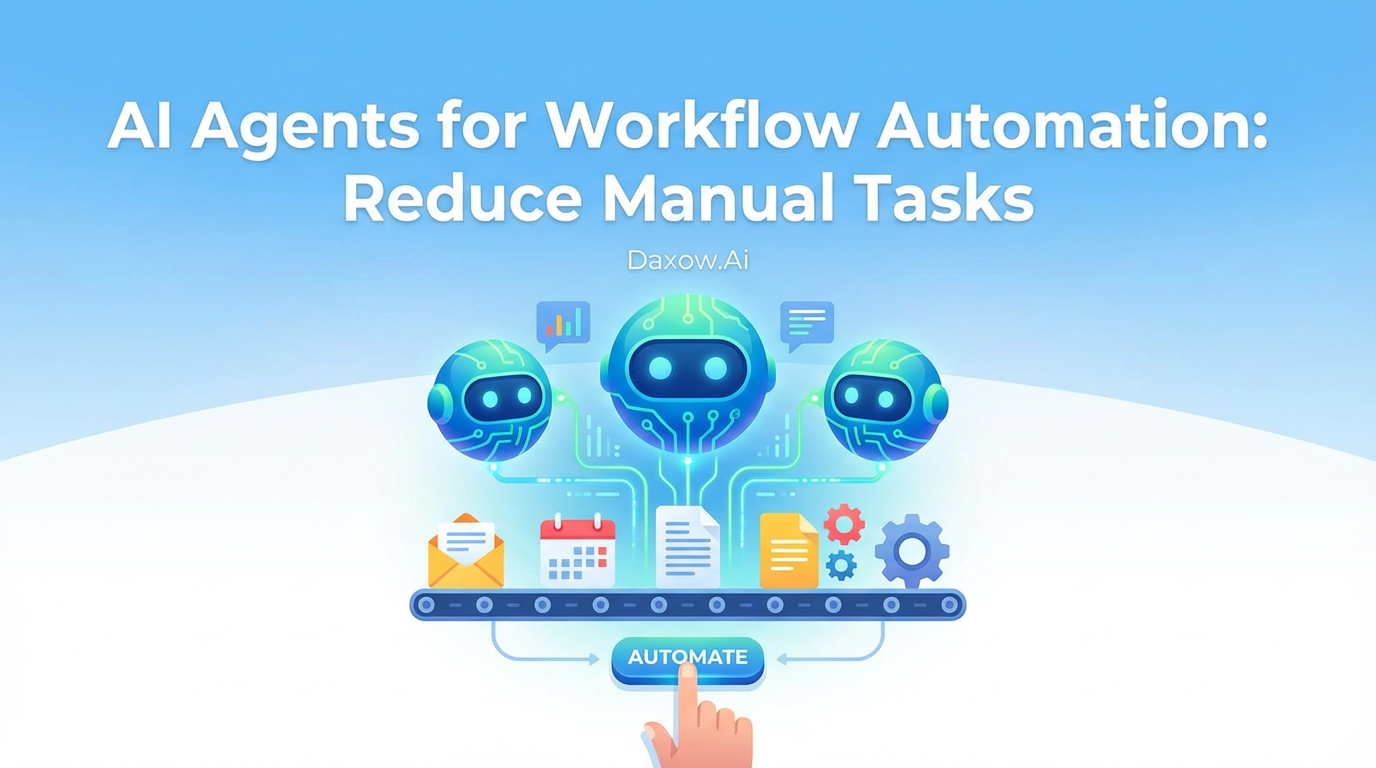
AI agents that automate workflows to cut manual tasks, boost productivity, and deliver measurable ROI. Use cases and a deployment framework.
AI Agents for Workflow Automation: How to Reduce Manual Tasks and Boost Productivity
Estimated reading time: 12 minutes
Key Takeaways
- AI agents automate complex workflows by combining natural language understanding, decision-making, and process orchestration.
- They differ from traditional automation by handling unstructured data, adapting contextually, and managing exceptions effectively.
- AI automation delivers significant productivity gains, cost reduction, and improved customer experiences across industries.
- Implementing AI agents requires a structured step-by-step process covering discovery, design, integration, testing, scaling, and governance.
- Daxow.ai provides custom AI agent solutions tailored to business needs, ensuring measurable ROI and operational excellence.
Table of Contents
- AI Agents for Workflow Automation — What Decision-Makers Need to Know
- Research Findings: Impact of AI Automation on Business Operations
- Practical Use Cases Across Industries
- Implementing AI Agents for Workflow Automation — A Step-by-Step Framework
- Technology Considerations: Models, Integrations, Security, and Compliance
- Measuring Success: KPIs and ROI for Business Automation
- How Daxow.ai Delivers Value: From Strategy to Execution
- Common Pitfalls and How to Avoid Them
- Getting Started: A Practical Checklist
- Conclusion and Call to Action
- Frequently Asked Questions
AI Agents for Workflow Automation — What Decision-Makers Need to Know
What are AI agents?
- AI agents are software systems that perceive information, make decisions, and act autonomously to complete tasks. They combine natural language understanding, process orchestration, APIs, and business rules to execute real work.
- Unlike simple scripts or rule-based bots, AI agents can reason over documents, interact with users or systems, and learn from feedback.
How AI agents differ from traditional automation
- Traditional workflow automation follows deterministic rules. AI agents incorporate unstructured data processing, context-aware decision-making, and adaptive responses.
- AI agents can handle exceptions, prioritize work, and coordinate between multiple systems — bridging gaps where standard automation stalls.
Core capabilities that drive business value
- Document understanding and data extraction (invoices, contracts, forms)
- Conversational automation for customer and employee interactions
- Task orchestration across CRMs, ERPs, and third-party tools
- Lead qualification and routing using intent and sentiment analysis
- Proactive execution: scheduling, follow-ups, and escalations without human prompts
Research Findings: Impact of AI Automation on Business Operations
Key research insights (summarized)
- Industry research shows a substantial portion of routine tasks across roles are automatable, resulting in large productivity gains when combined with process redesign.
- Organizations that adopt AI automation tend to reduce cycle times, improve first-contact resolution in support, and increase sales conversion through faster, data-driven lead qualification.
- Success hinges less on raw model performance and more on integration, data quality, and governance.
Operational benefits observed in practice
- Reduced manual work: Automating repetitive data entry, reconciliation, and routing reduces human hours dedicated to low-value tasks.
- Faster response and resolution: Customer support automation cuts average handling time and improves SLA compliance.
- Higher productivity: Teams redeploy time saved to higher-value activities such as strategic problem solving and customer relationships.
- Lower operational costs: Automation reduces error rates and the need for large teams to support high-volume processes.
- Improved customer experience: Consistency and speed from AI agents raise satisfaction and retention.
Practical Use Cases Across Industries
Customer Support and Service (All industries)
Use case: An AI agent triages incoming tickets across email, chat, and voice. It extracts intent, matches knowledge-base articles, and attempts first-contact resolution. Complex cases are enriched with summarized context and routed to the right specialist.
Business impact: Reduced manual tasks, faster SLA adherence, lower support headcount per ticket, and higher customer satisfaction.
Daxow.ai role: Build and integrate support automation, train domain-specific NLU models, and connect agents to ticketing systems and CRM.
Sales Automation and Lead Qualification (SaaS, B2B, Real Estate)
Use case: AI agent qualifies inbound leads by analyzing form responses, email, and LinkedIn signals to score intent, recommend outreach, and schedule discovery calls.
Business impact: Faster lead response, improved lead-to-opportunity conversion, and more efficient sales coverage.
Daxow.ai role: Implement lead-scoring workflows, integrate with CRM, and automate personalized follow-ups.
Finance and Accounting
Use case: Automated invoice processing with document extraction, validation against purchase orders, and exception routing. Agents reconcile payments and update ledgers.
Business impact: Reduced manual reconciliation, fewer late payments, and lower AP processing costs.
Daxow.ai role: Deploy intelligent document processing, connect to ERP, and create audit trails for compliance.
Human Resources and Administration
Use case: Onboarding agent collects documents, validates eligibility, schedules orientation, and creates accounts in HR systems.
Business impact: Quicker time-to-productivity for new hires and reduced HR administrative load.
Daxow.ai role: Orchestrate onboarding workflows, integrate with HRIS, and automate compliance checks.
Healthcare and Life Sciences
Use case: Intake automation extracts patient data from forms and referrals, pre-fills EHRs, and schedules appointments meeting specialist constraints.
Business impact: Reduced front-desk workload, fewer data errors, and improved patient flow.
Daxow.ai role: Ensure secure integrations, implement PHI-safe document processing, and maintain compliance frameworks.
E-commerce and Retail
Use case: AI agent automates returns and refund decisions by analyzing order history, images, and policy rules.
Business impact: Faster refunds, less manual review, and improved customer loyalty.
Daxow.ai role: Integrate agents with order management systems and CRM, and tune decision models for fraud prevention.
Real Estate and Property Management
Use case: Tenant inquiry agent handles scheduling viewings, pre-qualifying tenants, and generating lease drafts for review.
Business impact: Faster tenant placement and reduced agent workload.
Daxow.ai role: Connect AI agents to listing platforms, calendar systems, and document automation engines.
Implementing AI Agents for Workflow Automation — A Step-by-Step Framework
- Discovery and Process Mapping
- Map current workflows, measure manual touchpoints, and identify high-frequency, high-cost tasks.
- Output: Prioritized automation candidates and success criteria.
- Daxow.ai contribution: Conduct process analysis and estimate impact.
- Define Objectives and KPIs
- Set measurable goals (hours saved, SLA improvement, revenue uplift).
- Output: Clear project scope and ROI targets.
- Daxow.ai contribution: Align automation targets with business outcomes.
- Design AI Agent Workflows
- Define decision logic, data inputs, human handoffs, and escalation rules.
- Output: Process diagrams and agent specifications.
- Daxow.ai contribution: Architect agent behaviors and orchestration flows.
- Data Integration and Model Selection
- Connect CRMs, ERPs, ticketing systems, and document repositories. Select models for NLU, extraction, and decisioning.
- Output: Integrated data pipelines and model evaluation benchmarks.
- Daxow.ai contribution: Implement secure integrations and choose the right models for the task.
- Build, Test, and Pilot
- Develop the agent, run simulations, and launch a controlled pilot with monitoring.
- Output: Real-world performance data and refined workflows.
- Daxow.ai contribution: Deliver pilot, perform A/B testing, and iterate quickly.
- Scale and Maintain
- Roll out across teams, add additional integrations, and operationalize monitoring and retraining.
- Output: Full-scale automation with governance and SLA monitoring.
- Daxow.ai contribution: Provide ongoing ops, continuous improvements, and support.
- Governance, Compliance, and Change Management
- Establish data governance, audit logs, and employee training programs.
- Output: Risk-managed, compliant automation.
- Daxow.ai contribution: Implement auditability and compliance controls.
Technology Considerations: Models, Integrations, Security, and Compliance
Model and capability decisions
- Choose models based on task: extraction models for documents, conversational models for chat, and decision models for routing and scoring.
- Emphasize explainability for regulated environments.
Systems and integrations
- Agents must integrate with CRMs, ERPs, ticketing, email, calendars, and storage systems.
- APIs and middleware simplify orchestration and data normalization.
Data security and privacy
- Protect sensitive information with data minimization, encryption, and role-based access.
- Implement data retention policies and compliance controls (GDPR, HIPAA where applicable).
Operational excellence
- Monitor agent performance: accuracy, error rates, SLA compliance, and business KPIs.
- Implement feedback loops for continuous learning and improvement.
Measuring Success: KPIs and ROI for Business Automation
Core KPIs
- Reduction in manual hours: hours per week saved or staff FTE reduced.
- Cycle time improvement: average time to resolution or processing time.
- Accuracy and error reduction: fewer data mistakes and rework.
- Customer metrics: NPS, CSAT, first-contact resolution.
- Revenue metrics: lead-to-close rates, average deal size, upsell velocity.
Example ROI calculation (simplified)
Scenario: Automate invoice processing that currently consumes 800 human hours monthly at $30/hour = $24,000/month.
With automation: 70% reduction in manual hours → 560 hours saved → $16,800 monthly labor cost saved.
Subtract platform and maintenance cost (e.g., $4,000/month) → net savings $12,800/month → annualized ~ $153,600.
Add qualitative benefits: fewer late payments, improved vendor relationships, better financial forecasting.
How Daxow.ai Delivers Value: From Strategy to Execution
- Process analysis and prioritization: We map workflows and recommend high-impact automation opportunities.
- Custom AI agent design: We build agents that include conversational interfaces, document automation, lead qualification, and orchestration tailored to your systems.
- End-to-end automation: From data ingestion to system updates, our solutions automate entire processes, not just fragments.
- Systems integration: We connect AI agents to CRMs, ERPs, ticketing platforms, and other business tools to ensure smooth information flow.
- Operational support and continuous improvement: We monitor agents, retrain models, and refine processes so automation gets more effective over time.
- Focus on ROI and cost reduction: Our projects prioritize measurable outcomes — reducing manual tasks, improving productivity, and lowering operational costs.
Learn more about our custom AI agent design and case studies showcasing measurable returns.
Common Pitfalls and How to Avoid Them
- Over-automating without redesigning processes: Automation should follow process simplification.
- Ignoring data quality: Clean, structured data yields better agent accuracy.
- Poor integration planning: Lack of system connectivity creates brittle automations.
- Missing governance: No audit trails or human-in-the-loop controls leads to risk.
Daxow.ai addresses these issues through disciplined discovery, robust integrations, and governance frameworks.
Getting Started: A Practical Checklist
- Identify one high-volume, high-cost workflow to pilot.
- Define success metrics and target outcomes.
- Assemble stakeholder sponsors from IT, operations, and business units.
- Secure access to necessary systems for integration and data.
- Start with a time-boxed pilot and measure results before scaling.
Conclusion and Call to Action
AI Agents for Workflow Automation are a strategic lever for organizations that want to reduce manual tasks, increase productivity, and improve customer and employee experiences. The value comes from combining intelligent models with robust integrations, process redesign, and ongoing governance.
If you are evaluating business automation opportunities or want a tailored roadmap to deploy AI agents in your organization, Daxow.ai can help. We offer discovery workshops, process analysis, and end-to-end implementation services to design custom AI systems that deliver measurable ROI.
Book a free consultation with Daxow.ai, request a process analysis for your company, or contact us to build a custom AI system that reduces manual work and scales productivity across your organization.
Frequently Asked Questions
What distinguishes AI agents from traditional automation tools?
AI agents autonomously process unstructured data, make context-aware decisions, and adapt to changes, unlike traditional automation which follows fixed, rule-based scripts.
How can AI agents improve customer support?
By triaging tickets, extracting intent, and resolving common issues automatically, AI agents reduce response time, improve SLA adherence, and enable support teams to focus on complex cases.
What should companies consider before implementing AI automation?
They should assess workflows for automation potential, ensure data quality, plan integrations carefully, and establish governance and compliance frameworks.
How does Daxow.ai support AI automation projects?
Daxow.ai offers end-to-end services including process analysis, custom AI agent design, integrations, pilot execution, and ongoing operational support focused on delivering measurable ROI.