
AI Agents for Workflow Automation: Reduce Tasks & Boost Productivity
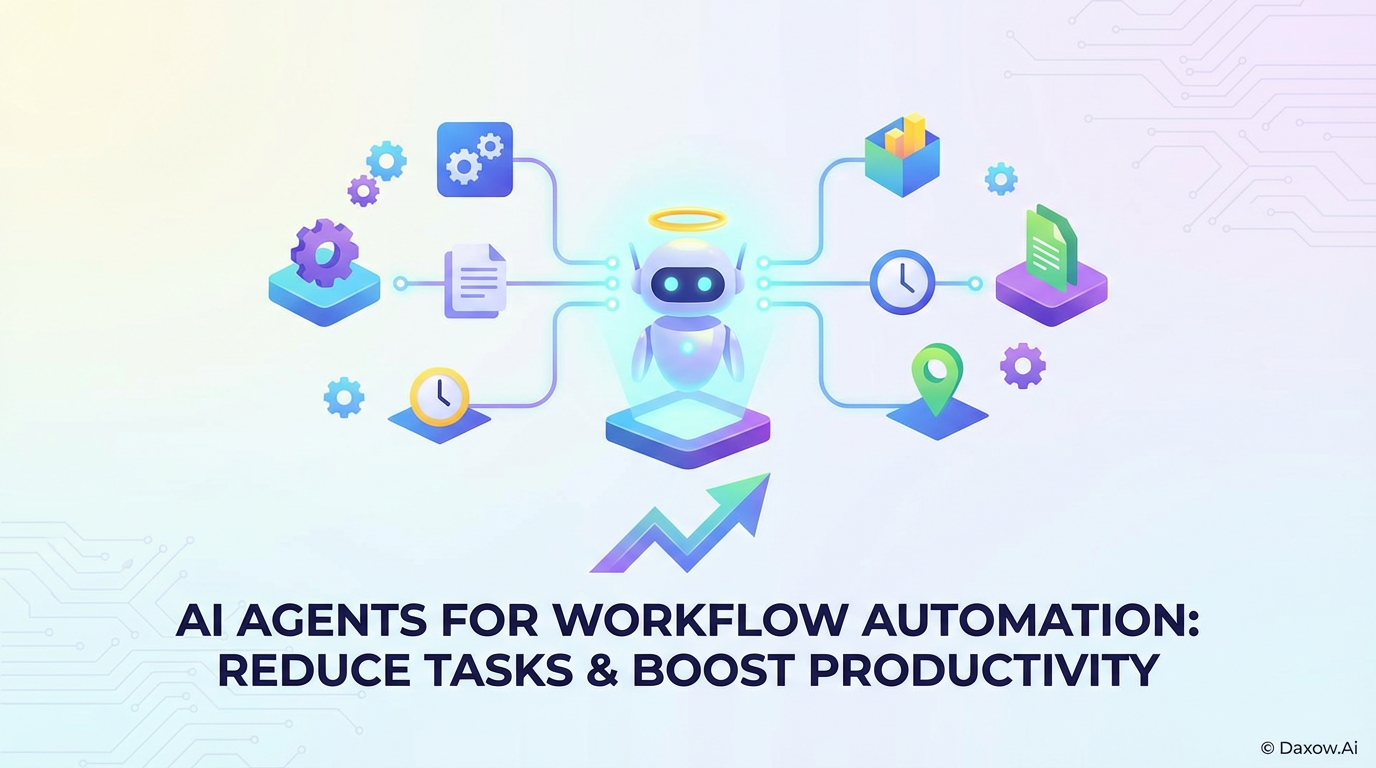
How AI agents automate workflows across departments with use cases, an implementation playbook, ROI metrics, and Daxow.ai solutions to reduce manual work.
AI Agents for Workflow Automation — How to Reduce Manual Tasks and Boost Productivity
Estimated reading time: 15 minutes
Key Takeaways
- AI agents accelerate workflow automation by reducing manual tasks, improving productivity, and delivering measurable business value.
- Practical AI agent use cases include customer support, sales, finance, HR, healthcare, and real estate automation.
- A five-step implementation framework: discovery, data prep, prototyping, integration, and continuous monitoring.
- Daxow.ai offers tailored AI system design and deployment to connect AI agents with existing tools and maximize ROI.
- Monitor risks, compliance, and performance to ensure successful and responsible automation adoption.
Table of Contents
- AI Agents for Workflow Automation — Why They Matter
- Research Insights and Practical Implications
- Use Cases — AI Agents for Workflow Automation Across Industries
- Implementation Playbook — From Discovery to Production
- Technology Stack and Integration Patterns
- Measuring ROI and Business Impact
- Risks, Compliance, and Governance
- Best Practices for Successful Adoption
- Why Partner with Daxow.ai for AI Agents and Workflow Automation
- Frequently Asked Questions
AI Agents for Workflow Automation — Why They Matter
AI agents are autonomous or semi-autonomous software entities that perform specific tasks, make decisions based on data, and interact with other systems or humans. When embedded into workflow automation, AI agents transform siloed processes into intelligent, end-to-end flows.
Key benefits:
- Reduce manual tasks by automating repetitive decision-making and data entry.
- Boost productivity by freeing employees to focus on higher-value work.
- Improve customer experience through faster, 24/7 responses and consistent outcomes.
- Lower operational costs by eliminating bottlenecks and manual errors.
- Scale business automation quickly across departments without multiplying headcount.
How AI Agents Differ from Traditional Automation
Traditional workflow automation follows deterministic rules. AI agents add:
- Natural language understanding for unstructured inputs.
- Predictive models for prioritization and routing.
- Adaptive learning to improve over time.
- API-driven actions that execute tasks across CRMs, ERP, and communication platforms.
Research Insights and Practical Implications
Industry adoption trends show that organisations are moving from point automations to platform-wide AI automation. Successful deployments combine domain expertise, data readiness, and robust integrations.
- Start with high-frequency, high-cost tasks. Automating frequent manual tasks yields the fastest ROI.
- Data quality drives accuracy. Clean, mapped data improves model performance and reduces human intervention.
- Human-in-the-loop is essential early on. Blended automation ensures safety, trust, and progressive autonomy.
- Integration posture determines impact. Seamless connectivity with CRMs, support platforms, and databases unlocks end-to-end value.
- Measure business outcomes, not just technical metrics. Track response times, resolution rates, lead qualification accuracy, cost per transaction, and employee time reclaimed.
Use Cases — AI Agents for Workflow Automation Across Industries
Customer Support Automation
Use case:
- An AI agent handles Tier 1 inquiries via chat and email, extracts intent and entities, resolves common issues, and escalates complex tickets to specialists.
Business impact:
- Faster first response times, higher self-service rates, and reduced average handling time.
- Cost savings from deflecting inbound volume and concentrating human agents on high-impact cases.
How Daxow.ai helps:
- Map support workflows, build intent classifiers, connect agents to helpdesk tools, and implement escalation rules that preserve SLAs.
Sales Automation and Lead Qualification
Use case:
- AI agents score inbound leads using CRM data, interaction history, and firmographic signals. Qualified leads trigger personalized outreach sequences and calendar scheduling.
Business impact:
- Higher lead-to-opportunity conversion, shorter sales cycles, and more efficient SDR teams.
How Daxow.ai helps:
- Integrate AI agents with your CRM, configure lead-scoring models tuned to your ICP, and deploy automated outreach that syncs with sales ops.
Finance and Accounting — Invoice & Expense Automation
Use case:
- An AI agent extracts invoice data, validates line items against purchase orders, assigns GL codes, and routes exceptions for review.
Business impact:
- Reduced manual data entry, faster invoice processing, lower error rates, and improved vendor relationships.
How Daxow.ai helps:
- Implement document automation models, design exception workflows, and integrate agents with your accounting system for automated postings.
HR and Administrative Automation
Use case:
- AI agents pre-screen resumes, extract candidate qualifications, schedule interviews, and answer common employee queries about benefits.
Business impact:
- Reduced time-to-hire, lower administrative overhead, and consistent candidate experiences.
How Daxow.ai helps:
- Combine NLP-based resume parsing with ATS integrations and build conversational agents for employee self-service.
Healthcare — Triage and Administrative Support
Use case:
- AI agents perform intake triage, extract symptoms, prioritize appointments, and aid administrative staff in managing claims.
Business impact:
- Faster triage, reduced administrative burden, and improved patient experience while maintaining compliance.
How Daxow.ai helps:
- Design compliant workflows, ensure secure data handling, and integrate agents with EHR and scheduling systems.
Real Estate — Listing and Transaction Automation
Use case:
- AI agents generate property descriptions from structured data, qualify buyers, and manage document flows during closings.
Business impact:
- Faster listing publication, more accurate lead qualification, and reduced transaction friction.
How Daxow.ai helps:
- Automate content generation, integrate with MLS and CRM systems, and secure document management for transactions.
Implementation Playbook — From Discovery to Production
1. Discovery & Process Mapping
- Identify high-impact workflows (high volume, manual effort, measurable outcomes).
- Map current state, stakeholders, decision points, and required integrations.
- Define success metrics aligned with business KPIs (cost per ticket, time saved, conversion lift).
2. Data Assessment and Preparation
- Audit data sources: CRM, ticketing systems, email, documents, and databases.
- Clean and label sample data for model training.
- Establish data governance, retention, and access controls.
3. Prototype & Proof of Value
- Build a narrow-scope prototype focusing on the most valuable subtask.
- Run parallel operations with human oversight to validate accuracy and business impact.
- Gather feedback and refine models and workflows.
4. Integration & Automation Engineering
- Connect AI agents to business systems via APIs, middleware, or RPA as needed.
- Implement end-to-end orchestration for decision-making, task execution, and logging.
- Ensure secure authentication and role-based access.
5. Monitoring, Governance & Continuous Improvement
- Monitor performance using both technical metrics (latency, accuracy) and business metrics (SLA compliance, cost savings).
- Establish model retraining cadence and human review loops for edge cases.
- Maintain compliance, audit logs, and transparent decision explanations.
Technology Stack and Integration Patterns
Successful AI automation blends multiple technologies. Typical stack components:
- Data layer: data warehouses, CRM, ticketing systems.
- AI layer: LLMs, specialized classifiers, document OCR/NER.
- Orchestration: workflow engines, rule engines, API middleware.
- Execution: connectors to email, SMS, CRM, ERP, and RPA for UI-level tasks.
- Operations: monitoring dashboards, retraining pipelines, alerting.
Integration patterns:
- API-first: preferred for resilience and scalability.
- Event-driven: useful for near real-time workflows (webhooks, message buses).
- Hybrid RPA: when legacy systems lack APIs, agents can trigger UI actions safely.
- Human-in-the-loop: toggle between autonomous actions and human approvals.
Measuring ROI and Business Impact
Track metrics that link automation to value:
- Operational metrics: tickets handled per hour, average handling time, automation rate.
- Financial metrics: cost per transaction, savings from headcount reallocation, reduction in error-related costs.
- Customer metrics: NPS, first contact resolution, response time.
- Employee metrics: time reclaimed, productivity per FTE, turnover improvements.
ROI calculation approach:
- Baseline current costs and throughput.
- Estimate time and cost savings from automation (conservative and optimistic scenarios).
- Factor in implementation costs, licensing, and ongoing maintenance.
- Project payback period and three-year ROI.
Risks, Compliance, and Governance
Automating workflows with AI agents introduces new risks that must be managed.
- Data privacy and security. Encrypt data in transit and at rest; apply least privilege access.
- Regulatory compliance. Ensure workflows meet industry regulations (e.g., healthcare, finance).
- Bias and fairness. Monitor models for biased decisions that could harm customers or employees.
- Explainability. Maintain logs and decision trails for audit and dispute resolution.
- Change management. Address workforce impacts with retraining, redeployment, and clear communication.
How Daxow.ai mitigates risk:
- Implement robust security controls and compliance checks.
- Build transparent decision logs and governance frameworks.
- Provide training and transition plans to align automation with organisational change.
Best Practices for Successful Adoption
- Start with a use case that has clear, measurable outcomes and strong executive sponsorship.
- Keep workflows simple initially; expand complexity after achieving reliability.
- Maintain a human-in-the-loop strategy until the system proves robust.
- Invest in data quality early to reduce rework later.
- Monitor continuously and iterate based on real usage data.
Why Partner with Daxow.ai for AI Agents and Workflow Automation
Daxow.ai combines practical automation engineering with domain-specific AI expertise to deliver end-to-end solutions that drive measurable business value.
What Daxow.ai offers:
- Discovery and process analysis to identify the highest-impact automation opportunities.
- Custom AI agents that perform real tasks — from lead qualification to invoice processing.
- End-to-end system integration with CRMs, ERPs, ticketing platforms, and legacy systems.
- Operationalization including monitoring, retraining, and governance to maintain performance.
- Cost-conscious delivery focused on reducing operational costs and improving ROI.
Client outcomes:
- Faster time-to-value with prototypes validated in weeks.
- Reduced manual workload and improved customer SLAs.
- Scalable automation platforms that grow with your business needs.
Frequently Asked Questions
What are AI agents in workflow automation?
AI agents are autonomous or semi-autonomous software programs that perform specific workflow tasks, make decisions using data, and interact with systems or humans to automate and enhance business processes.
How do AI agents improve productivity?
By automating repetitive manual tasks, AI agents free employees to focus on higher-value work, reduce bottlenecks, and enable faster responses, which collectively boost overall productivity.
What industries can benefit from AI agents?
Industries such as customer support, sales, finance, HR, healthcare, and real estate are already leveraging AI agents for tasks ranging from lead qualification to claims management and document automation.
How does Daxow.ai support AI automation projects?
Daxow.ai offers a full lifecycle approach including process discovery, custom AI agent design, system integration, operationalization, and ongoing governance to ensure successful and measurable automation outcomes.