
AI Agents for Workflow Automation: Reduce Manual Tasks & Boost ROI
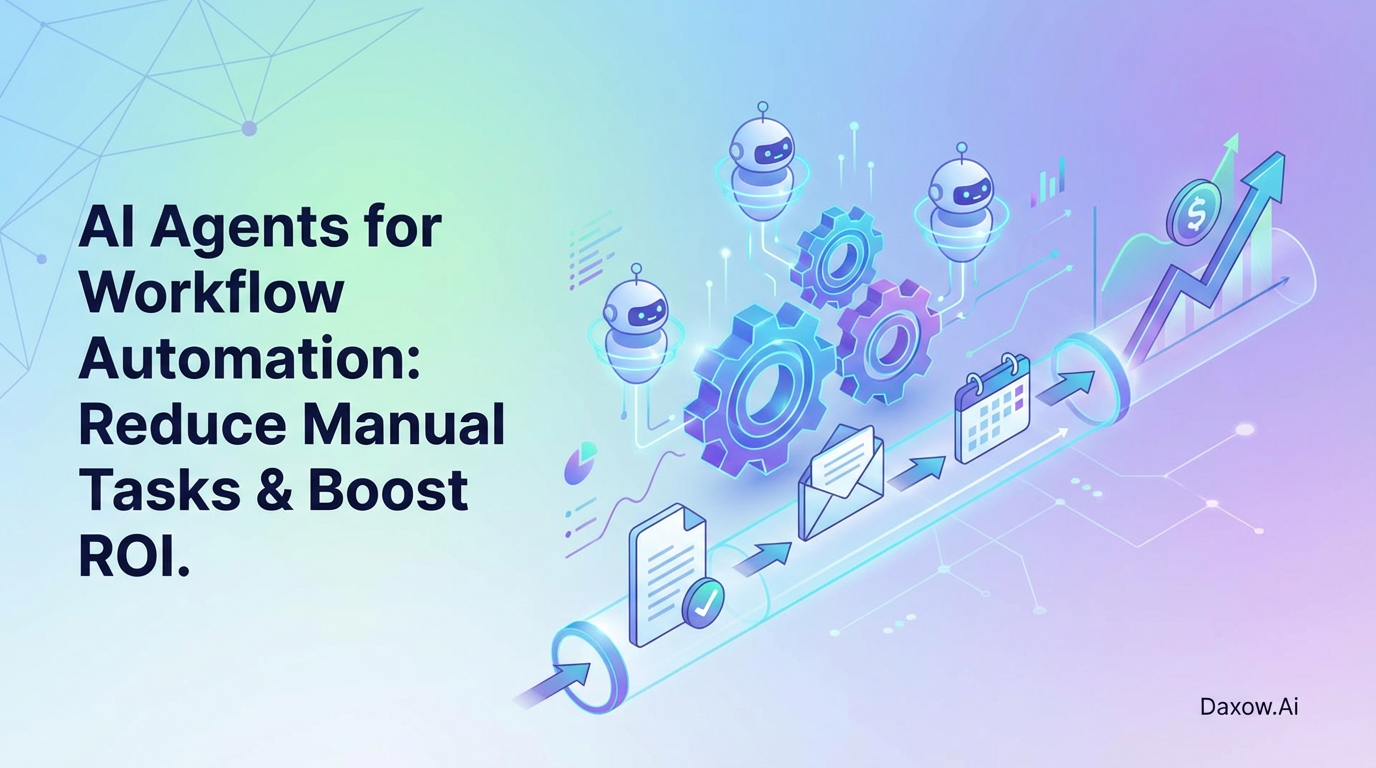
Learn how AI agents automate end-to-end workflows to cut manual work, boost productivity, and deliver fast ROI. Practical roadmap and Daxow.ai services.
AI Agents in Workflow Automation — How to Reduce Manual Tasks, Boost Productivity, and Transform Your Business
Estimated reading time: 12 minutes
Key Takeaways
- AI agents combine machine learning, NLP, and RPA to automate complex workflows end-to-end.
- They enable hyperautomation by adding cognitive capabilities beyond traditional RPA.
- Companies experience 30–50% process time reductions and significant efficiency gains.
- Use cases span e-commerce, healthcare, finance, real estate, and HR for measurable impact.
- A phased, governance-oriented implementation reduces risk and accelerates adoption.
- Daxow.ai partners with organizations to design, build, and operate custom AI agents integrated with core systems.
Table of Contents
- AI Agents in Workflow Automation
- Business Value and ROI from AI Automation
- Practical Use Cases Across Industries
- Implementation Steps and Best Practices for AI Automation
- Technical Architecture and Integrations
- How Daxow.ai Builds Custom AI Systems and AI Agents
- Getting Started — A Practical Checklist and KPI Set
- Frequently Asked Questions
AI Agents in Workflow Automation
What are AI agents and why they matter
AI agents are autonomous, software-driven systems that combine machine learning, natural language processing (NLP), and robotic process automation (RPA) to execute multi-step tasks. Unlike traditional RPA bots that follow rigid scripts, AI agents can reason, adapt to new inputs, summarize information, and make conditional decisions. This makes them ideal for complex, data-intensive workflows like invoice approval, customer support escalation, lead qualification, and document extraction.
Key benefits of AI agents:
- Automate end-to-end processes rather than isolated steps.
- Reduce manual tasks by handling repetitive, high-volume work.
- Improve productivity through faster, more accurate execution.
- Enable continuous learning and refinement of workflows.
AI agents vs. traditional automation
Traditional RPA excels at deterministic, rule-based tasks. AI agents extend that capability by adding cognitive layers—language understanding, pattern recognition, and predictive analytics. This shift enables hyperautomation: orchestrating RPA, APIs, and AI models across systems to close the gap between intent and execution.
Business Value and ROI from AI Automation
Quantifiable outcomes
Organizations that adopt AI automation report measurable improvements:
- 30–50% reductions in process times for targeted workflows.
- Error rates reduced below 1% in document-heavy processes.
- Payback periods of 6–12 months for focused implementations.
- 3–5x efficiency multipliers when AI agents are applied and iterated upon.
These gains translate into lower operational costs, faster customer response times, and the ability to handle seasonal or growth-related spikes without immediate hiring.
How value is realized across functions
- Customer support automation cuts average handle time and increases first-contact resolution by combining chatbots with back-end data retrieval agents.
- Sales automation accelerates lead qualification and follow-up, increasing conversion rates by ensuring timely engagement.
- Finance automation reduces invoice processing costs and improves compliance through automated validation and audit trails.
- HR automation streamlines screening and onboarding, enabling recruiters to focus on high-value candidate engagement.
Practical Use Cases Across Industries
E-commerce — Order-to-cash and fulfillment resilience
Challenge: High order volumes, frequent exceptions, and supply chain variability.
AI automation solution:
- AI agents orchestrate order validation, inventory checks, and exception resolution.
- Predictive analytics flag likely supply disruptions and recommend alternative sourcing.
- Automated content generation drafts product descriptions and marketing copy tailored to customer segments.
Business impact: Faster fulfillment, fewer cancellations, and improved conversion rates.
Daxow role: Build API connectors to ecommerce platforms, integrate predictive models, and deploy agents that manage order lifecycles end-to-end.
Healthcare — Document automation and patient experience
Challenge: Administrative load from unstructured records and long patient follow-up cycles.
AI automation solution:
- AI agents extract structured data from referral letters, claims, and lab reports.
- NLP summarization compiles patient issues and flags urgent items for clinicians.
- Automated patient outreach schedules follow-ups and triages questions.
Business impact: Reduced administrative time, better clinician focus, and improved patient satisfaction.
Daxow role: Implement secure data pipelines, ensure HIPAA-compliant handling, and integrate agents with EHR systems to automate record updates.
Finance — Fraud detection and accounts processing
Challenge: Volume of transactions and manual invoice processing create risk and delays.
AI automation solution:
- AI agents continuously monitor patterns for anomalous transactions using predictive models.
- End-to-end invoice automation extracts data, validates against purchase orders, and initiates approvals.
Business impact: Faster close cycles, fewer errors, and proactive fraud mitigation.
Daxow role: Deploy monitoring agents that connect to payment platforms and accounting systems, and automate exception workflows with auditable logs.
Real Estate — Market analytics and lead qualification
Challenge: High competition, time-consuming market research, and slow response to leads.
AI automation solution:
- Agents ingest market feeds, identify pricing patterns, and generate property reports.
- Automated triage and qualification of inbound inquiries accelerate agent follow-up.
Business impact: Shorter sales cycles and better-targeted outreach.
Daxow role: Integrate MLS feeds, CRM systems, and property databases to deliver agents that create instant property briefs and prioritize leads.
HR — Recruiting and onboarding
Challenge: Screening high volumes of applicants and repetitive onboarding steps.
AI automation solution:
- AI agents parse resumes, score candidates against job criteria, and summarize top matches.
- Automated onboarding workflows provision accounts, collect forms, and schedule orientation.
Business impact: Faster time-to-hire and reduced administrative load on HR teams.
Daxow role: Implement candidate scoring models, integrate ATS and HRIS systems, and build conversational bots for candidate queries.
Implementation Steps and Best Practices for AI Automation
A phased approach that reduces risk
- Define clear objectives — Identify measurable goals (e.g., 20% reduction in support SLA breaches).
- Identify processes and audit data — Use task mining and process mapping to pick high-impact, repeatable workflows.
- Select tools and assemble a cross-functional team — Choose secure, scalable platforms and a team of technologists, process owners, and compliance owners.
- Prototype with a pilot — Start small on non-critical processes, validate outcomes, and refine.
- Integrate and govern — Involve IT early, establish access controls, and adopt model monitoring.
- Measure and iterate — Track productivity, error rates, cycle times, and ROI; retrain and scale successful agents.
Common pitfalls and how to avoid them
- Poor data quality — Perform a data audit and remediation before building models.
- Shadow automation — Centralize governance to prevent sprawl and inconsistent agents.
- Legacy compatibility issues — Prioritize integration-friendly architectures and APIs.
- Lack of adoption — Provide training and involve business stakeholders from day one.
Technical Architecture and Integrations
Design patterns for resilient automation
A practical architecture for AI automation often includes:
- A data layer for secure ingestion, storage, and preprocessing.
- A model layer with LLMs, classification models, and predictive engines.
- An orchestration layer (AI agents) to sequence tasks, manage retries, and call downstream systems.
- Connectors to CRMs, ERPs, ticketing systems, and document repositories.
- A monitoring and observability layer for performance, accuracy, and compliance metrics.
Security and governance
- Enterprise-grade security: encryption in transit and at rest, RBAC, and activity logging.
- Ethical AI: bias monitoring, explainability where required, and data minimization practices.
- Auditability: maintain trails of automated decisions for regulatory and operational scrutiny.
Daxow engineers design this architecture to align with existing infrastructure, reducing refactor costs and accelerating time-to-value.
How Daxow.ai Builds Custom AI Systems and AI Agents
Our end-to-end process
- Discovery workshop: map processes, quantify potential savings, and set KPIs.
- Data audit: assess data quality, privacy requirements, and integration points.
- Prototype development: build an MVP AI agent for a single workflow to prove value.
- Integration and deployment: connect to CRMs, ERPs, and cloud services; automate end-to-end flows.
- Monitoring and continuous improvement: track metrics, retrain models, and scale agents across functions.
How we ensure business outcomes
- We focus on measurable KPIs such as reduced manual time, faster response rates, and cost-per-transaction improvements.
- We provide governance to control shadow AI, and deliver security and compliance tailored to regulated industries.
- We integrate with your existing tools to preserve legacy investments and accelerate adoption.
Learn more about our AI automation services and how our solutions integrate seamlessly with your business tools.
Getting Started — A Practical Checklist and KPI Set
Quick adoption checklist
- Identify 3 candidate processes with high volume and clear rules.
- Run a 4–8 week pilot on one process to measure improvements.
- Establish a cross-functional steering group (IT, ops, security, business).
- Prepare a data access plan and privacy impact assessment.
- Define KPIs and reporting cadence.
Suggested KPIs to track
- Reduction in manual hours (%)
- Cycle time improvement (hours/days)
- Error rate reduction (%)
- Cost per transaction ($)
- Customer satisfaction or NPS lift
- Time to ROI (months)
Frequently Asked Questions
What differentiates AI agents from traditional RPA bots?
AI agents incorporate cognitive abilities such as natural language understanding, reasoning, and predictive analytics, allowing them to handle complex, non-linear workflows unlike rule-based RPA bots.
How quickly can businesses expect to see ROI from AI automation?
Typical payback periods range from 6 to 12 months, depending on the complexity and scale of implementation.
Are AI agents suitable for regulated industries?
Yes, Daxow.ai designs AI systems with enterprise-grade security, compliance features, and audit trails tailored to regulated environments like healthcare and finance.
What level of IT involvement is required?
Early IT involvement is critical to ensure security, integration, and governance, making cross-functional teams essential for success.
AI Agents in Workflow Automation are no longer an experimental advantage — they are a strategic necessity for organizations that want to reduce manual tasks, boost productivity, and deliver superior customer experiences. By following a structured implementation path, focusing on high-impact use cases, and integrating agents with your core systems, companies can achieve rapid ROI and sustainable operational improvements.
Daxow.ai helps decision-makers design and deploy custom AI systems that automate end-to-end workflows, integrate with business tools and CRMs, and build AI agents that execute real tasks. If you are ready to reduce manual work, cut costs, and improve customer experience, take the next step.