
How AI Agents Transform Workflow Automation
Explore how AI agents automate tasks, integrate systems, and boost productivity across industries. See Daxow.ai's roadmap, use cases, and ROI metrics.
How AI Agents Are Transforming Workflow Automation
Estimated reading time: 12 minutes
Key Takeaways
- AI agents enable adaptive, end-to-end workflow automation that reduces manual tasks and increases productivity.
- Integrating AI agents across industries—from finance to healthcare—delivers measurable business value through faster processes and improved customer experiences.
- Successful AI automation depends on a phased implementation roadmap, continuous monitoring, and robust governance.
- Daxow.ai partners with businesses to design custom AI systems, ensuring seamless integration and scalable automation.
- Tracking metrics like time saved, error reduction, and customer satisfaction is critical to demonstrating ROI on AI automation investments.
Table of Contents
- How AI Agents Are Transforming Workflow Automation — the Business Case
- How AI Agents Work in Workflow Automation
- Use Cases — Industry-Specific Applications of AI Agents and Workflow Automation
- Implementation Roadmap — From Process Discovery to Live AI Agents
- Measuring ROI — Metrics That Matter
- Risk, Compliance, and Governance
- How Daxow.ai Helps Build and Scale AI Agents for Workflow Automation
- Best Practices for Successful AI Agent Deployments
- Frequently Asked Questions
How AI Agents Are Transforming Workflow Automation — the Business Case
AI agents combine natural language understanding, decision automation, integrations, and learning capabilities to execute real-world tasks autonomously. This capability turns traditional automation into adaptive workflow automation that can handle exceptions, learn from outcomes, and coordinate across teams and systems.
Why this matters for decision-makers
- Reduce manual tasks: Automate repetitive work such as data entry, routing, basic troubleshooting, and document processing.
- Boost productivity: Free skilled staff from low-value tasks so they focus on higher-impact work.
- Improve customer experience: Faster responses, fewer mistakes, and 24/7 availability through customer support automation and intelligent assistants.
- Lower operational costs: Streamline processes and reduce headcount or reallocate resources for growth.
- Enable sales and growth: Better lead qualification and sales automation accelerate time-to-revenue.
Evidence and expected outcomes
Current industry patterns show companies implementing AI automation often report:
- Significant reductions in time spent on manual tasks (30–70% in targeted workflows).
- Faster resolution times and improved first-contact resolution in customer support automation.
- Increased lead conversion rates when AI agents qualify and prioritize leads.
How AI Agents Work in Workflow Automation
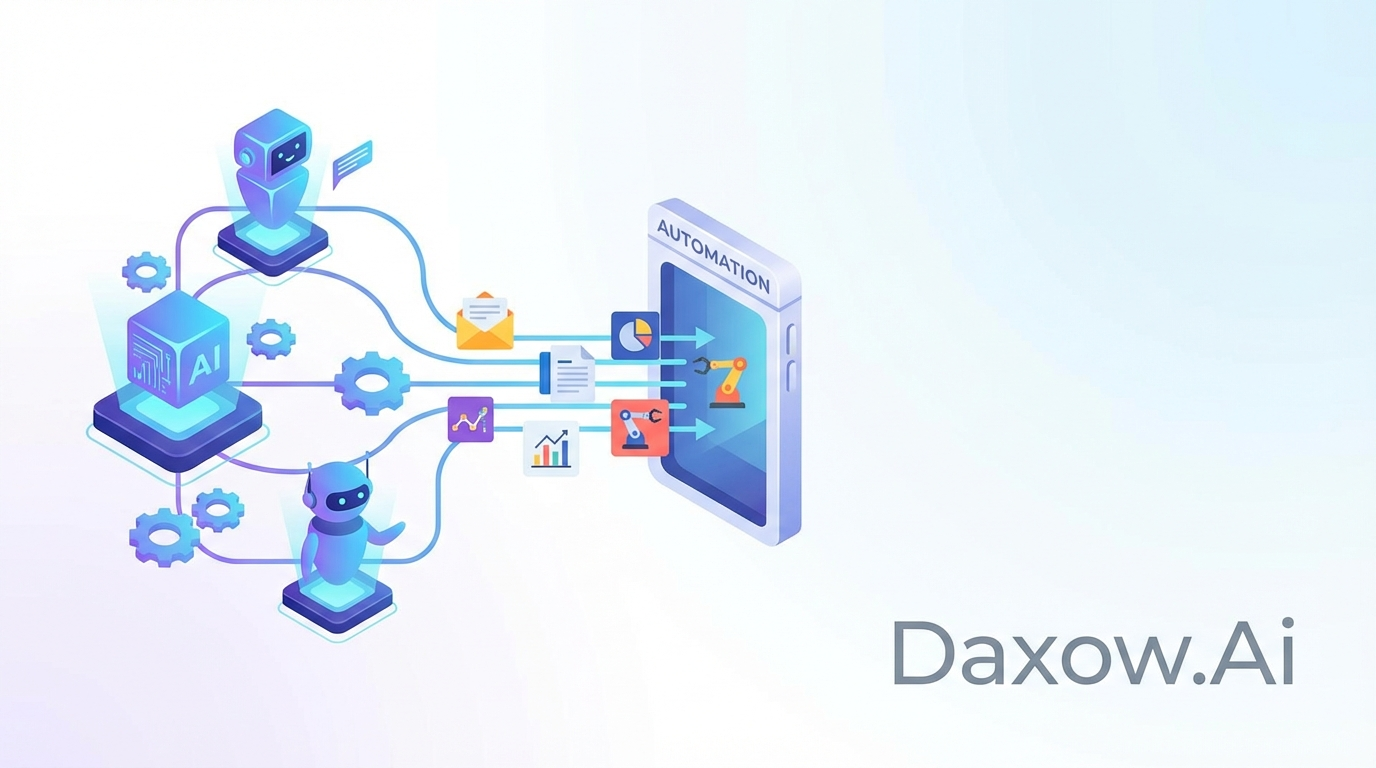
AI agents are programmed or trained to perform specific workflows end-to-end. They integrate with systems, make decisions, and act accordingly.
Key components
- Input processing: Document OCR, emails, chat messages, voice transcription.
- Intent and entity extraction: Natural language understanding to detect intent and key data points.
- Decision logic: Rules and models that determine next steps, including fallback to humans if needed.
- Action layer: Connectors to CRMs, ERPs, ticketing systems, databases, marketing platforms, and other tools.
- Learning and monitoring: Feedback loops to retrain models and optimize flows over time.
Practical flow example
- Customer request arrives via chat or email.
- AI agent extracts entities (account number, issue type) and cross-checks CRM.
- Agent applies decision logic to determine resolution steps.
- If an automated fix exists, the agent executes actions via integrations.
- If complex, the agent creates a ticket, summarizes context, and assigns to the right human.
- Agent learns from human actions to improve future automation.
Use Cases — Industry-Specific Applications of AI Agents and Workflow Automation
E-commerce and Retail
- Order validation and exception handling: AI agents verify orders, check inventory, and automatically route exceptions (address mismatches, payment failures).
- Returns processing: Automate return authorization, generate shipping labels, and issue refunds.
- Customer support automation: Handle common post-purchase inquiries and escalate complex issues with full context in the ticket.
Business value: Faster order processing, fewer returns-related costs, and improved customer satisfaction.
Finance and Banking
- KYC and onboarding: AI agents extract and validate documents, perform risk scoring, and trigger compliance workflows.
- Fraud detection workflows: Automate suspicious activity triage and enrich alerts with contextual data before human review.
- Loan origination automation: Aggregate documents, validate data, and route approvals to underwriters.
Business value: Reduced processing time, improved compliance, and lower operational risk.
Healthcare
- Patient intake and pre-authorization: Extract insurance details, schedule appointments, and verify eligibility.
- Clinical documentation automation: Convert visit notes to structured records, reducing clinician administrative burden.
- Claims processing: Validate claims, flag inconsistencies, and coordinate with payers for faster settlements.
Business value: Better clinician productivity, faster claims turnaround, and improved patient experience.
Real Estate and Property Management
- Lead qualification and scheduling: AI agents qualify prospects, schedule viewings, and follow up automatically.
- Tenant onboarding: Automate lease document verification, background checks, and move-in coordination.
- Maintenance request automation: Classify issues, assign vendors, and update tenants with status.
Business value: Faster conversions, lower vacancy rates, and reduced administrative workload.
Sales and Marketing
- Lead scoring and routing: AI agents analyze lead signals, score prospects, and route hot leads to sales reps.
- Quote generation and follow-up: Auto-generate proposals and send personalized follow-ups based on engagement.
- Campaign optimization: Extract performance signals and automate A/B testing and budget reallocations.
Business value: Higher sales productivity, improved conversion rates, and faster sales cycles.
HR and Administration
- Recruiting automation: Screen resumes, schedule interviews, and provide candidate summaries to hiring managers.
- Employee onboarding: Orchestrate equipment provisioning, account setup, and training workflows.
- Payroll and benefits inquiries: Answer routine questions and create tickets for exceptions.
Business value: Shorter time-to-hire, consistent onboarding experience, and reduced HR workload.
Implementation Roadmap — From Process Discovery to Live AI Agents
1. Process discovery and value assessment
- Map current workflows and identify repetitive, rule-based, or high-volume tasks.
- Quantify time spent, cost per task, error rates, and customer impact.
- Select initial use cases with clear ROI and measurable KPIs.
2. Design and feasibility
- Define the agent’s responsibilities and integration points.
- Establish data requirements, privacy constraints, and compliance needs.
- Prototype decision logic and user experiences for humans who will interact with agents.
3. Build and integrate
- Connect AI modules (NLP, OCR, classification) to business systems (CRM, ticketing, ERP).
- Implement secure APIs and middleware for reliable data exchange.
- Configure fallbacks and human-in-the-loop controls.
4. Test, validate, and iterate
- Run pilots with real-world data and monitor accuracy, action correctness, and business metrics.
- Iterate models and rules based on feedback and error analysis.
- Expand scope gradually, moving from assisted to fully autonomous workflows as confidence grows.
5. Monitor, govern, and scale
- Implement observability dashboards for performance, costs, and error rates.
- Maintain data governance, model retraining schedules, and incident response procedures.
- Scale across departments and regions with standardized templates and integrations.
Measuring ROI — Metrics That Matter
To justify investment and track success, focus on these metrics:
- Time saved per process: Hours reduced per task or per employee.
- Percentage of automated transactions: Share of total workflows handled by AI agents.
- Error reduction rate: Decrease in process mistakes or rework.
- Customer experience metrics: NPS, response times, resolution time.
- Cost savings: Operational expense reductions and reallocated headcount productivity.
- Revenue impact: Incremental sales attributable to lead qualification and sales automation.
Example: If an AI agent reduces manual order processing time by 50% and handles 10,000 orders monthly, calculate labor cost savings and reassign capacity to customer success — resulting in measurable ROI within months.
Risk, Compliance, and Governance
AI automation introduces new responsibilities. Consider these safeguards:
- Human-in-the-loop for high-risk decisions.
- Audit trails that record agent actions and decision rationale.
- Data privacy controls for PII and regulated data.
- Regular model validation to prevent drift and bias.
- Clear escalation paths for exceptions and disputes.
How Daxow.ai Helps Build and Scale AI Agents for Workflow Automation
Daxow.ai delivers end-to-end services to ensure your AI automation programs achieve business outcomes.
What we do
- Process analysis and use-case prioritization: We map workflows, quantify benefits, and recommend a prioritized automation roadmap.
- Custom AI agent design: We design agents tailored to your business rules and integrate advanced NLU, document processing, and decision automation.
- System integrations: We connect agents to CRMs, ERPs, support platforms, and third-party tools for seamless action execution.
- End-to-end automation: From intake to resolution, we build orchestrations that handle the full process with fallbacks and monitoring.
- Governance and monitoring: We implement observability, retraining cycles, and compliance controls to maintain reliability and trust.
- Change management and training: We help your teams adopt AI agents, redesign roles, and measure performance improvements.
Realistic deployment options
- Start with an Assisted Mode pilot: AI agents suggest actions, humans approve.
- Move to Hybrid Mode: Agents execute routine tasks, escalate exceptions.
- Deploy Autonomous Mode for safe, high-confidence workflows.
Example Daxow.ai engagements (illustrative)
- A fintech company automated KYC onboarding: reduced manual verification time by 65% and cut onboarding costs in half.
- An e-commerce retailer implemented returns processing agents: processed 80% of returns automatically and improved refund speed by 3x.
- A healthcare provider automated clinical documentation: clinicians reclaimed average 2 hours per day previously spent on notes.
Explore more about our customized solutions and integrations on our Solutions and Services pages.
Best Practices for Successful AI Agent Deployments
- Start small and measurable: Pick a high-volume, low-risk process with clear KPIs.
- Design for exceptions: Build human fallback and clear escalation rules.
- Focus on integrations: Reliable connectors to business systems are critical to automation success.
- Monitor continuously: Track both technical performance and business outcomes.
- Iterate quickly: Use feedback loops to improve models and processes.
- Align stakeholders early: Involve legal, compliance, IT, and business owners from the start.
Frequently Asked Questions
What industries benefit most from AI agents in workflow automation?
AI agents are highly versatile and deliver significant value across industries such as e-commerce, finance, healthcare, real estate, sales, marketing, HR, and administration. Each sector uses AI agents to automate industry-specific workflows and improve efficiency.
How do AI agents handle exceptions and complex cases?
AI agents apply decision logic and escalate complex or high-risk cases to humans using integrated ticketing and alerting systems, ensuring quality and compliance.
How can my company start implementing AI agents?
Begin with a process discovery and value assessment phase to identify suitable tasks. Partnering with providers like Daxow.ai can help design, build, and integrate AI agents tailored to your systems and workflows.
What metrics should I track to measure AI agent success?
Track metrics such as time saved, percentage of automated transactions, error reduction, customer experience scores, cost savings, and revenue impact to evaluate ROI.