
AI Agents in Workflow Automation: Impact, Use Cases & Implementation
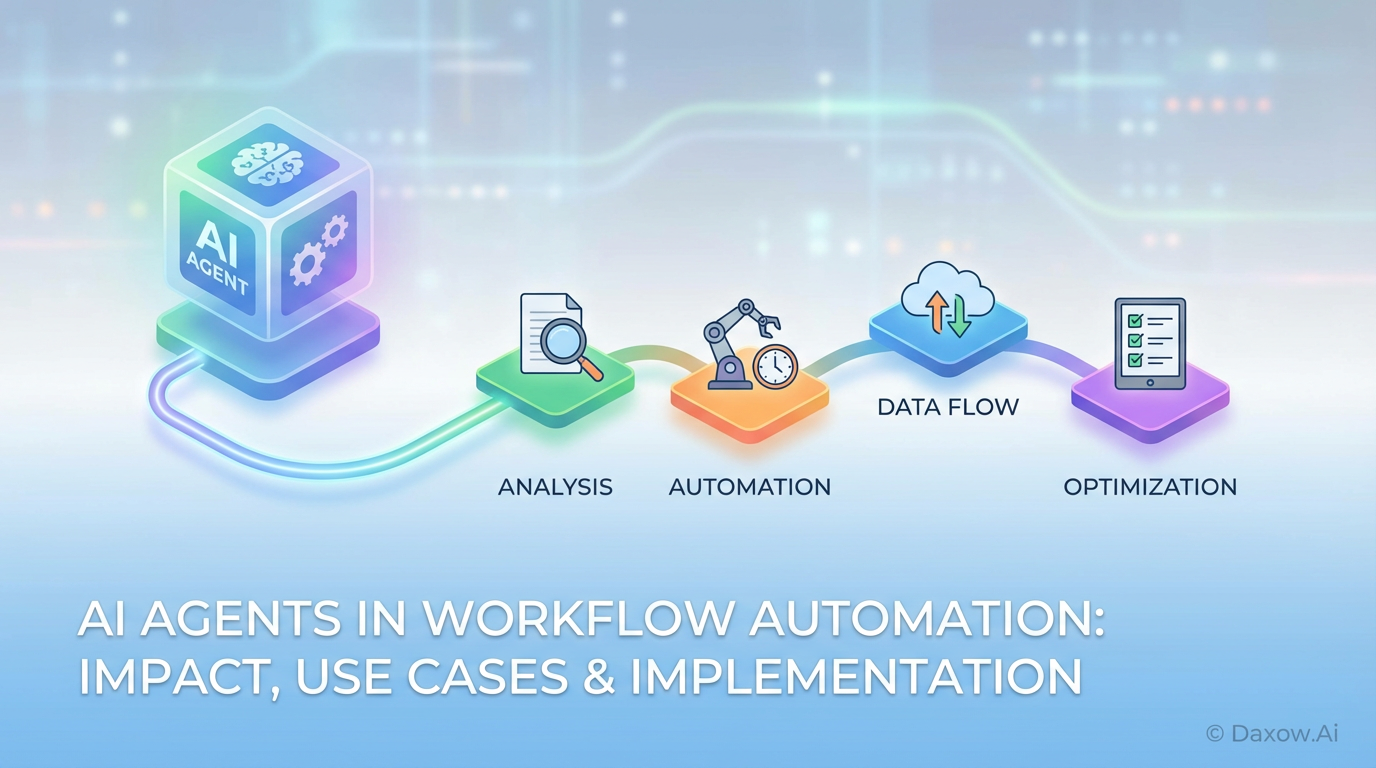
AI agents automate workflows to cut costs, boost productivity, and reduce errors. Covers use cases, ROI metrics, and a practical implementation roadmap.
AI Agents in Workflow Automation: How AI Automation Transforms Business Operations
Estimated reading time: 15 minutes
Key Takeaways
- AI agents enable hyperautomation by handling unstructured data and context-aware decisions across workflows.
- Businesses realize cost reductions up to 50%, and productivity improvements up to 10x with AI automation.
- Multiple industries benefit from AI agents, including e-commerce, healthcare, finance, real estate, and HR.
- A phased implementation approach minimizes risk and ensures measurable ROI.
- Daxow.ai offers end-to-end solutions from discovery to deployment, providing custom AI agents tailored to business needs.
Table of Contents
- Introduction
- AI Agents in Workflow Automation: Strategic Importance
- Business Value: Measurable Outcomes from AI Automation
- Practical Use Cases of AI Agents in Workflow Automation
- How to Implement AI Agents in Workflow Automation
- Measuring ROI and Scaling AI Automation
- How Daxow.ai Delivers Custom AI Automation and AI Agents
- Common Implementation Obstacles and How We Address Them
- Next Steps for Decision-Makers
- Conclusion and Call to Action
- Frequently Asked Questions
Introduction
AI Agents in Workflow Automation are reshaping how companies operate by replacing repetitive manual tasks with intelligent, autonomous systems. For business owners, operations managers, and technology leaders, understanding and adopting AI automation is no longer optional—it is a strategic imperative. This article explains how AI agents power workflow automation, presents actionable implementation steps, and offers concrete use cases across industries so decision-makers can assess business value and plan deployment. Throughout, we show how Daxow.ai designs and deploys custom AI solutions that reduce manual tasks, improve productivity, and deliver measurable ROI.
AI Agents in Workflow Automation: Strategic Importance
What is an AI agent and why it matters for business automation
- AI agents are autonomous software systems that perceive inputs, reason over data, and take actions to achieve defined objectives. Unlike traditional RPA, which automates fixed GUI interactions, AI agents handle unstructured data, adapt to new patterns, and make context-aware decisions.
- Key capabilities: natural language understanding, document extraction, predictive analytics, process orchestration, and API-driven integrations.
- Why this matters: agents enable hyperautomation—end-to-end workflow automation across multiple systems—so teams can scale operations without a proportional increase in headcount.
Business Value: Measurable Outcomes from AI Automation
- Cost reduction: AI automation routinely cuts operational costs in targeted processes by 30–50%, especially in areas like invoice processing and data entry.
- Productivity gains: Data-heavy tasks can see 5–10x productivity improvements when AI agents extract, classify, and populate systems automatically.
- Speed and accuracy: Response times and error rates improve substantially, enhancing customer experiences and compliance.
- Resilience and risk mitigation: Predictive analytics powered by agents helps detect fraud, anticipate supply chain disruptions, and reduce regulatory risk.
- Strategic advantage: Organizations with mature AI strategies report faster decision-making and higher revenue growth, positioning them ahead of competitors.
Practical Use Cases of AI Agents in Workflow Automation
E-commerce
- Use case: Autonomous customer support and order management.
- Agents handle complex customer queries across chat and email, perform return authorizations, update order statuses, and escalate exceptions to human agents.
- Agents extract sentiment and product feedback from reviews and tickets, producing prioritized improvement lists for product teams.
- Business impact: higher conversion rates, reduced support costs, and improved retention through faster, personalized responses.
Healthcare
- Use case: Document automation and patient triage.
- Agents extract data from referrals, lab results, and scanned forms to populate EHRs and schedule appointments.
- Triage agents evaluate incoming patient messages and route urgent cases to clinicians while scheduling routine requests automatically.
- Business impact: fewer administrative errors, faster throughput, and better clinician utilization—improving care delivery timelines and patient satisfaction.
Finance
- Use case: Fraud detection and invoice processing.
- Agents continuously monitor transaction streams to flag anomalous patterns and initiate investigation workflows.
- Invoice-processing agents extract line items, validate against purchase orders, route mismatches, and update ledgers automatically.
- Business impact: lower fraud exposure, faster reconciliation cycles, and reduced compliance risk.
Real Estate
- Use case: Market analysis and lead qualification.
- Agents aggregate listing data, public records, and social signals to produce property valuations and investment insights.
- Chat and email agents qualify inbound leads, schedule viewings, and pre-fill contract documents.
- Business impact: accelerated deal cycles, more accurate pricing, and reduced time-to-close.
HR and Administration
- Use case: Recruitment automation and onboarding.
- Agents screen resumes, score candidate fit against predefined criteria, and conduct initial candidate research and outreach.
- Onboarding agents generate offer letters, trigger IT provisioning, and guide new hires through compliance documentation.
- Business impact: reduced hiring time by up to 70%, better candidate matching, and lower administrative overhead.
How to Implement AI Agents in Workflow Automation
A structured, phased implementation minimizes risk and speeds time-to-value. Follow these practical steps when planning a deployment.
1. Define objectives and map processes
- Set clear, measurable goals (e.g., reduce invoice processing cost by 40% or decrease average support response time to under one hour).
- Conduct process discovery and mapping to identify repetitive, high-volume tasks suitable for automation.
- Use process mining where available to quantify cycle times and exception rates.
2. Assess data readiness
- Audit data sources for completeness, accuracy, and accessibility.
- Standardize formats, label training datasets, and create pipelines for real-time or batch ingestion.
- Ensure compliance requirements (GDPR, HIPAA, finance regulations) are built into data handling.
3. Select architecture and integration approach
- Choose scalable tools and frameworks that support secure API integrations, event-driven orchestration, and model explainability.
- Decide between off-the-shelf AI products for faster pilots or custom models for complex domain requirements.
- Prioritize platforms that integrate with existing CRMs, ERPs, ticketing systems, and document stores.
4. Build cross-functional teams
- Assemble a team with business owners, data engineers, ML engineers, integration specialists, and change managers.
- Assign process owners and define SLAs for automation performance and exception handling.
5. Prototype and pilot
- Start with a focused pilot on a single high-impact process to validate assumptions.
- Measure baseline KPIs and track metrics such as accuracy, processing time, exception rate, and cost per transaction.
6. Monitor, iterate, and govern
- Deploy monitoring to detect model drift, bias, and performance regressions.
- Implement a feedback loop so human experts can correct agent outputs and retrain models.
- Establish governance for ethics, access controls, and phased rollouts to scale safely.
Best practices to maximize adoption
- Prioritize data quality: poor inputs yield poor outputs.
- Set realistic success criteria: define short-term wins and long-term capability goals.
- Invest in change management: train users, document processes, and prevent shadow AI.
- Monitor for bias and compliance: continuously validate agents against fairness and regulatory constraints.
Measuring ROI and Scaling AI Automation
Quantifying outcomes is essential for executive buy-in and scaling automation across the enterprise.
Key metrics to track
- Cost per transaction and total cost reduction.
- Time-to-resolution or cycle time reduction.
- Accuracy rate and exception rate.
- Net promoter score (NPS) or customer satisfaction improvements.
- Time-to-hire and turnover reduction for HR processes.
Expected payback and long-term value
- Many implementations deliver payback within 6–12 months for targeted processes.
- Ongoing benefits include sustained efficiency gains (commonly 25–50%), faster decision-making, and revenue benefits from personalized customer engagement.
- Scaled ecosystems allow agents to orchestrate multi-step processes, unlocking cumulative benefits that exceed individual process improvements.
How Daxow.ai Delivers Custom AI Automation and AI Agents
Daxow.ai supports businesses from discovery through production, focusing on measurable business outcomes and robust integrations.
Our end-to-end approach
- Process analysis and discovery: We audit workflows, map value streams, and identify high-impact automation candidates.
- Custom AI design and prototyping: We build lightweight pilots to validate models, integrate quickly with your systems, and demonstrate ROI.
- Full-stack implementation: We develop AI agents that handle document extraction, decision-making, and multi-system orchestration.
- Integrations and data connectivity: We connect agents to CRMs, ERPs, ticketing systems, and third-party APIs to ensure seamless automation.
- Governance and monitoring: We implement model monitoring, retraining pipelines, and governance policies to maintain performance and compliance.
- Change management and training: We provide stakeholder training and operational playbooks so teams adopt automation confidently.
Why partner with Daxow.ai
- Domain expertise in designing AI-powered workflow automation for industries like finance, healthcare, e-commerce, real estate, and large enterprises.
- Practical, results-driven deployments that focus on reducing manual tasks, improving productivity, and delivering clear ROI.
- Security and compliance-first implementations with scalable architectures suitable for enterprise needs.
Example: A typical Daxow.ai engagement (hypothetical composite)
- Challenge: A mid-sized finance firm faced long invoice-processing cycles, high error rates, and manual reconciliation overhead.
- Daxow.ai solution: Implemented an AI agent that extracts invoice data from PDFs, validates line items against purchase orders, and posts transactions to the ERP. Exceptions are routed to a specialist queue with pre-filled context.
- Results: 40% reduction in processing cost, 60% faster cycle time, and a drop in manual reconciliation by 70%. Payback achieved within nine months. The firm redirected saved capacity to analytics and customer-facing activities.
Common Implementation Obstacles and How We Address Them
- Data silos: We build secure data pipelines and canonical data models.
- Legacy systems: We use API wrappers and event-driven connectors to integrate without massive replatforming.
- User resistance: We co-design workflows with users and provide clear escalation pathways to maintain trust.
- Model drift: We implement automated monitoring and retraining schedules to preserve accuracy.
Next Steps for Decision-Makers
If you are evaluating AI automation or want to pilot AI agents in workflow automation, the recommended starting points are:
- Conduct a rapid process audit focused on high-volume, repetitive workflows.
- Define a one-page business case with clear KPIs for a pilot.
- Choose an experienced partner to prototype, integrate, and scale—consider starting your journey with Daxow.ai’s AI Automation Services.
Conclusion and Call to Action
AI Agents in Workflow Automation are no longer theoretical—they are driving measurable cost savings, productivity gains, and improved customer experiences across industries. By following a structured implementation approach and partnering with specialists, organizations can realize rapid payback and build a scalable automation foundation.
Bold action delivers advantage. Book a free consultation with Daxow.ai to request a process analysis for your company and explore a tailored roadmap to deploy AI automation and AI agents that reduce manual tasks, improve productivity, and drive lasting business value. Contact us to build a custom AI system and start your automation journey today.
Frequently Asked Questions
What differentiates AI agents from traditional robotic process automation (RPA)?
Unlike traditional RPA that automates fixed GUI tasks, AI agents handle unstructured data, adapt to new patterns, and make context-aware decisions, enabling broader and smarter automation.
How quickly can businesses expect ROI after implementing AI agents?
Many implementations achieve payback within 6–12 months, depending on the target process and adoption scale, with ongoing efficiency and revenue benefits over time.
What industries benefit most from AI agents in workflow automation?
Industries with high-volume, pattern-rich processes such as finance, healthcare, e-commerce, real estate, and HR gain significant advantages from AI-driven workflow automation.
How does Daxow.ai ensure compliance and ethics in AI deployments?
Daxow.ai implements governance policies, model monitoring, bias detection, and compliance checks aligned with regulations like GDPR and HIPAA to maintain ethical and legal standards.