
How AI Agents Transform Workflow Automation
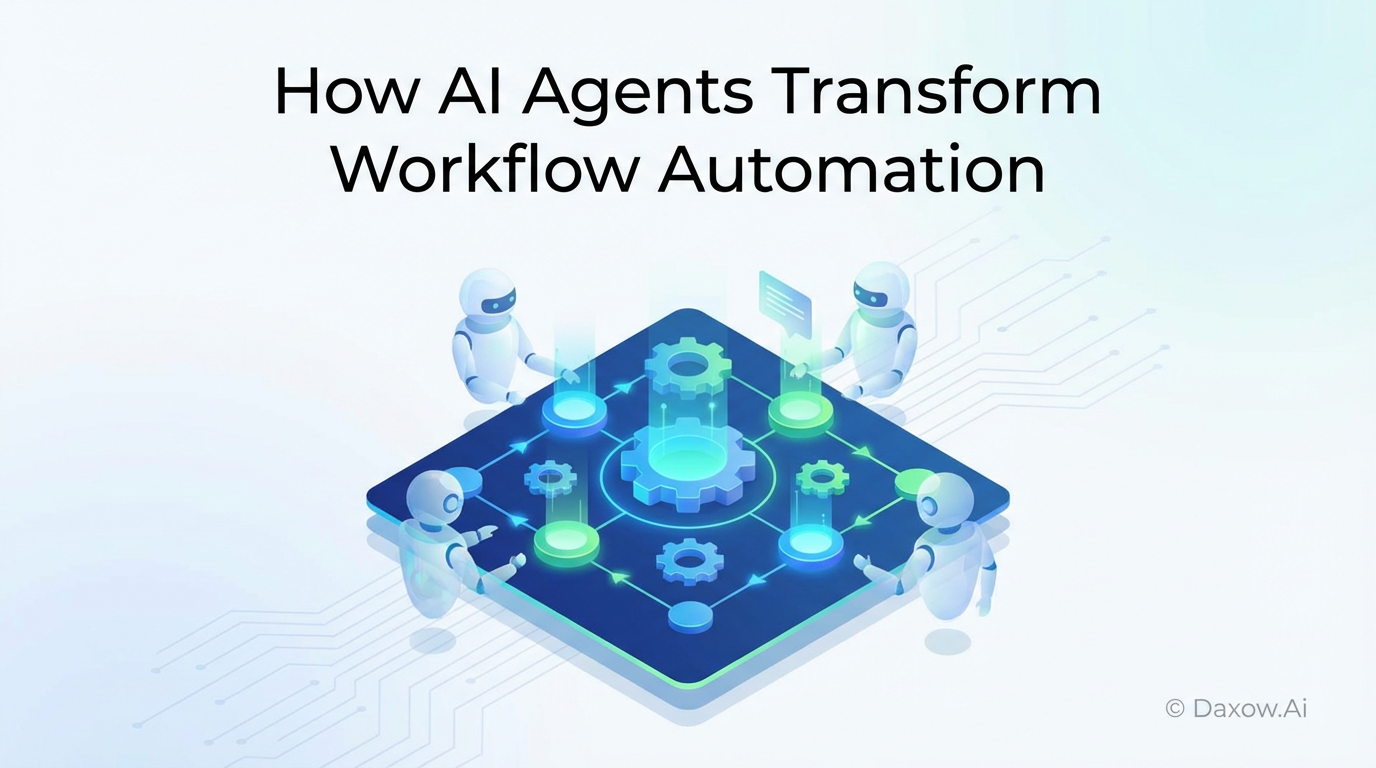
Business value, use cases and a practical roadmap for deploying AI agents to automate workflows, cut manual work, and improve customer outcomes.
How AI Agents are Transforming Workflow Automation
Estimated reading time: 15 minutes
Key Takeaways
- AI agents paired with workflow automation enable end-to-end intelligent processes that reduce manual work and improve productivity.
- Key business values include operational cost reduction, improved customer support, scalable operations, and faster sales cycles.
- Successful AI automation relies on integration with core systems, human-in-the-loop design, and continuous governance.
- Practical use cases span industries like e-commerce, finance, healthcare, real estate, and HR.
- Daxow.ai provides custom AI agents, system integration, and measurable ROI for workflow automation projects.
Table of Contents
- How AI Agents are Transforming Workflow Automation
- Business value of AI automation and AI agents
- Research-informed analysis (what working implementations show)
- Practical use cases by industry
- Implementation framework — a practical roadmap
- Common pitfalls and how to avoid them
- How Daxow.ai helps you deploy AI automation and AI agents
- Example Daxow.ai application scenarios (practical, actionable blueprints)
- Measuring success — metrics and KPIs
- Getting started — a pragmatic next step plan
How AI Agents are Transforming Workflow Automation
What we mean by AI agents and workflow automation
AI agents are software systems that sense context, reason over data, and execute tasks—often autonomously or in collaboration with humans. When combined with workflow automation, AI agents become the orchestration layer that replaces repetitive human work with event-driven, intelligent processes. This pairing enables organizations to automate end-to-end processes rather than fragmentary tasks.
Why this matters now
- Rapid improvement in natural language understanding and generative models makes AI agents viable for complex, knowledge-worker tasks.
- Integration platforms and APIs reduce the cost and time to connect legacy systems, CRMs, and cloud services.
- Competitive pressures demand faster customer response times, better lead qualification, and lower operational overhead.
Business value of AI automation and AI agents
Core value drivers
- Reduce manual tasks: Automate routine data entry, document processing, and status updates.
- Improve productivity: Free skilled employees from repetitive work so they focus on higher-value activities.
- Improve customer support automation: Faster responses and consistent resolutions lead to higher NPS and retention.
- Sales automation: Better lead qualification and faster follow-up increase conversion rates.
- Operational cost reduction: Remove human bottlenecks and reduce error-related costs.
- Scalable operations: AI agents can operate 24/7 and scale with demand without linear increases in headcount.
Measurable outcomes to target
- Average handle time reduction in customer support.
- Lead-to-opportunity conversion uplift.
- Processing time reduction for document workflows (invoices, contracts, claims).
- Percent decrease in manual data entry errors.
- Cost per transaction or customer interaction.
Research-informed analysis (what working implementations show)
- AI agents extend RPA-like automation by handling unstructured data (emails, documents) and decision-making steps.
- Workflow automation anchored around data connectivity and single source-of-truth systems yields the highest ROI.
- Successful implementations combine human-in-the-loop design with progressive autonomy for agents.
- Integration with CRMs, ERPs, ticketing, and messaging platforms is critical for end-to-end automation.
Practical use cases by industry
E-commerce and retail
- Automated returns and refunds
- AI agents parse return requests, validate order data, check policy rules, trigger refunds, and notify customers.
- Business benefits: Faster resolution, reduced chargebacks, improved customer satisfaction.
- Personalized post-purchase engagement
- Agents analyze purchase history and trigger personalized cross-sell campaigns through email and chatbots.
- Business benefits: Increased lifetime value and repeat purchases.
Finance and insurance
- Automated claims triage
- AI agents extract data from uploaded documents, validate policy coverage, estimate liability, and route complex claims to adjusters.
- Business benefits: Faster settlements, reduced fraud risk, lower operational costs.
- KYC and onboarding
- Agents automate identity verification, document extraction, and compliance checks integrated with CRM.
- Business benefits: Shorter onboarding time and improved regulatory compliance.
Healthcare
- Intake and prior authorization
- AI agents pre-fill forms, extract clinical details from referrals, and submit prior authorization requests to payers.
- Business benefits: Improved revenue cycle, reduced denials, and less administrative burden on clinicians.
- Patient engagement and follow-up
- Agents monitor appointments, send reminders, and triage follow-up questions to clinicians.
- Business benefits: Reduced no-shows and better chronic care management.
Real estate and property management
- Tenant onboarding and maintenance requests
- Agents process rental applications, validate documents, schedule viewings, and route maintenance tickets.
- Business benefits: Faster leasing cycles and improved tenant satisfaction.
- Lease abstraction
- Agents extract key lease terms and populate property management systems.
- Business benefits: Reduced legal and administrative overhead.
HR and administrative teams
- Candidate screening and interview scheduling
- Agents parse résumés, score candidates against role requirements, and coordinate interview logistics.
- Business benefits: Faster hiring cycles and better recruiter productivity.
- Employee service desk automation
- Agents resolve common HR queries and perform routine tasks (time-off requests, policy lookups).
- Business benefits: Better employee experience and fewer HR tickets.
Implementation framework — a practical roadmap
1. Process discovery and prioritization
- Map current workflows and identify high-volume, repetitive tasks.
- Score opportunities on impact, effort, and data readiness.
- Start with high-value, low-risk processes for rapid wins.
2. Design and architecture
- Define the agent’s scope: inputs, decisions, outputs, and fallback paths.
- Select integration points: CRM, ERP, ticketing, cloud storage, and messaging platforms.
- Design human-in-the-loop checkpoints for governance and escalation.
3. Data preparation and connectivity
- Normalize and centralize data sources to create a reliable single source of truth.
- Implement secure connectors and data mapping to ensure integrity.
- Ensure data privacy and compliance pathways for regulated industries.
4. Build and test
- Implement AI agents with modular components: extraction, classification, decision rules, and action execution.
- Use iterative testing with real workflows and simulated edge cases.
- Capture metrics from day one to measure baseline and improvements.
5. Deployment and orchestration
- Deploy agents progressively—start in pilot teams, then scale.
- Use workflow automation platforms to orchestrate multi-step processes.
- Monitor agent performance and tune models and rules continually.
6. Governance and continuous improvement
- Implement logging, audit trails, and performance dashboards.
- Regularly review error cases and update models and business rules.
- Establish an escalation loop and training program for end users.
Common pitfalls and how to avoid them
Pitfalls
- Automating broken processes: Automation amplifies inefficiencies if the underlying process isn’t optimized.
- Siloed integrations: Partial connectivity creates manual handoffs and reduces value.
- Lack of monitoring: Without metrics, it’s impossible to prove ROI or detect regressions.
- Over-automation without governance: Agents making irreversible decisions can cause compliance issues.
Remedies
- Re-engineer processes before automation.
- Prioritize system integrations and data normalization early.
- Implement KPIs and dashboards from Day 1.
- Start with supervised autonomy and increase agent independence as confidence grows.
How Daxow.ai helps you deploy AI automation and AI agents
End-to-end process automation expertise
Daxow.ai specializes in understanding existing workflows through a structured process analysis. We design AI agents and workflow automation solutions that eliminate manual tasks, reduce cycle times, and improve customer support automation. Our approach includes discovery, design, implementation, and continuous optimization.
Custom AI agents that execute real tasks
We build AI agents tailored to your business context—capable of document extraction, lead qualification, multi-step orchestration, and decision-making tied into your systems. Our agents don’t just assist; they execute tasks such as updating CRMs, creating tickets, and issuing refunds within governed workflows.
System integrations and data connectivity
Daxow.ai connects AI agents to your core systems—CRMs, ERPs, payment gateways, and messaging platforms—ensuring reliable data flows and a single source of truth. This integration is central to realizing the full potential of workflow automation.
Measurable ROI and operational cost reduction
We focus on delivering measurable business outcomes: reduced manual tasks, faster response times, higher conversion rates, and lower costs per transaction. Our pilots produce KPIs that track productivity improvements and enable business leaders to quantify ROI.
Security, compliance, and governance
For regulated sectors like finance and healthcare, Daxow.ai embeds compliance, secure data handling, and audit capabilities into the automation stack. We ensure agents operate within defined governance frameworks to minimize risk.
Example Daxow.ai application scenarios (practical, actionable blueprints)
Sales automation blueprint
- Problem: Leads stagnate in CRM; manual qualification delays follow-up.
- Solution: AI agent reads inbound lead forms and emails, scores leads using historical CRM data, schedules discovery calls, and creates follow-up sequences.
- Expected outcome: Higher lead-to-opportunity conversion and shorter sales cycles.
Customer support automation blueprint
- Problem: High ticket volume with repetitive queries drains support agents.
- Solution: AI agent classifies tickets, extracts relevant data from attachments, provides instant responses for common issues, and escalates complex tickets with a full context summary.
- Expected outcome: Reduced average handle time and improved first-contact resolution.
Finance automation blueprint
- Problem: Manual invoice processing causes delays in payment and reconciliation.
- Solution: AI agent extracts invoice data, validates against purchase orders, initiates approvals, and posts to the ERP.
- Expected outcome: Faster processing times, fewer errors, and improved cash flow visibility.
Measuring success — metrics and KPIs
Operational metrics
- Reduction in manual task hours.
- Percent of processes fully automated end-to-end.
- Error rate before and after automation.
Customer metrics
- Average response time.
- First-contact resolution rate.
- Customer satisfaction (CSAT) and Net Promoter Score (NPS).
Financial metrics
- Cost per transaction or ticket.
- Revenue uplift from faster sales cycles.
- Payback period for automation investment.
Getting started — a pragmatic next step plan
- Conduct a rapid process assessment to identify three pilot workflows.
- Define success metrics and baseline current performance.
- Build a minimum viable AI agent for one high-impact workflow.
- Run a 30–90 day pilot, measure results, and scale based on outcomes.
How AI Agents are Transforming Workflow Automation is an opportunity to move beyond incremental improvement to fundamental operational transformation. By combining AI agents with workflow automation and robust integrations, businesses can reduce manual tasks, improve productivity, and deliver stronger customer experiences.
If you want to evaluate where AI automation will deliver the most value in your organization, Daxow.ai can help. Book a free consultation, request a process analysis for your company, or contact us to build a custom AI system that reduces operational costs and scales your most critical workflows.
Frequently Asked Questions
What are AI agents in workflow automation?
AI agents are intelligent software systems that can autonomously sense context, analyze data, and execute tasks within workflows, often replacing repetitive manual work.
How can AI automation improve customer support?
AI automation enables faster responses, consistent issue resolution, and intelligent ticket routing, leading to reduced handle times and higher customer satisfaction scores.
What industries benefit most from AI-driven workflow automation?
Industries such as e-commerce, finance, healthcare, real estate, and HR benefit greatly, with use cases including claims processing, tenant onboarding, candidate screening, and more.
How does Daxow.ai support integration with existing systems?
Daxow.ai specializes in connecting AI agents to CRMs, ERPs, ticketing, and messaging platforms, ensuring smooth data flow and a single source of truth for automation success.