
AI Agents in Workflow Automation: Boost ROI & Scale Operations
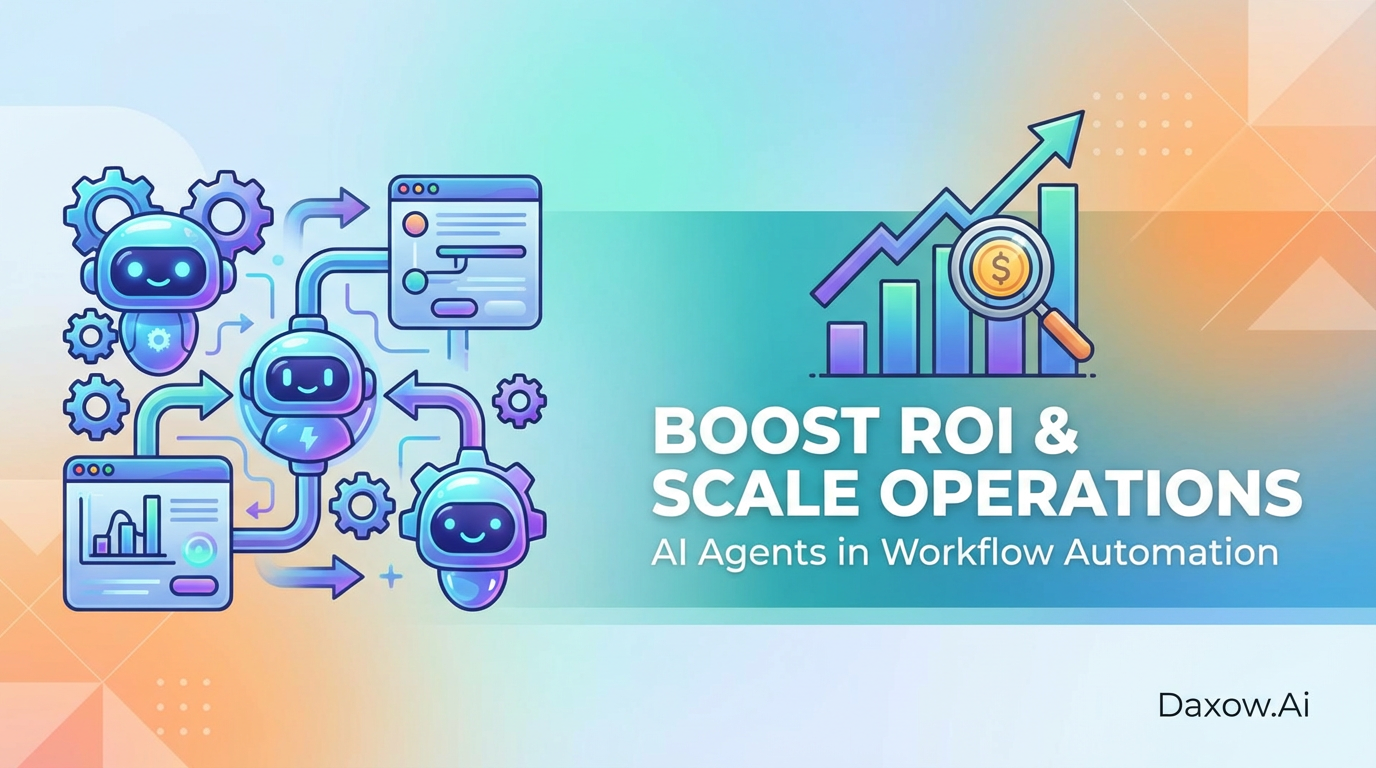
Learn how AI agents automate workflows to cut costs, boost productivity, and deliver measurable ROI. Use cases, implementation steps, and Daxow.ai solutions.
AI Agents in Workflow Automation: How Intelligent Automation Transforms Business Operations
Estimated reading time: 14 minutes
Key Takeaways
- AI agents enable scale, reduce errors, and improve customer experience by automating complex workflows.
- Industry-specific use cases illustrate measurable business impact across e-commerce, healthcare, finance, real estate, HR, and customer support.
- Successful AI automation requires a phased implementation approach, emphasizing objectives, data quality, prototyping, and governance.
- Avoid pitfalls such as over-automation, poor data quality, shadow AI, and lack of buy-in to ensure sustainable adoption.
- Daxow.ai offers end-to-end solutions combining custom AI agents, workflow automation, and managed services to maximize ROI.
Table of Contents
- AI Agents in Workflow Automation: What decision-makers need to know
- Practical Use Cases: AI Agents in Workflow Automation Across Industries
- How to implement AI automation successfully
- Avoiding common pitfalls and ensuring sustainable adoption
- Measuring ROI and business impact of AI automation
- Why partner with Daxow.ai to implement AI Agents in workflow automation
- Frequently Asked Questions
AI Agents in Workflow Automation: What decision-makers need to know
AI agents are autonomous software entities that perform multi-step tasks by reasoning across data sources, tools, and APIs. When combined with workflow automation, they move beyond simple rule-based automation to handle complex, data-rich processes that previously required human intervention.
Why AI agents matter for business automation
- Scale without proportional headcount: Agents execute end-to-end tasks, reducing the need to add staff as volumes grow.
- Reduce manual tasks and errors: Automation of repetitive work lowers error rates and frees teams for higher-value activities.
- Faster, data-driven decisions: Agents synthesize information and surface insights in real time for operational and strategic use.
- Improve customer experience: Customer support automation and chatbots resolve common queries instantly and route complex issues to humans.
Core capabilities of modern AI agents
- Natural language understanding for conversational interfaces and document interpretation.
- Integration across CRMs, ERPs, ticketing systems, and cloud data stores.
- Orchestration of multi-step workflows (e.g., qualify lead → update CRM → schedule demo).
- Predictive analytics for forecasting, anomaly detection, and risk scoring.
- Continuous learning via monitored retraining and feedback loops.
Where AI agents deliver highest ROI
- High-volume, low-variance workflows (billing, order processing, support triage).
- Data-intensive tasks that require aggregation and synthesis (fraud detection, inventory forecasting).
- Processes with clear decision rules that can be codified and augmented with ML predictions.
Practical Use Cases: AI Agents in Workflow Automation Across Industries
E-commerce — End-to-end order and inventory automation
Use case
- AI agents manage order-to-cash cycles: validate orders, update inventory, trigger fulfillment, and reconcile payments.
- Agents analyze customer behavior to create personalized recommendations and retention triggers.
Business impact
- Reduces stockouts and expedites fulfillment, improving conversion rates and customer satisfaction.
- Saves labor by automating routine order exceptions and reconciliation.
How Daxow.ai helps
- Process discovery to map order flows and exceptions.
- Integration with e-commerce platforms, warehouses, and payment processors.
- Build AI agents that predict inventory needs and trigger procurement or promotions.
Healthcare — Administrative automation and clinical support
Use case
- Automate patient scheduling, insurance verification, and medical record extraction.
- Flag anomalies in diagnostic data for clinician review and prioritize urgent cases.
Business impact
- Cuts administrative time by up to 30%, improving throughput and reducing patient wait times.
- Improves compliance and audit readiness through standardized workflows.
How Daxow.ai helps
- Secure data pipelines that comply with healthcare privacy requirements.
- Deploy document automation for claims, intake forms, and records extraction.
- Build agents that route cases to clinicians and provide summarized patient histories.
Finance — Fraud detection, compliance, and reporting
Use case
- AI agents monitor transactions for fraud indicators, automate regulatory reporting, and reconcile accounts.
- Forecast cash flows using predictive models across internal and market data.
Business impact
- Reduces risk exposure and accelerates audits.
- Shortens month-end closing and frees finance teams for analysis.
How Daxow.ai helps
- Integrate with banking feeds, payment gateways, and accounting systems.
- Develop models for anomaly detection and automated reporting pipelines.
- Establish governance and audit trails for regulatory oversight.
Real Estate — Lead qualification and pricing optimization
Use case
- Chatbots qualify inbound leads, schedule viewings, and update CRM records.
- AI agents analyze market data to recommend pricing strategies.
Business impact
- Accelerates sales cycles and improves lead-to-deal conversion.
- Enables dynamic pricing to capture more value per transaction.
How Daxow.ai helps
- Connect listing platforms, MLS data, and CRMs.
- Create conversational agents for initial contact and follow-up automation.
- Deploy forecasting models that integrate public and proprietary data.
HR — Recruitment automation and retention analytics
Use case
- Screen resumes, conduct initial interviews via conversational agents, and rank candidates based on skill fit and culture signals.
- Predict employee churn using engagement and performance metrics.
Business impact
- Reduces time-to-hire and improves candidate experience.
- Prioritizes retention interventions to decrease turnover cost.
How Daxow.ai helps
- Integrate ATS systems and interview platforms.
- Build AI-driven screening workflows and dashboards for HR managers.
- Implement feedback loops to refine candidate scoring.
Customer Support & Sales Automation — Scale service and qualify opportunities
Use case
- AI agents handle 80% of routine support queries, escalate complex issues, and auto-generate ticket summaries.
- Sales automation that qualifies leads, schedules demos, and preps reps with contextual summaries.
Business impact
- Reduces response times and support costs while increasing salesperson productivity.
- Improves lead qualification quality and shortens sales cycles.
How Daxow.ai helps
- Deploy customer support automation across chat, email, and voice channels.
- Integrate agents with CRMs to keep records up to date and orchestrate multi-channel follow-ups.
- Customize lead-scoring models and implement handoff rules to sales reps.
How to implement AI automation successfully
Phase 1 — Define objectives and audit processes
- Set clear goals: cost reduction, productivity improvement, NPS increase, or faster time-to-resolution.
- Conduct a process audit and process mining to identify repetitive, high-volume tasks.
- Evaluate data quality: completeness, accuracy, lineage, and compliance considerations.
Daxow.ai role
- Facilitate workshops to align stakeholders and quantify target metrics.
- Perform process mapping and identify quick-win automation candidates.
Phase 2 — Assess data and select architecture
- Prioritize data accessibility and security.
- Select platforms that support integrations (APIs, webhooks) and scale.
- Choose tooling that enables non-technical users to interact with automation workflows.
Daxow.ai role
- Recommend architectures and vendors that match your compliance, scalability, and cost requirements.
- Build secure connectors to CRMs, ERPs, and document repositories.
Phase 3 — Build cross-functional teams and prototypes
- Form cross-functional squads (product owner, engineers, data scientists, compliance).
- Build small prototypes for non-critical workflows to validate assumptions.
- Create monitoring dashboards and KPIs for early visibility.
Daxow.ai role
- Deliver MVPs that include AI agents, automations, and integration with live data.
- Run pilot programs and collect performance and user feedback.
Phase 4 — Test, deploy, and scale
- Use phased rollouts, prioritize high-impact workflows, and maintain human oversight.
- Implement retraining schedules and automated alerts when model drift occurs.
- Establish governance for access, auditability, and ethical constraints.
Daxow.ai role
- Manage deployments, train internal teams, and set up governance frameworks.
- Provide ongoing support to iterate models and expand automations across departments.
Phase 5 — Measure, iterate, and institutionalize
- Track productivity, error rates, cycle times, and ROI.
- Use feedback loops to refine models and rule-sets.
- Institutionalize continuous improvement through periodic process reviews.
Daxow.ai role
- Deliver dashboards and reporting to showcase impact.
- Offer managed services to optimize and extend automation capabilities.
Avoiding common pitfalls and ensuring sustainable adoption
While the upside of AI automation is compelling, avoid these pitfalls to protect ROI and ensure user trust.
- Over-automation: Do not automate creative or highly variable decision-making; focus on volume-driven tasks.
- Poor data quality: Garbage in, garbage out—prioritize data cleansing and validation.
- Shadow AI: Coordinate governance and training to prevent uncontrolled tool usage.
- Lack of stakeholder buy-in: Involve end users early and incorporate their feedback to ensure adoption.
- Security and compliance gaps: Build privacy and audit controls from day one.
Daxow.ai mitigates these risks by combining process audits, governance frameworks, and cross-functional change management.
Measuring ROI and business impact of AI automation
Quantifying benefits is critical to secure investment and scale programs.
Key metrics to monitor
- Productivity improvements (20–50% typical in automated processes).
- Cost reduction in target processes (up to 40% in well-scoped areas).
- Error rate reductions and compliance incident frequency.
- Time-to-resolution and customer satisfaction (NPS) improvements.
- Financial returns: many organizations report 3–5x returns within 12–18 months on high-impact workflows.
Practical ROI scenario
Automating invoice processing in a mid-size company: reduced manual processing hours by 70%, lowered error rates, and shortened payment cycles—resulting in annual savings that outweighed implementation costs within the first year.
How Daxow.ai helps prove value
- Baseline measurement: we quantify current process costs and KPIs.
- Outcome tracking: we deliver dashboards showing time saved, cost reductions, and error improvements.
- Continuous optimization: results are iteratively improved, increasing ROI over time.
Why partner with Daxow.ai to implement AI Agents in workflow automation
Daxow.ai combines a business-first approach with technical expertise to deliver end-to-end automation that produces measurable outcomes.
What we deliver
- Process discovery and analytics to identify highest-value automation opportunities.
- Custom AI agents that reason across tools, data sources, and APIs to execute real tasks.
- Workflow automation that integrates with CRMs, ERPs, ticketing systems, and document stores.
- Customer support automation and sales automation to scale service and revenue operations.
- Document automation and data extraction for faster, more accurate processing.
- System integrations and secure data connectivity that preserve compliance and auditability.
- Managed services for continuous monitoring, model retraining, and governance.
Business benefits you can expect
- Faster process cycles and fewer manual tasks.
- Lower operational costs and predictable ROI.
- Better customer experiences through faster, consistent responses.
- Scalable operations without linear increases in headcount.
Explore more about our approach and solutions on our Solutions and Services pages.
Frequently Asked Questions
What are AI agents in workflow automation?
AI agents are autonomous software systems that perform complex, multi-step tasks by integrating and reasoning across multiple data sources, tools, and APIs to automate workflows.
How do AI agents improve business operations?
They reduce manual work, minimize errors, increase productivity, enable faster data-driven decision-making, and improve the customer experience by automating high-volume and data-intensive workflows.
What industries benefit most from AI agent automation?
Industries such as e-commerce, healthcare, finance, real estate, HR, and customer support see significant gains from deploying AI agents within their workflow automation initiatives.
How does Daxow.ai support AI automation implementation?
Daxow.ai offers end-to-end services including process discovery, custom AI agent development, integration with existing systems, managed services, and continuous monitoring to ensure successful deployment and ROI realization.
What are common challenges when adopting AI automation?
Common challenges include over-automation of unsuitable tasks, poor data quality, shadow AI usage, lack of stakeholder buy-in, and security or compliance gaps—all of which must be managed carefully for sustained success.