
AI Agents for Workflow Automation: Implementation & ROI
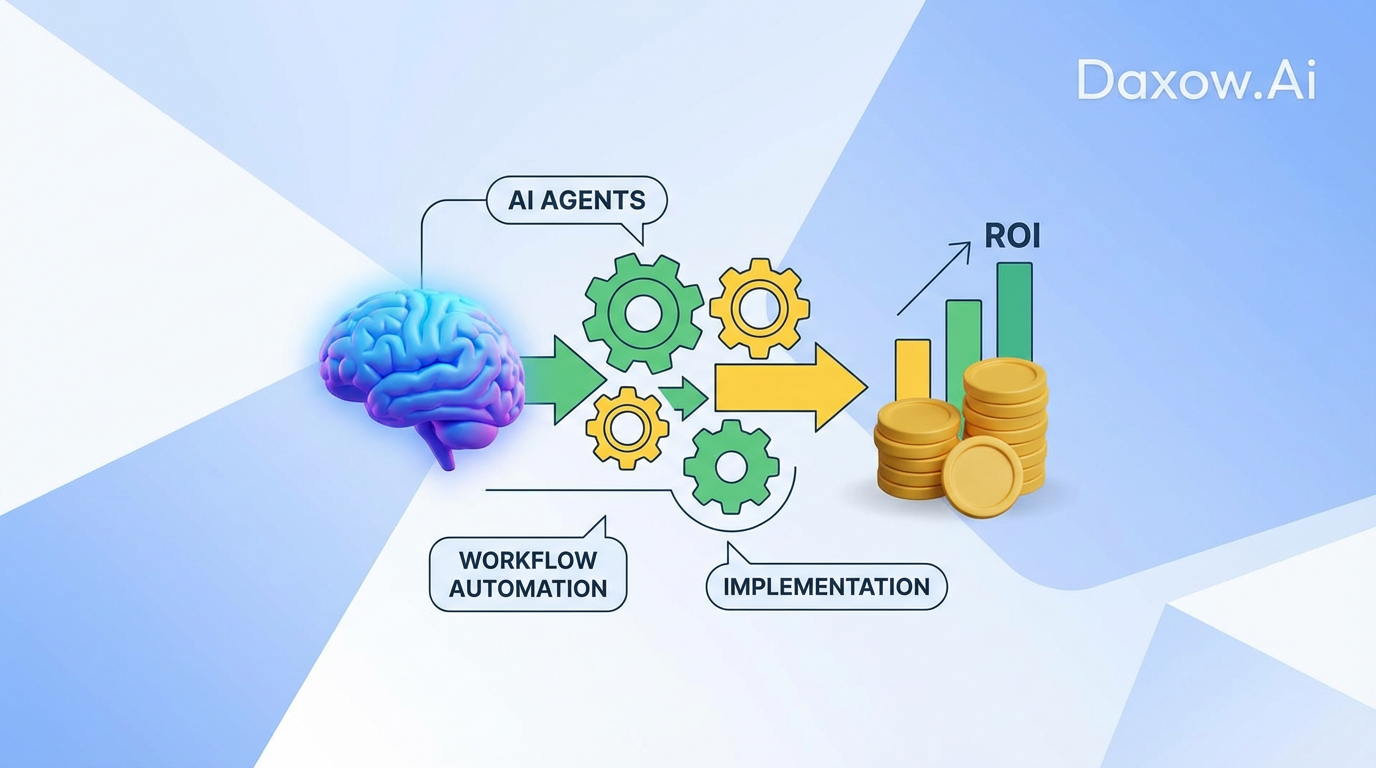
How AI agents automate workflows to cut costs, boost productivity, and deliver fast ROI. Use cases, implementation steps, and Daxow.ai’s approach.
AI Agents for Workflow Automation: How AI Automation Transforms Business Operations
Estimated reading time: 15 minutes
Key Takeaways
- AI agents autonomously execute complex workflows using machine learning and NLP, enabling 24/7 operations and predictive insights.
- Workflow automation with AI reduces manual tasks by up to 50%, cuts operational costs by 40-60%, and improves accuracy over 90%.
- Cross-industry applications span e-commerce, healthcare, finance, real estate, and HR, driving measurable business value.
- Daxow.ai delivers tailored AI automation solutions from process discovery to governance and continuous improvement.
- Successful implementation requires iterative steps: objectives definition, data readiness, prototyping, scaling, and change management.
Table of Contents
- AI Agents for Workflow Automation — What They Are and Why They Matter
- Strategic Implications for Businesses
- Practical Use Cases Across Industries
- How Daxow.ai Designs AI Automation Solutions
- Implementation Steps and Best Practices
- Measuring ROI and Tangible Business Value
- Risks, Governance, and Change Management
- How Daxow.ai Executes Real-World Automation Projects
- Practical Next Steps for Decision-Makers
- Frequently Asked Questions
AI Agents for Workflow Automation — What They Are and Why They Matter
AI agents are autonomous systems that combine machine learning, natural language processing (NLP), and workflow orchestration to execute multi-step business processes. Unlike traditional RPA, which follows rigid scripts, AI agents reason, adapt, and make context-driven decisions. When applied to workflow automation, they eliminate repetitive tasks, enable 24/7 operations, and surface predictive insights that turn reactive processes into proactive capabilities.
Key business outcomes:
- Reduce manual tasks across data entry, document processing, and routine decision-making.
- Improve productivity with observed gains of 20–50% in automated processes.
- Lower operational costs—targeted processes can see cost reductions of 40–60%.
- Enhance accuracy—rule-based error rates can drop by over 90%.
- Scale without proportional headcount increases, enabling growth while controlling workforce costs.
Strategic Implications for Businesses
AI automation shifts organizations from fragmented, manual workflows to coordinated, data-driven operations. The strategic benefits include faster response times, personalized customer interactions, risk mitigation, and the ability to forecast disruptions.
From Reactive to Proactive Operations
Deploying AI agents converts batch, human-driven tasks into continuous streams of insight. For example, an AI agent monitoring supply chain signals can recommend reroutes before stockouts occur, reducing downtime and lost sales.
Competitive and Financial Impact
Enterprises that implement AI automation see direct revenue and retention benefits. Faster resolution times and personalized experiences drive higher customer satisfaction and lower churn. On the cost side, automation reduces labor hours in high-volume tasks, reallocating talent to strategic initiatives.
Practical Use Cases Across Industries
E-commerce — Order-to-Cash and Personalization
Use case:
- AI agent monitors incoming orders, validates payment, detects fraud patterns, updates inventory, and triggers fulfillment workflows.
- Dynamically adjust pricing and promotions based on inventory forecasts and customer behavior.
Business impact:
- Reduced cart abandonment, faster fulfillment, and fewer fraudulent transactions.
- Example metric: personalized automation can lift conversion rates and cut manual exception handling by up to 50%.
Healthcare — Scheduling, Triage, and Documentation
Use case:
- An AI agent triages patient queries, schedules appointments, summarizes medical notes, and flags anomalies in diagnostic data for clinician review.
Business impact:
- Reduced administrative burden, faster patient response times, and improved compliance.
- Example outcome: improved throughput in outpatient clinics and more time for clinicians to focus on care.
Finance — Fraud Detection, Invoicing, Compliance
Use case:
- AI agents monitor transactions in real time, flag anomalous patterns, auto-process invoices, and generate compliance reports for audit teams.
Business impact:
- Faster reconciliation, reduced fraud exposure, and shorter audit cycles.
- Example metric: fraud losses decline as suspicious patterns are detected earlier and false positives are reduced through adaptive learning.
Real Estate — Lead Qualification and Market Insights
Use case:
- Conversational AI agents qualify leads, schedule viewings, analyze listing data for pricing signals, and generate tailored property summaries.
Business impact:
- Accelerated deal cycles, higher lead-to-conversion ratios, and better market positioning.
HR — Talent Acquisition and Employee Lifecycle
Use case:
- AI agents screen resumes using job-fit models, conduct initial conversational interviews, automate onboarding paperwork, and surface churn risk signals.
Business impact:
- Faster hiring, improved candidate experience, and reduced manual HR administration.
How Daxow.ai Designs AI Automation Solutions
Daxow.ai builds custom AI systems tailored to your workflows. Our approach is practical, measurable, and aligned to business objectives.
End-to-End Process Discovery
We start with a process audit to identify high-volume, repetitive tasks with strong ROI potential. Using task mining and stakeholder interviews, we map existing workflows and prioritize automation candidates using an AI-first scorecard.
Data Readiness and Integration
We assess data quality, design cleansing pipelines, and integrate data sources into a governed platform. Daxow emphasizes secure architecture and privacy compliance so models operate reliably across CRM, ERP, support tools, and document stores.
Custom AI Agent Development
Our teams design and train agents that:
- Connect to your business systems via secure integrations.
- Orchestrate multi-step workflows (e.g., customer support triage → case creation → resolution).
- Learn from interactions and incorporate feedback to reduce errors over time.
Rapid Prototyping and Iteration
We deploy non-critical pilots to validate assumptions, measure KPIs, and iterate quickly. This phased rollout limits risk and demonstrates value within quarters.
Governance, Security, and Change Management
Daxow implements governance frameworks, retraining schedules, and user training to prevent sprawl and shadow AI. We ensure auditability and model explainability where required.
Implementation Steps and Best Practices
Successful AI automation follows a disciplined, iterative process. Below are the practical steps Daxow follows with clients.
-
Define Objectives and Audit Processes
- Align automation with specific goals such as cost reduction, NPS improvement, or SLA compliance.
- Use a process audit to find quick wins: repetitive, high-volume tasks or frequent customer inquiries.
- Best practice: prioritize projects by expected ROI and operational risk.
-
Assess and Prepare Data
- Evaluate datasets for completeness, accuracy, and accessibility.
- Cleanse data and establish pipelines that protect privacy and ensure consistency.
- Best practice: involve IT early to manage integrations and data governance.
-
Select Tools and Build Teams
- Choose scalable platforms with strong integration capabilities.
- Form cross-functional teams: business owners, engineers, data scientists, and trainers.
- Best practice: use no-code/low-code tooling for rapid prototyping and to empower non-technical stakeholders.
-
Prototype, Deploy, and Monitor
- Start with low-risk pilots and define KPIs (throughput, accuracy, cost per process).
- Iterate models and workflows using user feedback and ongoing monitoring.
- Best practice: set up continuous retraining and alerts to detect drift.
-
Scale and Optimize
- Expand successful pilots across business units.
- Track long-term metrics: productivity, error rates, customer satisfaction, and cost per transaction.
- Best practice: maintain governance and a roadmap for continuous improvement.
Measuring ROI and Tangible Business Value
AI automation delivers quantifiable outcomes that justify investment. Typical returns include:
- Productivity gains: 20–50% faster processing for automated tasks.
- Cost reductions: 40–60% in targeted processes due to reduced manual labor and fewer exceptions.
- Accuracy improvements: Rule-based tasks see error reductions exceeding 90%.
- Faster time-to-value: Pilots can demonstrate measurable improvements within quarters.
Practical ROI example:
- A mid-sized finance team processes 10,000 invoices per month with two FTEs handling exceptions and approvals.
- After deploying an AI agent for invoice triage and auto-posting:
- Manual exceptions fall by 70%.
- Team capacity doubles, reducing FTE need by one full-time equivalent.
- Cost savings on labor and error recovery can offset the project investment within 6–9 months.
Risks, Governance, and Change Management
Common Risks
- Data quality issues leading to model errors.
- Process over-automation without human oversight.
- Shadow AI sprawl across departments.
Mitigations
- Implement data validation and retraining schedules.
- Define human-in-the-loop checkpoints for critical decisions.
- Centralize governance with role-based access and audit trails.
How Daxow.ai Executes Real-World Automation Projects
Daxow focuses on delivering business outcomes, not just technology. Our engagement model typically includes:
- Discovery and process audit.
- Rapid prototyping and pilot deployment.
- Integration with CRMs, ERPs, support platforms, and document systems.
- Production rollouts and continuous optimization.
- Training and governance for sustainable adoption.
We build AI agents that execute real tasks—qualifying leads, resolving customer tickets, extracting data from documents, or orchestrating cross-system workflows—so teams can focus on strategic priorities. Visit Daxow.ai Solutions for more details.
Practical Next Steps for Decision-Makers
If you are responsible for operations, customer support, sales, HR, or finance, consider the following immediate actions:
- Identify 2–3 high-volume processes where automation could free skilled staff.
- Run a quick process audit to estimate potential ROI and time-to-value.
- Pilot an AI agent for a contained workflow with clear success metrics.
- Establish governance and integration requirements before scaling.
Learn how Daxow.ai Services can guide your automation journey effectively.
Frequently Asked Questions
What differentiates AI agents from traditional robotic process automation (RPA)?
AI agents use machine learning and NLP to make adaptive, context-aware decisions across complex workflows, whereas traditional RPA follows fixed scripts without reasoning capabilities.
How quickly can a business expect to see ROI from AI workflow automation?
Pilots can demonstrate measurable improvements within a few quarters, and many clients realize cost savings that offset investments within 6 to 9 months.
Is it necessary to replace existing systems to implement AI agents?
No. Daxow.ai specializes in building custom AI that integrates securely with your existing CRM, ERP, support tools, and document management systems, preserving your technology investments.
How does Daxow.ai ensure governance and prevent shadow AI risks?
We implement role-based access control, audit trails, human-in-the-loop checkpoints, regular retraining, and comprehensive user training as part of our governance frameworks.