
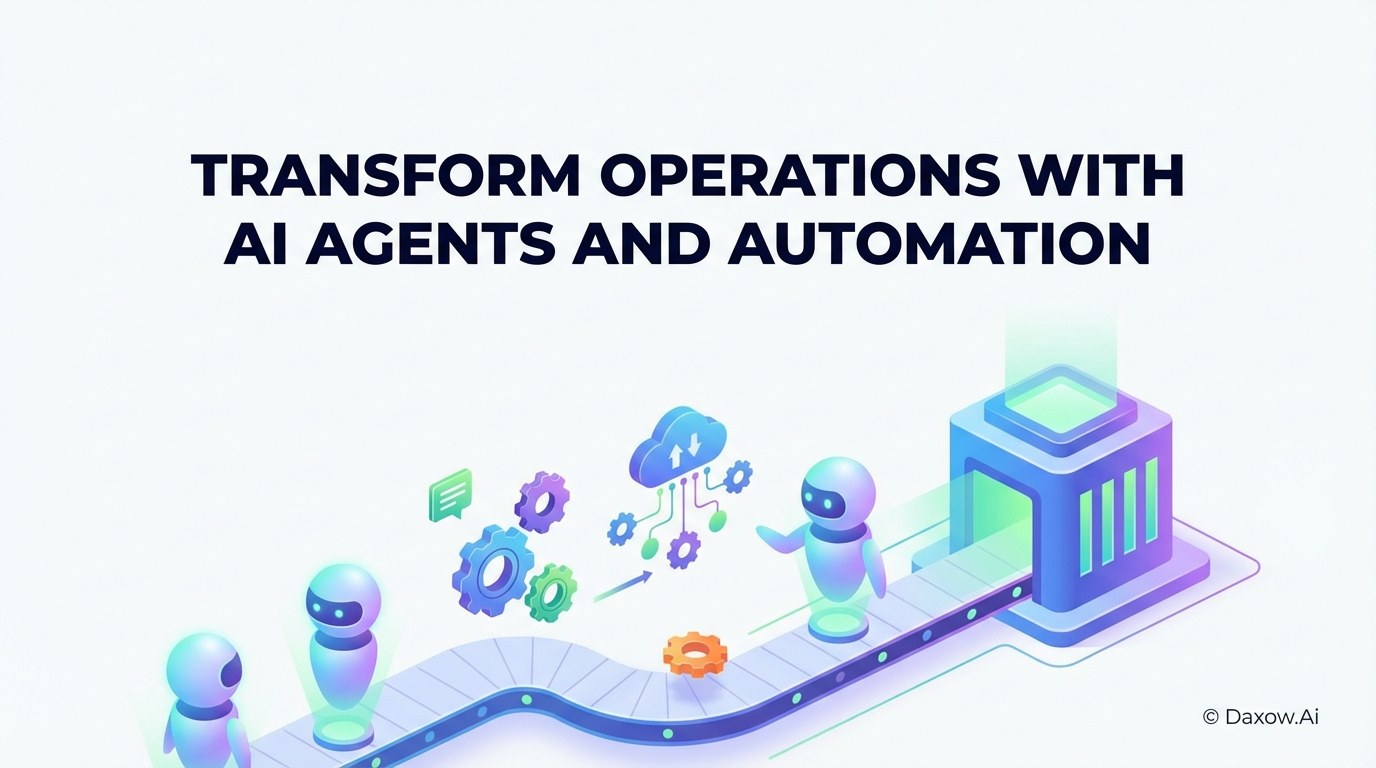
Transform Operations with AI Agents and Automation
How AI agents and workflow automation reduce manual work, cut costs, and boost productivity across industries, with Daxow.ai's roadmap and real-world use cases.
AI Agents and Workflow Automation: Transforming Business Operations
Estimated reading time: 15 minutes
Key Takeaways
- AI agents combined with workflow automation drastically reduce manual tasks and improve operational efficiency.
- Cross-industry use cases demonstrate measurable benefits like faster response times, cost reduction, and enhanced customer experience.
- Strategic deployment of AI automation requires goal prioritization, data auditing, and cross-functional collaboration.
- Daxow.ai offers tailored AI solutions that integrate with existing business tools to deliver scalable automation and ROI.
- Implementation challenges can be mitigated with proper training, governance, and iterative development.
Table of Contents
- AI Agents and Workflow Automation: Transforming Business Operations
- What AI Agents and Workflow Automation Mean for Your Business
- Practical Use Cases Across Industries
- How AI Agents and Automation Drive Business Value
- Implementation Steps and Best Practices
- Common Challenges and How to Mitigate Them
- ROI and Measurable Business Impact
- How Daxow.ai Partners with Your Business
- Example Client Scenarios (Illustrative)
- Getting Started: Practical Next Steps
- Frequently Asked Questions
AI Agents and Workflow Automation: Transforming Business Operations
What does this phrase mean in concrete business terms? At its core, it describes the convergence of intelligent, autonomous software (AI agents) with rule-based and event-driven orchestration (workflow automation). Together they enable systems that:
- Execute repetitive tasks autonomously (reduce manual tasks).
- Analyze structured and unstructured data in real time.
- Make or recommend decisions and adapt workflows based on outcomes.
- Integrate with CRMs, ERPs, ticketing systems, and cloud services to close feedback loops.
These capabilities result in faster response times, lower operational costs, fewer errors, and improved customer experiences. In practice, AI agents can perform tasks ranging from classifying incoming documents and routing invoices to autonomously qualifying leads and executing multi-step sales sequences.
What AI Agents and Workflow Automation Mean for Your Business
From manual processes to self-optimizing systems
Most organizations still rely on manual handoffs for high-volume operations such as invoicing, ticket triage, or lead qualification. Introducing AI agents and workflow automation transitions these tasks into automated pipelines that continuously learn and improve. This means:
- Lower processing costs by automating rule-based labor.
- Higher throughput with consistent, 24/7 execution.
- Improved accuracy by reducing human error in repetitive work.
- Scalable decisioning where agents surface patterns and insights that humans may miss.
Strategic benefits for decision-makers
For CTOs and business owners, benefits extend beyond operational efficiency:
- Accelerated time-to-market for new services enabled by automated back-office functions.
- Enhanced customer loyalty through proactive customer support automation.
- Better compliance and auditability via standardized, logged workflows.
- Competitive differentiation by becoming AI-native: companies that adopt early can outpace legacy incumbents.
Practical Use Cases Across Industries
E-commerce — Personalization and operational scale
- Objective: Improve conversion rates and reduce customer support load.
- Automation approach: AI agents classify incoming customer messages, respond to common queries, generate personalized product recommendations based on purchase history, and trigger inventory reorders with workflow automation.
- Outcomes: Reduced support response times, higher average order value through targeted offers, and fewer stockouts thanks to predictive inventory adjustments.
Healthcare — Faster, safer patient journeys
- Objective: Reduce administrative overhead and improve care coordination.
- Automation approach: Use document extraction to populate EHRs, AI agents triage referral requests, and workflow automation coordinates scheduling and follow-ups.
- Outcomes: Shorter onboarding times, reduced clerical errors, and improved patient satisfaction due to timely communications.
Finance — Compliance, fraud detection, and efficiency
- Objective: Strengthen risk controls and reduce manual review costs.
- Automation approach: Combine transaction monitoring agents for anomaly detection with automated workflows for escalations and compliance checks; automate extraction and classification of legal documents.
- Outcomes: Reduced fraud losses, faster audit cycles, and substantial labor savings in compliance teams.
Real Estate — Faster closings and better lead conversion
- Objective: Accelerate transactions and increase agent productivity.
- Automation approach: AI agents qualify leads using conversation and document signals, automate document preparation and verification, and trigger tasks across CRM and legal systems.
- Outcomes: Shorter time-to-close, higher lead-to-client conversion, and fewer administrative delays.
HR — Smarter hiring and retention
- Objective: Streamline recruitment and reduce turnover.
- Automation approach: Resume parsing and candidate scoring, automated interview scheduling, and sentiment analysis of employee feedback to predict churn.
- Outcomes: Faster hiring cycles, more consistent candidate evaluation, and proactive retention initiatives.
How AI Agents and Automation Drive Business Value
AI agents add value by extending automation into cognitive tasks. When combined with workflow automation, this creates an agile system that can act, learn, and improve without constant human intervention. Key value drivers include:
- Productivity uplift: Automating repetitive tasks frees knowledge workers to focus on high-value strategy and customer engagement.
- Operational resilience: Automated workflows reduce single points of failure and standardize responses.
- Data-driven insights: Agents process larger data volumes to reveal trends, improving forecasting and decision-making.
- Revenue impact: Faster lead qualification and personalized experiences increase conversion and upsell opportunities.
Daxow.ai’s clients frequently report multi-fold productivity multipliers when core processes are optimized and automated. These gains compound over time as agents improve through retraining and feedback loops.
Implementation Steps and Best Practices
1. Define goals and prioritize processes
- Identify high-volume, repetitive tasks with measurable KPIs (e.g., processing time, error rate).
- Create an AI-first scorecard to prioritize projects based on impact and feasibility.
- Start with small, high-impact pilots to demonstrate value quickly.
2. Audit data and integration points
- Evaluate data quality, gaps, and accessibility.
- Map systems that need to be integrated: CRM, ERP, ticketing, cloud storage, and document repositories.
- Favor solutions with pre-built connectors to simplify integration and reduce time-to-live.
3. Assemble a cross-functional team
- Include product owners, domain experts, data engineers, ML specialists, and change-management leads.
- Provide training and clear communication to prevent shadow AI adoption.
- Ensure responsible AI governance to address bias, compliance, and transparency.
4. Build, test, and iterate
- Use iterative sprints to build minimal viable agents and workflows.
- Define metrics such as accuracy, recall, processing time, and business KPIs.
- Implement dashboards and monitoring for performance drift; schedule automated retraining.
5. Scale and optimize
- Roll out successful pilots gradually, adding more data sources and edge cases.
- Standardize pipelines for logging, version control, and governance.
- Continuously measure ROI and refine models based on feedback.
Common Challenges and How to Mitigate Them
- Complex setup: Use platforms and partners that offer pre-built integrations and workflow mapping.
- Employee resistance: Demonstrate quick wins and invest in training to build trust.
- Data quality issues: Conduct audits early and standardize ingestion pipelines.
- Performance drift: Monitor models and schedule retraining with clear alerting.
ROI and Measurable Business Impact
- Efficiency gains of 20–50% on process throughput.
- Reduced manual labor with some document processing scenarios lowering human effort by up to 70%.
- Payback periods often fall between 6–12 months for targeted pilots.
- Long-term compounding benefits as agents improve and additional processes are automated.
Measure ROI using both operational metrics (processing time, error rate, cost per transaction) and business outcomes (NPS, conversion rates, fraud loss reduction). These provide the evidence base required to scale automation across the organization.
How Daxow.ai Partners with Your Business
Discovery and Process Analysis
- We map current workflows, identify automation opportunities, and prioritize high-impact processes using a tailored AI-first scorecard.
- Deliverable: A prioritized roadmap showing estimated savings, KPIs, and integration footprint.
Custom AI Agent Design and Development
- We build AI agents tailored to your data and workflows: document extraction, conversational agents for support, lead qualification agents for sales automation, or predictive agents for operations.
- Agents are designed to execute real tasks by integrating with business tools and CRMs.
End-to-End Workflow Automation and Integration
- Daxow.ai orchestrates workflows across systems, connecting AI agents to CRMs, ERPs, ticketing platforms, and data stores.
- We handle orchestration, error handling, and observability so automations run reliably at scale.
Monitoring, Governance, and Continuous Improvement
- We implement monitoring dashboards, automated retraining pipelines, and governance frameworks to mitigate drift and ensure ethical AI.
- Ongoing optimization focuses on increasing productivity and reducing operational costs over time.
Outcome-Focused Delivery
- Our projects emphasize measurable KPIs and rapid time-to-value. Typical deliverables include cost-savings estimates, process SLAs, and productivity multipliers.
Example Client Scenarios (Illustrative)
Sales automation for a B2B SaaS company
- Problem: Long lead qualification cycles and low MQL-to-SQL conversion.
- Solution: Daxow.ai built an AI agent to scan inbound inquiries, enrich leads via public and internal data, score leads, and initiate multichannel nurturing through CRM workflows.
- Result: 40% reduction in lead qualification time and a 25% increase in sales-ready leads.
Customer support automation for an e-commerce retailer
- Problem: High call volumes and inconsistent responses.
- Solution: Deploy conversational AI agents integrated with order systems to automate common inquiries, escalate complex cases, and create automated return workflows.
- Result: 60% reduction in first-response time and a 30% drop in live-agent handling time.
Getting Started: Practical Next Steps
- Run a rapid process audit to identify 2–3 high-impact pilots.
- Calculate baseline KPIs to measure improvement.
- Choose a partner who offers integration expertise, ethical AI governance, and proven delivery methodology.
Daxow.ai can lead this discovery and deliver pilots that demonstrate measurable ROI within months.
Learn more about our AI development services and workflow automation solutions to start transforming your operations today.
Frequently Asked Questions
What are AI agents in the context of business automation?
AI agents are intelligent software entities that autonomously perform tasks, analyze data, and make decisions by interacting with business systems, reducing manual work.
How does workflow automation complement AI agents?
Workflow automation orchestrates rule-based and event-driven processes, enabling AI agents to act within larger business systems and ensure consistent execution and integration.
Which industries benefit most from AI and workflow automation?
Industries like e-commerce, healthcare, finance, real estate, and HR have demonstrated clear benefits through use cases such as personalization, compliance, lead conversion, and hiring efficiency.
What are common challenges when implementing AI automation?
Challenges include complex integration, employee resistance, data quality issues, and performance drift; these can be mitigated with careful planning, training, and monitoring.
How can I measure the ROI of AI automation projects?
ROI can be measured via operational KPIs like processing speed and error rates, combined with business KPIs such as customer satisfaction, conversion rates, and fraud reduction.