
How AI Agents Transform Workflow Automation — Practical Guide
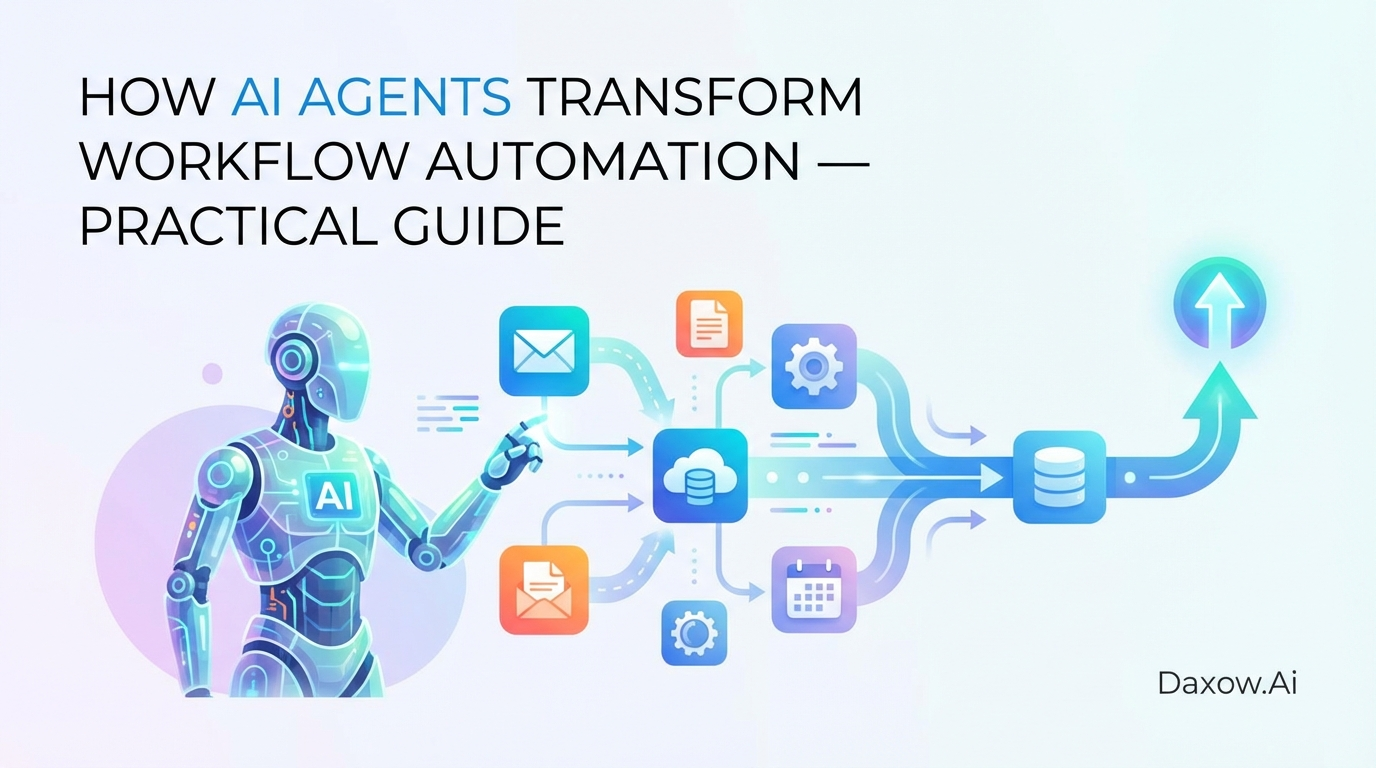
Learn how AI agents automate end-to-end workflows to cut costs, boost productivity, and integrate with CRMs/ERPs. Roadmap, use cases, and Daxow.ai solutions.
How AI Agents are Transforming Workflow Automation
Estimated reading time: 15 minutes
Key Takeaways
- AI agents automate end-to-end workflows, reducing manual tasks by up to 70% and accelerating processing times.
- Core AI agent components include intelligence, orchestration, integration, and governance layers enabling reliable automation.
- Industry use cases span e-commerce, healthcare, finance, real estate, and HR, driving measurable ROI and operational efficiency.
- A phased implementation roadmap from discovery through continuous improvement ensures low risk and high impact.
- Daxow.ai delivers custom AI agent solutions integrating seamlessly with existing business systems while ensuring security and compliance.
Table of Contents
- How AI Agents are Transforming Workflow Automation — the Business Case
- Core Components of AI Agent–Driven Workflow Automation
- Practical Use Cases — How AI Agents are Transforming Workflow Automation Across Industries
- Implementation Roadmap — Deploying AI Agents for Workflow Automation
- Measuring ROI — What Success Looks Like
- Operational Considerations and Risk Management
- Technology Stack and Integration Patterns
- Best Practices — Maximizing Business Value
- Why Partner with Daxow.ai
- Frequently Asked Questions
How AI agents are transforming workflow automation is the central question every operations leader, CTO, and business owner is asking in 2026. Organizations face pressure to reduce manual tasks, increase productivity, and deliver better customer experiences while controlling costs. AI agents are the practical tool that closes the gap between strategy and execution—delivering intelligent, end-to-end business automation that replaces repetitive human effort and accelerates decision-making.
This article explains how AI agents drive workflow automation across industries, provides actionable implementation guidance, and shows how Daxow.ai builds custom AI systems that reduce operational costs, improve ROI, and integrate with existing business tools.
How AI Agents are Transforming Workflow Automation — the Business Case
AI agents are software entities that execute tasks autonomously or semi-autonomously by combining large language models, connectors, rules, and business logic. When applied to workflow automation, they can:
- Automate end-to-end processes rather than single tasks.
- Orchestrate human-in-the-loop interventions only when exceptions occur.
- Integrate data from multiple systems to make context-aware decisions.
- Continuously learn and optimize workflows from outcomes and feedback.
Business impact (typical outcomes):
- Reduced manual tasks: 40–70% reduction in routine task hours in targeted functions.
- Increased productivity: 20–50% faster processing times for workflows such as onboarding, claims processing, or lead qualification.
- Improved customer experience: faster response times, higher first-contact resolution rates.
- Lower operational costs: automation reduces FTE dependence for repetitive work and shifts staff to higher-value activities.
Core Components of AI Agent–Driven Workflow Automation
To understand how AI agents are transforming workflow automation, it helps to view the architecture and components:
1. Intelligence Layer
- LLMs and task-specific models for natural language understanding and generation.
- Knowledge bases, context windows, and retrieval-augmented generation (RAG) for accurate, up-to-date responses.
- Why it matters: Enables agents to interpret unstructured inputs (emails, chat, documents) and act appropriately.
2. Orchestration Layer
- Workflow engines that sequence tasks, manage state, and schedule jobs.
- Human approval gates and escalation paths.
- Why it matters: Converts AI decisions into reliable, auditable process flows.
3. Integration Layer
- Connectors to CRMs, ERPs, ticketing systems, document repositories, and databases.
- API-based data exchange and event-driven triggers.
- Why it matters: Allows AI agents to execute real tasks (e.g., update records, create orders, trigger refunds).
4. Governance & Monitoring
- Logging, explainability tools, performance metrics, and user feedback loops.
- Version control for models and business logic.
- Why it matters: Ensures compliance, traceability, and continuous improvement.
Practical Use Cases — How AI Agents are Transforming Workflow Automation Across Industries
E-commerce — Order Management and Customer Support Automation
Problem:
- High volume of order inquiries, returns, and payment exceptions.
Solution:
- AI agents handle multi-channel customer inquiries, process returns, and update order statuses by integrating with the e-commerce platform and CRM.
Outcomes:
- Reduced manual tasks in support by up to 60%.
- Faster refunds and returns processing, improving customer satisfaction and lowering chargeback rates.
Daxow.ai contribution:
- We design AI agents that blend customer support automation and sales automation—routing high-value leads, escalating complex issues, and automating post-purchase follow-ups to increase repeat purchases.
Healthcare — Patient Intake and Documentation Automation
Problem:
- Administrative burden from intake forms, insurance verification, and clinical documentation.
Solution:
- AI agents extract patient data from forms and documents, pre-fill EHR entries, verify coverage, and flag missing information to staff.
Outcomes:
- Reduced clinician documentation time by 30–50%.
- Faster patient throughput and fewer billing denials.
Daxow.ai contribution:
- Daxow.ai builds HIPAA-aligned, secure AI systems to automate document processing, integrate with clinical systems, and implement human-in-the-loop review where required.
Finance — Loan Processing and Compliance Monitoring
Problem:
- Slow loan adjudication and manual compliance checks increase cycle times and risk.
Solution:
- AI agents perform KYC data extraction, financial statement summarization, risk-rule checks, and trigger automatic decisioning for low-risk profiles.
Outcomes:
- Loan decision times reduced from days to hours.
- Improved compliance with automated audit trails and consistent rule application.
Daxow.ai contribution:
- We integrate AI agents with core banking systems, provide explainable decision logs, and design escalation flows for borderline cases to balance automation with risk controls.
Real Estate — Lead Qualification and Transaction Coordination
Problem:
- Agents spend time qualifying leads and coordinating documents across parties.
Solution:
- AI agents qualify leads via conversational interfaces, schedule viewings, prepare draft agreements, and coordinate signatures.
Outcomes:
- Higher sales conversion through faster lead follow-up and improved agent productivity.
Daxow.ai contribution:
- Daxow.ai streamlines sales automation and document workflows, connecting CRMs, calendar systems, and e-signature providers to enable seamless deal progression.
HR and Administration — Recruitment, Onboarding, and Policy Compliance
Problem:
- High volume of screening and repetitive onboarding steps.
Solution:
- AI agents screen resumes, schedule interviews, automate offer letters, and guide new hires through onboarding checklists.
Outcomes:
- Reduced time-to-hire and administrative workload.
- Consistent onboarding experience, improving retention.
Daxow.ai contribution:
- Our AI workflow automation includes integrations with applicant tracking systems, payroll, and HRIS to ensure a single source of truth and automated triggers throughout employee lifecycle.
Implementation Roadmap — Deploying AI Agents for Workflow Automation
Phase 1 — Discovery and Process Mapping
- Identify high-impact workflows with repetitive manual steps and measurable KPIs.
- Map current process, inputs/outputs, and exception points.
- Daxow.ai role: Conduct process analysis to prioritize automation candidates and estimate ROI.
Phase 2 — Proof of Value (PoV)
- Build a small-scale AI agent pilot focused on one process (e.g., invoice processing, lead qualification).
- Connect to necessary systems and validate outputs with real users.
- Measure accuracy, time savings, and user acceptance.
- Daxow.ai role: Deliver PoV within 4–8 weeks, including integration prototypes and baseline metrics.
Phase 3 — Production Rollout
- Harden integrations, add governance, implement monitoring, and scale agents.
- Establish SLAs and human-in-the-loop controls for edge cases.
- Daxow.ai role: Deploy production-grade agents, set up observability, and train internal teams.
Phase 4 — Continuous Improvement
- Use feedback loops, retraining, and business metric analysis to optimize agents.
- Expand automation scope to adjacent processes for compounded gains.
- Daxow.ai role: Provide ongoing optimization, model maintenance, and feature enhancements.
Measuring ROI — What Success Looks Like
To demonstrate how AI agents are transforming workflow automation, track both quantitative and qualitative metrics:
Quantitative metrics:
- Reduction in manual task hours (%).
- Processing time per transaction (minutes/hours saved).
- Cost per transaction.
- Error rate and rework reduction.
- Conversion lift (for sales and lead workflows).
Qualitative metrics:
- Employee satisfaction and reallocation to higher-value work.
- Customer satisfaction scores (NPS, CSAT).
- Faster decision-making and reduced cycle times.
Example ROI calculation:
If a company processes 1000 monthly claims at $10 manual handling cost each, a 50% automation reduces monthly handling cost by $5,000. Adding improved throughput and reduced leakages compounds savings.
Operational Considerations and Risk Management
Data Privacy and Compliance
- Ensure appropriate data access controls and encryption.
- Implement privacy-preserving design when handling sensitive data.
- Daxow.ai builds secure connectors and compliance workflows to meet industry standards.
Explainability and Auditability
- Provide logs and decision rationales for automated actions.
- Use human-review flags for high-risk decisions.
- Daxow.ai implements explainability features tailored to auditors and compliance teams.
Change Management
- Train staff and design workflows that gradually shift responsibility to agents.
- Preserve user trust by demonstrating accuracy and offering easy override mechanisms.
- Daxow.ai supports change programs and training materials to accelerate adoption.
Technology Stack and Integration Patterns
Model and Data Strategy
- Combine foundation models with domain-specific fine-tuning and retrieval of internal knowledge.
- Maintain a single source of truth for structured data and a retrieval layer for unstructured content.
- Daxow.ai helps design model pipelines and knowledge architectures that serve enterprise needs.
Integration and APIs
- Use middleware for robust system integration (CRMs, ERPs, ticketing).
- Event-driven triggers and webhooks enable near-real-time automation.
- Daxow.ai builds reliable connectors and integration strategies aligned with your tech stack.
Monitoring and Observability
- Track agent performance, latency, error rates, and business KPIs.
- Implement dashboards that correlate agent behavior with business outcomes.
- Daxow.ai delivers monitoring frameworks and dashboards for continuous insight.
Best Practices — Maximizing Business Value
- Start with high-frequency, rule-based processes that have clear KPIs.
- Keep humans in the loop for edge cases and high-risk decisions.
- Measure continuously and expand automation iteratively.
- Prioritize integrations that enable agents to complete transactions end-to-end.
- Focus on usability: conversational interfaces reduce training friction and increase adoption.
Why Partner with Daxow.ai
Daxow.ai brings a structured, end-to-end approach to AI automation:
- Process-first methodology: We map and optimize workflows before automating, ensuring the highest ROI.
- Custom AI agents: We design agents that execute real tasks, not just chat—integrating with CRMs, ERPs, and document systems.
- End-to-end automation: From discovery and PoV to production and continuous improvement, we manage the full lifecycle.
- Security and compliance: We adhere to industry standards and implement governance frameworks to protect sensitive data.
- Cross-industry experience: Practical use cases across e-commerce, healthcare, finance, real estate, and HR ensure tailored solutions for your sector.
Frequently Asked Questions
What are AI agents in workflow automation?
AI agents are software programs that autonomously execute and manage complex workflows by leveraging AI models, connectors, and business logic to reduce manual effort and optimize processes.
How quickly can an organization implement AI agent automation?
Typical implementation follows a phased approach over weeks to months, starting with discovery and proof of value (4–8 weeks), then proceeding to production rollout and continuous improvement phases.
How does Daxow.ai ensure data privacy and compliance?
Daxow.ai builds secure AI agents with data encryption, access controls, HIPAA alignment in healthcare, and regulatory frameworks tailored to industries, ensuring compliance and auditability.
Can AI agents integrate with my existing business systems?
Yes. Daxow.ai specializes in integrating AI agents with your CRM, ERP, ticketing, and document management systems to enable end-to-end automation workflows.