
AI Agents and Workflow Automation: Transform Your Business
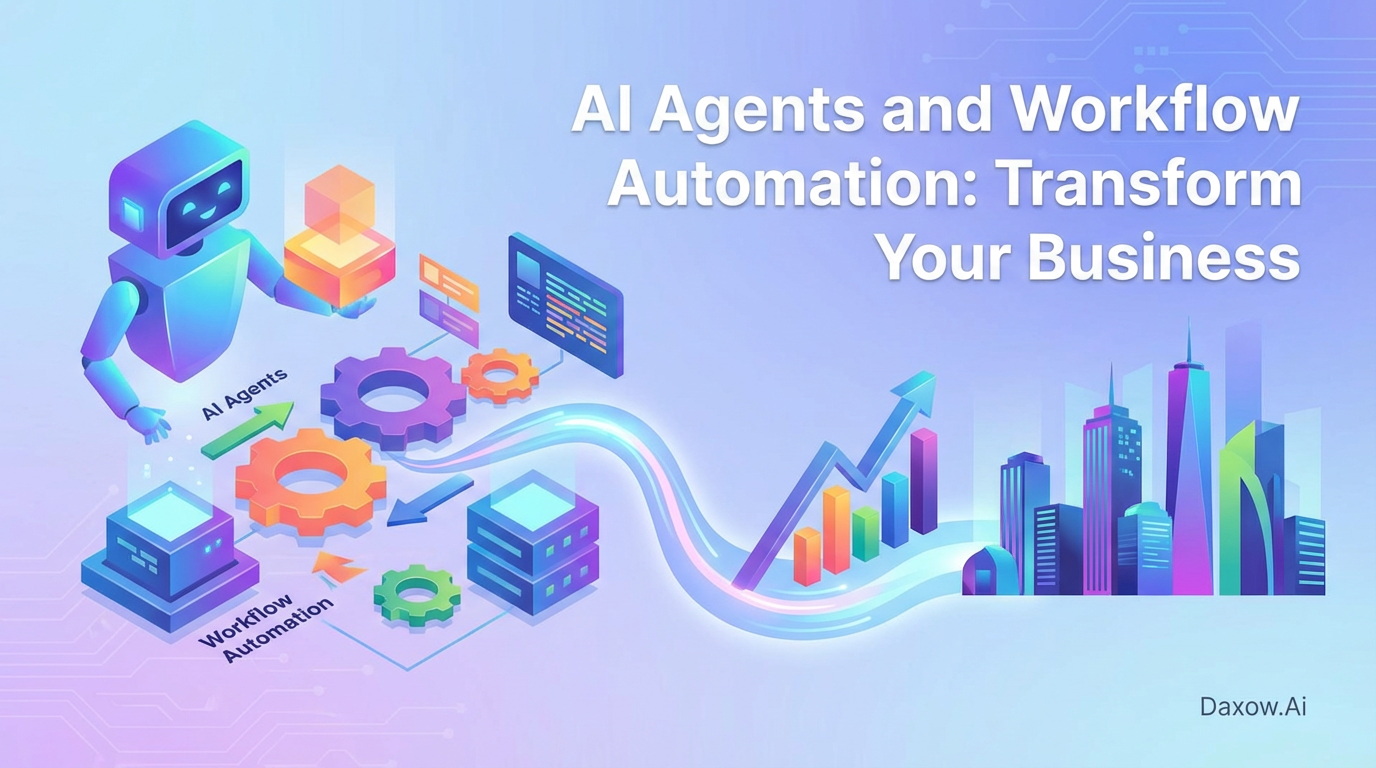
AI agents and workflow automation cut manual work, speed processes, and deliver rapid ROI. A 6-step roadmap and Daxow.ai case studies show how.
Unlocking Business Transformation: The Power of AI Agents and Workflow Automation
Estimated reading time: 15 minutes
Key Takeaways
- AI agents and workflow automation reduce manual effort and drive measurable business value.
- Combining autonomous AI with process orchestration cuts cycle times by up to 60% and manual labor by up to 50%.
- Key business impacts include operational resilience, improved decision quality, and enhanced employee productivity.
- A proven 6-step implementation framework helps companies pilot, validate, and scale AI automation initiatives.
- Daxow.ai partners with organizations to build custom AI automation systems that deliver rapid ROI and scalable value.
Table of Contents
- Unlocking Business Transformation: The Power of AI Agents and Workflow Automation
- What AI Agents and Workflow Automation Mean for Your Organization
- Use Cases — Practical Examples Across Industries
- How AI Agents and Workflow Automation Drive Business Success
- Implementation Roadmap — A Proven 6-Step Framework
- How Daxow.ai Partners with You to Unlock Value
- Case Studies (Illustrative Examples)
- Measuring Success — KPIs to Track
- Getting Started — Practical Next Steps
- Frequently Asked Questions
Unlocking Business Transformation: The Power of AI Agents and Workflow Automation
AI agents are autonomous software entities powered by machine learning and generative models that execute complex tasks end-to-end. When combined into workflow automation, these agents power processes such as approvals, customer interactions, invoice processing and lead qualification with minimal human intervention.
Research and recent enterprise practice indicate this combination delivers:
- Significant reduction in manual labor, often cutting repetitive, rule-based work by up to 50%.
- Faster process times, with many automations reducing cycle times by 40–60%.
- Rapid payback, where high-impact projects commonly pay back within 6–12 months.
- Adaptive, continuous improvement through monitoring and retraining, enabling models to evolve with changing data and business conditions.
These outcomes are the backbone of hyperautomation—a strategic approach that fuses RPA, AI agents, and workflow automation to scale operations without proportional increases in headcount.
What AI Agents and Workflow Automation Mean for Your Organization
Definitions and capabilities
- AI agents: Autonomous software that understands context, makes decisions, and executes tasks such as extracting data, generating drafts, scoring leads, or triggering follow-up actions.
- Workflow automation: The orchestration layer that integrates AI agents with business systems (CRMs, ERPs, support platforms) to run end-to-end processes, route exceptions, and log outcomes.
Practical business impacts
- Operational resilience: Continuous monitoring and anomaly detection reduce risk and alert teams before issues escalate.
- Higher-quality decisions: Models analyze larger datasets than humans can reasonably process, improving accuracy and consistency.
- Employee productivity: By automating low-value tasks, teams focus on revenue-generating activities and innovation.
Use Cases — Practical Examples Across Industries
E-commerce
- Inventory forecasting agent predicts stock needs by analyzing sales velocity, returns, supplier lead times and seasonal trends.
- Automated workflow triggers purchase orders, updates ERP stock levels, and notifies buyers only when human input is necessary.
- Result: Reduced stockouts and overstock, improved conversion rates, and lower carrying costs.
Customer Support and Customer Support Automation
- AI agents triage incoming support tickets using NLP, route them to the correct queue, and provide draft replies for common issues.
- Workflow automation escalates complex cases to human agents and auto-populates case notes in the CRM.
- Result: Faster response times, higher first-contact resolution, and reduced average handle time, boosting NPS.
Finance and Accounting
- Invoice processing agents extract structured data from PDFs and match invoices to purchase orders.
- Automated approval workflows route exceptions to finance managers and reconcile payments automatically.
- Result: 40–60% shorter processing times, fewer payment errors, and reduced audit friction.
Healthcare
- Patient onboarding agents collect intake forms, verify insurance eligibility, and populate EHR fields.
- Workflow automation schedules appointments and sends reminders based on clinical rules.
- Result: Faster intake, fewer administrative errors, and better patient throughput while preserving compliance.
Sales and Sales Automation
- Lead qualification agents score inbound leads using historical conversion data, intent signals, and CRM activity.
- High-quality leads are routed directly to account reps with a recommended outreach script and next steps.
- Result: Shorter sales cycles, higher pipeline conversion, and better allocation of sales resources.
Real Estate
- Agents analyze listing data and market indicators to recommend pricing and draft property descriptions and social copy.
- Workflow automation coordinates listing approvals, syndication, and lead follow-ups.
- Result: Faster listing-to-sale timelines and increased listing conversion rates.
HR and Recruitment
- Resume screening agents filter candidates according to role-specific criteria and surface best matches.
- Automated workflows schedule interviews, send pre-screening questionnaires, and collect feedback.
- Result: Shorter time-to-hire and improved recruiter productivity.
How AI Agents and Workflow Automation Drive Business Success
Key value drivers
- Scalability without proportional headcount growth: Automations handle volume spikes and repetitive work.
- Cost reduction and ROI: Reduced processing times and fewer errors translate into measurable savings—often with a 6–12 month payback on targeted automations.
- Improved customer experience: Faster, consistent responses and personalized interactions improve retention and revenue.
- Continuous improvement: Monitoring and retraining keep models accurate and relevant, converting data into a long-term asset.
Risk management and governance
- Ethical deployment and bias detection are essential. Implement rigorous testing, holdout validation, and monitoring dashboards to detect drift and unintended outcomes.
- Design human-in-the-loop escalation paths so AI agents handle routine work while experts manage exceptions.
Implementation Roadmap — A Proven 6-Step Framework
Successful AI automation starts with business alignment and follows a structured, iterative approach. Use this six-step framework:
-
Define clear goals and audit data
- Identify the exact inefficiency (e.g., invoice exceptions, slow lead response).
- Set measurable targets (e.g., 30% faster processing time).
- Audit data for completeness, format consistency, and accessibility.
-
Identify high-impact processes
- Prioritize repetitive, high-volume tasks with clear rules and available data.
- Choose pilot projects with strong ROI potential and measurable KPIs.
-
Select scalable tools and build cross-functional teams
- Choose platforms that integrate easily with CRMs, ERPs and other infrastructure.
- Assemble teams combining business owners, data scientists, engineers, and compliance leads.
- Provide training to avoid shadow AI and ensure governance.
-
Design, test and validate
- Use holdout datasets to validate model performance with metrics such as precision and recall.
- Run a controlled pilot to validate operational assumptions and gather user feedback.
-
Deploy and integrate with existing systems
- Implement APIs and connectors to ensure seamless data flow.
- Design automated monitoring and alerting for performance and exceptions.
-
Monitor, retrain and scale
- Track KPIs and model drift with dashboards.
- Schedule retraining and incorporate user feedback.
- Scale successful pilots across departments and geographies.
Best practices and common pitfalls
- Start small: pilot one process, measure impact, then scale.
- Maintain governance: control unvetted AI usage and ensure data provenance.
- Invest in change management: communicate wins, train staff, and clarify new roles.
- Avoid over-automation: keep humans in loop for decisions requiring judgment and accountability.
How Daxow.ai Partners with You to Unlock Value
Daxow.ai, founded in Estonia in 2024, specializes in translating business workflows into automated systems that deliver measurable outcomes. Our approach aligns with the framework above and focuses on end-to-end delivery.
What Daxow.ai offers
- Process discovery and analysis: We audit workflows to quantify waste and identify automation opportunities that will reduce manual tasks and lift productivity.
- Custom AI agent development: We build agents tailored to your use cases—document automation, lead qualification, customer support automation, and more.
- Workflow automation and orchestration: We integrate agents into end-to-end flows that connect to your CRM, ERP and third-party services.
- System integrations and data connectivity: We design secure, auditable data pipelines to ensure reliable input/output for models.
- Deployment, monitoring and model maintenance: We operationalize continuous monitoring, retraining and governance to sustain long-term value.
- Change management and training: We provide training materials, dashboards and playbooks to ensure adoption and mitigate risk.
How we drive ROI
- We prioritize high-impact pilots to achieve early payback (often within 6–12 months).
- We quantify savings in time, error reduction and revenue uplift to build a business case.
- We build escalation paths and human oversight to reduce operational risk and ensure ethical AI behavior.
Case Studies (Illustrative Examples)
Finance firm — Invoice automation
A mid-sized financial services company struggled with high invoice exception rates and long settlement cycles. Daxow.ai deployed document extraction agents and an automated approval workflow integrated with their ERP. Outcome:
- 50% reduction in manual invoice reviews
- 45% faster processing time
- Payback achieved in under 9 months
eCommerce retailer — Inventory and customer support
An online retailer faced stockouts during peak seasons and mounting support tickets. Daxow.ai implemented forecasting agents and a customer support automation layer that triaged queries and provided self-serve solutions. Outcome:
- 30% fewer stockouts
- 35% reduction in support volume
- Increased conversion and customer satisfaction scores
Healthcare provider — Patient intake and scheduling
A clinic experienced long patient intake times and administrative burden. Daxow.ai built an onboarding agent to pre-fill records, verify insurance and trigger automated scheduling workflows. Outcome:
- Shorter wait times
- Improved staff productivity
- Better compliance documentation
Measuring Success — KPIs to Track
- Cycle time reduction (e.g., invoice processing time)
- Percentage of tasks fully automated (reduction in manual tasks)
- Error and exception rates
- Time saved per employee (productivity gains)
- Customer satisfaction metrics (NPS, CSAT)
- Payback period and ROI
Getting Started — Practical Next Steps
- Select a single, high-volume process with clear data and a measurable target.
- Conduct a short process audit to quantify time and cost impacts.
- Prototype an AI agent that solves the core task and integrate it into a narrow workflow.
- Measure results, optimize, and expand.
Daxow.ai combines domain expertise, technical delivery and change management to accelerate this path. Our engagements typically begin with a process analysis and pilot that demonstrates value and sets the stage for enterprise-wide automation.
Conclusion and Call to Action
Unlocking Business Transformation: The Power of AI Agents and Workflow Automation is a strategic move for organizations that want to reduce manual tasks, increase productivity, and create durable competitive advantage. By following a structured implementation framework and partnering with experienced automation teams, businesses can achieve rapid ROI, stronger customer experiences, and scalable operations.
Book a free consultation with Daxow.ai to request a process analysis for your company. Contact us to build a custom AI system that automates your highest-value workflows and transforms how your organization works.
Frequently Asked Questions
What are AI agents?
AI agents are autonomous software entities that use machine learning and generative models to understand context, make decisions, and execute complex tasks end-to-end with minimal human intervention.
How does workflow automation improve business processes?
Workflow automation integrates AI agents and business systems to orchestrate end-to-end processes, route exceptions, and log outcomes, resulting in faster cycle times, fewer errors, and scalable operations.
What industries benefit most from AI agents and workflow automation?
Industry benefits are broad and include e-commerce, customer support, finance, healthcare, sales, real estate, and HR, among others, where repetitive tasks and data-heavy processes can be automated.
How does Daxow.ai support the implementation of AI automation?
Daxow.ai offers process discovery, custom AI agent development, workflow orchestration, system integration, deployment and monitoring, and change management to ensure effective AI automation adoption and rapid ROI.