
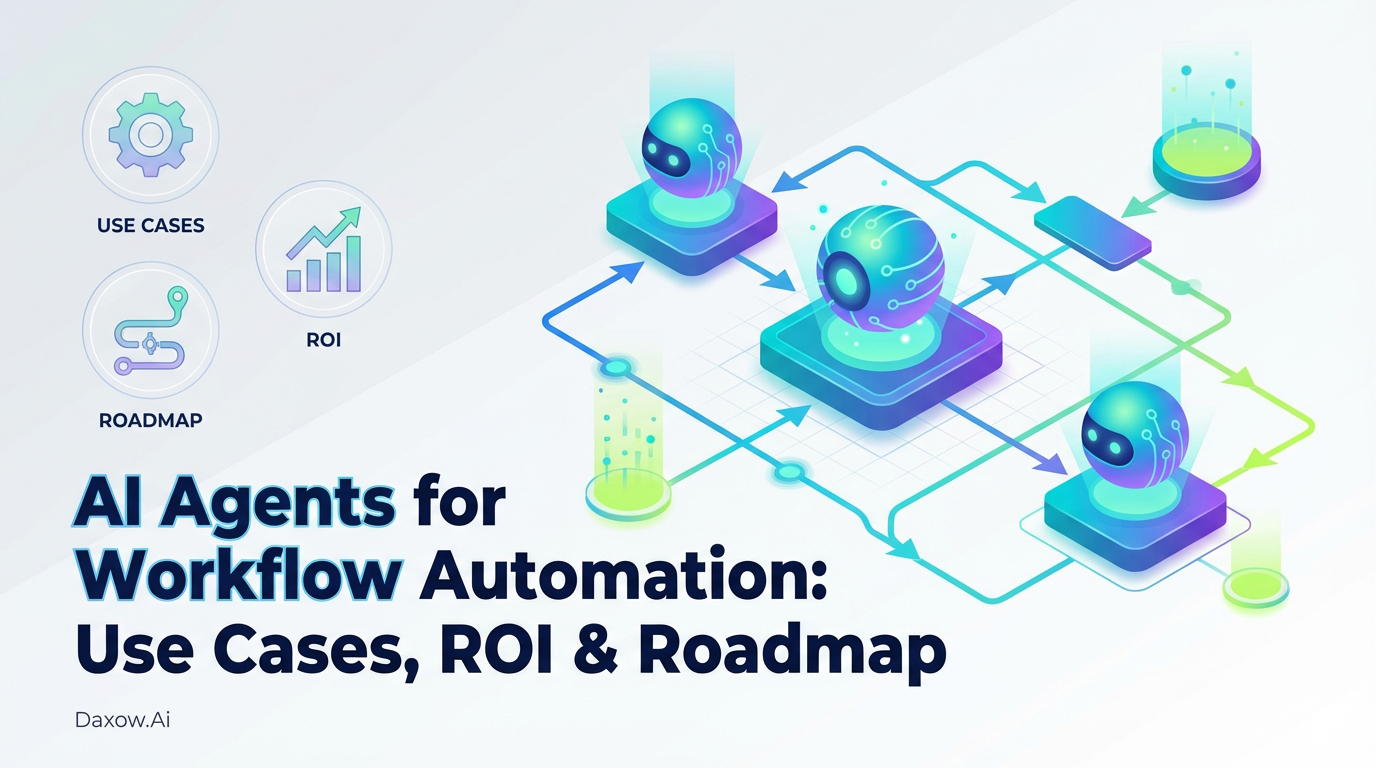
AI Agents for Workflow Automation: Use Cases, ROI & Roadmap
How AI agents automate workflows, cut costs, and boost ROI - practical use cases, deployment roadmap and governance from Daxow.ai.
AI Agents for Workflow Automation: How Intelligent Automation Transforms Business Operations
Estimated reading time: 15 minutes
Key Takeaways
- AI agents automate repetitive tasks and augment decision-making, enabling faster, scalable workflows.
- Cross-industry use cases include e-commerce, healthcare, finance, real estate, and HR, delivering measurable outcomes.
- Effective deployment requires defining objectives, assessing data, selecting appropriate tools, and building cross-functional teams.
- Governance, security, and ethics are critical to responsible AI automation at scale.
- Daxow.ai specializes in custom AI agents integrated end-to-end to maximize ROI and streamline operations.
Table of Contents
- Why AI Agents for Workflow Automation Matter Today
- Practical Use Cases: Industry Applications of AI Agents and Automation
- How AI Agents Deliver Business Value: From Task Automation to Autonomous Workflows
- A Practical Implementation Roadmap for AI Agents and Workflow Automation
- Governance, Security, and Ethical Considerations
- Measuring ROI: What Results to Expect
- How Daxow.ai Designs and Delivers Custom AI Automation
- Getting Started: Practical Checklist for Decision-Makers
- Conclusion and Call to Action
- Frequently Asked Questions
Why AI Agents for Workflow Automation Matter Today
Organizations face three core pressures: rising customer expectations, complex data volumes, and cost control. AI agents — autonomous or semi-autonomous software entities that can read, reason, act, and integrate with systems — directly address those pressures by automating rule-based work and augmenting decision-making.
- Eliminate repetitive work: AI automation handles data entry, invoice processing, and status updates without manual intervention.
- Scale personalized experiences: AI agents deliver personalized customer interactions at scale, improving CSAT and conversion rates.
- Unlock predictive insights: Models predict anomalies like fraud or supply chain disruptions, enabling proactive responses.
Research shows that AI automation blends RPA and AI to scale operations efficiently while enabling data-driven decisions. Companies that adopt an AI-first strategy align technology with measurable goals and use readiness assessments to manage scope and scalability. Daxow.ai helps teams translate these strategic objectives into concrete automation programs, designing AI agents that execute real tasks and integrate with CRMs and core systems.
Practical Use Cases: Industry Applications of AI Agents and Automation
E-commerce — Real-time Support, Personalized Offers, and Supply Chain Resilience
Problem: High cart abandonment, slow responses to complex customer queries, and supply chain disruptions that erode revenue.
How AI agents help:
- Answer complex customer queries across chat and email using contextual understanding.
- Draft personalized recommendations and marketing content.
- Monitor supplier data to predict disruptions and trigger alternative sourcing workflows.
Business impact:
- Conversion improvements through tailored recommendations.
- Reduced cart abandonment by 20–30% with timely, automated intervention.
Daxow.ai capability: Build AI agents that integrate with e-commerce platforms and logistics systems, automating support flows and predictive alerts.
Healthcare — Document Automation and Clinical Alerting
Problem: Clinicians and admin staff spend significant time on paperwork and data extraction.
How AI agents help:
- Extract structured data from medical records and populate EHR fields.
- Monitor vitals and flag anomalies to care teams for early intervention.
Business impact:
- Faster administrative processing and improved clinical focus on patient care.
- Improved compliance and reduced documentation errors.
Daxow.ai capability: Implement secure, HIPAA-aligned data extraction agents and integrate outputs into EHRs and workflows.
Finance — Fraud Detection and Compliance Automation
Problem: High-volume transactions require continuous surveillance and timely compliance reporting.
How AI agents help:
- Continuously analyze transaction patterns to detect anomalies and escalate suspicious activity.
- Automate compliance reports by pulling data and generating audit-ready documentation.
Business impact:
- Rapid fraud detection and reduced financial losses.
- 90% faster auditing and reporting processes.
Daxow.ai capability: Deploy surveillance agents that connect to transaction systems and feed alerts into case-management workflows.
Real Estate — Market Intelligence and Lead Prioritization
Problem: Large data sets from listings, buyers, and markets make lead prioritization manual and slow.
How AI agents help:
- Aggregate market signals to predict property value trends.
- Score and prioritize leads based on intent signals and transactional likelihood.
Business impact:
- Faster deal cycles and higher lead conversion by focusing on high-intent prospects.
Daxow.ai capability: Create market-insight agents that combine public data, CRM records, and predictive models to automate outreach and listing updates.
HR — Talent Screening and Retention Prediction
Problem: Screening resumes and predicting turnover are time-consuming and inconsistent.
How AI agents help:
- Automate resume screening, initial interviewing via chat, and candidate scoring.
- Analyze employee engagement to predict turnover risk and suggest retention actions.
Business impact:
- 50% reduction in time-to-hire and proactive retention measures.
Daxow.ai capability: Build recruitment agents that integrate with ATS systems and deliver candidate shortlists and interview summaries.
How AI Agents Deliver Business Value: From Task Automation to Autonomous Workflows
AI agents combine automation tools with AI models to handle multi-step, decision-driven tasks. Their value comes from three capabilities:
- Autonomy: Agents can perform multiple actions across systems — e.g., read an invoice, post an entry in ERP, notify accounts payable, and escalate exceptions.
- Integration: Agents connect to CRMs, ERPs, ticketing, and analytics tools to create end-to-end flows.
- Adaptation: Continuous learning and feedback loops reduce error rates and improve outcomes over time.
By embedding AI agents into workflows, businesses realize measurable ROI: substantial cost reductions on repetitive tasks, faster process times, and improved customer experience metrics. Daxow.ai focuses on designing these agents to execute real tasks and integrate with existing infrastructures to accelerate value capture.
A Practical Implementation Roadmap for AI Agents and Workflow Automation
1. Define Objectives and Prioritize Processes
- Start with business KPIs: cost reduction, faster response times, NPS improvement, or reduced error rates.
- Use an AI-first scorecard to prioritize repetitive, high-volume, and high-impact processes.
- Outcome: A prioritized backlog of automation candidates with estimated business value.
2. Assess Data Quality and Accessibility
- Audit data sources for completeness and compliance.
- Standardize formats and build pipelines so agents receive reliable inputs.
- Outcome: Clean, accessible data ready for model training and operational use.
3. Select Tools, Models, and Architecture
- Choose scalable platforms that support integrations (APIs, connectors) and vendor support.
- Decide between off-the-shelf models for speed or custom models for unique needs.
- Outcome: A technology stack aligned with scale, security, and integration requirements.
4. Build a Cross-Functional Team
- Assemble product owners, data engineers, ML experts, security, and stakeholders from operations.
- Establish governance roles for ethics, privacy, and bias mitigation.
- Outcome: A team capable of delivery and long-term stewardship.
5. Integrate and Deploy Incrementally
- Start with low-risk pilot automations; expand scope as confidence grows.
- Ensure compatibility with legacy systems and monitor for biases or drift.
- Outcome: Stable, scalable automation with controlled change management.
6. Measure, Iterate, and Scale
- Monitor KPIs: processing time, error rates, cost savings, and customer satisfaction.
- Incorporate user feedback for continuous improvement and retrain models regularly.
- Outcome: Ongoing performance improvement and expanded automation coverage.
Daxow.ai’s role: We conduct readiness assessments, map current workflows, design agent architectures, and execute phased rollouts while ensuring governance, compliance, and seamless integrations.
Governance, Security, and Ethical Considerations
Deploying AI agents responsibly is essential. Best practices include:
- Establish AI governance to define accountability, model validation procedures, and bias mitigation.
- Ensure compliance and data privacy by auditing data flows and enforcing encryption and access controls.
- Monitor model drift and performance to retrain models and maintain accuracy.
- Manage shadow AI by educating teams and centralizing deployments.
Daxow.ai builds governance into project designs, implementing auditing, logging, and role-based access across deployed agents to protect data and maintain regulatory compliance.
Measuring ROI: What Results to Expect
Quantifying ROI is a critical step for decision-makers. Typical findings from implementations include:
- 30–50% cost savings on repetitive, rules-based activities.
- 40% faster processing times for tasks like invoice handling and compliance reporting.
- Significant revenue uplift from personalized sales automation and proactive customer support.
- Short-term fraud detection ROI in finance with losses avoided within months.
- Long-term returns of 3–5x when AI projects are aligned with clear KPIs and iteratively scaled.
Daxow.ai helps build ROI models during the scoping phase and tracks performance post-deployment, focusing on measurable metrics like reduced manual tasks, improved throughput, and customer satisfaction gains.
How Daxow.ai Designs and Delivers Custom AI Automation
Daxow.ai was founded in Estonia in 2024 to help businesses move from manual workflows to intelligent automation. Our approach centers on three capabilities:
- Custom AI Agents: We build agents that execute real tasks — from multi-step document processing to lead qualification and sales automation.
- End-to-end Process Automation: We map existing workflows, automate repetitive actions, integrate systems, and enforce governance.
- Systems Integration and Data Connectivity: We connect agents to CRMs, ERPs, ticketing systems, and analytics platforms to ensure a seamless flow of information.
Typical project phases:
- Discovery and process analysis to identify automation candidates.
- Proof-of-concept pilots to validate value and measure impact.
- Full-scale implementation, integration, and training for adoption.
- Ongoing optimization and governance to maintain and grow value.
Getting Started: Practical Checklist for Decision-Makers
- Define the top 3 business objectives you want to improve.
- Identify 2–3 processes that are high-volume, repeatable, and measurable.
- Audit data sources and confirm accessibility and quality.
- Appoint a cross-functional owner for the automation program.
- Start with a small pilot and plan for phased scaling.
- Commit to governance, monitoring, and iterative improvement.
Daxow.ai can run a process analysis to convert this checklist into a tailored roadmap and pilot plan for your organization.
Conclusion and Call to Action
AI Agents for Workflow Automation are a strategic lever to reduce manual tasks, increase productivity, and improve customer and employee experiences. When implemented with clear goals, solid data practices, and strong governance, AI automation delivers rapid ROI and sustainable competitive advantage.
Book a free consultation with Daxow.ai to request a process analysis for your company and explore how custom AI agents and workflow automation can transform your operations. Contact us to build a custom AI system that reduces operational costs and scales your business.
Frequently Asked Questions
What types of business processes are best suited for AI agents?
AI agents excel at repetitive, rule-based tasks as well as complex, multi-step processes that require data integration and decision-making, such as invoice processing, customer support, fraud detection, and talent screening.
How does Daxow.ai ensure data privacy and security in AI automation projects?
We implement strict governance frameworks with role-based access controls, data encryption, compliance audits, and continuous monitoring to maintain privacy and security standards aligned with regulations like HIPAA and GDPR.
Can AI agents integrate with existing enterprise systems?
Yes, our AI agents are designed to seamlessly integrate with CRMs, ERPs, ticketing systems, and analytics platforms via APIs and connectors, enabling end-to-end automation workflows without replacing your current infrastructure.
What ROI can businesses expect from deploying AI agents?
Typical ROI includes 30–50% cost savings on manual tasks, 40% faster processing times, significant revenue gains from personalized automation, and long-term returns of 3–5x through iterative scaling and optimization.