
AI Agents for Workflow Automation: Cut Manual Work & Scale
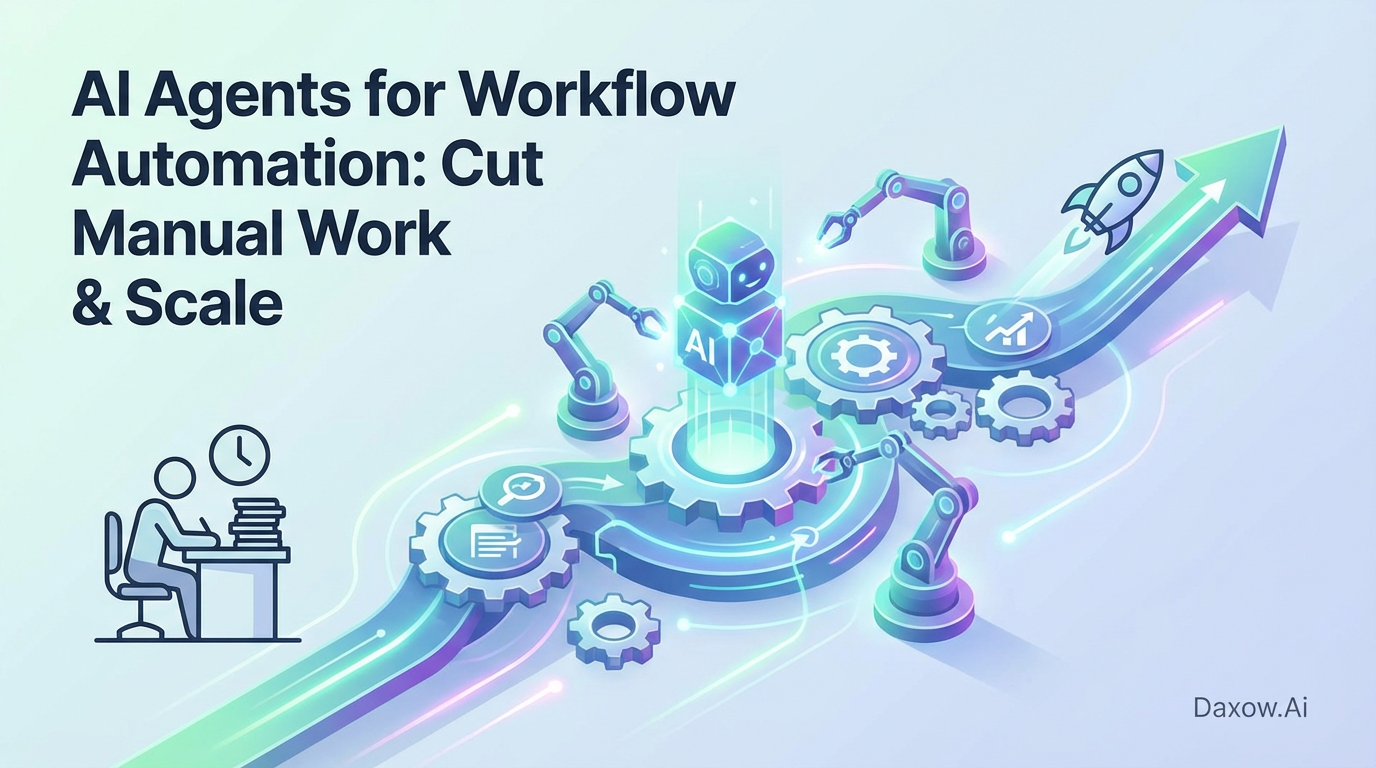
Learn how AI agents automate workflows to reduce manual work, boost productivity, and scale automation, with implementation steps, use cases, ROI, and Daxow.ai services.
AI Agents for Workflow Automation — How to Cut Manual Work, Boost Productivity, and Scale Business Automation
Estimated reading time: 15 minutes
Key Takeaways
- AI agents combine AI, process orchestration, and system integration to automate complex workflows.
- They drastically reduce manual effort, improve customer satisfaction, and increase operational scalability.
- Daxow.ai specializes in implementing AI agents end-to-end, ensuring measurable ROI and secure integrations.
- Practical deployment follows discovery, data integration, prototyping, production, and continuous improvement phases.
- Common pitfalls like poor data quality and lack of governance can be avoided with proper planning and change management.
Table of Contents
- AI Agents for Workflow Automation — What They Are and Why They Matter
- A Practical Implementation Framework for AI Agents and Workflow Automation
- Use Cases — Practical Examples of AI Agents for Workflow Automation Across Industries
- Measuring ROI — KPIs to Track for AI Automation Success
- Common Implementation Pitfalls and How to Avoid Them
- How Daxow.ai Designs and Delivers AI Agents for Workflow Automation
- Frequently Asked Questions
AI Agents for Workflow Automation — What They Are and Why They Matter
AI agents are software components that combine artificial intelligence, process orchestration, and systems integration to perform tasks autonomously or semi-autonomously. Unlike single-purpose automation tools, AI agents can interpret natural language, make contextual decisions, interact with multiple systems, and learn over time.
- Business impact: AI agents reduce manual tasks, accelerate throughput, and lower error rates across customer support, sales, operations, HR, and finance.
- Scalability: Agents operate 24/7 and can scale to handle variable demand without linear increases in headcount.
- Value drivers: Faster response times, higher first-contact resolution, improved lead qualification, and consistent policy enforcement.
How AI Agents Differ from Traditional Automation
Traditional workflow automation (rule-based RPA, scheduled jobs) is deterministic and brittle. AI agents bring three differentiators:
- Contextual understanding: Use NLP to interpret messages, documents, and intents.
- Decision-making: Apply models to select next actions, escalate, or route tasks.
- System orchestration: Coordinate across CRMs, ticketing systems, databases, and third-party APIs to complete end-to-end processes.
Core Capabilities of Effective AI Agents
- Natural Language Processing (NLP): For customer interactions, ticket classification, and document understanding.
- Task orchestration: Sequence actions, trigger workflows, and manage exceptions.
- Integrations & connectors: Native or custom integrations with CRMs, ERPs, HRIS, support platforms, and databases.
- Learning and analytics: Continuous improvement via feedback loops and monitoring.
- Human-in-the-loop: Allow humans to supervise complex or sensitive decisions.
A Practical Implementation Framework for AI Agents and Workflow Automation
Delivering production-ready AI agents requires a structured approach. Daxow.ai follows a practical, business-focused methodology designed for predictable outcomes.
1. Discovery & Process Mapping
- Conduct stakeholder interviews to capture outcomes and constraints.
- Map current workflows and quantify manual effort, cycle times, and error rates.
- Identify high-impact automation candidates: repetitive, rule-bound tasks; high volume; cross-system handoffs.
- Daxow role: We run workshops and deliver a prioritized automation roadmap.
2. Data Assessment & Integration Planning
- Assess data quality, availability, and access controls.
- Identify required integrations (CRMs, support platforms, cloud storage, document repositories).
- Design data flows, transformation rules, and retention policies.
- Daxow role: We build secure connectors and ensure reliable data pipelines for model inputs and outputs.
3. Prototype & Validation
- Build an MVP agent for a contained use case (for example, auto-triage of support tickets).
- Validate accuracy, throughput, and exception rates with real-world data.
- Iterate quickly using performance metrics and user feedback.
- Daxow role: Rapid prototyping with focused KPIs to demonstrate early value.
4. Production Deployment & Orchestration
- Harden the solution: logging, monitoring, alerting, and fallback mechanisms.
- Deploy orchestration logic that integrates agents with existing automation and human workflows.
- Implement access controls, audit trails, and governance.
- Daxow role: End-to-end deployment and operational readiness.
5. Continuous Improvement & Scale
- Establish feedback loops to retrain models and improve decision logic.
- Monitor KPIs and expand agent coverage to adjacent processes.
- Build a roadmap for scaling from departmental to enterprise-wide automation.
- Daxow role: Ongoing optimization, support, and scaling strategy.
Security, Compliance, and Governance
- Implement role-based access and data encryption.
- Ensure compliance with industry regulations (finance, healthcare, GDPR).
- Build transparent decision logs for auditability.
- Daxow role: Security-first architecture and compliance support integrated into every project.
Use Cases — Practical Examples of AI Agents for Workflow Automation Across Industries
Customer Support Automation (SaaS & Enterprise)
Use case: Automatic ticket triage and resolution
- Agent functions: Classify incoming tickets, fetch account data, propose responses, and execute routine fixes (password resets, subscription changes).
- Benefits: Reduce manual tasks, shorten time-to-resolution, and increase first-contact resolution.
- Metrics: Reduced average handle time, decreased backlog, improved CSAT.
- Daxow role: Design and deploy chatbots and backend agents integrated with support platforms and CRMs.
Sales Automation (B2B & B2C)
Use case: Lead qualification and handoff
- Agent functions: Ingest inbound leads, enrich profiles (company data, intent signals), score leads, and schedule follow-ups.
- Benefits: Increase productivity of sales reps, faster response to hot leads, higher conversion rates.
- Metrics: Higher SQL conversion, increased revenue per rep, reduced lead response time.
- Daxow role: Build lead qualification pipelines and integrate with sales automation stacks.
Finance & Accounting
Use case: Accounts payable automation and invoice processing
- Agent functions: Extract invoice data from PDFs, validate against purchase orders, route exceptions, and post payments.
- Benefits: Fewer manual approvals, faster payment cycles, and reduced duplicate payments.
- Metrics: Invoice processing time, error rates, DPO improvements.
- Daxow role: Deliver document automation, OCR integrations, and rule-based exception handling.
HR & Administrative Operations
Use case: Employee onboarding automation
- Agent functions: Collect documents, validate identities, provision accounts, and schedule training.
- Benefits: Faster onboarding, consistent compliance checks, reduced HR workload.
- Metrics: Time-to-productivity, onboarding completion rate, HR person-hours saved.
- Daxow role: Automate cross-system onboarding workflows tied to HRIS and IT systems.
Healthcare Administration
Use case: Claims intake and prior authorization
- Agent functions: Extract clinical data, check coverage, flag missing information, and coordinate approvals.
- Benefits: Faster claims processing, fewer denials, compliance with privacy rules.
- Metrics: Claims adjudication time, denial rates, administrative cost per claim.
- Daxow role: Build secure, compliant agents that integrate with EHRs and billing systems.
Real Estate & Property Management
Use case: Tenant service automation
- Agent functions: Handle maintenance requests, schedule contractors, and apply billing adjustments.
- Benefits: Improved tenant satisfaction, faster issue resolution, optimized contractor utilization.
- Metrics: Ticket resolution time, tenant retention, maintenance costs.
- Daxow role: Configure automated workflows and agent-driven scheduling tied to property management platforms.
E-commerce & Logistics
Use case: Order exception management
- Agent functions: Detect fulfillment exceptions, communicate with carriers, reroute shipments, and trigger customer notifications.
- Benefits: Reduced shipping delays, better customer communication, minimized manual investigation.
- Metrics: On-time delivery, support ticket volume, logistic cost reduction.
- Daxow role: Orchestrate agent actions across inventory, fulfillment, and customer communication systems.
Measuring ROI — KPIs to Track for AI Automation Success
Quantifying value is essential before and after deployment. Focus on metrics that tie to revenue and cost.
Operational KPIs
- Reduction in manual tasks (hours per week saved)
- Cycle time reduction (e.g., average handle time, processing time)
- Error rate reduction (fewer rework cases)
Customer & Revenue KPIs
- Response time improvement (lead response or customer reply time)
- Conversion lift (sales qualified leads converted)
- CSAT and NPS improvements
Financial KPIs
- Cost-per-transaction decrease
- Headcount redeployment value (reassigning FTEs to higher-value work)
- Time-to-value for automation projects (payback period)
Practical measurement approach
- Baseline current-state metrics during discovery.
- Define target KPIs for the MVP.
- Monitor and report weekly during deployment, then move to monthly reviews as processes stabilize.
- Tie performance improvements back to dollar impact (labor costs saved, revenue uplift).
Common Implementation Pitfalls and How to Avoid Them
Avoiding these pitfalls increases the likelihood of successful, scalable business automation.
- Poorly defined scope: Start with a well-scoped pilot focused on measurable outcomes.
- Insufficient data quality: Invest in data cleanup and reliable connectors before production.
- Over-automation: Preserve human judgment for complex cases — use human-in-the-loop.
- Lack of governance: Put monitoring, auditing, and rollback plans in place.
- Change management failure: Communicate benefits, train users, and show quick wins.
Daxow approach: We mitigate risks through iterative delivery, governance frameworks, and change management programs that ensure technology adoption and sustained ROI.
How Daxow.ai Designs and Delivers AI Agents for Workflow Automation
Daxow.ai provides end-to-end services to bring AI agents into production and keep them delivering value.
- Discovery and ROI mapping: Identify high-impact processes and quantify potential savings.
- Custom AI agent design: Build agents tailored to your business logic, language, and systems.
- Integrations and data connectivity: Connect CRMs, support platforms, ERPs, and other tools securely.
- End-to-end process automation: Orchestrate agents so they execute complete tasks from trigger to resolution.
- Monitoring and continuous improvement: Implement observability, retraining loops, and optimization roadmaps.
- Security and compliance: Embed privacy and regulatory controls into every solution.
Why partner with Daxow
- Practical, business-first approach: We prioritize measurable outcomes over technology for its own sake.
- Cross-domain expertise: Experience across finance, healthcare, real estate, e-commerce, and enterprise operations.
- Operational delivery: We don’t just prototype—we deploy, monitor, and scale production-grade agents that reduce manual work and increase productivity.
Frequently Asked Questions
What distinguishes AI agents from traditional automation tools?
AI agents combine natural language processing, decision-making, and system orchestration, enabling them to handle complex, context-aware workflows autonomously, unlike traditional rule-based or scheduled automations.
How does Daxow.ai ensure security and compliance in AI automation?
Daxow.ai implements role-based access, data encryption, audit trails, and ensures adherence to regulations such as GDPR and industry-specific standards, embedding security and compliance throughout the development lifecycle.
Can AI agents scale with growing business demands?
Yes, AI agents operate continuously and can scale to handle varying workloads without a linear increase in headcount, supporting enterprise-wide automation expansions.
What industries benefit the most from AI agent-powered workflow automation?
Industries such as customer support, sales, finance, HR, healthcare, real estate, e-commerce, and logistics significantly benefit from AI agents by automating repetitive tasks and improving operational efficiency.
If you want to evaluate how AI agents can transform your workflows, take the next step with Daxow.ai.