
AI Agents and Workflow Automation: Practical Roadmap & Use Cases
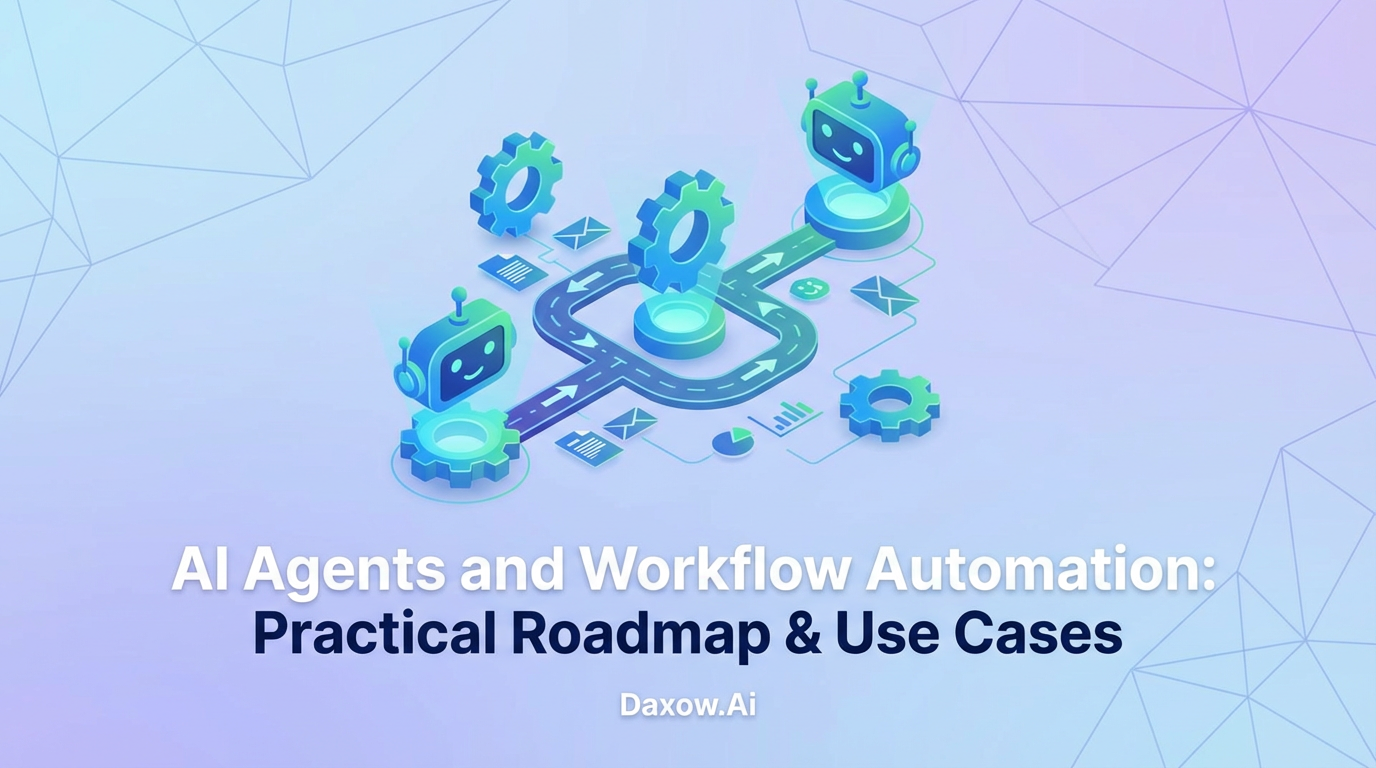
How AI agents and workflow automation drive cost savings, faster processes, and better CX across industries — includes roadmap, KPIs, and Daxow.ai services.
Unlocking Business Transformation: The Power of AI Agents and Workflow Automation
Estimated reading time: 12 minutes
Key Takeaways
- AI agents and workflow automation replace repetitive tasks with intelligent systems, enabling scalability and improved customer experience.
- Successful implementation requires clear objectives, quality data, proper tools, and a cross-functional team.
- Industry-specific use cases show measurable gains in productivity, cost savings, and customer satisfaction.
- Daxow.ai offers end-to-end AI automation solutions with proven ROI in 6–12 months.
- Integration with core business systems is crucial for real-time, end-to-end automation and operational resilience.
Table of Contents
- Unlocking Business Transformation: The Power of AI Agents and Workflow Automation
- Industry Use Cases: Practical Examples of AI Agents and Workflow Automation
- How AI Agents and Workflow Automation Drive Business Value
- Implementation Roadmap: From Strategy to Scale
- Measuring ROI and Long-Term Value
- How Daxow.ai Designs and Delivers Custom AI Automation
- Frequently Asked Questions
Unlocking Business Transformation: The Power of AI Agents and Workflow Automation
What AI agents and workflow automation actually are
AI agents are autonomous software entities that use machine learning, natural language processing, and decision logic to perform multi-step tasks with minimal human oversight.
Workflow automation connects systems, data, and people to orchestrate processes from start to finish—reducing manual handoffs and error-prone steps.
Together, they enable AI automation that can route exceptions, interact with customers, extract data from documents, and trigger actions across CRMs, ERPs, and other business systems.
Why this matters now
- Businesses report dramatic time savings and error reduction when routine processes are automated. High-volume operations see error reductions up to 90% and time reductions that translate into measurable cost savings.
- Rather than replacing people, AI agents amplify human capabilities—enabling a human-in-the-loop model where staff handle complexity and agents handle scale.
- The combination of predictive analytics, real-time orchestration, and seamless integrations makes this a strategic lever for long-term digital transformation.
Industry Use Cases: Practical Examples of AI Agents and Workflow Automation
E-commerce — order-to-cash automation
- What to automate: inventory checks, order validation, invoice processing, returns management, and personalized post-sale communications.
- AI agent capabilities: autonomously reconcile orders with inventory, trigger replenishment, generate invoices, and handle customer queries via conversational automation.
- Expected results: up to 50% shorter fulfillment times, reduced chargebacks, and improved NPS from instant query resolution.
- KPIs: order cycle time, return rate, average handling time, and customer satisfaction.
Healthcare — scheduling, triage, and records management
- What to automate: appointment scheduling, initial triage through chatbots, claims pre-checks, and clinical documentation extraction.
- AI agent capabilities: process patient messages, prioritize urgent cases, extract structured data from referral letters, and flag billing anomalies for human review.
- Expected results: reduced administrative load, faster patient access to care, and improved compliance.
- KPIs: time-to-booking, scheduling errors, administrative hours saved, and audit error rate.
Finance — reconciliation and fraud detection
- What to automate: invoice reconciliation, account reconciliation, suspicious transaction detection, and regulatory reporting prep.
- AI agent capabilities: match invoices to payments, surface anomalies through pattern detection, and prepare audit-ready trails.
- Expected results: 60–80% reductions in manual reconciliation time and faster audit cycles.
- KPIs: cost per transaction, error rate, time to close monthly books, and incidents detected.
Real Estate — lead qualification and contract automation
- What to automate: lead intake, property matching, virtual listing descriptions, and contract review.
- AI agent capabilities: qualify leads via conversational workflows, auto-generate tailored property descriptions, and pre-fill agreements for legal review.
- Expected results: shorter sales cycles, higher lead conversion, and reduced legal bottlenecks.
- KPIs: lead-to-contract time, conversion rate, and contract turnaround time.
HR — talent screening and onboarding
- What to automate: resume screening, pre-qualification chats, interview scheduling, and new-hire onboarding tasks.
- AI agent capabilities: score candidates against job criteria, run initial chat-based interviews, and automate compliance paperwork.
- Expected results: faster hiring times (up to 40% improvement), consistent candidate experiences, and fewer compliance issues.
- KPIs: time-to-hire, quality-of-hire, and onboarding completion rate.
Customer Support — conversational automation and escalation
- What to automate: first-line support via chatbots, ticket categorization, SLA monitoring, and escalation routing.
- AI agent capabilities: resolve low-complexity queries, extract intent from emails, and escalate complex issues to specialists with context.
- Expected results: lower average handling times, improved SLA compliance, and higher CSAT.
- KPIs: first-contact resolution, average response time, and ticket volume handled autonomously.
How AI Agents and Workflow Automation Drive Business Value
Core value levers
- Productivity gains: AI agents automate repeatable tasks and free staff for strategic work. Daxow clients typically see 30–70% productivity improvements in automated areas.
- Reduced manual tasks: Automation reduces human error and repetitive workloads, cutting operational costs and improving accuracy.
- Faster decisions: Agents provide real-time insights and predictive analytics for demand forecasting and resource planning.
- Improved customer experience: Automated, personalized interactions increase satisfaction while lowering response times.
- Scalability: Systems can handle increased transaction volumes without proportional headcount increases, enabling growth with a predictable cost base.
AI agents versus traditional bots
Traditional automation follows fixed rules and requires explicit decision paths.
AI agents handle ambiguity and unstructured inputs (emails, documents, images), make probabilistic decisions, and reroute workflows dynamically based on live data.
This difference enables end-to-end automation where exceptions are minimized and human attention is reserved for strategic exceptions.
Integrations and data connectivity
Real business value comes from connecting AI agents to core systems: CRM, ERP, billing platforms, HRIS, and data warehouses.
Seamless integrations allow agents to execute real tasks—updating records, issuing refunds, creating contracts—rather than only recommending actions.
Implementation Roadmap: From Strategy to Scale
1. Define clear objectives
- Identify high-impact processes with repetitive manual work and clear KPIs (cost per transaction, response times, error rates).
- Set measurable targets (e.g., 30% reduction in processing time, 20% cost savings).
2. Assess data quality and accessibility
- Audit data sources and clean silos.
- Ensure data governance and compliance are embedded early to avoid costly rework.
3. Select tools and design integrations
- Choose scalable AI platforms that integrate with your CRM/ERP and support secure APIs.
- Prioritize modular architectures to enable incremental additions.
4. Build a cross-functional team
- Combine technical experts, process owners, and business stakeholders.
- Invest in change management and training to accelerate adoption.
5. Pilot, validate, then scale
- Start with a pilot on a high-volume, low-risk process.
- Collect performance data, retrain models, and iterate before broad rollout.
Best practices and governance
- Focus on quick wins first to build momentum.
- Embed compliance, fairness, and explainability into models from day one.
- Monitor performance continuously and implement feedback loops for model retraining.
- Avoid over-scoping: deliver value in small, measurable increments.
Measuring ROI and Long-Term Value
Quantifying impact
- Measure direct savings (hours saved × fully loaded labor cost) and indirect gains (revenue uplift from faster response, improved conversion).
- Track KPIs like cost per transaction, error rates, average handling time, and customer satisfaction.
Typical timelines and payback
- Organizations can expect pilot outcomes in weeks and enterprise payback in 6–12 months for targeted automations.
- As agents scale, efficiency multipliers commonly reach 3–5x in impacted processes.
Example metrics to monitor
- Cost savings as a percentage of operational spending.
- Time-to-resolution and SLA achievement.
- Fraud reduction and compliance incidents.
- Employee satisfaction and redeployment of staff to strategic tasks.
How Daxow.ai Designs and Delivers Custom AI Automation
End-to-end service model
Daxow.ai partners with your team to map current workflows, identify automation opportunities, and deliver production-grade AI agents and workflow automation.
Our services include AI agents, workflow automation, chatbots and support automation, lead qualification, document and data extraction, and system integrations with CRMs and ERPs.
Practical approach we follow
- Discovery: We analyze your processes to prioritize automation with the highest ROI.
- Design: We architect secure, scalable workflows and agent behaviors tailored to your systems.
- Build: We develop AI agents that execute real tasks—interacting with systems, extracting data from unstructured inputs, and making decisions within defined guardrails.
- Integrate: We connect agents to your CRM, ERP, ticketing, and analytics platforms to enable end-to-end automation.
- Operate: We provide monitoring, governance, and continuous improvement services, including retraining models and updating workflows as needs evolve.
Why partner with Daxow.ai
- Domain expertise: We combine automation engineering with practical process knowledge to deliver meaningful outcomes.
- Proven ROI: Clients regularly achieve payback within 6–12 months and sustained efficiency gains as agents scale.
- Operational focus: Our designs emphasize operational resilience, data security, and measurable business value.
- Human-centric automation: We embed human oversight where it matters, ensuring accuracy, compliance, and ethical decision-making.
Frequently Asked Questions
What are AI agents and how do they differ from traditional bots?
AI agents are autonomous software that use machine learning and natural language processing to handle complex, multi-step tasks with minimal oversight, unlike traditional bots that follow fixed rules and require explicit decision paths.
How quickly can businesses expect ROI from AI automation?
Pilot results often appear in weeks, with enterprise-wide payback commonly achieved within 6 to 12 months after scaling targeted automations.
Which industries benefit most from AI agents and workflow automation?
Industries such as e-commerce, healthcare, finance, real estate, HR, and customer support have demonstrated significant gains in efficiency, accuracy, and customer experience through AI-driven workflow automation.
How does Daxow.ai ensure compliance and ethical AI use?
Daxow.ai embeds compliance, fairness, and explainability into models from day one and maintains rigorous monitoring and governance to uphold ethical decision-making and regulatory adherence.